
SpaceX's Record $86 Billion IPO Delivers Unprecedented Share Access to Everyday Investors
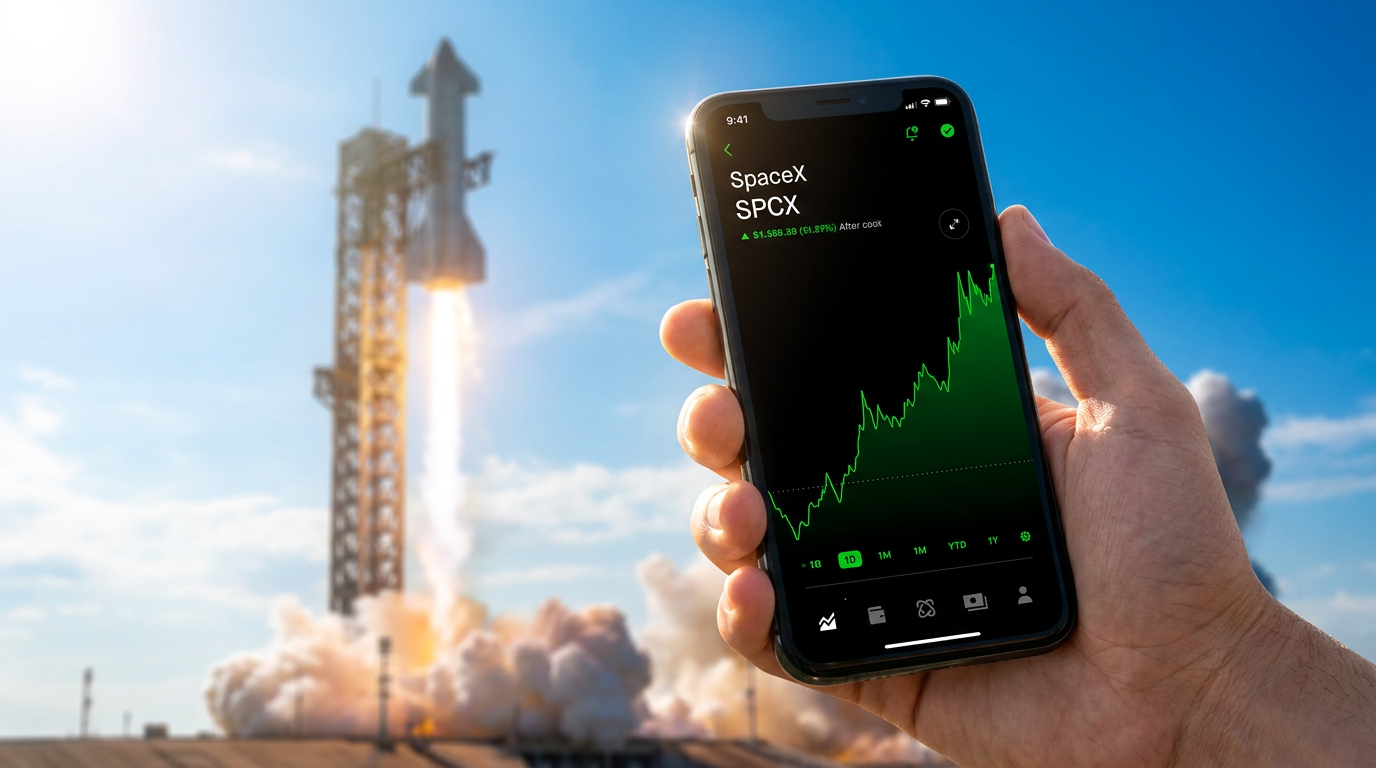
In a historic shift for Wall Street, up to 30% of SpaceX's record-breaking initial public offering was allocated directly to retail investors, ensuring customers at major brokerages received at least one share.
By Factlen Editorial Team
- Retail Access Advocates
- Supporters argue that everyday investors deserve the same early-stage access to generational growth companies as Wall Street institutions.
- Institutional Skeptics
- Financial analysts warn that the massive valuation leaves retail investors exposed to significant downside risk.
- Market Structure Analysts
- Observers focus on how the fixed-price offering and broker 'flipping' rules are rewriting the mechanics of going public.
What's not represented
- · Traditional Investment Bank Underwriters
- · Early-stage Venture Capitalists
Why this matters
Historically, the most lucrative tech IPOs have been walled off for institutional giants and high-net-worth clients. SpaceX's decision to bypass traditional Wall Street gatekeepers and allocate a massive chunk of its offering to everyday investors sets a new precedent for how private mega-companies go public.
Key points
- SpaceX raised up to $86.2 billion in the largest initial public offering in history, valuing the company at over $1.75 trillion.
- In an unprecedented move, up to 30% of the IPO shares were allocated directly to retail investors through major brokerages.
- Customers at platforms like Robinhood and Fidelity who requested shares received at least one, with Robinhood filling over 855,000 requests.
- Brokerages instituted 'flipping' rules, requiring retail investors to hold their shares for a set period to prevent immediate sell-offs.
The largest initial public offering in financial history did not just enrich Wall Street insiders and early venture capitalists. When SpaceX debuted on the Nasdaq last Friday, it executed an unprecedented democratization of capital, ensuring that everyday retail investors secured a meaningful piece of the $86.2 billion pie. For years, retail traders have watched from the sidelines as private tech unicorns multiplied in value, only gaining the opportunity to invest after the companies went public at premium valuations. SpaceX fundamentally altered that dynamic, structuring its massive liquidity event to prioritize the very public that follows its rocket launches and subscribes to its satellite internet services.[1][2]
Customers utilizing major U.S. retail brokerages—including Robinhood, Fidelity, Charles Schwab, SoFi, and E*Trade—who requested shares at the $135 offering price received at least one share. Robinhood alone disclosed that it successfully filled requests for over 855,000 of its customers, validating the platform's role as a primary conduit for retail participation in landmark market events. The sheer logistical feat of distributing millions of shares across multiple consumer platforms without major technical failures marks a significant milestone for retail brokerage infrastructure, proving that everyday trading apps can handle the immense volume generated by a generational mega-cap listing.[1][8]
The scale of the retail allocation represents a seismic shift in how mega-cap companies choose to go public. Historically, retail investors are allocated roughly 5% to 10% of a standard IPO, leaving the lion's share for institutional giants, mutual funds, and high-net-worth clients who enjoy privileged relationships with investment banks. SpaceX, driven by CEO Elon Musk's populist approach to his mission-driven shareholder base, earmarked up to 30% of the offering for the public. This massive carve-out effectively transferred billions of dollars in early trading upside directly into the brokerage accounts of ordinary citizens, challenging the long-standing Wall Street monopoly on early-stage wealth creation.[4][5][7]

"Retail is going to be a critical part of this and a bigger part than any IPO in history," noted SpaceX Chief Financial Officer Bret Johnsen ahead of the listing, emphasizing the company's desire to reward long-time supporters of its space exploration ambitions. Johnsen's comments reflect a growing recognition among tech founders that cultivating a passionate, financially invested retail base can provide a powerful buffer against short-term institutional pressures. By aligning the financial interests of the public with the company's long-term goal of making humanity multiplanetary, SpaceX has effectively crowdsourced its capital base on an unprecedented scale.[4]
The strategy paid off immediately and spectacularly. Shares of the aerospace and satellite communications giant surged 19% on Friday and climbed another 17% on Monday, closing at $187.70. The two-day rally pushed SpaceX's market capitalization above $2.2 trillion, instantly vaulting it into the ranks of the world's six most valuable public companies. For the retail investors who managed to secure allocations at the $135 offer price, the immediate paper gains vindicated their enthusiasm, providing a rare instance where main street participants captured the initial pop typically reserved for institutional flippers and hedge funds.[2][3]
To achieve this historic outcome, SpaceX bypassed the traditional Wall Street bookbuilding process entirely. Instead of letting investment banks gauge institutional demand to set a fluctuating price range, the company established a fixed price of $135 per share, targeting an initial valuation of approximately $1.75 trillion. This fixed-price mechanism stripped away much of the opacity that usually surrounds IPO pricing, allowing retail investors to know exactly what they were paying without the fear of being priced out at the last minute by aggressive institutional bidding wars.[4][7]

To achieve this historic outcome, SpaceX bypassed the traditional Wall Street bookbuilding process entirely.
The massive capital raise—which includes an 83.3 million share "greenshoe" over-allotment option—is expected to fund the capital-intensive development of the Starship deep-space vehicle, the expansion of the Starlink satellite internet constellation, and the integration of the recently merged xAI artificial intelligence division. With over $86 billion in fresh capital, SpaceX has secured the financial runway necessary to pursue its most ambitious and expensive projects without needing to return to the debt markets or seek additional private funding rounds in the near future.[2][3]
However, the unprecedented retail access came with strict, carefully designed guardrails. To prevent immediate volatility caused by short-term speculation, the participating brokerages instituted "flipping" rules. Investors who sell their allocated IPO shares too quickly face severe penalties, including being barred from participating in future IPOs on those platforms. These restrictions were implemented to ensure that the retail allocation functioned as a long-term investment vehicle rather than a mechanism for day traders to extract quick profits at the expense of the stock's overall stability.[6]
Fidelity implemented a 15-day lock-up period for its retail buyers, a restriction that industry observers noted was actually shorter than the holding periods enforced by competitors like Robinhood and SoFi. These rules highlight the delicate balance brokerages must strike between democratizing access and maintaining orderly aftermarket trading. By forcing retail participants to hold their shares through the initial weeks of trading, brokerages are artificially constraining the tradable float, which helps support the stock price but also introduces the risk of delayed volatility once those lock-up periods eventually expire.[6]
Despite the euphoric market reception, some independent analysts are urging caution amid the retail frenzy. Financial research firm Morningstar estimated SpaceX's fair intrinsic value at approximately $780 billion—less than half of its IPO pricing. Skeptics warn that the $1.75 trillion valuation prices in decades of flawless execution across launch services, satellite broadband, and artificial intelligence. If the company encounters significant delays with its Starship program or faces increased regulatory scrutiny over its satellite network, the current valuation leaves very little margin for error, exposing retail investors to substantial downside risk.[7]

"Investors should honestly ask themselves why the big investors and dealmakers who run Wall Street would want to cut them in on the kind of great deal they usually reserve for insiders," cautioned analysts at MarketWise, noting the risks of buying into a company that still burns through billions in research and development. This contrarian perspective suggests that the massive retail allocation may have been a strategic necessity to absorb an $86 billion offering that institutional investors alone might have balked at, effectively transferring the risk of an overvalued asset onto the public.[4]
Nevertheless, the enthusiasm has spilled across borders, proving that the appetite for space-based investments is a global phenomenon. European and UK retail investors also surged into the market, with London-based payments group TrueLayer reporting a 27% spike in top-ups to investment platforms in the days leading up to the listing. This international demand underscores the unique cultural resonance of the SpaceX brand, which has managed to capture the imagination of a global audience that views the company not just as a financial asset, but as a proxy for human technological progress.[5]
For the broader technology sector, the flawless execution of the SpaceX offering is being viewed as a "Goldilocks outcome." Analysts suggest that the market's ability to absorb an $86 billion liquidity event without draining capital from other tech stocks paves the way for highly anticipated public debuts from AI leaders like OpenAI and Anthropic later this year. By proving that retail investors can successfully anchor a mega-cap listing, SpaceX has permanently altered the IPO landscape, ensuring that future tech giants will face immense pressure to open their doors to the public from day one.[2][3]
How we got here
April 2026
SpaceX confidentially files its S-1 registration for a public offering.
June 6, 2026
The company announces a fixed IPO price of $135 per share, bypassing traditional Wall Street bookbuilding.
June 12, 2026
SpaceX officially debuts on the Nasdaq under the ticker SPCX.
June 15, 2026
Shares surge 17% on their first full day of trading, pushing the company's market capitalization past $2.2 trillion.
Viewpoints in depth
Retail Access Advocates
Supporters argue that everyday investors deserve the same early-stage access to generational growth companies as Wall Street institutions.
For decades, the most lucrative gains in the technology sector have been captured in private markets, leaving retail investors to buy in only after valuations have already skyrocketed. Advocates view the 30% retail allocation as a necessary corrective, arguing that the public—who often fund these companies indirectly through government contracts and consumer purchases—should have the opportunity to build wealth alongside venture capitalists. They point to the seamless execution by brokerages like Robinhood and SoFi as proof that retail infrastructure can handle mega-cap liquidity events.
Institutional Skeptics
Financial analysts warn that the massive valuation leaves retail investors exposed to significant downside risk.
Skeptics point to the stark divergence between the $1.75 trillion IPO pricing and independent fair-value estimates, such as Morningstar's $780 billion assessment. They argue that by bypassing the traditional bookbuilding process, SpaceX avoided the rigorous price discovery normally imposed by institutional investors. Critics worry that retail buyers, driven by enthusiasm for space exploration and Elon Musk's brand, are absorbing the risk of a capital-intensive company that still faces massive R&D hurdles with its Starship program and xAI integration.
Market Structure Analysts
Observers focus on how the fixed-price offering and broker 'flipping' rules are rewriting the mechanics of going public.
Market structure experts are closely monitoring the aftermarket effects of the 'flipping' rules instituted by retail brokerages. By enforcing 15-day or longer lock-up periods, brokerages are artificially constraining the tradable float, which can lead to heightened volatility once those lock-ups expire. However, analysts also note that the successful distribution of shares directly through consumer platforms proves that companies can bypass traditional investment bank underwriters, potentially threatening Wall Street's lucrative IPO fee structures.
What we don't know
- How the expiration of retail lock-up periods in the coming weeks will impact SpaceX's stock volatility.
- Whether the SEC will introduce new regulations governing massive retail allocations in future mega-cap IPOs.
- How quickly SpaceX's capital-intensive Starship and xAI divisions will generate the revenue needed to justify the $1.75 trillion valuation.
Key terms
- Greenshoe Option
- A provision that allows underwriters to sell more shares than originally planned if public demand is higher than expected.
- Flipping
- The practice of buying shares in an IPO and selling them almost immediately for a quick profit.
- Float
- The number of a company's shares that are available for trading by the public.
Frequently asked
Which brokerages offered SpaceX IPO shares?
Fidelity, Charles Schwab, Robinhood, SoFi, and E*Trade were the primary retail channels for the offering.
Can retail investors sell their shares immediately?
Most brokerages instituted 'flipping' rules, requiring investors to hold the stock for a set period—such as 15 days at Fidelity—or face penalties.
How much of the company was sold to the public?
SpaceX raised up to $86.2 billion, with 30% of the offering earmarked specifically for retail buyers.
Sources
Source coverage
8 outlets
3 viewpoints surfaced








[1]BloombergMarket Structure Analysts
SpaceX Investors at US Retail Brokers Got at Least One IPO Share
Read on Bloomberg →[2]Yahoo Finance UKRetail Access Advocates
SpaceX is already one of the world's top six companies by market cap
Read on Yahoo Finance UK →[3]Advisor PerspectivesMarket Structure Analysts
SpaceX Shares Jump in Second Day of Trading After Record IPO
Read on Advisor Perspectives →[4]MarketWiseInstitutional Skeptics
SpaceX's Massive IPO: Should You Stay Away?
Read on MarketWise →[5]IT Brief UKMarket Structure Analysts
UK retail investors top up accounts ahead of SpaceX
Read on IT Brief UK →[6]FX News GroupMarket Structure Analysts
Fidelity's SpaceX IPO Flipping Rule: 15-Day Lock Shorter Than Some Competitors
Read on FX News Group →[7]KuCoinInstitutional Skeptics
SpaceX IPO: $135 Per Share, 556 Million Shares to Raise $75 Billion in Massive Public Offering
Read on KuCoin →[8]Robinhood NewsRetail Access Advocates
Robinhood Stock In Focus: Record SpaceX Traffic, New IPO Business
Read on Robinhood News →

More in business
See all 5 stories →SpaceX IPO
SpaceX's $86.2 Billion IPO Makes History With Unprecedented Retail Investor Access
0 sources
Energy Markets
US-Iran Deal to Reopen Strait of Hormuz Sends Oil Tumbling, But Economic Scars Will Linger
0 sources

Retail Investing
SpaceX's Record $86.2 Billion IPO Rewrites Wall Street Rules With Massive Retail Allocation
0 sources
Every angle. Every day.
Get business stories with full source coverage and perspective breakdowns delivered to your inbox.