
How Video Podcasts Became the New Mainstream TV
Driven by YouTube's dominance and new investments from premium streamers like Netflix, video podcasts have evolved from a niche format into a global entertainment staple reaching one in five internet users.
By Factlen Editorial Team
- Video-First Creators
- Argue that video is essential for audience discovery and maximizing cross-platform monetization.
- Industry Analysts
- Focus on the data-driven shift in consumer behavior and the cost-efficiency of the format.
- Premium Streamers
- View video podcasts as strategic assets to capture living-room viewership and challenge YouTube.
What's not represented
- · Independent audio-only creators who may be priced out of the expensive video production arms race.
- · Visually impaired audiences whose experience of the medium changes as it becomes more reliant on visual cues.
Why this matters
The convergence of audio and video is fundamentally changing how creators build audiences and how advertisers spend money. For viewers, it means the traditional 'chat show' is being replaced by highly accessible, cross-platform digital formats.
Key points
- One in five internet users globally now watches video podcasts on a monthly basis.
- YouTube is the dominant platform for the format, driven by its powerful discovery algorithm.
- Video viewing does not cannibalize audio listening; 60% of video viewers also consume audio podcasts.
- Netflix is aggressively entering the space with exclusive deals to challenge YouTube's dominance.
The era of the audio-only podcast is giving way to a visual revolution. What started as a few creators setting up cameras in their studios has transformed into a mainstream entertainment juggernaut, fundamentally altering how audiences consume digital talk shows. For years, the medium was defined by its intimacy and portability—a voice in your ear while commuting or doing chores. Today, the landscape has shifted dramatically. The most successful shows are now highly produced visual experiences that rival traditional television broadcasts in both quality and viewership. This evolution is reshaping not just how content is made, but how it is discovered, monetized, and distributed across the global internet.[8]
The scale of this shift is massive and accelerating faster than many industry observers predicted. According to recent data released in early 2026, one in five internet users globally now watches video podcasts on social platforms every single month. This rapid growth highlights a transition from a niche hobbyist medium into a core pillar of the modern media diet. The numbers reflect a fundamental change in consumer expectations; audiences no longer just want to hear their favorite hosts, they want to see their reactions, their studio environments, and the visual chemistry between guests. It is a testament to the power of visual storytelling in an increasingly crowded digital ecosystem.[1][2][8]
In this new visual landscape, YouTube has emerged as the undisputed kingmaker of the format. Industry research indicates that 11% of all internet users watched a video podcast on YouTube in the past month alone, making it the leading destination for visual audio content. The platform's sophisticated recommendation algorithm, combined with its massive global reach, has made it an indispensable tool for creators looking to scale their audiences. Unlike traditional podcast directories that rely heavily on existing subscriber bases, YouTube actively pushes new content to potential viewers, transforming the platform into the primary engine for podcast discovery and sustained audience growth.[1][3][5]

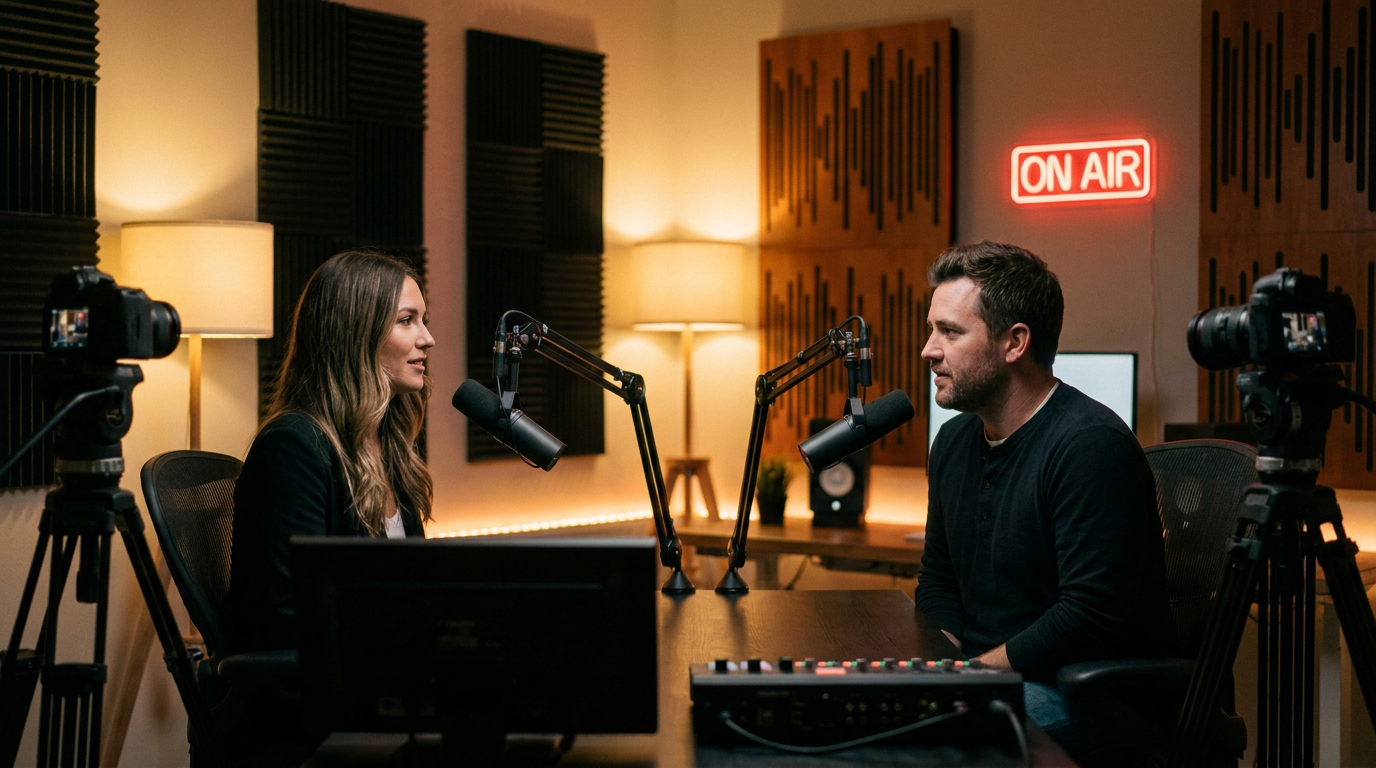
The mechanism driving this explosive growth is a widespread adoption of a 'video-first' production strategy. Creators are no longer just uploading a single audio file to an RSS feed; the visual recording now serves as the master file, with the audio extracted merely as a derivative product. This approach requires significant investment in multi-camera setups, professional lighting, and dedicated set design. By treating the video as the primary asset, podcasters can create a more immersive experience that holds viewer attention longer and provides a richer canvas for storytelling, ultimately elevating the perceived value of the content.[7]
Short-form video acts as the crucial discovery funnel for these full-length episodes. Platforms like TikTok, Instagram Reels, and YouTube Shorts are utilized to distribute viral, 30-second highlight clips that capture the most dramatic, funny, or insightful moments of an interview. These micro-moments are designed to capture immediate attention in fast-scrolling feeds, acting as digital billboards that funnel viewers toward the complete, long-form episodes. This symbiotic relationship between short-form discovery and long-form retention has become the blueprint for modern podcast success, allowing creators to reach audiences who might never have searched for their show organically.[3][7]
This visual shift is heavily propelled by younger demographics who have grown up in a video-dominant internet culture. Consumers aged 18 to 34 are 24% more likely than the average internet user to watch video podcasts, reflecting their willingness to consume media fluidly across different screens and formats. For this generation, the distinction between a YouTuber, a podcaster, and a traditional entertainer is practically nonexistent. They expect their media to be accessible wherever they are, whether that means listening on a smartphone during a workout or watching on a laptop during a lunch break.[1][4]
A common fear among industry purists was that the rise of video would inevitably cannibalize traditional audio listening. There was widespread concern that forcing audiences to watch a screen would destroy the multitasking appeal that made podcasts so popular in the first place. However, recent evidence suggests the exact opposite is happening: the introduction of video actually deepens overall engagement with the medium. Rather than replacing audio consumption, video serves as an additive layer that strengthens the parasocial relationship between the host and the audience.[3]
A common fear among industry purists was that the rise of video would inevitably cannibalize traditional audio listening.
Data shows that 60% of people who watch video podcasts also listen to audio podcasts at least a few times a week. This compares to just 36% of the general internet population, indicating that video viewers are 'super consumers' of the format rather than defectors. A viewer might discover a show through a video clip on TikTok, watch a full episode on YouTube over the weekend, and then seamlessly transition to listening to the audio version on Spotify during their morning commute. The formats work together to capture different parts of the consumer's day.[1][2][4][6]

The global footprint of video podcasting is expanding rapidly, proving that this is not just a Western phenomenon. While the trend remains exceptionally strong in mature media markets like the United States, Canada, and Spain, it is seeing explosive engagement in mobile-first markets. Countries such as Brazil, India, Indonesia, and Malaysia are driving massive viewership numbers, as mobile devices serve as the primary screen for entertainment. In these regions, video podcasts offer an accessible, low-bandwidth alternative to premium streaming television, allowing creators to build massive international followings.[2][6]
The undeniable success of the format has not gone unnoticed by premium streaming giants, who are now eager to claim their share of the market. Netflix is aggressively moving into the space to challenge YouTube's dominance and capture lucrative living-room viewership. Recognizing that podcasts command hours of dedicated attention, these platforms see an opportunity to keep subscribers engaged between major television and film releases. This marks a significant turning point, as podcasts transition from user-generated content platforms to the highest tiers of premium digital distribution.[1][5]
Netflix's strategy involves securing exclusive distribution deals for highly popular shows. The streamer has partnered with Spotify for properties like The Ringer and struck significant deals with Gary Lineker's Goalhanger production company for sports coverage. By bringing these established brands behind a paywall, Netflix hopes to leverage existing fanbases to drive subscription retention. This approach mirrors the early days of the streaming wars, where platforms raced to secure exclusive rights to beloved sitcoms and dramas, signaling that top-tier podcasts are now viewed as highly valuable intellectual property.[1][6]
The economic appeal for these platforms is abundantly clear. Video podcasts offer 'easy viewing' akin to traditional linear TV chat shows, but they can be produced at a mere fraction of the cost of scripted television. A single episode of a premium drama can cost millions of dollars, whereas a high-quality video podcast requires only a studio, a few cameras, and compelling hosts. This incredible cost-efficiency allows platforms to generate hundreds of hours of sustained engagement with minimal overhead, making it an incredibly attractive investment in a tightening media economy.[2][4]

The influx of video has also fundamentally altered podcast economics and advertising models. Sponsors are no longer just buying a simple audio read; they are purchasing comprehensive cross-platform distribution that includes YouTube visibility, social media clips, and traditional audio placements. This multi-channel approach provides advertisers with tangible visual branding opportunities, such as product placements on the studio desk or on-screen graphics. Consequently, the CPM (cost per mille) math has changed, allowing creators with strong visual components to command significantly higher rates than their audio-only counterparts.[7]
Despite the boom, the transition to video introduces new tensions within the creator community. Netflix's push for exclusivity clashes directly with the historically open, widely distributed nature of podcasting. For nearly two decades, the medium thrived on RSS feeds that allowed anyone to listen on any app for free. Now, creators are forced to weigh the benefits of a massive premium paycheck against the potential loss of reach that comes with locking their content behind a closed ecosystem. It is a delicate balancing act between monetization and audience accessibility.[5]
Furthermore, some industry insiders caution that the visual potential of the medium might be slightly overstated. Because many users treat YouTube as a background music player, high video view counts do not always equate to active, eyes-on-screen viewership. There is a growing concern that the industry might be misinterpreting the data, building expensive visual sets for audiences who are still primarily just listening while they work or browse other tabs. This raises questions about the long-term return on investment for the increasingly elaborate studio setups.[5]
Ultimately, the definition of a 'podcast' has permanently expanded beyond its original audio-only roots. Whether consumed via headphones on a morning commute, watched in short bursts on a smartphone, or streamed on a living room television, the format has proven its remarkable resilience. By evolving to meet the demands of a highly visual digital landscape, video podcasts have secured their place as a dominant force in modern entertainment, bridging the gap between intimate audio storytelling and mainstream television.[5]
How we got here
Early 2020s
Creators begin uploading raw studio footage to YouTube, establishing the visual podcast format.
2023-2024
Spotify and Apple Podcasts introduce and expand native video support within their audio apps.
Q3 2025
Global video podcast viewership reaches 20% of all internet users, cementing the format's mainstream status.
Early 2026
Netflix aggressively enters the market, signing exclusive deals to bring video podcasts to living room TVs.
Viewpoints in depth
Video-First Creators
Argue that video is essential for discovery and monetization.
For modern creators, audio is no longer enough. They argue that video is the primary engine for audience growth, relying on platforms like YouTube and TikTok to capture new viewers through viral clips. This visual approach allows for deeper parasocial connections, as audiences can see facial expressions and studio environments, which in turn drives higher engagement and opens up lucrative cross-platform sponsorship opportunities.
Industry Analysts
Focus on the data-driven shift in consumer behavior and platform economics.
Analysts view the rise of video podcasts as a natural evolution of the streaming wars. They point to the data showing that video doesn't cannibalize audio, but rather creates 'super consumers' who engage across multiple formats. For platforms, these shows represent a highly cost-effective way to generate long-form, bingeable content that rivals traditional linear television chat shows without the massive production budgets.
Premium Streamers
See video podcasts as the next frontier for living room entertainment.
Companies like Netflix view video podcasts as a strategic asset to capture time spent on television screens and challenge YouTube's dominance. By securing exclusive rights to top-tier shows, they aim to bring the intimacy of podcasting into the premium streaming environment, though this strategy risks alienating creators who prefer the wide reach of open, free platforms.
What we don't know
- Whether audiences will accept paywalled, exclusive video podcasts on platforms like Netflix, given the medium's history of free, open distribution.
- How much of the reported YouTube viewership is active, eyes-on-screen watching versus users simply playing the video in the background for audio.
Key terms
- Video Podcast (Vodcast)
- A podcast that includes a video recording of the hosts and guests, distributed alongside or instead of the traditional audio feed.
- Cross-Platform Distribution
- The strategy of publishing content across multiple services (e.g., YouTube, Spotify, TikTok) to maximize audience reach.
- Linear TV Chat Show
- Traditional television talk shows broadcast on a set schedule, which video podcasts are increasingly replacing for younger demographics.
Frequently asked
Do video podcasts mean the end of audio-only shows?
No. Research shows that 60% of video podcast viewers also listen to audio formats regularly, suggesting the two mediums complement rather than cannibalize each other.
Why are streaming services like Netflix investing in podcasts?
Video podcasts offer highly engaging, long-form content at a much lower production cost compared to scripted television series, helping platforms retain subscribers.
Where do most people watch video podcasts?
YouTube is the dominant platform, with 11% of all internet users watching a video podcast there monthly, though TikTok is heavily used for discovering short clips.
Sources
Source coverage
8 outlets
3 viewpoints surfaced








[1]Ampere AnalysisIndustry Analysts
Insight - YouTube leads as video podcasts go mainstream
Read on Ampere Analysis →[2]Broadband TV NewsIndustry Analysts
Ampere: YouTube leads as video podcasts go mainstream
Read on Broadband TV News →[3]TheDesk.netIndustry Analysts
Ampere: YouTube, TikTok are dominant platforms for video podcasts
Read on TheDesk.net →[4]Media Play NewsIndustry Analysts
Ampere: YouTube Tops Video Podcast Market Share
Read on Media Play News →[5]Business InsiderPremium Streamers
YouTube, Netflix Are Set to Change the Nature of Podcasts in 2026
Read on Business Insider →[6]Advanced TelevisionIndustry Analysts
Report: YouTube leads as video podcasts go mainstream
Read on Advanced Television →[7]ThoughtLeadersVideo-First Creators
Podcast Trends Shaping Sponsorships in 2026
Read on ThoughtLeaders →[8]PodbeanVideo-First Creators
The Rise of Video Podcasting: Statistics and Trends 2026
Read on Podbean →
Every angle. Every day.
Get entertainment stories with full source coverage and perspective breakdowns delivered to your inbox.