
How to Buy a Used EV in 2026: Battery Health, Tax Credits, and What to Look For
The secondary market for electric vehicles has stabilized, offering massive savings for buyers who know what to look for. This guide breaks down how to test a used EV's battery health and navigate the IRS rules to claim a $4,000 point-of-sale tax credit.
By Factlen Editorial Team
- Value-Driven Consumers
- Prioritizes total cost of ownership, depreciation curves, and maximizing federal tax incentives.
- Diagnostic & Testing Industry
- Advocates for standardized, independent battery health verification to build consumer trust.
- Automotive Dealerships
- Focuses on moving inventory while navigating complex IRS compliance and educating hesitant buyers.
What's not represented
- · Private Market Sellers
- · Independent EV Mechanics
Why this matters
With millions of electric vehicle leases ending in 2026, the used EV market offers unprecedented bargains for everyday drivers. Understanding how to verify battery health and claim the $4,000 federal tax credit can save buyers thousands of dollars while eliminating the risk of purchasing a degraded vehicle.
Key points
- A massive wave of lease returns has stabilized the used EV market, making them highly affordable.
- Battery State of Health (SOH) is the most critical metric to check before purchasing a used EV.
- Buyers can use OBD2 scanners or third-party reports to verify battery degradation.
- The federal government offers a $4,000 point-of-sale tax credit for qualifying used EVs under $25,000.
- Federal law mandates an 8-year/100,000-mile warranty that guarantees at least 70% battery capacity.
For years, the electric vehicle market was defined by high upfront costs and early-adopter premiums. But in 2026, the landscape has fundamentally shifted. A massive wave of lease returns from the 2022 and 2023 EV boom has flooded the secondary market, driving down prices and creating an unprecedented buyer’s market. Today, a three-year-old electric car often costs less than its gasoline-powered equivalent, making the transition to electric driving accessible to the masses. However, buying a used EV requires a complete rewiring of the traditional car-shopping checklist. Instead of listening for engine knocks or checking transmission fluid, buyers must focus almost entirely on the vehicle's most expensive and critical component: the high-voltage battery pack. Navigating this new terrain means understanding battery diagnostics, federal tax incentives, and the reality of long-term electric vehicle ownership.[3][6]
The single most important metric when evaluating a used electric vehicle is its State of Health (SOH). Unlike the fuel tank in a gas car, which holds the exact same amount of liquid regardless of age, an EV battery slowly loses its maximum capacity over time due to chemical degradation. The SOH is expressed as a percentage of the battery’s original factory capacity. For example, an EV that originally boasted 250 miles of range with a 90 percent SOH will now max out at roughly 225 miles. Industry experts and diagnostic firms note that a healthy used EV battery should generally display an SOH between 80 and 100 percent, depending on its age and mileage. Anything dipping below 75 percent on a relatively young vehicle warrants caution, as it indicates accelerated degradation, often caused by frequent fast-charging or extreme climate exposure.[4][5]
Fortunately, uncovering a vehicle's true State of Health no longer requires a degree in electrical engineering. Some manufacturers build battery health indicators directly into the car's dashboard. The Nissan Leaf, for instance, famously uses a 12-bar display; a model showing only eight or nine bars has experienced significant capacity loss. For other brands, accessing this data requires a bit more effort. Tesla vehicles feature a hidden "Service Mode" that can run a comprehensive battery diagnostic, though the full test requires the car to completely drain and recharge, which can take up to 24 hours. Because this is rarely practical during a standard test drive, buyers and dealers have adopted faster, more accessible methods to pull the raw data directly from the vehicle's computer.[3][5]

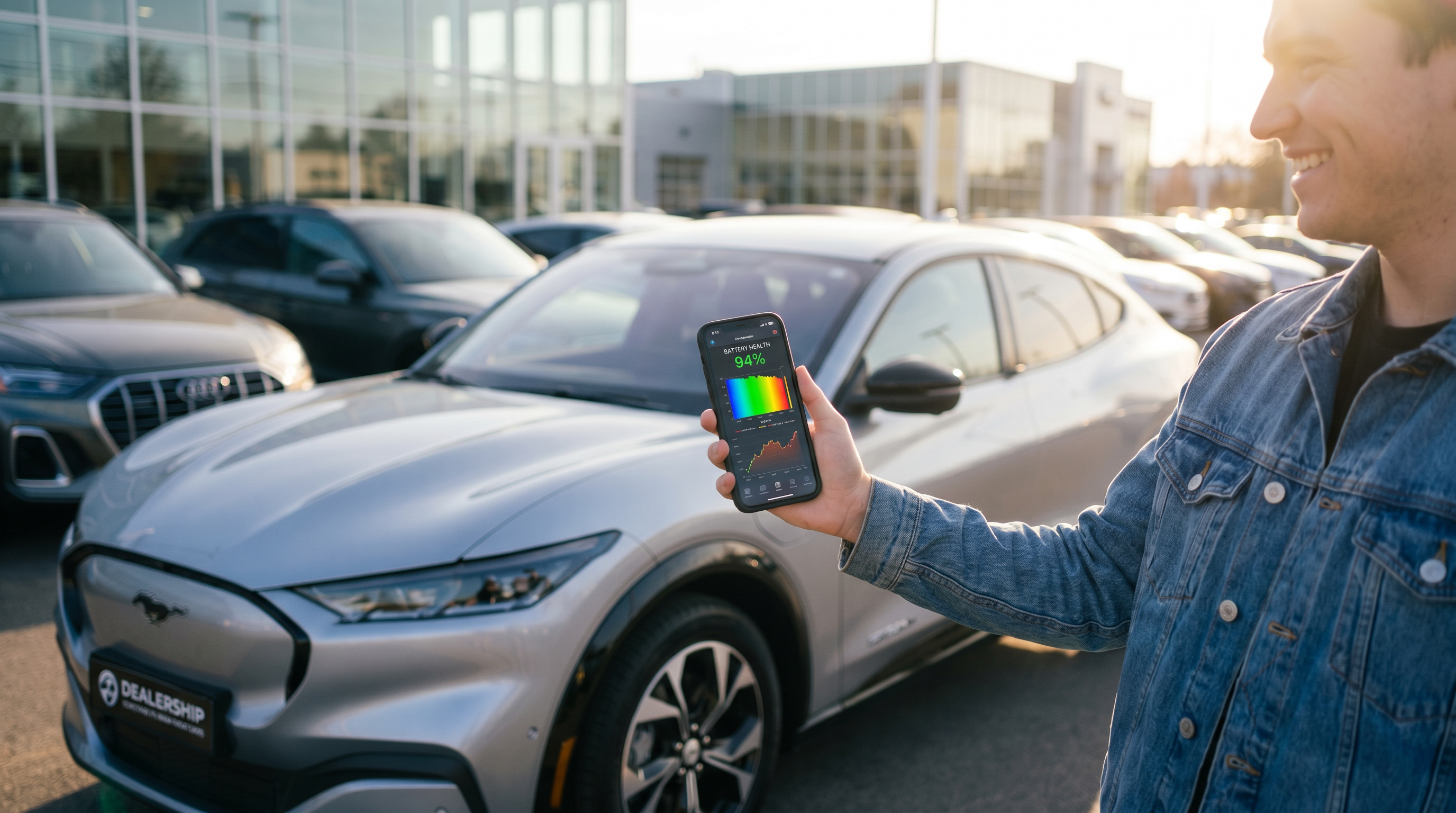
The most accurate and popular method for tech-savvy buyers involves using an On-Board Diagnostics (OBD2) scanner. By plugging a small, inexpensive Bluetooth adapter into the diagnostic port under the steering wheel, shoppers can pair the car with specialized smartphone apps. These applications bypass the dashboard estimates and pull exact degradation percentages, cell voltage balances, and charge cycle histories directly from the Battery Management System. For those who prefer not to play mechanic, the industry is rapidly standardizing third-party battery reports. Dealerships increasingly provide certified health certificates from diagnostic companies, treating them much like traditional accident history reports. These independent audits offer buyers peace of mind by comparing the specific car’s battery performance against thousands of similar models on the road.[3][4][5]
Despite lingering anxieties, large-scale data collected over the past decade reveals that EV batteries are far more resilient than early skeptics predicted. Diagnostic companies testing hundreds of thousands of high-mileage vehicles consistently find that catastrophic battery failure is exceedingly rare, affecting only one to two percent of cars. The vast majority of modern electric vehicles retain well over 85 percent of their original capacity even after crossing the 100,000-mile threshold. Advanced thermal management systems—which actively heat and cool the battery pack to protect the chemical cells—have largely solved the rapid degradation issues that plagued the very first generation of electric cars. For the average driver, the battery will likely outlast the vehicle's chassis and suspension components.[3][4]
Despite lingering anxieties, large-scale data collected over the past decade reveals that EV batteries are far more resilient than early skeptics predicted.
Even if a buyer happens to purchase a vehicle with a prematurely degrading battery, federal regulations provide a robust safety net. In the United States, automakers are legally required to warranty electric vehicle batteries for a minimum of eight years or 100,000 miles. Crucially, this warranty does not just cover complete failure; it guarantees a specific capacity retention, typically 70 percent. If a used EV's State of Health drops below that 70 percent threshold while still within the warranty window, the manufacturer is obligated to repair or replace the battery pack at no cost to the owner. Because these warranties automatically transfer to subsequent owners, buying a three- or four-year-old EV carries significantly less financial risk than many consumers assume.[3][6]

Beyond the mechanical checks, the 2026 used EV market is heavily shaped by aggressive federal financial incentives. Under the Inflation Reduction Act, buyers of qualifying used electric vehicles can claim a tax credit equal to 30 percent of the sale price, capped at a maximum of $4,000. This subsidy fundamentally alters the math of buying used, often bringing the price of a modern, long-range EV well below $20,000. Furthermore, the credit is now fully transferable. Instead of waiting until tax season to claim the refund, buyers can sign the credit over to the dealership at the point of sale, treating the $4,000 essentially as an instant cash down payment that lowers the immediate purchase price and reduces financing costs.[1][2]
However, unlocking that $4,000 credit requires navigating a strict set of Internal Revenue Service rules. First, the vehicle's total sale price cannot exceed $25,000, a cap designed to ensure the subsidy benefits middle-class buyers rather than subsidizing luxury purchases. Second, the car must be at least two model years old. Most importantly, the transaction must occur through a licensed dealership registered with the IRS; private party sales on platforms like Craigslist or Facebook Marketplace do not qualify for the federal credit. Finally, the specific vehicle can only qualify for the used EV tax credit once in its lifetime. If a previous owner already claimed the used credit when they bought the car, it is permanently disqualified for all future buyers.[1][2]

The federal government also imposes strict income limits on who can claim the used EV tax credit. To qualify, a buyer's modified adjusted gross income must be $150,000 or less for married couples filing jointly, $112,500 for heads of household, and $75,000 for single filers. Buyers can use their income from either the year of purchase or the prior year, whichever is lower. If a buyer transfers the credit at the dealership to get the instant discount but later realizes their income exceeded the legal limits for that tax year, they will be required to repay the $4,000 to the IRS when they file their annual return. Buyers are also limited to claiming one used EV tax credit every three years.[1][2]
Once the battery is verified and the tax credits are calculated, buyers must honestly assess their daily driving habits. While the allure of a 300-mile range is strong, paying a premium for a massive battery is often unnecessary for the average commuter. A used EV with a 150-mile range is more than sufficient for drivers who travel 30 miles a day and can plug in at home overnight. Buyers must also verify the vehicle's charging hardware. While the industry is rapidly standardizing around the North American Charging Standard (NACS), many older used EVs utilize the CCS or CHAdeMO plug types. Ensuring the car comes with the correct adapters, or factoring the cost of a home Level 2 charger into the budget, is a critical final step before signing the paperwork and driving off the lot.[3][6]
How we got here
Aug 2022
The Inflation Reduction Act passes, establishing the first federal tax credit for pre-owned electric vehicles.
Jan 2023
The $4,000 used EV tax credit officially goes into effect for qualifying buyers.
Jan 2024
The tax credit becomes transferable, allowing buyers to apply the discount directly at the dealership point of sale.
2026
A massive wave of lease returns hits the secondary market, significantly expanding used EV inventory and stabilizing prices.
Viewpoints in depth
Value-Driven Consumers
Focuses on maximizing the $4,000 tax credit and finding the sweet spot of depreciation.
For budget-conscious buyers, the used EV market in 2026 represents the best financial deal in the automotive sector. By targeting three-year-old models that have already absorbed their steepest depreciation hit, consumers can secure a high-tech vehicle for the price of a used economy gas car. These buyers prioritize finding vehicles priced just under the $25,000 IRS cap to unlock the $4,000 federal tax credit, effectively treating the government subsidy as an instant down payment that drastically lowers their monthly financing costs.
Diagnostic & Testing Industry
Advocates for standardized, independent battery health verification to build consumer trust.
Diagnostic experts argue that the used EV market cannot reach its full potential until battery health transparency becomes the industry standard. They caution against relying solely on dashboard 'guess-o-meters,' which can fluctuate based on recent driving habits rather than true chemical degradation. Instead, this camp pushes for mandatory third-party State of Health (SOH) certificates at the point of sale, ensuring buyers know exactly what capacity they are purchasing and protecting them from the rare but costly scenario of premature battery failure.
Automotive Dealerships
Focuses on moving inventory while navigating complex IRS compliance and educating hesitant buyers.
Traditional dealerships view the used EV boom as both a lucrative opportunity and a logistical headache. While the point-of-sale tax credit is a powerful tool for closing deals, the strict IRS reporting requirements place a heavy compliance burden on finance departments. Furthermore, sales teams must now act as technology educators, spending significant time walking hesitant buyers through charging infrastructure, battery warranties, and SOH reports before a transaction can be finalized.
What we don't know
- Whether the $4,000 federal used EV tax credit will be extended or modified by future administrations.
- How the widespread adoption of the North American Charging Standard (NACS) will affect the long-term resale value of older EVs with CCS ports.
Key terms
- State of Health (SOH)
- A percentage indicating a battery's current maximum capacity compared to when it was brand new.
- OBD2 Scanner
- A small diagnostic device that plugs into a car's port to read raw data, including battery health metrics.
- Charge Cycle
- The process of charging a battery from empty to full and discharging it again, which slowly degrades capacity over time.
- Battery Management System (BMS)
- The electronic system that manages a rechargeable battery, protecting it from operating outside its safe temperatures and voltages.
Frequently asked
Can I get the tax credit if I buy from a private seller?
No. To qualify for the federal $4,000 credit, the used EV must be purchased from a licensed dealership registered with the IRS.
How long do electric vehicle batteries actually last?
Data shows most modern EV batteries retain 80% to 90% of their original capacity even after 100,000 miles, often outlasting the car's chassis.
Does the used EV tax credit apply at the time of sale?
Yes. The credit is transferable, meaning you can apply it directly at the dealership to lower the upfront purchase price instead of waiting for tax season.
What happens if the battery fails after I buy the car?
Federal law requires EV batteries to carry an 8-year or 100,000-mile warranty that guarantees at least 70% capacity. This warranty automatically transfers to used buyers.
Sources
Source coverage
6 outlets
3 viewpoints surfaced






[1]Internal Revenue Service
Used Clean Vehicle Credit
Read on Internal Revenue Service →[2]Kelley Blue BookAutomotive Dealerships
Used EV Tax Credits Explained
Read on Kelley Blue Book →[3]InsideEVsValue-Driven Consumers
The 2026 Used EV Buying Guide: What to Check
Read on InsideEVs →[4]DEKRADiagnostic & Testing Industry
Used Electric Vehicles: Battery Health Testing
Read on DEKRA →[5]AutoTraderDiagnostic & Testing Industry
How to Check Battery Health When Buying a Used EV
Read on AutoTrader →[6]Factlen Editorial Team
Synthesis by Factlen editorial team
Read on Factlen Editorial Team →

More in shopping
See all 56 stories →Electric Bikes
The 2026 E-Bike Buying Guide: How to Choose the Right Electric Bicycle
7 sources

Luggage Choice
Travel Backpack vs. Rolling Carry-On: Which Luggage Fits Your Trip?
7 sources

Summer Sales
The 2026 Summer Retail Price War: Amazon, Walmart, and Target Launch Massive June Sales Events
7 sources

E-Bike Tech
The 2026 E-Bike Buying Guide: Motors, Batteries, and Finding Your Perfect Ride
8 sources

Every angle. Every day.
Get shopping stories with full source coverage and perspective breakdowns delivered to your inbox.