
Travel Backpack vs. Rolling Carry-On: Which Luggage Fits Your Trip?
Choosing between a travel backpack and a rolling carry-on comes down to a fundamental trade-off between hands-free mobility and effortless transport. Here is how to match your luggage to your itinerary.
By Factlen Editorial Team
- One-Bag Minimalists
- Advocate for hands-free mobility and terrain adaptability above all else.
- Comfort-First Travelers
- Prioritize zero physical strain and structured packing efficiency.
- Hybrid Pragmatists
- Choose luggage dynamically based on the specific demands of the itinerary.
What's not represented
- · Travelers with physical disabilities
- · Airlines enforcing baggage policies
Why this matters
Your choice of luggage dictates your physical comfort and mobility for the duration of your trip. Selecting the wrong bag can lead to unnecessary physical strain, broken wheels on cobblestones, or the frustration of a forced gate-check.
Key points
- Travel backpacks offer superior mobility for uneven terrain, public transit, and hands-free navigation.
- Rolling carry-ons provide effortless transport on smooth surfaces and protect clothing from wrinkles.
- Backpacks typically weigh 3-5 pounds empty, while hard-shell rollers weigh 6-8 pounds, impacting strict airline weight limits.
- Soft-sided backpacks are less likely to be gate-checked on full flights compared to rigid hard-shell suitcases.
At some point before every trip, travelers face a fundamental packing dilemma that will dictate their comfort for the duration of their journey: whether to carry their belongings on their back or roll them alongside. The debate between the travel backpack and the rolling carry-on has intensified in recent years, fueled by the rise of the minimalist one-bag movement clashing with the ubiquitous dominance of the four-wheel hard-shell spinner. This is not merely a question of aesthetics; it is a structural choice between mobility and stability. The wrong luggage rarely ruins a trip in one dramatic moment, but it slowly creates friction throughout the journey—whether that means dragging a heavy bag up a narrow hostel staircase or suffering through shoulder strain during a long layover.[7]
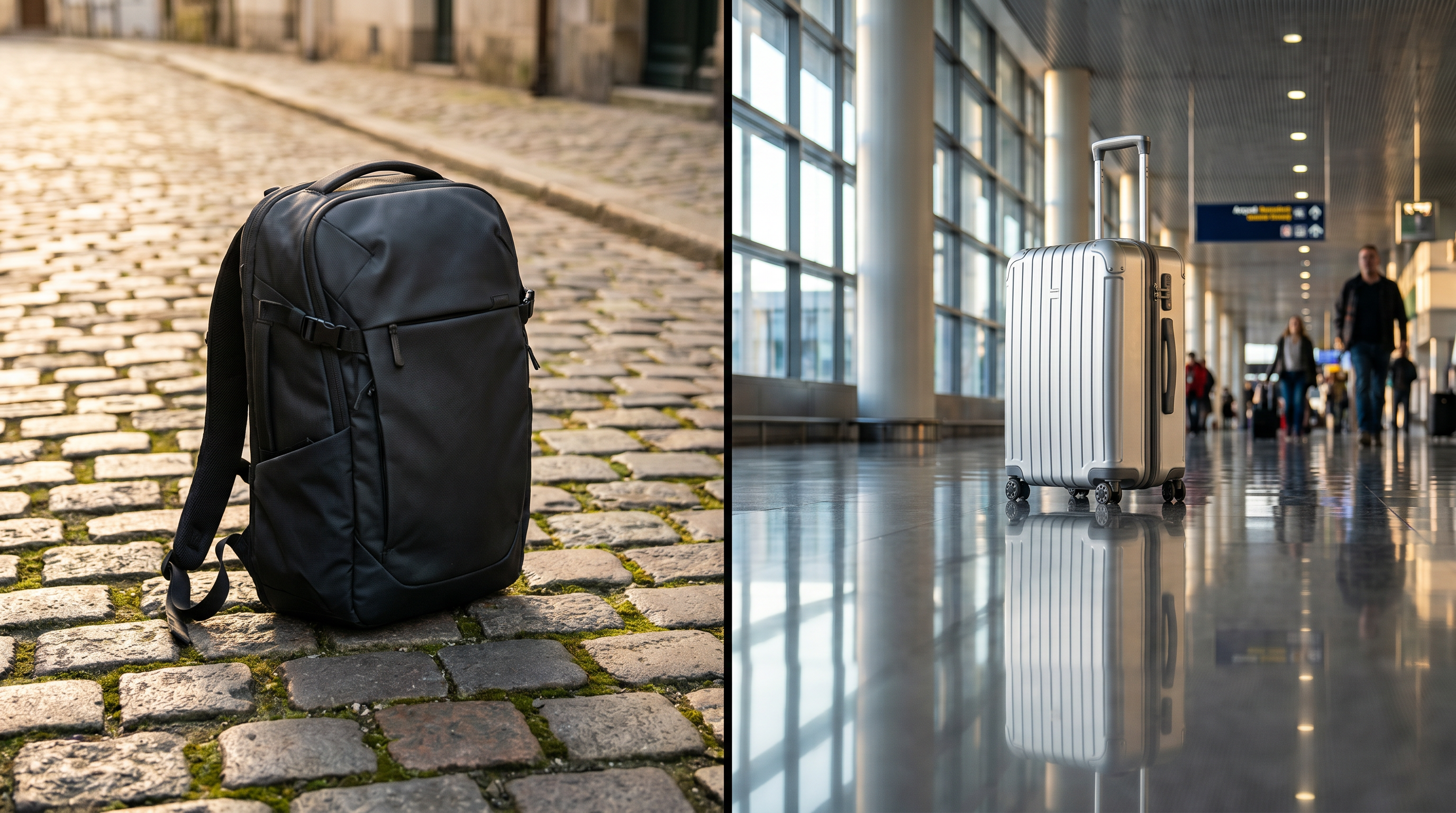
The case for the travel backpack centers entirely on hands-free navigation and terrain adaptability. Proponents argue that a backpack moves with the body, allowing travelers to navigate crowded subway turnstiles, sprint for tight connections, and hold a coffee or a passport without juggling a handle. Evidence from seasoned travelers highlights that when an itinerary involves cobblestone streets, ferries, or frequent use of public transit, a backpack eliminates the friction of dragging a wheeled anchor. It provides a level of freedom that a suitcase simply cannot match, transforming the traveler from a burdened tourist into an agile pedestrian.[4][5]
However, the case against the backpack is rooted in the undeniable physical toll it extracts. Carrying twenty pounds or more of gear on your back for extended periods inevitably causes fatigue, shoulder strain, and sweat. Furthermore, the softer structure of a backpack requires more strategic packing; it is difficult to keep business attire wrinkle-free, and retrieving an item from the bottom of the bag often necessitates unpacking the entire contents. For travelers who prioritize a crisp, professional appearance or who suffer from back pain, the backpack quickly becomes a liability rather than an asset.[2][3][6]
Quantifying the backpack reveals its distinct advantages in weight and flexibility. Most purpose-built travel backpacks range from 35 to 45 liters in capacity and weigh between three and five pounds when empty. This lightweight baseline is crucial for travelers flying on budget airlines with strict cabin weight limits, as it maximizes the allowance for actual belongings rather than the bag's hardware. Additionally, the soft-sided nature of a backpack allows it to be compressed and squeezed into tight overhead bins or under seats, significantly reducing the risk of being forced to gate-check the bag on full flights.[1][2][6]

Conversely, the case for the rolling carry-on centers on effortless transport and superior organization. In controlled environments like polished airport terminals, smooth sidewalks, and hotel lobbies, the wheels bear one hundred percent of the weight. This allows the traveler to glide through massive transit hubs without expending physical energy or arriving at their destination drenched in sweat. The structured, rectangular bucket shape of a roller also maximizes packing efficiency, allowing clothes to be laid flat and items to be easily accessed without disrupting the entire load.[1][2]
Conversely, the case for the rolling carry-on centers on effortless transport and superior organization.
The case against the rolling carry-on exposes its vulnerability to unpredictable terrain and crowded spaces. Evidence from European travel experts notes that spinner wheels are quickly hobbled by cobblestones, gravel, and uneven pavement. When faced with a broken escalator or a multi-story walk-up apartment, the roller must be carried by a side handle, instantly defeating its primary purpose. Furthermore, navigating a rolling bag through a dense crowd is inherently slower and more cumbersome than weaving through with a backpack, as the suitcase occupies a larger footprint and requires constant steering.[2][3]
Quantifying the rolling carry-on highlights the trade-offs of its hardware. While hard-shell rollers typically offer 45 liters or more of capacity, the addition of wheels, a retractable handle, and a rigid frame pushes their empty weight to between six and eight pounds. This heavier baseline eats into strict airline weight limits. Moreover, the rigid dimensions mean that if the bag is even a fraction of an inch too large, it cannot be squeezed into a sizing bin. As airlines increasingly crack down on overhead space, hard-shell rollers are frequently the first items targeted by gate agents for mandatory checking.[1][2][6]

Beyond physical metrics, the choice of luggage communicates a specific aesthetic and professional intent. In business settings, arriving with a structured, sleek rolling suitcase reads as formal, organized, and polished. Showing up to a corporate meeting or an upscale hotel lobby with a 40-liter hiking-style pack strapped to your shoulders can feel distinctly out of place, regardless of how expensive the bag might be. For travelers bridging the gap between work and leisure, the rolling carry-on offers a chameleon-like quality that blends seamlessly into professional environments while still functioning perfectly well for standard vacation travel.[2]
In an attempt to split the difference, some manufacturers offer hybrid rolling backpacks, but experts generally advise against them. These hybrid models often combine the worst traits of both systems: the wheels and handle add significant weight and consume valuable interior space, while the rigid back panel makes them uncomfortable to wear as a backpack for any length of time. Most travelers who purchase hybrid bags report using them almost exclusively as rollers, carrying around the extra weight of unused backpack straps for the duration of their trip.[3]
A more effective compromise is the two-bag strategy, which pairs a primary rolling carry-on with a smaller, personal-item-sized backpack. This approach allows the traveler to effortlessly roll their heavy clothing and toiletries through the airport, while keeping electronics, documents, and mid-flight essentials accessible on their back. Upon arriving at the destination, the heavy roller can be left at the accommodation, freeing up the small backpack for nimble daily exploration. This system offers the best of both worlds without the structural compromises of a hybrid bag.[1][7]

Ultimately, determining which luggage system fits best requires an honest assessment of the specific itinerary. The travel backpack fits perfectly when the journey involves multiple cities, heavy reliance on public transit, and unpredictable terrain. It is the optimal choice for travelers who value speed, hands-free mobility, and the flexibility to walk straight from the airport to their first activity without needing to drop off bags. It empowers the traveler to navigate the world on their own terms, unencumbered by the infrastructure around them.[6]
Conversely, the travel backpack does not fit well when the traveler has physical limitations, requires crisp business attire, or is simply moving from an airport straight to a resort via a taxi. The rolling carry-on fits perfectly when the itinerary is point-to-point, the surfaces are guaranteed to be smooth, and the traveler prioritizes physical comfort over nimble movement. It does not fit well when the trip involves frequent hotel changes, historic cities with uneven streets, or tight connections where speed is essential. The best luggage is simply the one that matches how you actually travel.[4][7]

How we got here
1970s
The first commercially successful rolling suitcase is patented, featuring a simple strap and two wheels.
1987
The modern 'Rollaboard' with a retractable handle and two inline skate wheels is invented by a pilot, revolutionizing air travel.
2004
Four-wheel 'spinner' luggage is introduced to the mass market, allowing bags to glide upright and reducing arm strain.
2010s
The 'one-bag' travel movement gains mainstream traction, leading to the development of purpose-built, clamshell travel backpacks.
2020s
Airlines strictly enforce carry-on dimensions and overhead bin limits, intensifying the debate between compressible backpacks and rigid rollers.
Viewpoints in depth
One-Bag Minimalists
Travelers who prioritize ultimate mobility and refuse to check bags.
This camp views wheels as an unnecessary liability that adds weight and restricts movement. They argue that modern travel backpacks, equipped with ergonomic suspension systems and clamshell openings, offer all the organizational benefits of a suitcase without the terrain limitations. For them, the ability to walk off a plane and straight onto a crowded subway train without breaking stride is the ultimate travel luxury.
Comfort-First Travelers
Travelers who prioritize physical ease and structured organization.
This perspective argues that carrying twenty pounds of gear on your back is an outdated and unnecessary physical strain. They point out that 90 percent of modern travel occurs on smooth surfaces—airports, train stations, and hotel lobbies—where spinner wheels excel. For this camp, the minor inconvenience of carrying a bag up a flight of stairs is a worthwhile trade-off for the effortless glide and pristine clothing organization a hard-shell roller provides.
Hybrid Pragmatists
Travelers who adapt their luggage choice to the specific itinerary.
Rather than pledging loyalty to one style of bag, this camp evaluates each trip individually. They will deploy a travel backpack for a multi-city European train tour involving cobblestones, but switch to a rolling carry-on for a direct flight to a beachfront resort. They often utilize a two-bag system, pairing a rolling suitcase with a smaller daypack to maximize both transit comfort and on-the-ground mobility.
What we don't know
- Whether airlines will continue to shrink the allowable dimensions for carry-on luggage, potentially obsoleting current hard-shell models.
- How the development of ultra-lightweight materials might eventually close the weight gap between heavy rollers and soft-sided backpacks.
Key terms
- One-Bag Travel
- A minimalist travel philosophy where a person packs all their belongings into a single carry-on bag to avoid check-in fees, lost luggage, and restricted mobility.
- Spinner Wheels
- A luggage design featuring four wheels that rotate 360 degrees, allowing the bag to be pushed upright alongside the traveler rather than pulled behind them.
- Clamshell Opening
- A backpack design that unzips entirely around the perimeter to lay flat like a suitcase, making it easier to pack and access items without digging from the top.
- Gate-Check
- The airline practice of forcing passengers to surrender their carry-on bags at the boarding gate to be placed in the cargo hold, usually due to a lack of overhead bin space.
Frequently asked
Can a travel backpack fit as much as a rolling carry-on?
Generally, no. While both can maximize airline dimensions, the rectangular bucket shape of a rolling carry-on usually offers slightly more usable volume (45L+) compared to the contoured shape of a backpack (35-45L).
Are rolling backpacks a good compromise?
Most travel experts advise against them. They combine the heavy hardware of a roller with the reduced capacity of a backpack, and the rigid wheel frame often makes them uncomfortable to wear for long periods.
Which bag is less likely to be gate-checked?
Soft-sided travel backpacks are much less likely to be gate-checked. They can often be compressed to fit into tight overhead spaces or shoved under the seat, whereas rigid hard-shell rollers cannot.
Is a backpack or a roller better for European travel?
A travel backpack is generally recommended for multi-city European trips due to the prevalence of cobblestone streets, narrow staircases, and frequent train transfers that easily break or hobble spinner wheels.
Sources
Source coverage
7 outlets
3 viewpoints surfaced







[1]Pack HackerComfort-First Travelers
Best Carry On Luggage | On a roll!
Read on Pack Hacker →[2]The Carry CollectiveComfort-First Travelers
Backpack or Rolling Luggage?
Read on The Carry Collective →[3]Rick StevesHybrid Pragmatists
Choosing the Right Travel Bag
Read on Rick Steves →[4]Reddit r/onebagOne-Bag Minimalists
Backpack vs Roller bag for 5-7 day trips
Read on Reddit r/onebag →[5]Boundary SupplyOne-Bag Minimalists
Carry-on backpack vs suitcase for travel
Read on Boundary Supply →[6]Style & VoyagerOne-Bag Minimalists
Backpack vs Rolling Carry On for a 5-7 Day Trip
Read on Style & Voyager →[7]Factlen Editorial TeamHybrid Pragmatists
Synthesis by Factlen editorial team
Read on Factlen Editorial Team →
More in shopping
See all 55 stories →Used EVs
How to Buy a Used EV in 2026: Battery Health, Tax Credits, and What to Look For
6 sources
Summer Sales
The 2026 Summer Retail Price War: Amazon, Walmart, and Target Launch Massive June Sales Events
7 sources

E-Bike Tech
The 2026 E-Bike Buying Guide: Motors, Batteries, and Finding Your Perfect Ride
8 sources
EV Transition
EV vs. PHEV in 2026: The Complete Cost and Lifestyle Comparison
7 sources

Every angle. Every day.
Get shopping stories with full source coverage and perspective breakdowns delivered to your inbox.