
How Branded Resale and Circular E-Commerce are Rewriting Retail Economics
Major brands are abandoning the linear 'take-make-waste' model, leveraging AI and reverse logistics to turn secondhand sales into a $700 billion opportunity.
By Factlen Editorial Team
- Brand Strategists
- View branded resale primarily as a powerful customer acquisition tool that lowers marketing costs and builds long-term loyalty.
- Circular Economy Advocates
- Focus on the environmental imperative of decoupling corporate revenue from the extraction of virgin natural resources.
- Supply Chain Operators
- Emphasize the immense physical and technological challenges of reverse logistics, single-SKU processing, and cross-border shipping.
What's not represented
- · Garment workers in traditional manufacturing hubs facing reduced demand for new production
- · Local thrift store operators facing inventory competition from major brands
Why this matters
By taking ownership of the secondhand market, brands are reducing their environmental footprint while offering consumers high-quality goods at lower prices. This shift fundamentally changes how we value, purchase, and dispose of the products we use every day.
Key points
- The global secondhand apparel market is projected to reach nearly $393 billion by 2030, growing four times faster than traditional retail.
- Over 50 major global brands have launched in-house resale programs to capture secondary market margins and improve customer acquisition.
- The Ellen MacArthur Foundation estimates that circular business models could represent a $700 billion opportunity by the end of the decade.
- AI product recognition and digital IDs are solving the historical complexities of reverse logistics and single-SKU inventory management.
- Extending a garment's life by just nine months reduces its carbon, water, and waste footprints by 20 to 30 percent.
For decades, the global e-commerce industry operated on a simple, linear premise: take materials, make products, ship them to consumers, and eventually, watch them become waste. But a quiet revolution is currently rewriting the underlying code of global retail. Driven by a convergence of advanced reverse logistics, artificial intelligence, and a generational shift in consumer values, "circular e-commerce" is rapidly moving from a niche sustainability initiative to a core profit engine for the world's largest brands. This transition represents a fundamental rethinking of how value is created and retained in the digital age, proving that economic growth no longer requires the relentless extraction of virgin resources.[6]
The sheer scale of the secondhand market reflects a seismic shift in how goods are consumed and valued. Recent industry projections indicate that the global secondhand apparel market alone is expected to reach nearly $393 billion by 2030. More importantly, this sector is growing at a compound annual growth rate that outpaces the traditional retail clothing market by up to four times. This is no longer just about local thrift stores or peer-to-peer marketplaces moving online; it is a structural restructuring of retail unit economics that is forcing every major brand to adapt or risk losing market share to more agile competitors.[1][5]
To understand why brands are pivoting so aggressively, one must look at the traditional e-commerce return process, which has long been the industry's Achilles' heel. Historically, reverse logistics—the journey a product takes from the consumer back to the retailer—has been a costly and inefficient nightmare. Because processing, inspecting, cleaning, and restocking a single returned item often costs more than manufacturing a brand new one overseas, millions of tons of perfectly usable goods have routinely been incinerated or sent directly to landfills. This linear model is not only environmentally devastating but increasingly economically fragile.[2]
Enter the era of "Branded Resale." Rather than ceding the lucrative secondary market to third-party platforms, major retailers are launching their own in-house resale channels. Over 50 major global brands across outdoor gear, high fashion, and consumer electronics have recently introduced branded resale programs. These platforms allow customers to seamlessly trade in their used items in exchange for store credit. The brand then authenticates, refurbishes, and resells the item on its own dedicated digital storefront, effectively capturing the margin on the same product for a second, or even third, time.[5][6]

This transition is being formalized and accelerated by major industry coalitions aiming to standardize circular practices. The Ellen MacArthur Foundation recently launched "The Fashion ReModel," a landmark initiative uniting high-street and high-end brands, including Arc'teryx, H&M, and Reformation. The project's explicit goal is to decouple revenue from the production of new garments. By participating in this initiative, these brands are working to prove that businesses can significantly increase their bottom line and satisfy shareholder demands without extracting new natural resources or contributing to global waste.[2]
The financial upside of this transition is staggering. According to the Foundation's comprehensive research, circular business models—which encompass resale, rental, repair, and remaking—could grow to represent 23 percent of the entire global fashion market by the end of the decade. This represents an estimated $700 billion opportunity. For retail executives, this data transforms sustainability from a mandatory compliance cost or a marketing buzzword into a primary vector for long-term commercial growth and supply chain resilience.[2]
Managing a circular supply chain, however, requires entirely different software and operational infrastructure than selling new goods. When a brand sells a new shirt, it might hold 10,000 identical units of a single SKU in a central warehouse. In the resale market, every single item is a unique SKU with its own specific condition, wear pattern, and optimal price point. Artificial intelligence is bridging this massive operational gap. AI-powered product recognition tools can now instantly identify a traded-in garment, assess its physical condition, verify its authenticity against counterfeit databases, and dynamically price it for the secondary market in seconds.[1][5][6]
Managing a circular supply chain, however, requires entirely different software and operational infrastructure than selling new goods.
To further streamline this complex authentication process, forward-thinking brands are increasingly embedding digital IDs—such as scannable QR codes, NFC chips, or RFID threads—directly into new garments at the point of manufacture. When an item is traded in years later, a quick scan instantly pulls up its original manufacturing data, material composition, and sizing information. This technological leap eliminates the need for manual data entry, drastically reduces the labor costs associated with reverse logistics, and guarantees the authenticity of the product for the next buyer.[3]

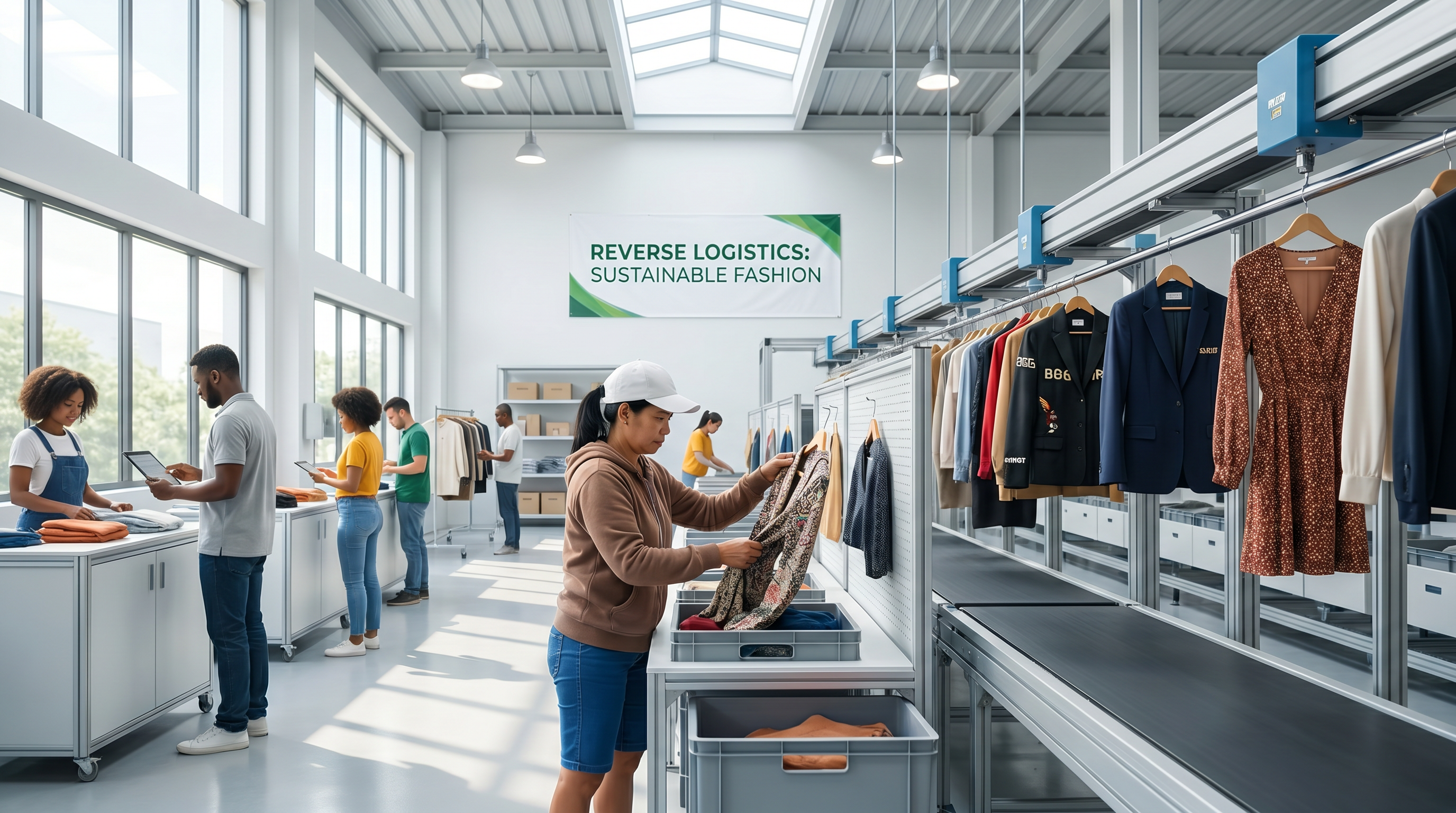
Because building this specialized infrastructure from scratch is prohibitively expensive for most retailers, a booming business-to-business sector has emerged to provide "Resale-as-a-Service" (RaaS). Third-party logistics partners now handle the messy physical reality of circularity on behalf of major brands. These specialized facilities receive consumer trade-ins, utilize ozone technology to clean garments, photograph single items using automated studio setups, and fulfill orders. Crucially, this all happens while integrating seamlessly into the brand's existing e-commerce frontend, providing a frictionless experience for the end consumer.[1][6]
The push for circularity is not limited to the products themselves; it extends to the physical materials used to ship them. The sustainable e-commerce packaging market is experiencing explosive growth, projected to reach $36.46 billion in 2026. Retailers are increasingly abandoning single-use cardboard and plastic polybags in favor of returnable, durable mailers that can be utilized dozens of times. Consumers simply fold the empty mailer after receiving their order and drop it in a standard mailbox, where it is routed back to a centralized cleaning facility and reintroduced into the active supply chain.[4]
For brands, the underlying financial logic of circular e-commerce is highly compelling, particularly in an era of rising digital advertising costs. Customer acquisition costs in traditional digital marketing have skyrocketed, making it harder to find profitable new buyers. Branded resale acts as a powerful, low-cost acquisition tool; industry data shows that shoppers who initially buy secondhand are highly likely to eventually purchase new, full-price items from the same brand. Furthermore, offering trade-in credits ensures that the customer's secondary spending stays securely locked within the brand's proprietary ecosystem.[1][5]
This economic model is being rapidly accelerated by changing consumer preferences, with younger demographics leading the charge. Gen Z and Millennial shoppers increasingly view resale value as a critical factor when making their initial purchasing decisions. Nearly half of consumers now state they are less inclined to buy a new apparel item if it lacks a strong, proven resale value. This shift indicates that younger consumers are treating their wardrobes more like investment portfolios or liquid assets than disposable, single-use goods.[1]

Beyond sustainability and shifting values, macroeconomic pressures are providing a massive tailwind for the adoption of circular e-commerce. Persistent inflation, supply chain volatility, and shifting international trade tariffs have made the affordability of secondhand goods increasingly attractive to a broader swath of the population. When household budgets tighten, consumers generally do not stop shopping entirely; instead, they shift their spending to platforms and brands that offer premium, durable goods at more accessible price points.[1][5]
The environmental imperative driving this industry-wide shift cannot be overstated. The traditional fashion industry is one of the most resource-intensive sectors on the planet. However, extending the active life of a single garment by just nine months reduces its carbon, water, and waste footprints by 20 to 30 percent. By keeping products in circulation at their highest possible value for as long as possible, the e-commerce sector can significantly reduce its reliance on virgin materials and dramatically lower its overall greenhouse gas emissions.[2][3]

Despite the immense momentum, significant operational and regulatory hurdles remain before circular e-commerce can fully replace the linear model. Cross-border reverse logistics are still fraught with complex taxation rules, customs duties, and high shipping costs that make international resale difficult to scale. Additionally, as the resale market grows in value, platforms face an ongoing arms race against increasingly sophisticated counterfeiters, necessitating continuous, heavy investment in both AI authentication technologies and expert manual verification.[3][5]
The era of disposable, single-use e-commerce is slowly but inevitably drawing to a close. By successfully aligning environmental stewardship with hard-nosed unit economics, circular e-commerce is proving that sustainability and profitability are not mutually exclusive concepts. As digital infrastructure continues to mature and consumer habits solidify around resale, the most successful and resilient retail brands of the next decade will undoubtedly be those that master the complex art of selling the exact same product twice.[6]
How we got here
2017
The Ellen MacArthur Foundation publishes 'A New Textiles Economy,' identifying the linear take-make-waste model as a critical flaw in global retail.
2021
Major third-party resale platforms go public, validating the massive consumer demand for secondhand apparel.
May 2024
The Ellen MacArthur Foundation launches 'The Fashion ReModel' at the Global Fashion Summit, uniting major brands to decouple revenue from new production.
2025
Global secondhand apparel market growth officially outpaces the broader retail clothing sector by nearly four times.
2026
Advanced AI grading and digital product IDs become standard infrastructure for major branded resale programs.
Viewpoints in depth
Retail Executives
Viewing circularity as a core driver of customer acquisition and supply chain resilience.
For retail leadership, the shift toward branded resale is fundamentally about unit economics. As digital advertising costs continue to rise, acquiring new customers has become increasingly expensive. Resale platforms offer a lower-cost entry point for aspirational shoppers, who data shows often graduate to buying full-price items. Additionally, by issuing store credit for trade-ins, brands ensure that secondary spending remains locked within their ecosystem, boosting lifetime customer value while hedging against the volatility of international supply chains.
Sustainability Advocates
Pushing for genuine decoupling of corporate revenue from the extraction of virgin resources.
Environmental organizations and circular economy advocates view branded resale as a critical first step, but they warn against 'greenwashing.' Their primary concern is ensuring that resale programs actually displace the production of new goods, rather than simply encouraging consumers to buy more items with the justification that they can be traded in later. These advocates push for systemic changes, such as designing products for durability and repairability from the outset, to ensure the circular loop is genuinely sustainable.
Logistics Providers
Focusing on the operational realities of processing millions of unique, used items.
The companies building the physical infrastructure for circular e-commerce face a daunting operational challenge. Unlike traditional retail, where thousands of identical items are processed simultaneously, resale requires 'single-SKU' management. Every traded-in item must be individually inspected, cleaned, photographed, and priced. Logistics providers argue that without massive, ongoing investments in AI automation, robotics, and digital product IDs, the labor costs of reverse logistics will remain a significant bottleneck to scaling the circular economy globally.
What we don't know
- Whether the rise of branded resale will actually reduce the total volume of new goods manufactured, or simply encourage higher overall consumption.
- How quickly international tax and customs regulations will adapt to facilitate cross-border reverse logistics for secondhand goods.
- If AI authentication tools can reliably stay ahead of increasingly sophisticated counterfeit manufacturing rings.
Key terms
- Circular Economy
- An economic system aimed at eliminating waste and the continual use of resources by keeping products, equipment, and infrastructure in use for longer.
- Reverse Logistics
- The supply chain process of moving goods from their typical final destination back to the retailer for returns, refurbishment, or recycling.
- Resale-as-a-Service (RaaS)
- B2B platforms that provide the backend logistics, software, and cleaning infrastructure for brands to launch their own resale channels.
- Digital ID
- A scannable code or RFID tag embedded in a product that stores its manufacturing data, materials, and authenticity to streamline future resale.
- Single-SKU Inventory
- An inventory system where every single item is unique (due to wear, condition, or age), requiring individualized processing and pricing.
Frequently asked
What exactly is branded resale?
Branded resale is a model where a retailer creates its own platform to buy back and resell its used products, rather than relying on third-party marketplaces like eBay or Poshmark.
Why are major brands embracing secondhand sales?
Resale helps brands acquire new customers at a lower cost, retains existing customers through trade-in store credits, and meets growing consumer demand for sustainable shopping options.
How does AI help the secondhand market?
Artificial intelligence is used to instantly identify traded-in items, assess their physical condition, verify authenticity, and set dynamic pricing, making the processing of unique used items economically viable at scale.
Sources
Source coverage
6 outlets
3 viewpoints surfaced






[1]ThredUpBrand Strategists
2026 Resale Report: Key Insights and Trends in the Global Secondhand Market
Read on ThredUp →[2]Ellen MacArthur FoundationCircular Economy Advocates
The Fashion ReModel: Decoupling Revenue from Production
Read on Ellen MacArthur Foundation →[3]UN Trade and DevelopmentCircular Economy Advocates
Digital Economy Report: Shaping an Environmentally Sustainable Digital Future
Read on UN Trade and Development →[4]Mordor IntelligenceSupply Chain Operators
Sustainable E-Commerce Packaging Market Size & Outlook 2026–2031
Read on Mordor Intelligence →[5]InsightAce AnalyticBrand Strategists
Second Hand Products Market Deep Analysis Report 2026 to 2035
Read on InsightAce Analytic →[6]Factlen Editorial TeamSupply Chain Operators
Synthesis by Factlen editorial team
Read on Factlen Editorial Team →

More in business
See all 31 stories →Space Economy
SpaceX Raises $75 Billion in Record-Setting IPO Ahead of Nasdaq Debut
8 sources

Energy Markets
Global Markets Rally and Oil Retreats as U.S. and Iran Signal Framework Peace Deal
8 sources
SpaceX IPO
SpaceX Prices Historic $75 Billion IPO at $135 Per Share
8 sources
Space Economy
SpaceX Raises $75 Billion in Largest IPO in History as Retail Demand Surges
6 sources
Every angle. Every day.
Get business stories with full source coverage and perspective breakdowns delivered to your inbox.