
U.S. Strikes Hit Iranian Water Facilities, Sparking War Crime Accusations and Escalation
A U.S. military strike destroyed two drinking water reservoirs in southern Iran, cutting off supply to 20,000 people and triggering Iranian retaliatory attacks on U.S. bases.
By Factlen Editorial Team
- Humanitarian & Legal Critics
- Focuses on the potential war crime and civilian toll caused by the destruction of water infrastructure.
- Regional Mediators & Observers
- Prioritizes immediate de-escalation and a return to diplomatic negotiations to protect the global economy.
- Iranian State & Allied Voices
- Condemns the strikes as deliberate war crimes against civilians and justifies military retaliation.
- U.S. Defense Establishment
- Argues the strikes were necessary, precision-targeted self-defense measures against Iranian military assets.
What's not represented
- · The 20,000 residents of Bemani currently surviving without running water
- · Commercial shipping companies attempting to navigate the disputed Strait of Hormuz
Why this matters
The destruction of civilian water infrastructure marks a dangerous new threshold in the U.S.-Iran conflict, raising the specter of international war crime investigations. Furthermore, Iran's retaliatory closure of the Strait of Hormuz threatens to choke off a vital artery for global energy supplies, risking severe economic fallout.
Key points
- U.S. strikes destroyed two water reservoirs in Bemani, Iran, cutting off drinking water to 20,000 residents.
- Munitions experts identified fragments of a U.S.-made GBU-39 precision-guided bomb at the site.
- The U.S. claims the strikes were in self-defense after Iran shot down an Apache helicopter.
- Iran retaliated by launching missiles at U.S. bases in Jordan, Kuwait, and Bahrain.
- Tehran announced the closure of the Strait of Hormuz, though the U.S. says the waterway remains open.
- Legal experts warn that intentionally targeting civilian water infrastructure constitutes a war crime.
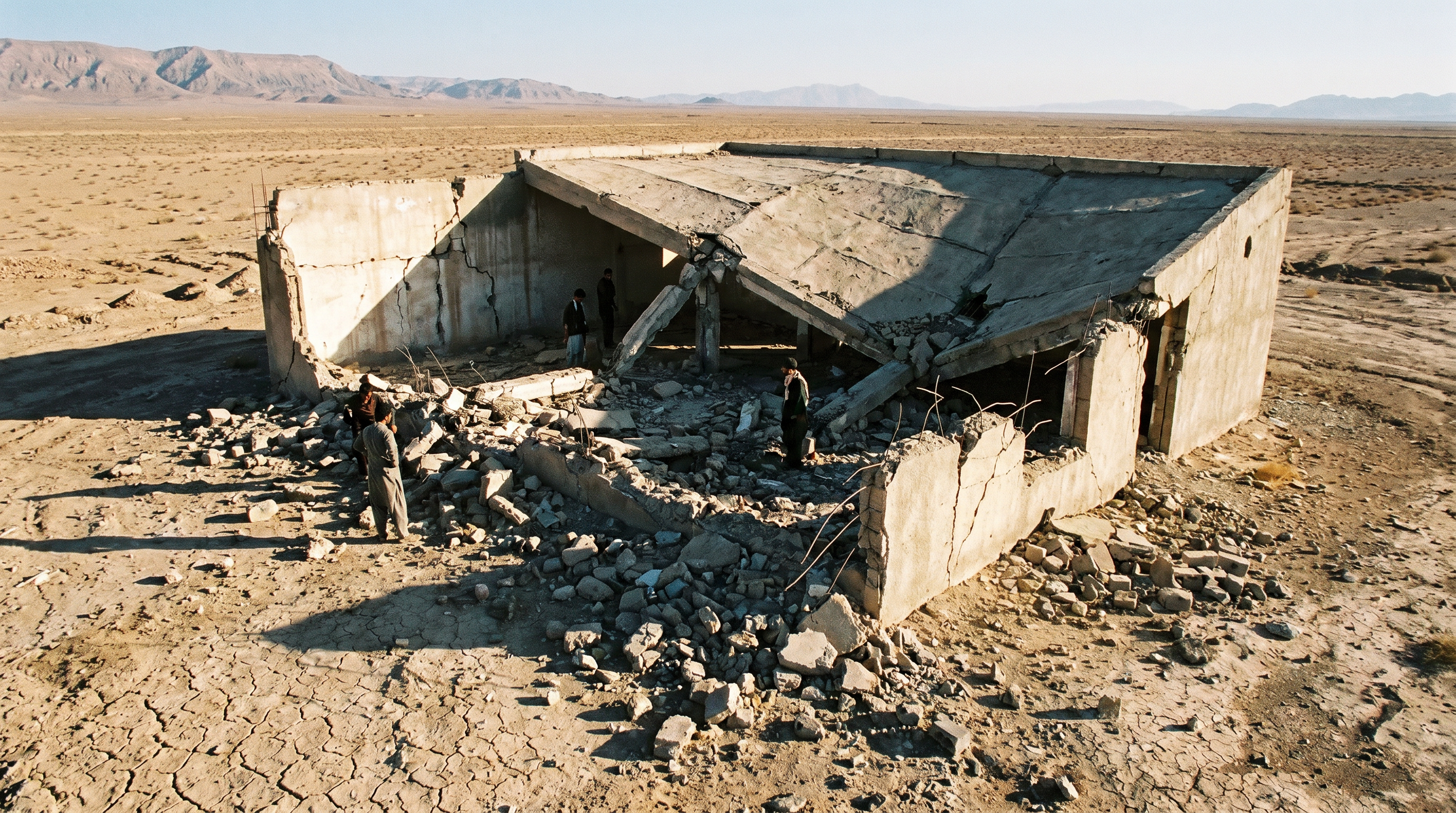
The U.S.-Iran conflict has crossed a perilous new threshold, shifting from military skirmishes to attacks that directly imperil civilian survival. On Wednesday, U.S. military strikes destroyed two vital drinking water reservoirs in the southern Iranian village of Bemani, located just miles from the strategic Strait of Hormuz. The destruction of these facilities has instantly transformed a geopolitical standoff into a severe local humanitarian crisis, leaving thousands without access to clean water in one of the hottest regions on earth.[1][2]
The attack instantly severed the clean water supply for approximately 20,000 residents spread across ten villages in the Hormozgan province. With regional temperatures currently soaring above 100 degrees Fahrenheit amid a historic, decades-long drought, local authorities have described the situation as absolutely critical. Provincial water executives reported that the area has insufficient groundwater to replace the damaged reservoirs, forcing the government to rapidly deploy mobile water tankers to prevent mass dehydration and heat-related casualties among the vulnerable civilian population.[2][6]
The destruction of the Bemani facilities has ignited immediate and severe accusations of war crimes from international observers and human rights advocates. Under international humanitarian law—specifically the Geneva Conventions and the Berlin Rules on Water Resources—water infrastructure is explicitly classified as protected civilian property. These treaties strictly prohibit the targeting of drinking water installations, treatment plants, and pipelines during armed conflict, recognizing that denying water to a civilian population causes indiscriminate suffering and violates the fundamental rules of engagement.[1][2]
The central question now dividing military analysts, legal experts, and lawmakers is one of intent: was the destruction of the water tanks a deliberate tactical choice designed to exert maximum pressure on Tehran, or was it a catastrophic intelligence failure? If the U.S. military intentionally targeted the reservoirs, it would represent an unprecedented and illegal escalation. Conversely, if the facilities were struck accidentally, it raises profound concerns about the accuracy of U.S. targeting intelligence in a highly volatile theater of operations.[1]

Evidence compiled by independent visual investigations strongly points toward a deliberate precision strike rather than accidental collateral damage. Satellite imagery and video analysis of the aftermath reveal that the two water storage structures were remotely located, with no other obvious military infrastructure, radar installations, or missile silos in their immediate vicinity. The isolated nature of the facilities makes it highly unlikely that they were inadvertently hit by stray munitions intended for a nearby military target, suggesting they were the primary coordinates.[6]
Furthermore, weapons debris recovered from the Bemani site has been positively identified by open-source munitions experts as fragments of a GBU-39 guided bomb. The GBU-39 is a 250-pound American-made precision weapon specifically designed to strike exact coordinates with minimal collateral damage. The deployment of such highly accurate guided munitions against isolated civilian structures further bolsters the argument that the water reservoirs were specifically targeted by U.S. forces, rather than being the unfortunate victims of a wider, indiscriminate bombing run.[1][6]
U.S. Central Command (CENTCOM), the operating authority for American military operations in the Middle East, has not explicitly confirmed intentionally targeting the water facilities, stating only that it is 'looking into' the reports of civilian infrastructure damage. However, CENTCOM did confirm that American forces conducted a series of 'self-defense strikes' against multiple Iranian targets on Wednesday. The command stated that Marine Corps, Air Force, and Navy assets used precision munitions to degrade Iranian air defense systems, ground control stations, and surveillance radars near the Strait of Hormuz.[1][6]
The U.S. military maintains that Wednesday's aggressive bombing campaign was a necessary and proportionate response to Iran's 'unwarranted and continued aggression' in the region. Specifically, Washington cited the recent downing of a U.S. Army Apache helicopter that was conducting routine patrols over the Gulf waters. President Donald Trump quickly blamed Tehran for the incident, declaring that the United States had no choice but to respond forcefully to what he characterized as a direct attack on American service members.[2][6]
Iranian officials have vehemently rejected the U.S. justification, labeling the Apache helicopter incident a fabricated 'false pretext' designed to provide cover for a calculated attack on civilian life-sustaining infrastructure. Iran's Foreign Ministry spokesman Esmaeil Baqaei called the strike on the Bemani reservoirs a 'flagrant violation of human rights' and a 'calculated war crime.' Tehran has demanded that the international community hold the United States accountable for what it views as a systematic campaign to inflict suffering on the Iranian populace.[6]
The fallout from the Bemani strike has rapidly triggered a massive kinetic escalation across the Middle East, shattering a tenuous ceasefire that had been in place since April. In direct retaliation for the attack on its infrastructure, Iran's Islamic Revolutionary Guard Corps (IRGC) launched a coordinated wave of ballistic missile and drone attacks against U.S. military installations scattered across several neighboring Gulf nations, dramatically widening the geographic scope of the conflict and raising fears of a full-scale regional war.[4]

According to official statements from the IRGC, Iranian aerospace forces successfully struck 18 distinct targets in two waves of attacks. The targeted facilities included the U.S. al-Azraq Air Base in Jordan, the Ali Al Salem and Ahmad al-Jaber air bases in Kuwait, and the Sheikh Isa airbase in Bahrain. The IRGC claims that its precision strikes inflicted significant damage on critical U.S. military infrastructure, including hangars housing advanced fighter aircraft, Patriot air-defense radar systems, and vital central command-and-control centers.[4]
According to official statements from the IRGC, Iranian aerospace forces successfully struck 18 distinct targets in two waves of attacks.
Beyond the immediate military tit-for-tat, Iran has deployed its ultimate economic weapon: the Strait of Hormuz. Following the U.S. strikes, the Iranian military announced the complete and indefinite closure of the vital maritime chokepoint to all vessels, including commercial cargo ships and international oil tankers. The Khatam al-Anbiya Central Headquarters declared that the drastic measure was necessary due to the severe security risks posed by the ongoing military tensions and the presence of hostile American forces in the region.[5]
To enforce this newly declared blockade, the Iranian navy reportedly went on the offensive, attacking two ships that were attempting to transit the strait on Thursday. In a stark warning broadcast via state media, the Revolutionary Guard urged all vessels currently in the Persian Gulf and the Gulf of Oman to remain at their current locations, explicitly stating that any approach toward the Strait of Hormuz would be regarded as an act of cooperation with the enemy and met with military force.[5]
The U.S. military has fiercely disputed Iran's ability to effectively close the strait, setting up a dangerous narrative clash over control of the waters. CENTCOM issued a statement insisting that commercial ships are continuing to transit the area without interruption. Furthermore, the U.S. Mission to China took to social media to declare unequivocally that the narrow, strategic waterway is 'controlled by the United States of America, not Iran,' signaling Washington's intent to maintain freedom of navigation by force if necessary.[3][4]

Nevertheless, the mere threat of a closed Strait of Hormuz—a critical artery through which roughly a fifth of the world's daily oil consumption passes—has sent immediate shockwaves through global energy markets. The prospect of a prolonged blockade has prompted a flurry of diplomatic panic among nations heavily reliant on Middle Eastern crude, as analysts warn that a sustained disruption could trigger a severe spike in global energy prices, exacerbate inflation, and derail fragile economic recoveries worldwide.[3][5]
Regional powers are now scrambling to contain the fallout before the situation spirals entirely out of control. Saudi Arabia issued a statement strongly condemning the Iranian retaliatory strikes on neighboring Gulf states, while simultaneously urging both Washington and Tehran to step back from the brink. Riyadh has called for a rapid return to constructive diplomatic negotiations, specifically highlighting the ongoing mediation efforts sponsored by Pakistan and Qatar as the most viable off-ramp to end the escalating hostilities.[3]
The Kremlin has echoed these urgent calls for restraint, positioning itself as a concerned observer of the escalating crisis. A Russian government spokesman warned that the new strikes risk severe negative consequences not only for the stability of the Middle East but for the entire global economy. Moscow has publicly urged all parties involved in the conflict to exercise maximum restraint and return to the negotiating table before the ongoing cycle of retaliation makes a diplomatic resolution entirely impossible.[3]
In Washington, the strikes on the Bemani water facilities have reignited fierce domestic debates over presidential war powers and the legality of the administration's military strategy. Several lawmakers have pointed to the destruction of civilian infrastructure as alarming evidence that the conflict is spiraling out of control without adequate congressional oversight. Plans are reportedly underway in the Senate to introduce a binding war powers resolution designed to rein in the executive branch's authority to continue the bombing campaign.[1]
President Trump has offered decidedly mixed signals regarding the path forward, oscillating between threats of further escalation and hints at a potential diplomatic breakthrough. While publicly warning that military action will continue—and potentially expand to target Iranian oil infrastructure—if Tehran fails to accept terms for an agreement, he also reportedly suggested to allies that the immediate bombing campaign might be paused to allow for de-escalation and a much-needed resumption of the recently stalled peace talks.[1][7]
For the 20,000 residents of Bemani and the surrounding villages, however, the high-level geopolitical maneuvering in Washington and Tehran offers little immediate relief. As they face another day of blistering, triple-digit heat without access to running water, their plight underscores the devastating reality of modern warfare. The destroyed reservoirs stand as a stark, concrete reminder of the severe civilian toll exacted by the escalating shadow war between the United States and Iran, leaving a vulnerable population caught in the crossfire.[2][6]
How we got here
April 2026
A tenuous ceasefire agreement is reached between the U.S. and Iran following a previous escalation.
Early June 2026
An American Apache helicopter is shot down over the Gulf, which the U.S. blames on Iran.
June 10, 2026
U.S. forces launch strikes in southern Iran, destroying two water reservoirs in Bemani.
June 11, 2026
Iran retaliates with missile strikes on U.S. bases in three countries and announces the closure of the Strait of Hormuz.
Viewpoints in depth
U.S. Military Command
Maintains the strikes were necessary self-defense against Iranian aggression.
U.S. Central Command argues that the bombing campaign was a direct and necessary response to Iran shooting down an American Apache helicopter. From Washington's perspective, the strikes were precision operations aimed at degrading Iran's air defense, radar, and surveillance capabilities near the Strait of Hormuz to protect U.S. assets and ensure freedom of navigation. While CENTCOM has not confirmed intentionally targeting water infrastructure, officials frame the broader operation as a legitimate defensive measure to deter further Iranian attacks.
Iranian Government
Views the attack on water facilities as a calculated war crime.
Tehran categorizes the destruction of the Bemani water reservoirs as a deliberate and systematic attack on civilian life-sustaining infrastructure. Iranian officials point to the isolated nature of the facilities and the use of precision-guided munitions as evidence that the strike was not accidental collateral damage. By framing the U.S. actions as a flagrant violation of international humanitarian law, Iran justifies its retaliatory missile strikes on U.S. bases and its blockade of the Strait of Hormuz as legitimate defensive responses to an illegal act of war.
International Legal Experts
Focus on the critical question of targeting intent under the Geneva Conventions.
Legal scholars and human rights observers emphasize that the legality of the U.S. strike hinges entirely on intent. Under the Geneva Conventions and the Berlin Rules on Water Resources, drinking water installations are strictly protected civilian property. If the U.S. intentionally targeted the reservoirs to exert pressure on the Iranian population or government, it constitutes a war crime. If the facilities were struck due to faulty intelligence mistaking them for military assets, it may not meet the threshold of a war crime, but it represents a catastrophic failure in targeting protocols.
What we don't know
- Whether the U.S. military intentionally targeted the water facilities or struck them due to an intelligence failure.
- The full extent of the damage inflicted on U.S. bases in Jordan, Kuwait, and Bahrain by Iranian retaliatory strikes.
- How long the water supply disruption in Bemani will last and whether mobile tankers can adequately support the population.
- Whether the Strait of Hormuz is functionally closed to commercial shipping, given conflicting claims from Washington and Tehran.
Key terms
- GBU-39 Guided Bomb
- A 250-pound American-made precision-guided munition designed to strike specific targets with minimal collateral damage.
- Strait of Hormuz
- A narrow, strategically vital waterway between the Persian Gulf and the Gulf of Oman through which roughly 20% of the world's oil supply passes.
- Geneva Conventions
- A set of international treaties that establish the legal standards for humanitarian treatment in war, including the protection of civilian infrastructure.
- CENTCOM
- United States Central Command, the unified military command responsible for U.S. operations in the Middle East, Central Asia, and parts of South Asia.
Frequently asked
Why did the U.S. bomb Iran?
The U.S. military stated the strikes were a 'self-defense' response to Iran's unwarranted aggression, specifically citing the recent downing of an American Apache helicopter.
Is bombing a water facility a war crime?
Yes, under international humanitarian law, intentionally targeting civilian life-sustaining infrastructure, such as drinking water facilities, is classified as a war crime.
How did Iran respond to the strikes?
Iran launched retaliatory missile and drone attacks against U.S. military bases in Jordan, Kuwait, and Bahrain, and announced the closure of the Strait of Hormuz.
Is the Strait of Hormuz actually closed?
Iran claims it is completely closed to all vessels, but the U.S. military disputes this, stating that commercial ships are continuing to transit the waterway.
Sources
Source coverage
7 outlets
4 viewpoints surfaced







[1]The GuardianHumanitarian & Legal Critics
Military strikes on water facilities in Iran may constitute a war crime, experts say
Read on The Guardian →[2]Al JazeeraIranian State & Allied Voices
Has the US hit Iran's water infrastructure before?
Read on Al Jazeera →[3]The HinduRegional Mediators & Observers
Thousands of Iranians left without water after strike on reservoir tanks
Read on The Hindu →[4]CGTNIranian State & Allied Voices
Iran's IRGC says it launched missile attacks on US bases in Jordan, Kuwait and Bahrain
Read on CGTN →[5]The Brussels TimesRegional Mediators & Observers
Iran closes Strait of Hormuz, targets two ships after US strikes
Read on The Brussels Times →[6]Asia TimesHumanitarian & Legal Critics
Did US 'precisely' bomb water facilities serving 20,000 Iranians?
Read on Asia Times →[7]TruthoutHumanitarian & Legal Critics
US Bombs Water Facilities in Iran, a Possible War Crime Violation
Read on Truthout →
More in news politics
See all 53 stories →Energy Economics
Fact Check: Is Renewable Energy Now Cheaper Than Fossil Fuels?
7 sources
Iran War
Trump Halts Planned Strikes on Iran, Claims Peace Deal is Imminent Despite Tehran's Caution
7 sources
Emissions Standards
Historic Legal Battle Escalates Over EPA's Repeal of the Greenhouse Gas Endangerment Finding
8 sources
Crowdsourced Moderation
Fact Check: Can Crowdsourced 'Community Notes' Actually Stop Political Misinformation?
8 sources

Every angle. Every day.
Get news politics stories with full source coverage and perspective breakdowns delivered to your inbox.