
OLED vs. Mini-LED TVs: Which Premium Display Tech Wins in 2026?
As Tandem OLEDs push brightness limits and RGB Mini-LEDs close the contrast gap, the 2026 premium TV market offers no single winner. Choosing the right display now depends entirely on room lighting, screen size, and viewing habits.
By Factlen Editorial Team
- Home Cinema Purists
- Advocates for OLED's pixel-level precision and infinite contrast.
- Bright-Room Viewers & Sports Fans
- Champions of Mini-LED's sustained brightness and glare resistance.
- Productivity & PC Gamers
- Users who demand high refresh rates, text clarity, and burn-in immunity.
What's not represented
- · Budget-conscious consumers who find both flagship OLED and Mini-LED technologies prohibitively expensive.
- · Professional colorists who require reference-grade monitors rather than consumer televisions.
Why this matters
Dropping thousands of dollars on a flagship TV that doesn't match your living room's lighting can ruin the viewing experience. Understanding the exact trade-offs between OLED and Mini-LED ensures you buy the right panel for your specific space and habits.
Key points
- OLED delivers perfect black levels and infinite contrast by turning off individual pixels.
- Mini-LED offers significantly higher full-screen brightness, making it ideal for sunlit rooms.
- New 2026 Tandem OLED technology boosts peak brightness to 2,800 nits, narrowing the gap.
- RGB Mini-LED models now use pure colored LEDs to rival OLED's color accuracy.
- Mini-LED dominates the ultra-large TV market, offering 100-inch screens at accessible prices.
- OLED remains vulnerable to long-term burn-in from static images, while Mini-LED is immune.
The 2026 premium TV market is moving faster than it has in years. For consumers looking to upgrade, the choice essentially boils down to two heavyweight technologies: OLED and Mini-LED. While both promise stunning 4K HDR performance and next-generation gaming features, they achieve these results through fundamentally different engineering approaches. The gap between them has never been narrower, making the buying decision less about finding an objective "best" TV and more about matching the panel to your specific living room.[1][2]
The core technological divide remains unchanged. OLED (Organic Light-Emitting Diode) is a self-emissive technology, meaning each of its over 8 million pixels generates its own light and color. Mini-LED, on the other hand, is an evolution of traditional LCD technology. It uses thousands of microscopic LEDs positioned behind the screen, grouped into local dimming zones that turn on and off to control contrast.[2][4]
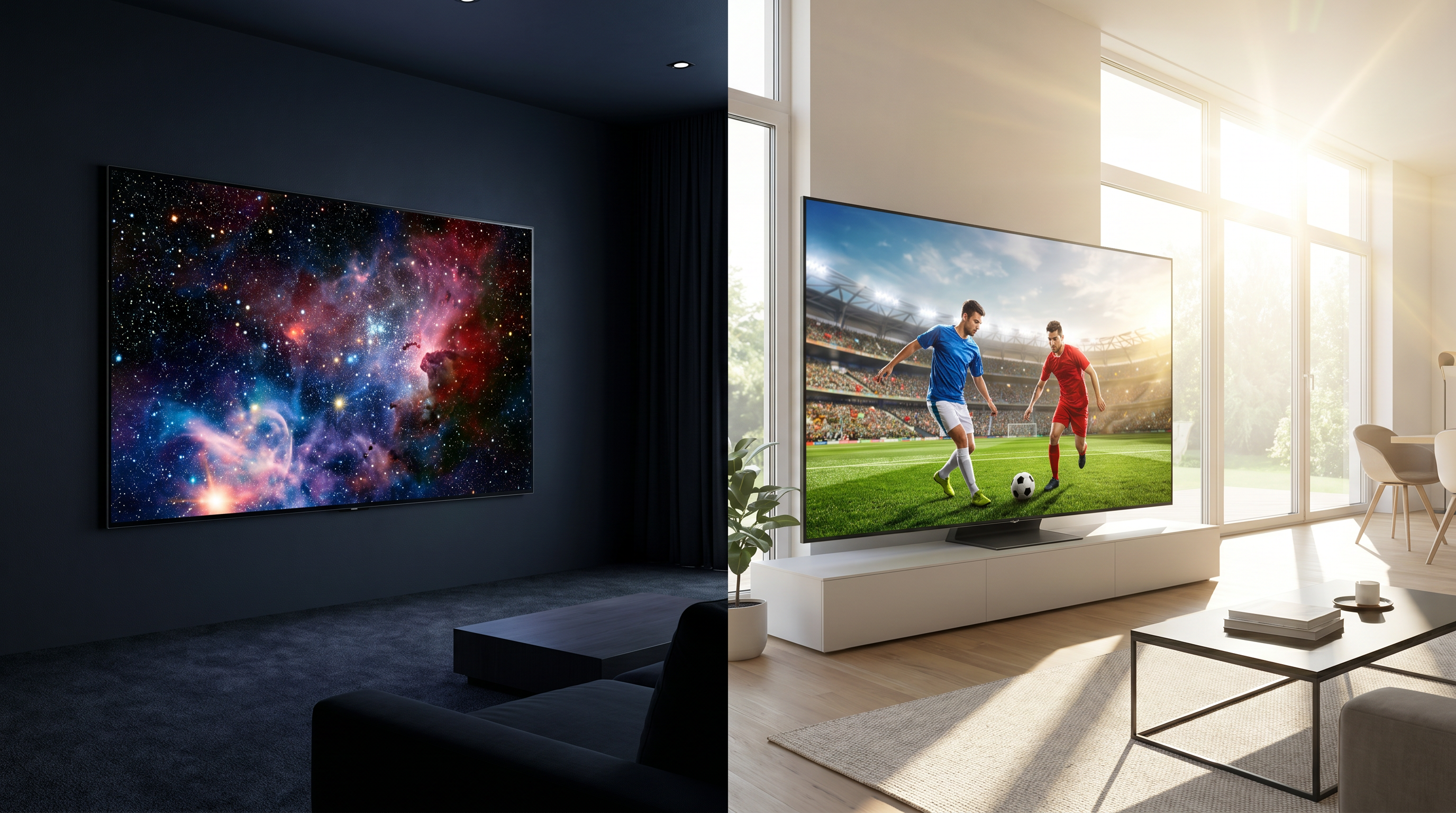
The argument for OLED centers on absolute precision and cinematic depth. Because each pixel can turn off completely, OLED TVs deliver perfect, infinite black levels. When a bright star is displayed against a dark night sky, the pixel illuminating the star is blindingly bright, while the pixel immediately next to it is pitch black. This micro-contrast creates a three-dimensional pop that backlit TVs fundamentally cannot replicate.[2][5]
The argument against OLED focuses on its brightness limitations and long-term durability. To prevent the organic compounds from overheating and degrading, OLED TVs employ an Automatic Brightness Limiter (ABL). While an OLED can make a small highlight incredibly bright, if the entire screen fills with white—like a hockey rink or a snow-covered landscape—the TV will aggressively dim the image. Additionally, prolonged exposure to static elements like news tickers or gaming HUDs still carries a slight risk of permanent image retention, known as burn-in.[4][5]

The evidence in 2026 shows OLED aggressively closing its brightness gap. New "Tandem OLED" architectures, like those found in the LG G5, stack multiple organic light-emitting layers to dramatically increase output. Alongside QD-OLED models from Samsung and Sony, these flagship panels are now hitting peak highlight brightness between 2,000 and 2,800 nits. However, their full-screen sustained brightness still lags behind LCD competitors, making them less punchy in sun-drenched rooms.[1][5]
Conversely, the argument for Mini-LED is built on brute-force illumination and bulletproof durability. Mini-LED TVs are essentially light cannons, capable of sustaining massive full-screen brightness without any ABL dimming. They are completely immune to burn-in, meaning users can leave them on sports channels or use them as massive PC monitors for 12 hours a day without anxiety.[3][4]
The argument against Mini-LED focuses on blooming and viewing angles. Because Mini-LED relies on a backlight shining through an LCD layer, it cannot control light at the individual pixel level. When a bright object moves across a dark background, the dimming zones behind it must light up, often creating a faint halo or "bloom" around the object. Furthermore, the picture quality on many Mini-LED panels degrades slightly when viewed from an off-center angle.[4][5]
The argument against Mini-LED focuses on blooming and viewing angles.
The evidence from 2026 testing reveals that Mini-LED is largely overcoming its historical weaknesses. Flagship models like the Hisense U8QG and Sony Bravia 9 now feature thousands of independent dimming zones, minimizing blooming to near-imperceptible levels in all but the most challenging dark scenes. These panels are routinely pushing past 3,000 nits of peak brightness, delivering an HDR punch that physically dazzles the viewer.[1][3]

A major 2026 wildcard is the introduction of RGB Mini-LED technology. Traditional Mini-LEDs use white backlights pushed through color filters, but new models from brands like Hisense and Samsung use pure red, green, and blue LEDs. This breakthrough allows Mini-LED TVs to produce significantly more accurate, lifelike colors, directly challenging OLED's historical dominance in color volume and saturation.[2][6]
When it comes to gaming, both technologies are highly capable, but they cater to different needs. Both OLED and Mini-LED models in 2026 routinely offer four HDMI 2.1 ports, Variable Refresh Rate (VRR), and support for 144Hz to 240Hz refresh rates. OLED holds the edge for competitive gamers due to its near-instantaneous pixel response time, which eliminates motion blur. Mini-LED, however, is the safer bet for gamers who play the same HUD-heavy title for hundreds of hours, thanks to its burn-in immunity.[1][4]
Size and value scaling present another massive divergence. While OLED manufacturing becomes exponentially more expensive at larger sizes—with 97-inch models costing upwards of $25,000—Mini-LED has democratized the ultra-large screen. Consumers can now purchase high-quality 100-inch Mini-LED TVs for under $3,000, making it the undisputed champion for buyers looking to build a massive home theater on a realistic budget.[3]

Ultimately, OLED fits well when the viewing environment can be controlled. If the TV sits in a dedicated media room, a basement, or a living room with blackout curtains, OLED remains the king. It is the definitive choice for cinephiles watching 4K Blu-rays, viewers who prioritize absolute picture precision, and gamers who want the cleanest motion clarity in dark-room settings.[2][5]
OLED does not fit when the TV is placed in a bright, sunlit room with lots of windows. It is also the wrong choice for households that leave the TV running in the background on news networks all day, or for users who plan to connect a PC and display static desktop windows for hours on end.[4][5]
Mini-LED fits well when the TV is the centerpiece of a bright, open-concept living room. It is the superior choice for daytime sports viewing, where sustained full-screen brightness is required to make the field pop against ambient glare. It is also the best option for buyers who want the largest possible screen size without spending the price of a new car.[3][4]
Mini-LED does not fit when the viewer is a purist highly sensitive to blooming in dark sci-fi or horror movies. It may also disappoint buyers who have wide, wrap-around seating arrangements, as the contrast and color accuracy of the LCD panel will shift for viewers sitting far off to the side.[4][5]
How we got here
2013
LG introduces the first mass-market OLED TVs, establishing a new standard for black levels.
2019
Mini-LED technology enters the consumer market, offering a brighter alternative to OLED.
2022
QD-OLED panels debut, combining quantum dots with OLED for improved color volume.
2025
First RGB Mini-LED TVs are announced, replacing white backlights with pure colored LEDs.
2026
Tandem OLED and RGB Mini-LED models hit the mainstream, blurring the performance lines between the two technologies.
Viewpoints in depth
Home Cinema Purists
Advocates for OLED's pixel-level precision and infinite contrast.
For dedicated movie watchers, the conversation begins and ends with OLED. This camp argues that no amount of Mini-LED dimming zones can replicate the micro-contrast of a self-emissive display. When watching a starfield or a moody thriller, OLED's ability to place a blindingly bright pixel directly next to a completely black one creates a three-dimensional depth that LCDs still struggle to match. They view blooming—even minor halos—as a dealbreaker for cinematic immersion.
Bright-Room Viewers & Sports Fans
Champions of Mini-LED's sustained brightness and glare resistance.
This perspective prioritizes real-world living conditions over dark-room perfection. In a sun-drenched living room, OLED's perfect blacks are often washed out by ambient light and reflections. Mini-LED advocates point out that sustained full-screen brightness is essential for daytime sports, where a bright green soccer pitch needs to pop without the TV's Automatic Brightness Limiter (ABL) dimming the image. They also value the zero burn-in risk for static scoreboards and news tickers.
Productivity & PC Gamers
Users who demand high refresh rates, text clarity, and burn-in immunity.
For those using their displays as massive PC monitors or for HUD-heavy gaming, the priorities shift. This camp leans heavily toward Mini-LED due to the absolute zero risk of burn-in from static taskbars and minimaps. Furthermore, they note that Mini-LED panels often handle sub-pixel text rendering better than some QD-OLED layouts, reducing the color fringing around documents and spreadsheets.
What we don't know
- How the long-term lifespan of the new Tandem OLED stacked layers will compare to traditional single-layer OLEDs under heavy daily use.
- Whether RGB Mini-LED manufacturing costs will drop enough to replace standard white Mini-LEDs in budget-tier models.
- If upcoming micro-LED technology will eventually scale down in price enough to render both OLED and Mini-LED obsolete for everyday consumers.
Key terms
- OLED (Organic Light-Emitting Diode)
- A display technology where each individual pixel generates its own light and can turn off completely for perfect blacks.
- Mini-LED
- An LCD technology that uses thousands of tiny LEDs behind the screen to create highly precise, ultra-bright dimming zones.
- Blooming
- A visual artifact where light bleeds from a bright object into the surrounding dark areas of the screen, common on backlit TVs.
- ABL (Automatic Brightness Limiter)
- A safety feature in OLED TVs that dims the entire screen during bright scenes to prevent overheating and burn-in.
- Tandem OLED
- A newer OLED architecture that stacks multiple light-emitting layers to achieve higher brightness and longer panel life.
- Nits
- A unit of measurement for screen brightness; higher numbers mean a brighter display.
Frequently asked
Will an OLED TV get burn-in?
While modern OLEDs have built-in mitigations like pixel shifting, permanent burn-in is still a slight risk if you watch content with static elements (like news tickers or game HUDs) for many hours every day.
Is Mini-LED the same as Micro-LED?
No. Mini-LED is an advanced backlight for traditional LCD TVs. Micro-LED is a completely different, ultra-expensive technology where microscopic LEDs act as individual pixels, similar to OLED.
Which TV is better for a bright living room?
Mini-LED is generally better for bright rooms because it can sustain much higher full-screen brightness to cut through glare, whereas OLEDs will dim to protect the panel.
Do I need a 144Hz TV for gaming?
Only if you are a PC gamer with a high-end graphics card. Current generation consoles like the PS5 and Xbox Series X max out at 120Hz.
Sources
Source coverage
6 outlets
3 viewpoints surfaced






[1]Data Wire SolutionsHome Cinema Purists
Best TVs for 2026: 10 OLED and Mini-LED Picks by Room, Brightness, and Install Reality
Read on Data Wire Solutions →[2]What Hi-Fi?Home Cinema Purists
Best TVs 2026: our top OLED and Mini LED picks
Read on What Hi-Fi? →[3]TechRadarBright-Room Viewers & Sports Fans
Why I recommend mini-LED over OLED for big-screen sports
Read on TechRadar →[4]EcoPicksGoProductivity & PC Gamers
LG G5 OLED vs LG QNED9M Mini LED Comparison (2026 Buyer's Guide)
Read on EcoPicksGo →[5]KTC PlayProductivity & PC Gamers
Tandem OLED vs. Mini-LED: Choosing the Best HDR Panel in 2026
Read on KTC Play →[6]NextGen PickBright-Room Viewers & Sports Fans
Top 3 Mini LED TVs of 2026: Brighter, Sharper, and Shockingly Close to OLED
Read on NextGen Pick →
More in shopping
See all 48 stories →Nursery Tech
Smart Bassinets vs. Traditional Sleepers: The Complete Trade-Off Analysis
8 sources
Kitchen Upgrades
Induction vs. Gas Cooktops: The 2026 Trade-Off Analysis
8 sources
Camera Tech
How AI Autofocus and Global Shutters Are Revolutionizing Cameras in 2026
8 sources
Wearable Tech
Smart Ring vs. Smartwatch: Which Wearable Wins the 2026 Health Tracking Debate?
6 sources
Every angle. Every day.
Get shopping stories with full source coverage and perspective breakdowns delivered to your inbox.