
Smart Ring vs. Smartwatch: Which Wearable Wins the 2026 Health Tracking Debate?
As smart rings achieve feature parity with flagship smartwatches, consumers face a choice between passive, screen-free recovery tracking and active, real-time fitness monitoring.
By Factlen Editorial Team
- Passive Optimizers
- Users who prioritize ambient data collection and minimal digital distraction.
- Active Athletes
- Fitness enthusiasts who require live metrics and interactive training tools.
- Hybrid Adopters
- Data-driven users who wear both devices to maximize their respective strengths.
What's not represented
- · Traditional Watch Enthusiasts
- · Medical Professionals
Why this matters
Choosing the right wearable dictates whether you actually build a consistent health-tracking habit. Understanding the trade-offs between comfort, battery life, and real-time data ensures you invest in a device that fits your lifestyle rather than fighting against it.
Key points
- Smart rings excel at passive health monitoring, offering superior comfort for sleep tracking and multi-day battery life.
- Smartwatches dominate active fitness tracking, providing real-time GPS pacing, heart-rate zones, and interactive apps.
- Rings typically weigh under 5 grams and last up to a week, while watches weigh over 30 grams and require daily charging.
- A growing number of users are adopting a hybrid approach, wearing a watch during the day and a ring at night.
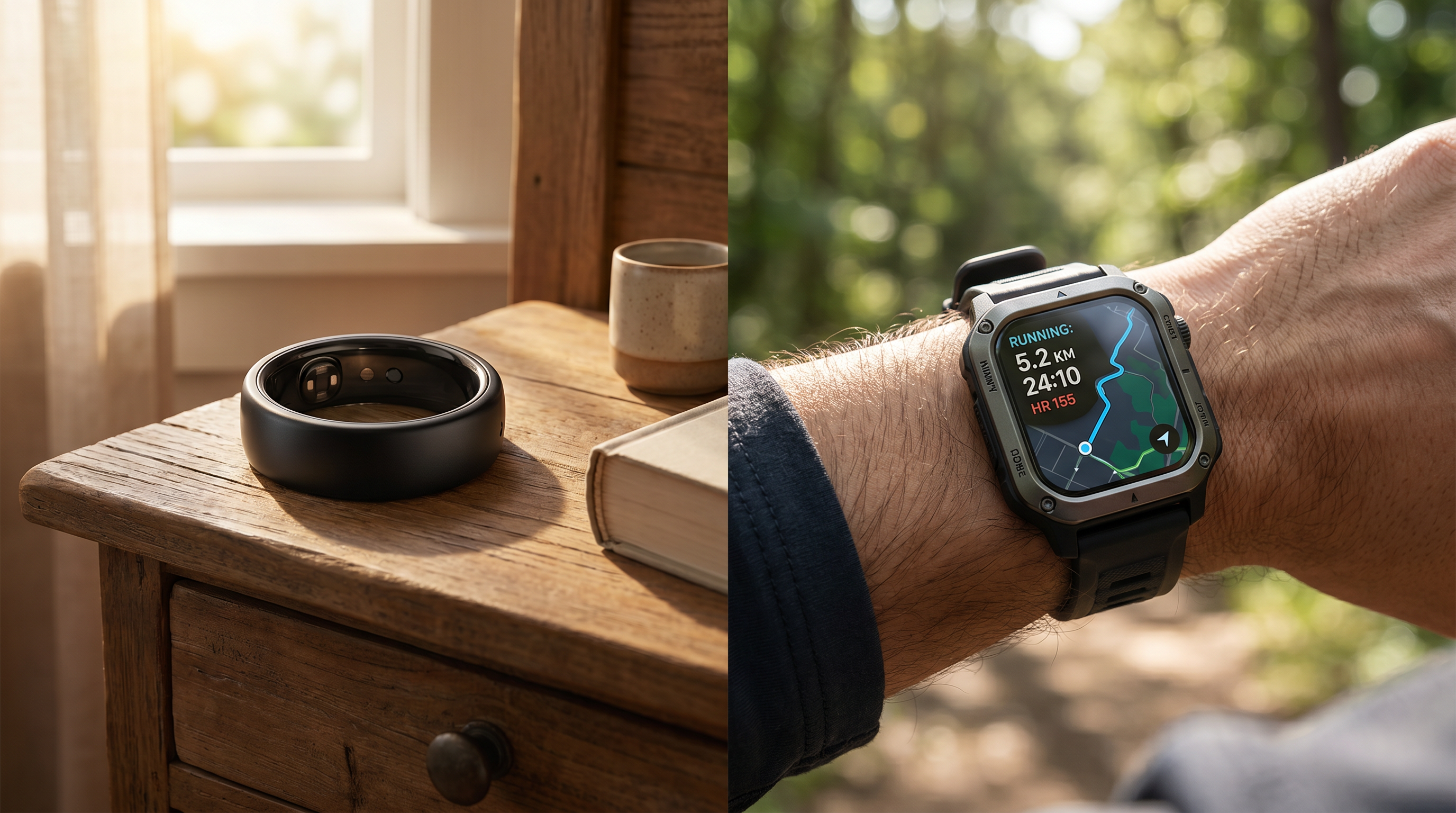
The wearable technology market in 2026 has fractured into two distinct philosophies: the interactive wrist computer and the ambient finger sensor. With major tech companies now offering mature smart rings alongside their flagship smartwatches, consumers are no longer choosing between a capable device and a limited one. Instead, the decision requires a side-by-side trade-off analysis of how each form factor integrates into daily life. Both categories now boast advanced photoplethysmography sensors, temperature tracking, and blood oxygen monitoring, but they deploy these tools with entirely different goals in mind. As the technology has miniaturized, the debate has shifted from which device is more accurate to which device better suits a user's psychological relationship with their personal health data.[5][6]
The fundamental divide between the two devices comes down to active engagement versus passive observation. The smartwatch is designed to command attention, serving as an extension of a smartphone that delivers notifications, real-time workout metrics, and on-demand electrocardiograms. It thrives on interaction, prompting users to stand up, breathe, or check an incoming email. In contrast, the smart ring is built to disappear. It operates quietly in the background, collecting biometric data without ever buzzing with a text message or lighting up in a dark room. This screen-free approach appeals to users who want the benefits of continuous health tracking without the cognitive load of managing yet another digital display on their body.[3][5]
When evaluating the smart ring for 24/7 wearability, the arguments for it heavily favor its physical footprint and absolute minimalism. The evidence is starkly quantified by weight: a modern smart ring typically weighs between 2.3 and 5 grams, while a flagship smartwatch ranges from 30 to over 80 grams depending on the chassis material. The argument against the ring's comfort usually centers on finger swelling during intense exercise or hot weather, which can make a rigid titanium band feel restrictive. However, for the vast majority of users, the sheer lack of mass makes the ring significantly less obtrusive during daily tasks, allowing it to blend seamlessly into a wardrobe like traditional jewelry rather than a piece of consumer electronics.[1][2]

In the arena of sleep tracking, the smart ring holds a distinct advantage in both data continuity and user compliance. The argument for the ring is rooted in sensor placement and nighttime comfort. Evidence from recent validation studies shows that the digital arteries in the finger provide a stronger, more consistent signal for resting heart rate and heart rate variability than the wrist. Furthermore, because fingers move less than wrists during sleep, rings suffer from fewer data gaps caused by positional drift. The argument against the ring for sleep is its inability to wake the user; without a haptic motor, wearers must still rely on an audible phone alarm, whereas a smartwatch can silently tap the wrist to wake them without disturbing a partner.[4][6]
Conversely, when analyzing active fitness tracking, the smartwatch dominates the trade-off analysis. The arguments for the watch include real-time pacing, built-in GPS for outdoor routing, and visible heart-rate zones during high-intensity interval training. The evidence is clear: a runner cannot check their mile split or adjust their effort on a screenless ring. The arguments against the smartwatch in the gym primarily involve its bulk, which can interfere with wrist mobility during weightlifting, yoga, or kettlebell swings. While a ring stays out of the way during these specific movements, it simply cannot provide the live, actionable feedback that serious athletes rely on to modulate their effort and track their progression mid-workout.[4][5]
Conversely, when analyzing active fitness tracking, the smartwatch dominates the trade-off analysis.
Battery life presents another stark contrast in the daily user experience, heavily influencing how consistently data is collected. The argument for the smart ring is its multi-day endurance, with most models delivering four to eight days of continuous monitoring on a single charge. The evidence shows that this longevity prevents gaps in longitudinal health data, as users are not forced to remove the device daily. The argument against the smartwatch is its power-hungry display and processor, which typically limit battery life to 18 to 36 hours for standard models. This forces users to find a dedicated charging window—often sacrificing either crucial overnight sleep data or daytime activity tracking while the watch sits tethered to a desk charger.[1][2]

The financial trade-offs extend beyond the initial retail price, which generally hovers between $250 and $400 for both premium rings and standard smartwatches. The argument for the smartwatch is that its upfront cost usually covers the entire software ecosystem, including all future health updates and algorithmic improvements. The argument against certain smart rings is the hidden cost of subscription models. Evidence from the current market shows that while some rings offer subscription-free platforms, others lock detailed sleep staging and recovery insights behind a $10 to $20 monthly fee. Over a three-year lifespan, this recurring charge can add hundreds of dollars to the total cost of ownership, making a seemingly cheaper ring significantly more expensive than a premium watch.[5][6]
To bypass these trade-offs entirely, a growing segment of quantified-self enthusiasts has adopted a hybrid approach to wearable technology. By wearing a smartwatch during the day for notifications, GPS routing, and active workout tracking, and then switching to a smart ring at night for frictionless sleep monitoring, users can aggregate the best data from both form factors. While this strategy requires a higher financial investment and the mental overhead of managing two separate charging schedules, it effectively eliminates the compromises inherent in choosing just one device. Health platforms like Apple Health and Google Health Connect now seamlessly merge data from multiple sources, making this dual-wielding setup increasingly viable for those who demand uncompromising accuracy around the clock.[4][5]

Ultimately, the decision between these two form factors requires honest reflection on personal habits, as there is no single winner without conditions. The smart ring fits well when a user prioritizes passive recovery tracking, values multi-day battery life, and wants to minimize screen-based distractions. It is the ideal choice for individuals whose primary goal is optimizing sleep architecture, monitoring long-term stress trends, and gathering continuous biometric data without feeling tethered to another digital display. For those who find traditional watches uncomfortable or simply prefer the aesthetics of a mechanical timepiece, the ring offers a stealthy alternative for health monitoring.[3][6]
On the other hand, the smart ring does not fit well when a user needs real-time pacing data, relies on wrist-based notifications to manage their workday, or frequently trains outdoors without carrying a smartphone. For the active athlete who requires GPS routing, live heart-rate zones, and the ability to control audio playback mid-run, the smartwatch remains the undisputed and necessary tool. It is the superior choice for anyone who views their wearable not just as a passive health monitor, but as an interactive digital assistant that actively guides their fitness journey and keeps them connected on the go.[2][4]
How we got here
2015
Apple Watch launches, establishing the wrist as the primary location for consumer health tracking and notifications.
2021
Oura Ring Gen 3 introduces continuous heart rate and temperature tracking, proving the viability of finger-based sensors.
2024
Samsung launches the Galaxy Ring, bringing smart rings into the mainstream consumer electronics ecosystem.
2026
Smart rings achieve near feature parity with watches for passive tracking, sparking widespread debate over the optimal wearable form factor.
Viewpoints in depth
The Passive Optimizers
Users who prioritize ambient data collection and minimal digital distraction.
This camp argues that the best wearable is one you forget you are wearing. They value the smart ring's ability to track heart rate variability and sleep stages without introducing another glowing screen into their lives. For these users, the lack of notifications is a feature, not a bug, allowing them to focus on long-term recovery trends rather than real-time alerts.
The Active Athletes
Fitness enthusiasts who require live metrics and interactive training tools.
This perspective maintains that health tracking is only useful if it can be acted upon in the moment. They rely on smartwatches to deliver GPS pacing, live heart-rate zones, and interval timers during workouts. To this group, a device that only reports data after the fact is insufficient for pushing athletic performance, making the smartwatch's display an absolute necessity.
The Hybrid Adopters
Data-driven users who wear both devices to maximize their respective strengths.
Unwilling to compromise, this camp utilizes a smartwatch during the day for connectivity and active fitness tracking, then switches to a smart ring at night for superior sleep monitoring. They argue that until a single device can offer the battery life and comfort of a ring alongside the real-time utility of a watch, dual-wielding is the only way to achieve a complete, uninterrupted picture of human health.
What we don't know
- Whether future smart rings will successfully integrate haptic feedback motors for silent alarms without sacrificing their ultra-lightweight design.
- How long-term subscription fatigue will impact the market share of premium smart rings compared to subscription-free smartwatches.
Key terms
- Photoplethysmography (PPG)
- An optical sensor technology that uses light to measure changes in blood volume, commonly used in wearables to track heart rate.
- Heart Rate Variability (HRV)
- The variation in time between consecutive heartbeats, used as a key indicator of physical recovery and stress levels.
- Sleep Staging
- The process of categorizing sleep into distinct phases, such as light, deep, and REM sleep, to evaluate overall rest quality.
- SpO2
- A measurement of the oxygen saturation level in the blood, which can help detect breathing disturbances during sleep.
Frequently asked
Can a smart ring track my outdoor runs?
Most smart rings lack built-in GPS and a display, meaning they cannot provide real-time pacing or route tracking without being tethered to a smartphone.
Do all smart rings require a monthly subscription?
No. While some popular models charge a monthly fee for full data access, several newer rings in 2026 offer comprehensive health insights with no ongoing subscription costs.
Which device is more accurate for sleep tracking?
Smart rings are generally considered more accurate for sleep tracking because they fit snugly on the finger, reducing data gaps caused by the device shifting during the night.
Can I wear a smart ring while lifting weights?
Yes, but a rigid metal ring can feel uncomfortable or scratch against knurled barbells. Some users prefer silicone covers or switch to a smartwatch for heavy lifting sessions.
Sources
Source coverage
6 outlets
3 viewpoints surfaced






[1]CNETPassive Optimizers
What I Learned After Swapping My Apple Watch for Samsung's Galaxy Ring
Read on CNET →[2]ZDNETActive Athletes
I put the Galaxy Ring to the test - and it's better than my Apple Watch in one critical area
Read on ZDNET →[3]InversePassive Optimizers
Samsung's Galaxy Ring Is the Apple Watch Replacement I Didn't Know I Needed
Read on Inverse →[4]KnowWave JournalHybrid Adopters
Smartwatch Vs Ring Health Tracking-what Wins In 2026?
Read on KnowWave Journal →[5]Vora BlogHybrid Adopters
Smart Ring or Smartwatch? How to Choose the Right Wearable in 2026
Read on Vora Blog →[6]J-StyleActive Athletes
Smart Ring vs Fitness Tracker vs Smartwatch: Ultimate Comparison 2026
Read on J-Style →

More in shopping
See all 50 stories →E-Bike Tech
The 2026 E-Bike Buying Guide: Motors, Batteries, and the New Safety Rules
8 sources

Audio Tech
Solid-State MEMS Speakers Are Replacing Traditional Headphone Drivers
7 sources
Nursery Tech
Smart Bassinets vs. Traditional Sleepers: The Complete Trade-Off Analysis
8 sources

Kitchen Upgrades
Induction vs. Gas Cooktops: The 2026 Trade-Off Analysis
8 sources

Every angle. Every day.
Get shopping stories with full source coverage and perspective breakdowns delivered to your inbox.