
Induction vs. Gas Cooktops: The 2026 Trade-Off Analysis
As kitchen technology evolves, the choice between induction and gas cooktops comes down to a strict trade-off between energy efficiency, boiling speed, and traditional flame control.
By Factlen Editorial Team
- Electrification Advocates
- Focus on indoor air quality, climate impact, and maximum energy efficiency.
- Pragmatic Consumers
- Weigh upfront costs, local utility rates, and cleaning convenience above ideology.
- Traditional Culinary Enthusiasts
- Value tactile flame control, versatile cookware compatibility, and proven techniques.
What's not represented
- · Landlords and Property Developers
- · Off-Grid Homeowners
Why this matters
Upgrading a kitchen appliance is a decade-long commitment that directly impacts your household's daily energy bills, indoor air quality, and cooking experience. Understanding the precise conditions where each technology excels ensures you don't waste money on a system that doesn't fit your lifestyle.
Key points
- Induction cooktops transfer 85 to 90 percent of their energy directly to the pan, making them significantly more efficient than gas.
- Gas stoves offer intuitive visual feedback and tactile control, which remains preferred by many traditional chefs.
- Burning natural gas indoors releases nitrogen dioxide, prompting health advocates to recommend induction for better air quality.
- The true cost-effectiveness of either option depends heavily on local electricity and natural gas utility rates.
In 2026, the kitchen appliance market is undergoing a generational shift, forcing homeowners to weigh the traditional reliability of gas against the high-tech precision of induction. As local municipalities update building codes and consumers become more conscious of indoor air quality, the debate between these two cooking methods has moved from niche culinary circles to mainstream home improvement. This is no longer just a question of aesthetics; it is a fundamental choice about energy efficiency, household health, and daily convenience.[1][8]
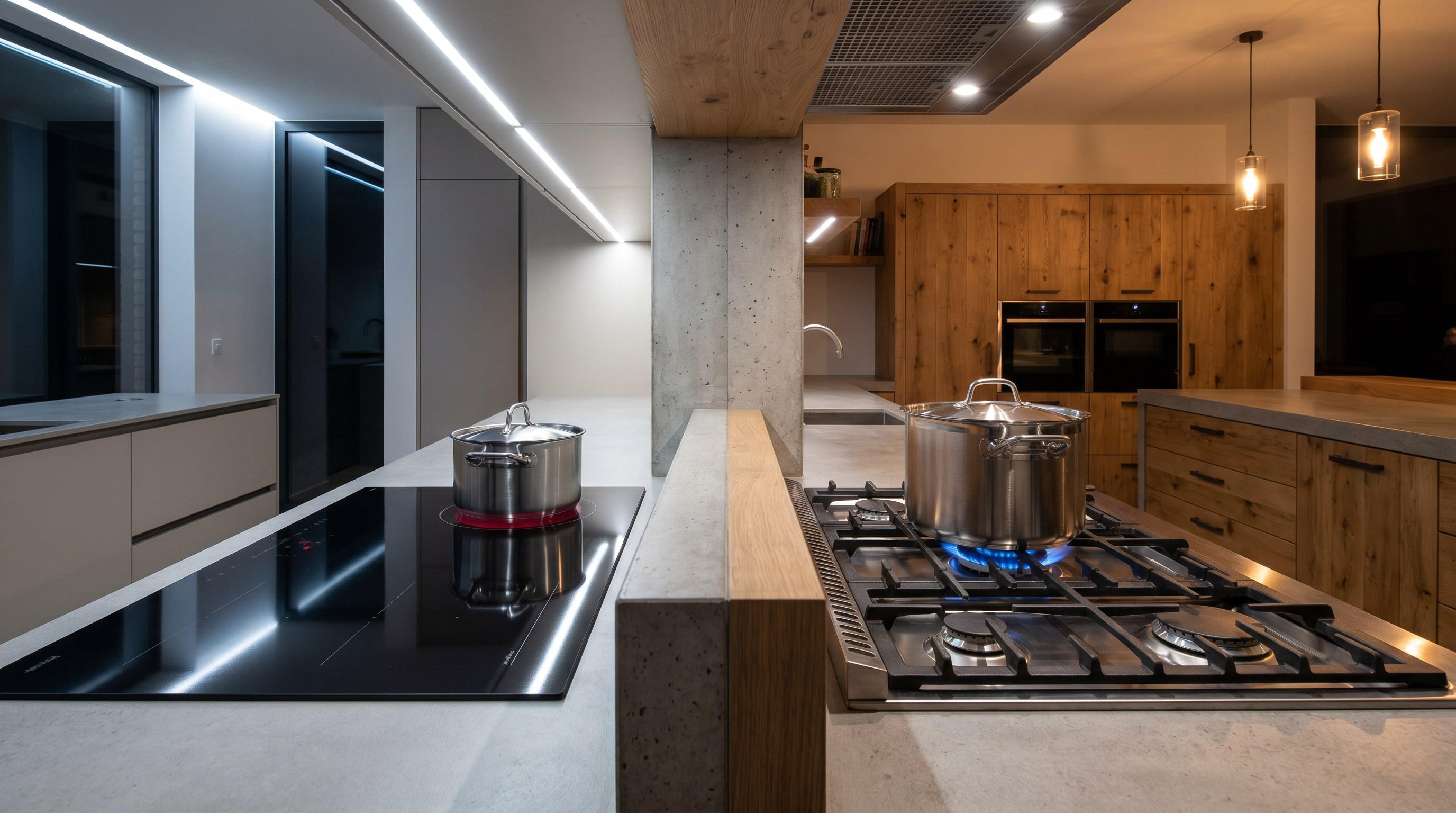
To understand the trade-offs, one must look at the underlying mechanics. Gas cooktops rely on combustion, igniting natural gas or propane to create an open flame that heats the bottom of a pan. Induction, conversely, uses copper coils beneath a glass surface to generate an alternating magnetic field. This field induces an electrical current directly inside the cookware, turning the pot itself into the heat source. This fundamental difference in heat generation dictates every advantage and drawback of the two systems.[1][6]
The most quantifiable metric in this comparison is thermal efficiency, and the evidence heavily favors induction. According to 2026 appliance benchmarks and the U.S. Department of Energy, induction cooktops transfer between 85 and 90 percent of their energy directly into the cookware. Gas stoves, by contrast, operate at a mere 32 to 40 percent efficiency. The majority of the heat generated by a gas flame escapes around the sides of the pan, warming the ambient air in the kitchen rather than the food.[2][4][7]

However, the argument for energy efficiency does not automatically translate to lower monthly bills. The running cost of each cooktop is entirely dependent on local utility rates. In regions where electricity is expensive and natural gas is heavily subsidized, a gas stove may still cost less to operate annually despite its massive heat waste. Conversely, in areas with affordable, renewable-heavy electrical grids, induction provides clear, compounding financial savings over the appliance's typical 10-to-15-year lifespan.[1][6]
When evaluating raw speed, the evidence again points to induction. Independent lab data from 2026 shows that an induction cooktop can bring one liter of water to a rolling boil in approximately two to three minutes. A standard gas burner requires four to six minutes to achieve the same result under identical conditions. Because the electromagnetic energy transfers instantly and directly into the metal, induction eliminates the waiting period required for a heavy iron grate and a pan to absorb ambient heat.[2][3]

The case for gas, however, is built on tactile control and visual feedback. For decades, professional and home chefs have relied on the immediate visual cue of a bright blue flame to gauge heat levels. Turning a dial and watching the fire shrink provides an intuitive, analog connection to the cooking process that tapping a digital glass interface simply cannot replicate. Furthermore, gas allows for aggressive, dynamic techniques like charring bell peppers directly on the cast-iron grate or tossing fried rice in a round-bottom wok, which requires lifting the pan away from the heat source without losing temperature.[1][8]
The case for gas, however, is built on tactile control and visual feedback.
A significant argument against gas cooktops centers on indoor air quality and household health. Recent data from the Environmental Protection Agency and international health bodies confirm that burning natural gas indoors releases nitrogen dioxide (NO2) and particulate matter. In homes with poor ventilation, these emissions can spike to levels that exceed outdoor air quality standards, increasing the risk of respiratory issues like asthma by up to 40 percent. Induction cooktops produce zero point-source emissions, making them the definitive choice for maintaining pristine air quality.[2][5][6]
Safety and maintenance also present a stark contrast between the two technologies. The case for induction highlights its cool-to-the-touch surface; because the cooktop itself does not generate heat, the risk of severe burns or accidental fires is drastically reduced. Additionally, the flat, continuous glass surface can be wiped clean with a damp cloth immediately after cooking. Gas stoves require disassembling heavy cast-iron grates and scrubbing burner caps to remove baked-on grease and stubborn food debris.[1][5]

The primary evidence against induction lies in its strict cookware requirements and absolute grid dependency. Induction technology only functions with ferrous metals—meaning cast iron, enameled iron, and magnetic stainless steel. Consumers transitioning to an induction range often face the frustrating, hidden cost of replacing expensive copper, aluminum, or ceramic cookware that simply will not heat up on the new surface. Furthermore, an induction stove is entirely useless during a power outage, whereas a traditional gas burner can typically be ignited with a match to provide a reliable, off-grid cooking source during winter storms or rolling blackouts.[1][5][8]
Ultimately, choosing between the two requires matching the technology to the household's specific conditions. Induction fits well when a homeowner prioritizes boiling speed, effortless cleanup, and pristine indoor air quality. It is the optimal choice for households with young children where safety is paramount, or for homes equipped with solar panels that can offset the electrical load. It is also the logical upgrade for anyone looking to future-proof their kitchen against shifting municipal energy codes.[1][5]
Conversely, induction does not fit well when a home experiences frequent power grid failures, or when a cook relies heavily on a curated collection of non-magnetic specialty pans. It may also be cost-prohibitive if installing the cooktop requires a multi-thousand-dollar electrical panel upgrade to support the necessary 240-volt circuit.[6][8]

Gas fits well when a cook demands the intuitive, visual feedback of an open flame and frequently employs techniques that require lifting and tilting the pan. It remains the most practical choice for homes situated in regions with highly reliable, cheap natural gas and expensive electricity. For those who value off-grid resilience and the ability to cook during winter storms, gas provides unmatched peace of mind.[1][8]
However, gas does not fit well when a kitchen lacks a high-powered, externally vented exhaust hood to mitigate the respiratory risks of NO2 emissions. It is also a poor fit for homeowners who despise the tedious chore of scrubbing grates, or those looking to maximize the energy efficiency of their household footprint in an increasingly electrified world.[2][6]
How we got here
1920s-1950s
Gas stoves become the dominant cooking technology in American and European households.
1970s
The first induction cooktops are introduced by Westinghouse, though high costs prevent widespread adoption.
2022-2024
Several municipalities introduce bans on new gas hookups, accelerating consumer interest in induction.
2025-2026
Induction technology reaches price parity with high-end gas ranges, capturing a record share of the kitchen remodel market.
Viewpoints in depth
Electrification Advocates
Focus on indoor air quality, climate impact, and maximum energy efficiency.
This camp, heavily represented by environmental agencies and health organizations, views the transition away from gas as a public health imperative. They point to the elimination of point-source nitrogen dioxide emissions and the 85-to-90 percent thermal efficiency of induction as undeniable proof of its superiority. For these advocates, the upfront cost of induction is a necessary investment in both household respiratory health and broader climate goals, especially as electrical grids become greener.
Traditional Culinary Enthusiasts
Value tactile flame control, versatile cookware compatibility, and proven techniques.
Chefs and traditional home cooks often defend gas for its analog reliability and sensory feedback. This perspective emphasizes that cooking is a tactile art; the ability to visually gauge a flame, char ingredients directly on the grate, and use specialty cookware like round-bottom woks or heirloom copper pans cannot be replicated by a flat glass surface. They argue that while induction is fast, it lacks the intuitive, dynamic control that seasoned cooks rely on.
Pragmatic Consumers
Weigh upfront costs, local utility rates, and cleaning convenience above ideology.
The pragmatic viewpoint strips away both the environmental and culinary romance, focusing strictly on daily utility and household economics. This camp acknowledges induction's superior boiling speed and effortless cleanup but remains highly sensitive to the initial price tag and the potential need for expensive electrical panel upgrades. For these consumers, the 'best' choice is entirely conditional on local electricity versus natural gas rates, and whether they already own a compatible set of magnetic cookware.
What we don't know
- How quickly the prices of entry-level induction ranges will drop to match the cheapest budget gas models.
- Whether future municipal building codes will retroactively require homeowners to cap existing gas lines during major renovations.
Key terms
- Electromagnetic Induction
- The process of using a magnetic field to generate heat directly inside a ferrous cooking vessel.
- Thermal Efficiency
- The percentage of energy consumed by the appliance that actually transfers into the food being cooked.
- Nitrogen Dioxide (NO2)
- A gaseous air pollutant produced by burning fossil fuels, linked to respiratory irritation.
- Ferrous Cookware
- Pots and pans containing enough iron to be magnetic, a strict requirement for induction cooking.
Frequently asked
Do I need to replace all my pots and pans for induction?
Only if they are not magnetic. Cast iron, enameled iron, and magnetic stainless steel work perfectly, while copper, aluminum, and ceramic will not.
Is an induction stove the same as an electric glass-top stove?
No. Traditional electric stoves use glowing radiant coils under the glass to generate heat, whereas induction uses electromagnetic fields to heat the pan directly.
Can I use a gas stove during a power outage?
Yes, most traditional gas burners can be manually ignited with a match during a blackout, providing a reliable off-grid cooking source.
Does induction cooking emit harmful radiation?
No. Induction cooktops use low-frequency electromagnetic fields that are tightly concentrated just above the glass surface and are entirely safe for everyday use.
Sources
Source coverage
8 outlets
3 viewpoints surfaced








[1]Stahl KitchensTraditional Culinary Enthusiasts
Induction vs Gas Cooktops: Which One Is the Better Choice in 2026?
Read on Stahl Kitchens →[2]KnowWave JournalElectrification Advocates
Induction Vs Gas: Which Stove Saves More Energy In Real Life?
Read on KnowWave Journal →[3]InsightBlendPragmatic Consumers
Induction Vs Gas Cooktop Speed Comparison Gets Surprising
Read on InsightBlend →[4]FOTILEPragmatic Consumers
Induction vs Gas vs Electric Ranges: 2025 Stats Guide
Read on FOTILE →[5]CHOICEElectrification Advocates
Switching from gas to induction: What you need to know
Read on CHOICE →[6]CNETPragmatic Consumers
The Real Difference Between Gas, Electric and Induction Stoves — and Why It Matters
Read on CNET →[7]U.S. Department of EnergyElectrification Advocates
Energy Efficiency of Induction Cooktops
Read on U.S. Department of Energy →[8]Alabama ApplianceTraditional Culinary Enthusiasts
Induction vs. Gas Cooktops: Which One Should You Choose?
Read on Alabama Appliance →

More in shopping
See all 52 stories →E-Bike Tech
The 2026 E-Bike Buying Guide: Motors, Batteries, and Finding Your Perfect Ride
8 sources

EV Transition
EV vs. PHEV in 2026: The Complete Cost and Lifestyle Comparison
7 sources
E-Bike Tech
The 2026 E-Bike Buying Guide: Motors, Batteries, and the New Safety Rules
8 sources

Audio Tech
Solid-State MEMS Speakers Are Replacing Traditional Headphone Drivers
7 sources
Every angle. Every day.
Get shopping stories with full source coverage and perspective breakdowns delivered to your inbox.