
SpaceX Prices Historic $75 Billion IPO at $135 Per Share
Elon Musk's aerospace giant has finalized the largest initial public offering in history, raising $75 billion and valuing the company at $1.77 trillion ahead of its Nasdaq debut.
By Factlen Editorial Team
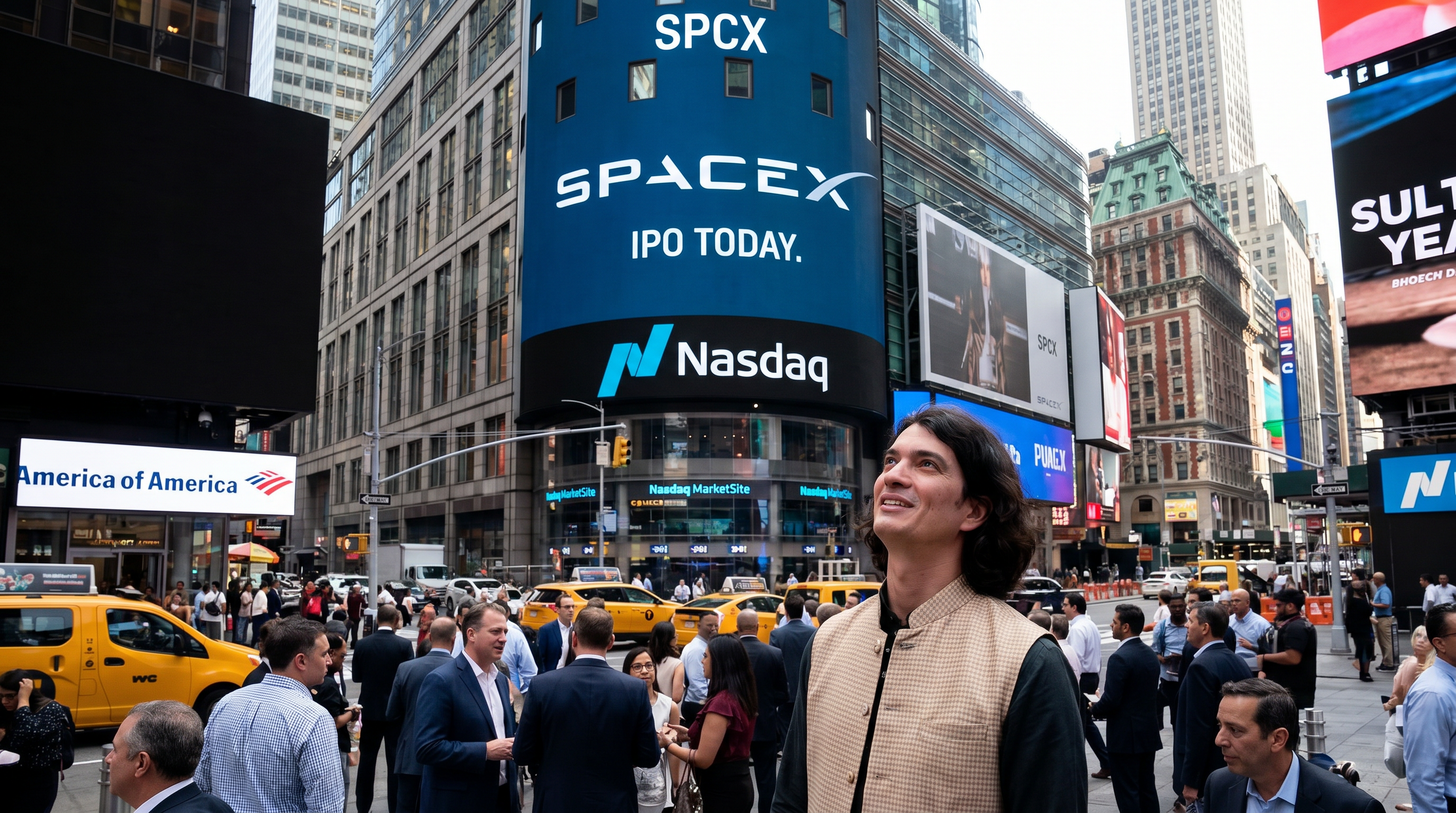
- Retail Investors
- Everyday traders view the IPO as a rare opportunity to buy into a generational tech monopoly.
- Market Optimists
- Wall Street strategists see the mega-IPO as a catalyst that will unfreeze the broader public markets.
- Institutional Skeptics
- Traditional analysts and regulators warn that the valuation is disconnected from the company's financial reality.
What's not represented
- · Space Industry Competitors
- · Index Fund Managers
Why this matters
The sheer scale of the SpaceX IPO is expected to reshape the public equity markets, instantly creating a new mega-cap tech bellwether while testing the limits of retail investor demand and founder-controlled governance.
Key points
- SpaceX has officially priced its initial public offering at a fixed $135 per share, raising a record-breaking $75 billion.
- The offering values the aerospace and satellite company at $1.77 trillion, making it one of the most valuable publicly traded firms in the world.
- Retail investors placed over $100 billion in orders, taking advantage of an unusual structure that reserved up to 30% of shares for everyday traders.
- Despite generating $18.67 billion in revenue in 2025, the company reported a net loss of $4.94 billion, prompting skepticism over its 93x price-to-sales valuation.
- Elon Musk will retain an 82.4% voting majority through a dual-class share structure, a point of contention for regulators and lawmakers.
SpaceX has officially priced its initial public offering at $135 per share, culminating a months-long buildup to the largest public market debut in global financial history. By selling 555.56 million shares, Elon Musk’s aerospace and satellite communications giant raised a staggering $75 billion, effortlessly shattering the previous global record of $29.4 billion set by Saudi Aramco in 2019. The pricing values SpaceX at an implied $1.77 trillion. When shares begin trading on the Nasdaq exchange on Friday morning under the ticker symbol SPCX, the company will immediately rank among the ten most valuable publicly traded firms in the United States. It will leapfrog legacy financial titans like Berkshire Hathaway and JPMorgan Chase, as well as established technology giants like Meta Platforms, instantly reshaping the hierarchy of the American equities market.[1][8]
Demand for the stock has been entirely unprecedented, driven in large part by a highly unusual allocation strategy that specifically targeted everyday traders. SpaceX reportedly reserved up to 30% of its IPO shares for retail investors—a massive departure from traditional public offerings, which typically allocate only 5% to 10% of their shares to non-institutional buyers. That accessibility sparked an immediate frenzy across the retail trading landscape. Individual investors placed orders for more than $100 billion in SpaceX shares ahead of the final pricing, flooding consumer brokerages like Fidelity, Robinhood, Charles Schwab, and SoFi. For many retail participants, the offering represents a rare, ground-floor opportunity to buy into a generational technology monopoly that dominates both the global commercial space launch industry and the rapidly expanding satellite internet sector.[1][2][5]

Institutional demand proved to be equally voracious, with the total order book reportedly oversubscribed by nearly four times, drawing an estimated $250 billion in total demand from banks, hedge funds, and asset managers. Heavyweight financial institutions scrambled to secure their allocations before the window closed. BlackRock alone submitted an order for at least $5 billion in shares, an amount nearly equal to the entire initial public offering of AI chipmaker Cerebras earlier this year. The global appetite for the stock has been so intense that investors in Asia, many of whom were locked out of direct allocations due to regional restrictions or brokerage limitations, have been forced to seek out creative derivative markets and proxy bets just to gain indirect exposure to the $75 billion spectacle.[2][3][4]
Beyond its sheer size, the SpaceX offering has broken with decades of Wall Street tradition in how it was priced and marketed to the public. Under the conventional IPO process, a company announces a preliminary price range before embarking on an investor roadshow, giving underwriters the flexibility to move the final number up or down depending on the appetite they encounter during pitch meetings. Instead, SpaceX declared a fixed $135 price tag weeks in advance and outright refused to budge. The fixed-price strategy was reportedly designed to strip the usual uncertainty and volatility out of the pricing process, making the upcoming investor meetings more straightforward. However, financial analysts note that the move also reflects the immense leverage Musk holds over the market, dictating terms to Wall Street banks rather than the other way around.[1][8]
Beyond its sheer size, the SpaceX offering has broken with decades of Wall Street tradition in how it was priced and marketed to the public.
Despite the overwhelming market euphoria, the underlying financials present a highly complex picture for prospective shareholders trying to justify the $1.77 trillion price tag. According to the company's public S-1 prospectus, SpaceX generated $18.67 billion in revenue in 2025, representing a robust 33% year-over-year increase. However, the company also swung to a massive net loss of $4.94 billion, driven by the extraordinary capital expenditures required to fund its ambitious engineering projects. At its current valuation, the company is trading at roughly 93 times its trailing sales. For context, the average price-to-sales ratio in the tech-heavy Nasdaq-100 index is currently hovering around 6.7. That staggering premium indicates that investors are paying entirely for future potential rather than current profitability, betting that the company's dual growth engines will eventually yield unprecedented margins.[6][8]

That future potential hinges almost entirely on the success of two capital-intensive mega-projects: the Starlink satellite internet constellation and the fully reusable Starship rocket program. Starlink already generates the majority of the company's revenue and is rapidly expanding its subscriber base globally, providing a reliable cash-flow engine that traditional aerospace competitors lack. Meanwhile, Starship represents the company's ultimate gamble. If SpaceX can successfully commercialize the massive, fully reusable launch vehicle, it promises to drastically reduce the cost of transporting cargo and humans into low Earth orbit, effectively monopolizing the space economy for decades to come. Investors are essentially wagering that the short-term billions lost in research and development will translate into an insurmountable technological moat that no government or private competitor can cross.[6][7]
However, the company's corporate governance structure has drawn sharp scrutiny and outright opposition from regulators and lawmakers. Following the IPO, Elon Musk will retain an iron grip on the company's strategic direction, controlling approximately 82.4% of the shareholder voting power through a dual-class share structure. That extreme concentration of power prompted Senator Elizabeth Warren to send a scathing 12-page letter to the Securities and Exchange Commission earlier this week, formally requesting a delay in the IPO. Warren argued that Musk’s "unprecedented level of power" and the company's sky-high valuation warranted a much deeper investigation into whether retail investors and passive index funds were being adequately protected from potential mismanagement or erratic executive behavior.[1][2][8]

Nevertheless, the offering proceeded exactly on schedule, and market analysts now view the successful pricing as a critical bellwether for the broader public equities market. The IPO landscape has been recovering from a prolonged slump, and the ability of the market to absorb a $75 billion offering proves that there is immense sidelined capital eager for high-growth technology narratives. If SpaceX shares perform well in their Friday debut, financial strategists believe it could pave the way for a wave of other highly anticipated mega-cap tech listings later this year, including artificial intelligence leaders like OpenAI and Anthropic. For now, Wall Street is bracing for intense volatility when the opening bell rings, as billions of dollars in unmet retail demand collide with the reality of public market price discovery.[1][6][7]
How we got here
March 2026
SpaceX confidentially files draft registration documents with the Securities and Exchange Commission.
May 20, 2026
The company publicly files its S-1 prospectus, revealing its internal finances and the massive scale of the offering.
June 4, 2026
SpaceX launches its investor roadshow, breaking tradition by declaring a fixed $135 share price in advance.
June 10, 2026
Senator Elizabeth Warren formally requests the SEC delay the IPO over valuation and governance concerns.
June 11, 2026
SpaceX officially prices the IPO at $135 per share, raising a record $75 billion ahead of its Nasdaq debut.
Viewpoints in depth
Retail Investors
Everyday traders view the IPO as a rare opportunity to buy into a generational tech monopoly.
Retail investors have flooded brokerages with over $100 billion in orders, driven by a belief that SpaceX's dominance in satellite internet and space launch makes it a uniquely defensible asset. Many view the $135 entry price as accessible, hoping to replicate the massive early gains seen in other tech giants, and are undeterred by the company's current lack of profitability.
Institutional Skeptics
Traditional analysts and regulators warn that the valuation is disconnected from the company's financial reality.
Skeptics point to the staggering 93x price-to-sales multiple and the $4.94 billion net loss in 2025 as evidence of a massive bubble. Lawmakers like Senator Elizabeth Warren have also raised alarms over the governance structure, arguing that Elon Musk's 82.4% voting control leaves public shareholders with virtually no recourse or oversight over the company's long-term direction.
Market Optimists
Wall Street strategists see the mega-IPO as a catalyst that will unfreeze the broader public markets.
For investment banks and market analysts, SpaceX's successful $75 billion raise proves that there is immense sidelined capital eager for high-growth tech stories. They argue that the sheer scale of the demand will encourage other highly valued private companies, particularly in the artificial intelligence sector, to finally execute their own public offerings and revitalize the equities market.
What we don't know
- How the stock will actually perform when the opening bell rings, given the unprecedented mix of massive retail demand and institutional skepticism.
- Whether the SEC will take any delayed action regarding the governance concerns raised by lawmakers.
- How quickly SpaceX can transition its capital-intensive Starship and Starlink programs into consistent profitability.
Key terms
- Initial Public Offering (IPO)
- The process by which a private company offers shares to the public for the first time, allowing it to raise capital from public investors.
- Price-to-Sales Ratio
- A valuation metric that compares a company's stock price to its revenues, where a higher ratio indicates investors are paying a premium for expected future growth.
- Dual-Class Share Structure
- A corporate structure where different classes of shares have different voting rights, allowing founders to maintain control of a company even after it goes public.
- Order Book
- The electronic list of buy and sell orders for a specific security, used by underwriters to gauge demand and set the final IPO price.
Frequently asked
When does SpaceX stock start trading?
SpaceX shares will begin trading on the Nasdaq exchange on Friday, June 12, 2026, under the ticker symbol SPCX.
Can regular people buy shares at the IPO price?
SpaceX reserved up to 30% of its shares for retail investors through brokerages like Fidelity and Robinhood, though massive demand means many orders may not be fully filled at the $135 price.
Is SpaceX currently a profitable company?
No. While SpaceX generated $18.67 billion in revenue in 2025, it reported a net loss of $4.94 billion due to heavy investments in its Starship and Starlink programs.
How does this compare to previous IPOs?
Raising $75 billion, the SpaceX IPO is the largest in global financial history, more than doubling the $29.4 billion raised by Saudi Aramco in 2019.
Sources
Source coverage
8 outlets
3 viewpoints surfaced








[1]ReutersMarket Optimists
Musk's SpaceX prices record $75 billion IPO at $135 a share
Read on Reuters →[2]ForbesRetail Investors
SpaceX Cements Final IPO Price At $135 As Retail Investor Orders Top $100 Billion
Read on Forbes →[3]BloombergMarket Optimists
Locked Out of IPO, Asia Investors Find New Ways to Bet on SpaceX
Read on Bloomberg →[4]The Wall Street JournalMarket Optimists
BlackRock Submits $5 Billion Order for SpaceX IPO
Read on The Wall Street Journal →[5]The GuardianRetail Investors
SpaceX IPO: how can I buy shares, and what are the risks?
Read on The Guardian →[6]The Motley FoolInstitutional Skeptics
SpaceX Goes Public at $135 a Share. Is It a Buy at That Price?
Read on The Motley Fool →[7]Business InsiderMarket Optimists
SpaceX IPO live updates: Record-setting IPO prices at $135 a share
Read on Business Insider →[8]QuartzInstitutional Skeptics
SpaceX IPO targets $75 billion at $135 per share
Read on Quartz →
More in business
See all 27 stories →Executive Talent
The Rise of the Fractional Executive: How Mid-Sized Companies Are Rethinking the C-Suite in 2026
6 sources

SpaceX IPO
SpaceX Prices Record $75 Billion IPO, Reaching $1.77 Trillion Valuation
10 sources
Space Economy
SpaceX Shatters Records With $75 Billion IPO, Reaching $1.77 Trillion Valuation
8 sources
Space Economy
SpaceX Raises $75 Billion in Largest Initial Public Offering in History
10 sources
Every angle. Every day.
Get business stories with full source coverage and perspective breakdowns delivered to your inbox.