
The Evidence on Office-to-Residential Conversions: What the Data Actually Shows
The national pipeline for converting empty office buildings into apartments has surged to over 90,000 units in 2026, but architectural and financial bottlenecks mean it is a targeted solution rather than a cure-all for the housing crisis.
By Factlen Editorial Team
- Commercial Real Estate Developers
- Focuses on the financial viability of projects, loan maturities, and the necessity of tax incentives to make the math work.
- Urban Planners & Architects
- Focuses on the physical feasibility of conversions, architectural limitations, and the need for neighborhood activation.
- Housing Policy Analysts
- Evaluates conversions based on their ability to deliver meaningful unit volume and affordable housing to cost-burdened renters.
- Climate & Sustainability Advocates
- Views adaptive reuse primarily as a decarbonization strategy to avoid the massive emissions associated with demolition.
What's not represented
- · Existing commercial tenants facing displacement from converting buildings
- · Local small business owners in commercial districts adapting to residential foot traffic
Why this matters
As remote work permanently alters the commercial landscape, adaptive reuse offers a rare opportunity to solve two generational crises at once: revitalizing hollowed-out downtowns and injecting desperately needed housing supply into the market. Understanding the physical and financial limits of this trend dictates whether your city's empty towers become vibrant neighborhoods or stranded assets.
Key points
- The national pipeline for office-to-apartment conversions reached 90,300 units in early 2026, a 28% year-over-year increase.
- Looming commercial loan maturities and sustained 20% office vacancy rates are forcing landlords to repurpose underperforming towers.
- Research indicates only about 11% of downtown office buildings are physically suitable for residential conversion due to floor plate constraints.
- Conversions offer massive environmental benefits, generating a fourfold reduction in carbon emissions compared to demolition and new construction.
- New York City leads the nation with over 16,000 units underway, heavily supported by municipal tax incentives and zoning reforms.
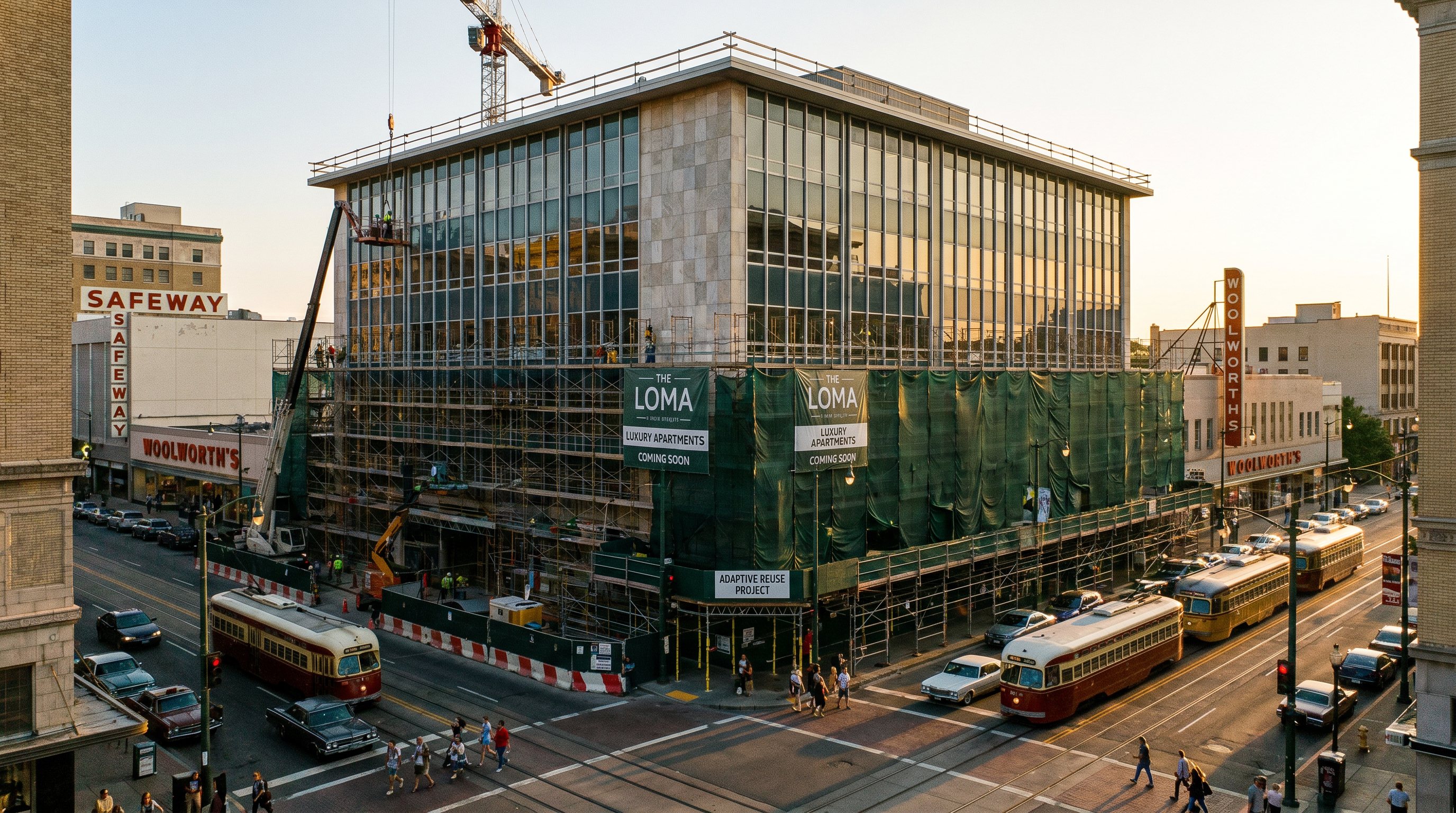
As the dust settles on the post-pandemic shift to hybrid work, American cities are confronting a dual reality: millions of square feet of commercial real estate sit empty, while a severe housing shortage prices residents out of the market. For urban planners and developers, the proposed solution has long been an elegant theory: convert the vacant boardrooms into bedrooms. Yet, for years, the actual volume of adaptive reuse projects remained a trickle, constrained by complex architectural realities and prohibitive financing. Now, the evidence suggests the theoretical is becoming a structural reality. A convergence of maturing commercial loans, plummeting office valuations, and aggressive municipal policy interventions has finally ignited a historic wave of office-to-residential conversions across the country.[1][2]
The scale of the shift is captured in the latest pipeline data. At the start of 2026, there were 90,300 apartment units actively in the process of being converted from office space nationwide. This represents a 28 percent year-over-year increase, and a nearly fourfold explosion compared to the roughly 23,000 units underway in 2022. Office conversions now account for 47 percent of all future adaptive reuse projects in the United States, outpacing hotel and industrial transformations by a wide margin. The momentum is no longer speculative; it is actively reshaping the construction landscape as developers pivot away from a commercial sector that may never fully return to its 2019 occupancy levels.[1][2][3]

The catalyst for this acceleration is largely financial necessity. At the close of 2025, national office vacancy rates hovered near 20 percent, with physical occupancy in many major metros stalling at roughly 55 percent. More critically, approximately $213 billion in commercial office loans are scheduled to mature by the end of 2026. With commercial property values depressed by remote work, many landlords cannot refinance their buildings as traditional offices. Faced with the prospect of defaulting on half-empty towers, owners are increasingly viewing residential conversion not just as an opportunistic real estate play, but as a mandatory lifeline to salvage their underlying asset values.[2][4]
However, the physical evidence reveals a strict bottleneck: not every glass box can become a home. A comprehensive study by the National Bureau of Economic Research (NBER) evaluated the commercial districts of the 105 largest U.S. cities to determine how many buildings were actually viable for residential use. The findings were sobering but precise: only about 11 percent of existing downtown office buildings are physically suitable for conversion. If all of these viable properties were transformed, it would add approximately 400,000 new apartments to the national housing stock. This data underscores that conversions are a targeted surgical tool, rather than a blanket cure for the broader housing deficit.[5]
The primary architectural hurdle lies in the "floor plate"—the total square footage of a single level. Modern office buildings constructed in the 1980s and 1990s were designed with massive, deep floor plates to maximize cubicle density. Because residential building codes require bedrooms to have operable windows and natural light, the deep, dark interior cores of these modern towers are virtually useless for apartments unless developers undertake the exorbitant expense of carving massive light wells down the center of the structure. Consequently, the most successful conversion candidates are older, pre-war buildings from the 1920s and 1930s, which were built in narrower U, C, or L shapes to allow natural light into offices before the advent of modern fluorescent lighting and central air conditioning.[7]

Where the evidence for conversion is overwhelmingly positive is in its environmental impact. The European Commission recently published benchmark data comparing the carbon footprint of adaptive reuse against the traditional cycle of demolition and new construction. The findings show that repurposing an existing office building results in a fourfold reduction in greenhouse gas emissions compared to tearing it down and building a new residential tower. By preserving the "embodied carbon"—the emissions already spent to forge the steel and pour the concrete decades ago—cities can add dense urban housing while aligning with aggressive climate targets. The NBER similarly framed this transition as turning "brown offices into green apartments," noting that retrofitting existing structures is one of the most efficient decarbonization strategies available to the real estate sector.[5][9]
Where the evidence for conversion is overwhelmingly positive is in its environmental impact.
Despite the environmental and social benefits, the financial evidence highlights a persistent "feasibility gap." A joint study by the Brookings Institution, Gensler, and the Department of Housing and Urban Development (HUD) analyzed case studies across six U.S. cities. The research confirmed that converting an office building is rarely cheaper than building from scratch. Stripping a commercial tower to its structural skeleton and replacing centralized HVAC and plumbing with hundreds of individual residential systems requires immense capital. In the current environment of elevated interest rates and high construction costs, the pure market math often fails to pencil out for developers without outside intervention.[6][7]
To bridge this gap, the evidence points to municipal policy as the decisive variable. The Brookings and HUD analysis identified that regulatory flexibility and direct financial incentives are the primary levers dictating whether a city sees a conversion boom or continued stagnation. Cities that have successfully catalyzed projects have implemented zoning reforms to allow conversions "by-right"—bypassing years of discretionary review—while offering property tax abatements and historic preservation credits. Without these subsidies, developers are forced to target ultra-luxury price points to recoup their costs, entirely missing the middle-income renters who are most squeezed by the housing shortage.[6]
New York City serves as the premier case study for how policy can unlock scale. The city currently leads the nation by a staggering margin, with 16,358 conversion units underway—a 97 percent year-over-year increase. According to Cushman & Wakefield, office-to-residential construction starts in New York more than doubled from 2023 to 2024, and the first eight months of 2025 alone saw 4.1 million square feet of conversions commence. This surge was directly engineered by proactive local government interventions, including the 2023 Office Conversion Accelerator Program and targeted tax incentives designed to offset the exorbitant costs of retrofitting Manhattan's aging commercial stock.[4][8]

Other major metros are following the data-driven blueprint. Washington D.C. currently ranks second nationally with 8,479 units in the pipeline, fueled by a municipal program offering 20 years of tax relief to developers who dedicate 15 percent of their new units to affordable housing. Chicago, ranking third with 4,360 units, has leveraged tax increment financing to reimagine its historic LaSalle Street corridor. Even cities like Los Angeles and Dallas are seeing pipelines near 4,000 units as local governments recognize that subsidizing conversions is ultimately cheaper than managing the civic fallout of hollowed-out downtowns and collapsing commercial property tax bases.[2][3][4]
The most significant area of uncertainty remaining in the evidence pack is the long-term demographic impact on downtown neighborhoods. A simulation by the Brookings Institution questioned whether these newly converted units would affirmatively further fair housing or simply create isolated luxury enclaves. The research concluded that while conversions produce meaningful housing, they remain a niche production strategy. Unless municipal subsidies are strictly tied to affordability mandates, the high cost of conversion naturally filters the resulting apartments toward high-income earners, limiting the potential for true socioeconomic integration in formerly commercial districts.[6]
Furthermore, transforming a building is only half the equation; transforming the neighborhood is the other. Traditional central business districts were engineered for the 9-to-5 commuter, heavily indexed toward fast-casual lunch spots and dry cleaners. They fundamentally lack the civic infrastructure required for 24/7 residential life—grocery stores, public schools, parks, and community centers. The Gensler and HUD research emphasizes that successful adaptive reuse must be paired with "demand-driven strategies," requiring cities to invest heavily in public space and neighborhood amenities to make these concrete canyons genuinely livable for families.[7]
Ultimately, the aggregated evidence paints a clear picture of the office-to-residential movement in 2026. It is not a panacea that will single-handedly solve the national housing crisis, nor is it a simple real estate flip that can be executed on any vacant tower. It is, however, a highly effective, climate-friendly urban intervention. Where the physical architecture allows, and where municipal governments are willing to share the financial burden, adaptive reuse is successfully transforming the obsolete relics of the 20th-century corporate commute into the foundational housing of the 21st-century city.[1][5][6][9]
How we got here
2020–2021
The pandemic triggers a mass shift to remote work, emptying downtown central business districts.
2022
Early conversion projects begin, with roughly 23,000 office-to-residential units entering the national pipeline.
2023–2024
Major cities like New York and Washington D.C. pass aggressive zoning reforms and tax incentives to accelerate adaptive reuse.
Early 2026
The national conversion pipeline surpasses 90,000 units, driven by record office vacancies and looming commercial loan maturities.
Viewpoints in depth
The Architectural Pragmatists
Focuses on the physical limitations that prevent many modern office buildings from becoming viable housing.
Architects and urban planners caution that adaptive reuse is not a one-size-fits-all solution. The primary barrier is the physical shape of modern office buildings. Structures built in the 1980s and 1990s feature massive, deep floor plates designed to maximize interior cubicle space. Because residential building codes strictly require bedrooms to have operable windows and access to natural light, the dark interior cores of these buildings are virtually unusable for apartments. While older, pre-war buildings with narrower footprints convert beautifully, modern glass boxes often require developers to cut expensive, structurally complex light wells down the center of the building just to make the units legally habitable.
The Financial Realists
Argues that without heavy municipal subsidies, the math behind office conversions simply does not pencil out.
Commercial real estate developers emphasize that converting an office building is rarely a cheap alternative to ground-up construction. Stripping a tower to its concrete skeleton and replacing centralized commercial HVAC and plumbing systems with hundreds of individual residential hookups requires immense capital. In an environment of elevated interest rates and high construction costs, developers argue that these projects are financially impossible without municipal intervention. They point to cities like New York and Washington D.C., where generous tax abatements and historic preservation credits have successfully bridged the feasibility gap, allowing developers to turn a profit while occasionally incorporating affordable units.
The Climate Advocates
Views adaptive reuse as a critical decarbonization strategy that preserves the embodied carbon of existing structures.
Sustainability researchers and climate advocates view the office conversion trend as a massive environmental win. Demolishing a concrete office tower and building a new residential high-rise in its place generates staggering amounts of greenhouse gas emissions. By preserving the existing structural frame—and the "embodied carbon" already spent to manufacture that steel and concrete decades ago—adaptive reuse offers a highly efficient way to add dense urban housing. European Commission data highlights that conversions can result in a fourfold reduction in carbon footprint compared to the traditional cycle of demolition and new construction, making it a vital tool for cities striving to meet aggressive climate targets.
What we don't know
- Whether the eventual stabilization of hybrid work schedules will halt the decline in office property values, changing the financial math for future conversions.
- How successfully purely commercial downtowns can transition into 24/7 residential neighborhoods with adequate schools, grocery stores, and parks.
- The extent to which converted units will remain accessible to middle-income renters without permanent municipal tax subsidies.
Key terms
- Adaptive Reuse
- The process of repurposing an existing building for a use other than what it was originally designed for, such as turning an office into apartments.
- Floor Plate
- The total leasable square footage of a single floor in a commercial building. Deep floor plates are a major obstacle for residential conversions due to lack of natural light.
- Embodied Carbon
- The total greenhouse gas emissions generated during the manufacturing, transportation, and construction of building materials.
- Class B and C Offices
- Older, less modernized commercial buildings that typically lack the premium amenities of newer "Class A" spaces, making them prime targets for conversion.
- Capitalization Rate (Cap Rate)
- A real estate valuation metric indicating the expected rate of return on an investment property, used to determine if a conversion is financially viable.
Frequently asked
Why can't all empty office buildings become apartments?
Many modern office buildings have massive, deep floor plates that prevent natural light from reaching the interior, making them illegal or undesirable for residential bedrooms without cutting expensive light wells into the core.
Does converting an office building cost less than building from scratch?
Not always. While the structural frame exists, completely replacing centralized commercial plumbing and HVAC systems with individual residential units is highly complex and often approaches the cost of ground-up construction.
Will these conversions solve the affordable housing crisis?
Only partially. Because conversion costs are so high, developers typically must charge luxury market rates to turn a profit, unless municipalities step in with heavy tax subsidies specifically tied to affordable unit mandates.
Which cities are leading the conversion trend?
New York City currently leads the nation by a wide margin, followed by Washington D.C., Chicago, and Los Angeles, driven by a combination of high office vacancies and proactive local zoning reforms.
Sources
Source coverage
9 outlets
4 viewpoints surfaced









[1]RentCafeHousing Policy Analysts
From Boardrooms to Bedrooms: A Record 55K Office-to-Apartment Conversions Expected in Major Cities
Read on RentCafe →[2]BisnowCommercial Real Estate Developers
Office-To-Resi Conversions Up 28% From Last Year's Record Levels
Read on Bisnow →[3]Construction DiveHousing Policy Analysts
Office-to-housing conversions grew 28% last year
Read on Construction Dive →[4]Multifamily ExecutiveCommercial Real Estate Developers
Office-to-Apartment Conversions Surge as Pipeline Nears 100,000 Units
Read on Multifamily Executive →[5]NBERClimate & Sustainability Advocates
Converting Brown Offices to Green Apartments
Read on NBER →[6]Brookings InstitutionUrban Planners & Architects
Simulating the impacts of office-to-residential conversion on neighborhood racial demographics
Read on Brookings Institution →[7]GenslerUrban Planners & Architects
New Study Offers Data-Driven Approach for Office-to-Housing Conversions
Read on Gensler →[8]Cushman & WakefieldCommercial Real Estate Developers
New York City Experiencing Wave of Office-to-Residential Conversions
Read on Cushman & Wakefield →[9]European CommissionClimate & Sustainability Advocates
The conversion of office real estate into residential real estate: trends following Covid-19
Read on European Commission →
More in real estate
See all 13 stories →Mass Timber
How 'Plyscrapers' and Mass Timber Are Rewriting the Rules of Global Real Estate
7 sources
Zoning Reform
Five Years Later, Data Shows Zoning Reforms in Minneapolis and Auckland Successfully Cooled Rent Growth
9 sources
AI Infrastructure
How Everyday Investors Are Owning the AI Boom Through Data Center REITs
7 sources

Mortgage Access
How New Credit Score Rules in 2026 Are Unlocking Mortgages for Millions of Renters
11 sources

Every angle. Every day.
Get real estate stories with full source coverage and perspective breakdowns delivered to your inbox.