
Smart Bassinets vs. Traditional Sleepers: The Complete Trade-Off Analysis
A detailed comparison of high-tech robotic bassinets and traditional sleep spaces, weighing the benefits of automated soothing against cost and developmental concerns.
By Factlen Editorial Team
- Sleep-Optimization Advocates
- Focus on the mental health benefits of maximizing parental sleep through automated technology.
- Developmental Traditionalists
- Prioritize natural movement, cue recognition, and avoiding tech dependencies in early infancy.
- Practical Accessibility Advocates
- Focus on budget efficiency, physical access for postpartum recovery, and mechanical simplicity.
What's not represented
- · Families with multiples (twins/triplets) who face compounded sleep challenges
- · Second-hand market buyers navigating warranty and hygiene concerns
Why this matters
Choosing a sleep space is one of the most expensive and consequential decisions for new parents. Understanding the trade-offs between automated soothing and traditional simplicity can save families thousands of dollars while directly impacting their nightly rest and their infant's physical development.
Key points
- Smart bassinets use microphones and motion sensors to automatically soothe waking infants.
- Traditional bassinets require manual soothing but offer better physical access for postpartum recovery.
- Clinical trials are studying if smart bassinets can reduce postpartum depression by improving maternal sleep.
- Pediatric experts warn that automated soothing may mask early hunger cues and restrict natural movement.
- Smart bassinets cost up to ten times more than traditional models, though rental programs exist.
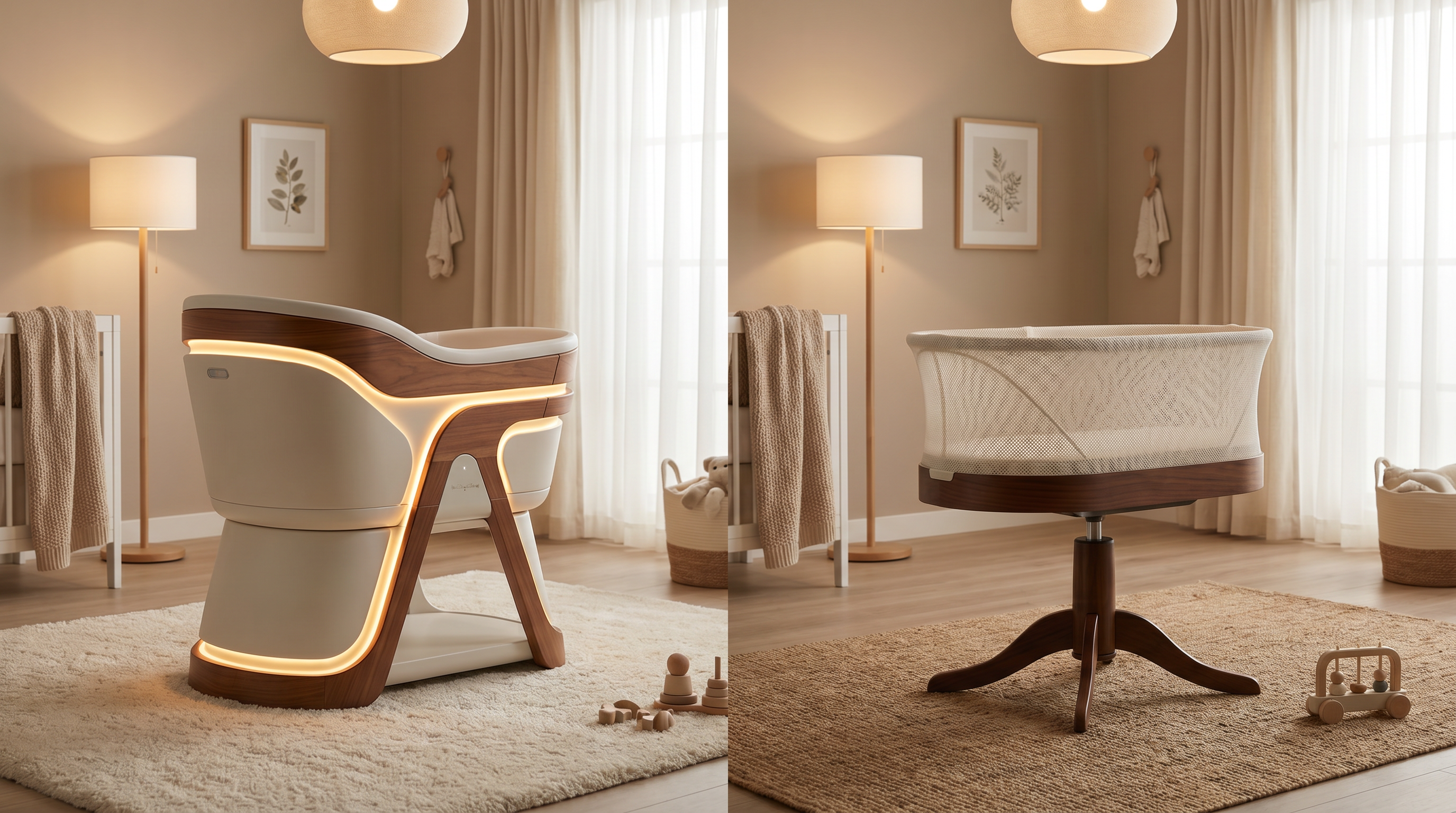
The modern nursery presents a stark financial and philosophical choice for new parents: the traditional bassinet, a passive sleep surface costing around $150, versus the smart bassinet, an active robotic assistant that can cost upwards of $1,500. For decades, the standard infant bed was simply a safe, flat basket. Today, technology has transformed the bassinet into a responsive machine designed to maximize household rest. As families navigate the exhaustion of the newborn phase, the decision between high-tech intervention and low-tech simplicity has become one of the most debated topics in early parenting.[1]
The core difference between the two approaches lies in the concept of intervention. Traditional bassinets require parents to be the engine of soothing; if an infant wakes in the night, the caregiver must physically rock, pat, or shush them back to sleep. Smart bassinets, equipped with integrated microphones and motion sensors, act as an extra set of hands. When they detect crying or restless movement, they automatically deploy escalating white noise and rhythmic motion to coax a fussy baby back to sleep before a full wake-up occurs.[1][8]
In the column for smart bassinets, the primary argument is the preservation of sleep for the entire household. Devices like the SNOO and the Cradlewise offer predictive or reactive soothing that mimics the rhythmic, noisy environment of the womb. By intervening at the first sign of stirring, these robotic beds can often settle an infant without requiring the parent to get out of bed, effectively serving as a digital night nurse during the most exhausting months of early parenthood.[1][8]
The evidence supporting this active intervention is measurable and significant. A peer-reviewed study published in Pediatric Research demonstrated that infants using smart bassinets slept significantly longer and cried less than those placed in traditional static cribs. Furthermore, the medical community is taking these benefits seriously; ongoing clinical trials are currently investigating whether the extra sleep afforded by automated bassinets can actively reduce the incidence of postpartum depression and anxiety in new mothers, particularly in high-stress populations.[2][4]

The argument against smart bassinets centers on the risk of over-intervention and the creation of heavy sleep associations. Pediatric nurses and lactation consultants warn that outsourcing the soothing process to a machine can disrupt the natural "serve and return" communication between parent and child. By automatically rocking a baby back to sleep, the device might inadvertently mask early hunger cues, delaying necessary feedings and potentially impacting milk supply for nursing mothers.[5][6]
Further evidence against prolonged smart bassinet use involves physical development and restricted movement. Some clinical practitioners note an anecdotal correlation between the tightly restrictive swaddles required by certain smart bassinets and an increase in plagiocephaly, or flat-head syndrome. Because the infant's head movement is artificially limited and they are kept on their backs for extended, uninterrupted periods, they miss out on the micro-movements that naturally relieve pressure on the skull.[6]
In the column for traditional bassinets, the strongest argument is simplicity, safety, and physical accessibility. Models like the Halo BassiNest feature 360-degree swivels and lowering side walls, which allow a parent to reach their baby from bed without engaging their core. For mothers recovering from a Cesarean section or traumatic birth, this physical accessibility is not just a convenience—it is a critical, pain-reducing feature that standalone smart bassinets currently cannot replicate.[7]
In the column for traditional bassinets, the strongest argument is simplicity, safety, and physical accessibility.
The evidence supporting traditional models centers on natural milestone development and long-term budget efficiency. Because the baby is not strapped into a proprietary, clip-in swaddle, they have the freedom to practice the "newborn curl" and naturally transition out of the swaddle when they begin showing signs of rolling. Traditional bassinets meet all safety standards set by the U.S. Consumer Product Safety Commission without introducing complex variables into the sleep environment.[3][5]

The argument against the traditional bassinet is primarily the physical and mental toll it takes on the parents. Without automated intervention, every minor sleep disruption requires a caregiver to physically wake up, lean over, and manually soothe the child. For infants who struggle to connect their sleep cycles, this can result in severely fragmented parental sleep, exacerbating postpartum exhaustion and making the transition back to work significantly more difficult.[1][4]
When evaluating the trade-offs, the financial disparity is impossible to ignore. A premium smart bassinet requires an upfront investment of $1,500 to $2,000, plus potential monthly app subscription fees, for a device that the child will physically outgrow in roughly six months. Conversely, a high-quality traditional bassinet rarely exceeds $300, leaving a substantial portion of the family budget available for other necessities like diapers, formula, or childcare.[7][8]
To bridge this massive cost gap, the market has evolved. Some smart bassinet manufacturers have introduced rental programs, allowing parents to access the technology for around $150 per month. Meanwhile, newer competitors have designed their smart beds to convert from a bassinet into a mini-crib, extending their usable life up to 24 months and fundamentally changing the return on investment for tech-forward families.[8]

Ultimately, a smart bassinet fits well when a family has a high-needs or easily startled infant who requires constant motion to settle. It is highly effective when parents lack secondary nighttime support, when both partners are returning to demanding jobs quickly, or when maximizing uninterrupted sleep is deemed medically critical for protecting maternal mental health.[4][5]
A smart bassinet does not fit well when parents are on a strict budget, when they prefer to respond to every infant cue personally to establish robust feeding routines, or when they are highly anxious about breaking tech-dependent sleep associations. It is also less ideal for parents who want their baby to have unrestricted movement during the night.[5][6]
Conversely, a traditional bassinet fits well when parents prioritize physical proximity and ease of access for nighttime nursing. It is the superior choice for mothers recovering from abdominal surgery who need a lowering wall, and for families who want to avoid the stress of weaning a baby off automated motion at the six-month mark.[5][7]
A traditional bassinet does not fit well when the primary caregiver is managing nighttime duties entirely alone while facing severe sleep deprivation. It is also a challenging fit when the infant consistently struggles to connect sleep cycles without continuous rhythmic motion, leaving the parents acting as a human rocking chair for hours on end.[1][4]
How we got here
2016
The SNOO, the first major smart bassinet, launches, creating a new category of tech-enabled infant sleep.
2021
Competitors begin entering the market, offering alternative motions like bouncing instead of side-to-side rocking.
2023
Smart cribs that convert from bassinets to toddler beds launch, extending the lifespan of the tech investment.
2025
Clinical trials begin investigating the direct impact of smart bassinets on reducing postpartum depression rates.
Viewpoints in depth
Tech-Forward Parents
Value data tracking, automated soothing, and maximizing sleep to protect mental health.
For parents returning to demanding jobs shortly after birth, the smart bassinet is viewed as an essential survival tool rather than a luxury. This camp argues that the mental health benefits of securing even one or two extra hours of uninterrupted sleep far outweigh the financial cost. They rely heavily on the companion apps to track sleep data, using the predictive analytics to establish routines and anticipate regressions before they happen.
Pediatric & Lactation Specialists
Emphasize natural milestone development, unrestricted movement, and parent-infant cue response.
Clinical professionals often view smart bassinets with caution, arguing that infancy is a critical period for establishing communication. When a machine automatically rocks a stirring baby back to sleep, it interrupts the 'serve and return' dynamic where a baby fusses to signal a need and a parent responds. Lactation consultants specifically warn that this can lead to missed nighttime feedings, which are crucial for establishing a robust milk supply in the early weeks.
Budget-Conscious Pragmatists
Argue that a $1,500 investment for six months of use is unnecessary when traditional models meet all safety standards.
This perspective highlights the fleeting nature of the newborn phase. Pragmatists point out that a baby will outgrow a bassinet by six months of age, making a $1,500 purchase mathematically inefficient. They advocate for traditional bassinets that meet strict CPSC safety guidelines, arguing that the saved funds are better allocated toward long-term childcare costs, diapers, or a high-quality convertible car seat.
What we don't know
- Whether the long-term use of smart bassinets definitively impacts the development of self-soothing skills in toddlerhood.
- The final results of ongoing clinical trials regarding the exact reduction in postpartum depression rates linked to automated sleep aids.
Key terms
- Plagiocephaly
- A condition characterized by a flat spot on the back or side of a baby's head, often caused by spending too much time lying in the same position.
- Torticollis
- A tightening of a baby's neck muscles that causes the head to tilt to one side, sometimes associated with restricted movement in sleep spaces.
- Sleep Association
- A condition, object, or action that a baby learns to rely on in order to fall asleep, such as rocking, nursing, or white noise.
- Newborn Curl
- The natural, scrunched-up fetal position that newborns often adopt during their first few weeks of life, which requires unrestricted movement to practice.
Frequently asked
Are smart bassinets safe for newborns?
Yes, provided they meet CPSC standards for a firm, flat mattress and breathable sides. However, parents must ensure the baby is placed on their back and stop using the bassinet when the baby begins to roll.
Do smart bassinets cause flat-head syndrome?
Prolonged use of restrictive swaddles combined with extended time on the back can increase the risk of plagiocephaly. Pediatricians recommend ample tummy time during the day to counteract this.
Can you rent a smart bassinet?
Yes, several manufacturers offer rental programs, typically costing around $150 per month, which can be a cost-effective alternative to purchasing a $1,500 device for only six months of use.
Do babies get addicted to the smart bassinet's motion?
Babies can develop sleep associations with continuous motion. Experts recommend using a weaning mode—which reduces motion while maintaining white noise—several weeks before transitioning to a standard crib.
Sources
Source coverage
8 outlets
3 viewpoints surfaced








[1]Factlen Editorial TeamSleep-Optimization Advocates
Synthesis by Factlen editorial team
Read on Factlen Editorial Team →[2]Pediatric Research
Infant sleep and crying in a smart bassinet
Read on Pediatric Research →[3]U.S. Consumer Product Safety CommissionPractical Accessibility Advocates
Bassinet and Cradle Safety Standards
Read on U.S. Consumer Product Safety Commission →[4]ClinicalTrials.gov
Smart Bassinet for Postpartum Depression
Read on ClinicalTrials.gov →[5]HarborDevelopmental Traditionalists
Smart Bassinets: What Parents Need to Know (From a Pediatric Nurse)
Read on Harbor →[6]Integrative Lactation CareDevelopmental Traditionalists
The Truth About Smart Bassinets: A Clinical Perspective
Read on Integrative Lactation Care →[7]Kido BebePractical Accessibility Advocates
Halo BassiNest vs SNOO: A Feature-by-Feature Comparison
Read on Kido Bebe →[8]PoppylistSleep-Optimization Advocates
Smart Sleeper Showdown: SNOO vs. Cradlewise
Read on Poppylist →

More in shopping
See all 54 stories →Luggage Choice
Travel Backpack vs. Rolling Carry-On: Which Luggage Fits Your Trip?
7 sources

Summer Sales
The 2026 Summer Retail Price War: Amazon, Walmart, and Target Launch Massive June Sales Events
7 sources

E-Bike Tech
The 2026 E-Bike Buying Guide: Motors, Batteries, and Finding Your Perfect Ride
8 sources

EV Transition
EV vs. PHEV in 2026: The Complete Cost and Lifestyle Comparison
7 sources

Every angle. Every day.
Get shopping stories with full source coverage and perspective breakdowns delivered to your inbox.