
Sony's AI Robot Defeats Elite Human Players in Table Tennis Milestone
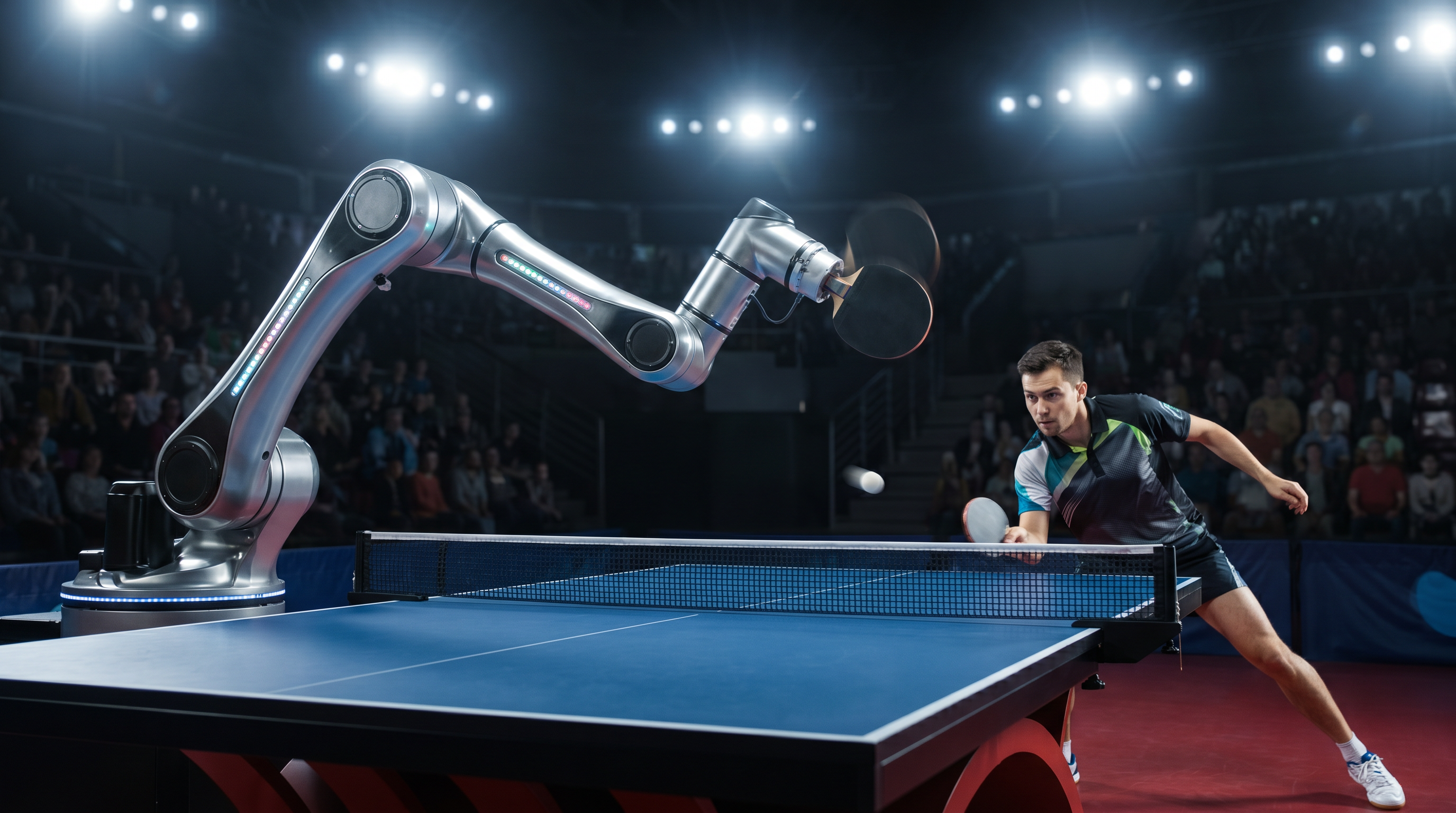
An autonomous robot named Ace has become the first machine to beat elite human athletes in a physical sport, marking a major leap for real-world artificial intelligence.
By Factlen Editorial Team
- AI & Robotics Researchers
- Viewing table tennis as the ultimate benchmark for physical artificial intelligence.
- Professional Athletes & Coaches
- Analyzing the unique psychological and tactical challenges of playing against a machine.
- Technology Analysts
- Looking beyond sports to the commercial applications of high-speed autonomous robots.
What's not represented
- · Amateur table tennis players who might use this technology for coaching.
- · Table tennis governing bodies regulating AI in official training.
Why this matters
For decades, artificial intelligence has been confined to screens and simulations. This breakthrough proves that AI can now perceive, react, and physically move faster than humans in the chaotic real world, paving the way for advanced robotics in manufacturing, disaster response, and healthcare.
Key points
- Sony AI's 'Ace' robot has become the first autonomous machine to defeat elite human players in table tennis.
- The robot uses a network of high-speed cameras to track the ball's logo, calculating extreme spins in milliseconds.
- Ace processes visual data and executes a physical return in just 20 milliseconds, roughly ten times faster than a human.
- While the robot beat elite amateurs, it still struggles against the overwhelming power of top-tier professionals.
- Researchers view the breakthrough as a major step toward deploying fast, precise robots in factories and healthcare.
For decades, artificial intelligence has conquered digital realms, mastering complex board games and virtual simulations with superhuman precision while remaining safely confined behind screens. Now, that intelligence has stepped out of the digital ether and into the physical arena. Sony AI's 'Ace' robot has achieved a historic first: defeating elite human athletes in a competitive, real-world sport under official tournament rules. This milestone represents a fundamental shift in the field of robotics, proving that machines can now match human agility, perception, and split-second decision-making in a chaotic physical space.[1][2]
The battleground chosen for this grand experiment was table tennis, a sport long considered a holy grail for robotics engineers due to its extreme demands on speed, perception, and precision. Unlike chess or Go, where players have time to calculate their next move in a static environment, table tennis requires continuous, real-time adaptation. A machine must track a small, fast-moving object, calculate its trajectory through the air, and physically move a mechanical arm to intercept it—all within a fraction of a second. For years, robots could only manage cooperative rallying; competitive play remained out of reach.[3][6]
In a landmark study published in the scientific journal Nature, Sony AI revealed that Ace successfully won three out of five matches against elite human players. The matches were conducted under official International Table Tennis Federation rules, complete with licensed umpires and standard equipment. While the robot dominated the elite amateur tier, it did lose its initial matches against top-tier professionals, clawing back only one game in those specific contests. However, the sheer fact that a machine could hold its own in a high-stakes, physical rally marks a paradigm shift.[1][3]
While artificial intelligence has previously mastered complex video games—including Sony's own Gran Turismo racing simulator—those victories occurred in virtual environments where the physics engine is perfectly predictable. In a video game, the AI has access to clean, flawless data about its surroundings. The physical world, by contrast, is messy. It is filled with sensor noise, unpredictable friction, slight variations in air pressure, and lighting changes that can confuse a computer vision system.[2][5]

Moving intelligence from a pristine computer simulation into a physical body is a monumental challenge known in the industry as 'sim-to-real' transfer. A robot must deal with the latency of its own motors and the physical limitations of its hardware. To bridge this gap, Sony's engineers had to build a custom robotic system that fundamentally reimagines how a machine perceives and interacts with its environment, stripping away human-like limitations in favor of pure mechanical efficiency.[2][6]
Ace does not rely on human-like eyes or a standard bipedal body. Instead, the system utilizes a network of nine active pixel sensor cameras positioned strategically around the court. These cameras track the ball's trajectory at an astonishing 200 frames per second, feeding a constant stream of high-resolution spatial data into the robot's central processing unit. This allows the machine to build a perfect three-dimensional map of the ball's flight path in real time.[1][4]
The most notoriously difficult aspect of table tennis is spin. A professional human player can impart up to 160 rotations per second on a ball, drastically altering its aerodynamic flight and how it violently kicks off the table upon bouncing. For a robot, failing to read the spin means swinging at empty air or launching the return shot wildly out of bounds. Human players read spin by watching their opponent's paddle angle and body mechanics.[3][5]
Ace solves the spin problem through sheer computational brute force. The camera system is designed to zoom in on the official ITTF logo printed on the table tennis ball. By analyzing exactly how that tiny logo blurs and rotates in the milliseconds it takes to cross the net, the system calculates the precise magnitude and axis of the spin. It knows exactly how the ball will behave before it even makes contact with the table.[3][4]

This sensory data feeds into an artificial brain trained via a technique called reinforcement learning. Before it ever swung a physical paddle, Ace spent 3,000 hours playing against itself in a highly accurate computer simulation. Through millions of trial-and-error iterations, the algorithm learned which paddle angles and swing speeds produced successful returns, slowly building a vast library of physical responses to almost any conceivable shot.[1][2]
This sensory data feeds into an artificial brain trained via a technique called reinforcement learning.
When this simulated intelligence is transferred to the physical robot, the results are staggering. Ace can process the ball's complex flight data, calculate the optimal return trajectory, and send the command to its motors in just 20 milliseconds. To put that in perspective, the average human reaction time is roughly 200 to 250 milliseconds. The robot is perceiving and deciding ten times faster than the elite athletes standing across the net.[4][6]
The physical execution of these decisions relies on a custom-built, six-jointed robotic arm. Because standard industrial robotic arms were too slow or lacked the necessary reach for a full table tennis court, Sony engineers designed a bespoke limb mounted on a track. This track provides two additional degrees of freedom for rapid lateral movement, allowing the robot to slide side-to-side to reach wide forehand and backhand shots.[4][5]
This lightweight, highly specialized hardware can whip the racket at over 20 meters per second. This explosive speed allows Ace to execute aggressive, deep returns that keep human opponents constantly on the defensive. The robot is not just blocking the ball back over the net; it is actively attacking, placing shots near the edges of the table with a level of millimeter precision that exhausts human players.[4][5]

Interestingly, the human athletes who played against Ace noted that the robot does not win simply by being faster. It wins by being highly unorthodox. Because the AI learned to play in a simulation without human coaching, it developed varied spins and return angles that human players rarely encounter in traditional training. It handles unpredictable net-cords with ease and executes rapid backspin shots that professionals previously thought were physically impossible.[3][5]
The psychological factor also plays a massive role in these inter-species matches. Human athletes are forced to face a machine that never tires, never panics under pressure, and shows absolutely no emotion regardless of the score. There is no body language to read, no heavy breathing to signal fatigue, and no frustration to exploit. The relentless, cold consistency of the machine forces humans to maintain an exhausting level of mental focus.[7][8]
Despite these advantages, Ace is not yet invincible. While it thoroughly dominates elite amateurs, it still struggles against the absolute highest tier of professional players. Top-ranked humans can hit the ball at speeds exceeding 67 miles per hour, combining overwhelming power with deceptive spin that pushes the robot's mechanical joints and processing speed to their absolute physical limits.[3][5]
In the initial matches recorded for the Nature study, Ace lost to the professional players. However, the machine is constantly learning. In subsequent test matches conducted in late 2025 and early 2026, the robot began to take games off the pros as its algorithms were refined and its hardware was tuned. The gap between human mastery and machine capability in physical sports is closing at an unprecedented rate.[1][3]

The ultimate goal of Project Ace is not to replace human athletes, win Olympic gold medals, or create a dystopian sports league. Table tennis is merely a highly visible, easily measurable benchmark. The true objective is to prove that autonomous machines can operate safely, effectively, and rapidly in highly dynamic environments alongside human beings.[2][6]
If a robotic system can track a ping-pong ball flying at 30 miles per hour, calculate its spin, and physically react in 20 milliseconds without crashing, those same underlying control systems can be deployed in far more critical industries. The algorithms powering Ace represent a massive leap forward for the entire field of physical artificial intelligence.[5][8]
Technology analysts predict that this sim-to-real breakthrough will eventually trickle down into autonomous manufacturing, where robots must sort irregular objects at high speeds. It could revolutionize surgical robotics, allowing machines to react instantly to unexpected complications in the operating room. It also paves the way for agile disaster-response robots that can navigate collapsing buildings and chaotic environments.[5][8]
For now, the frontier of artificial intelligence has officially crossed the net. The success of Sony's Ace proves that the next generation of machines will not just think faster than us in the digital realm—they are rapidly learning to outmaneuver us in the physical world. The era of the truly athletic robot has arrived.[8]
How we got here
1997
IBM's Deep Blue defeats world chess champion Garry Kasparov, marking a milestone for AI in turn-based strategy.
2016
Google's AlphaGo defeats Lee Sedol at the complex board game Go, mastering a game with near-infinite possibilities.
2022
Sony's Gran Turismo Sophy AI defeats the world's best human drivers in a highly realistic racing simulator.
April 2026
Sony AI publishes research in Nature detailing Ace, the first robot to defeat elite humans in a physical sport.
Viewpoints in depth
Robotics Researchers
Viewing table tennis as the ultimate benchmark for physical artificial intelligence.
For decades, AI developers have used board games and video games to test algorithms because virtual environments are perfectly predictable. Robotics researchers view table tennis as the ultimate 'sim-to-real' test. The sport requires a machine to perceive a high-speed object, calculate complex physics involving spin and air resistance, and physically move a mechanical arm to intercept it—all in a fraction of a second. Success here proves that AI can handle the chaotic, noisy reality of the physical world.
Professional Athletes
Analyzing the unique psychological and tactical challenges of playing against a machine.
Human players face a jarring experience when rallying against Ace. Unlike a human opponent, the robot does not telegraph its shots with body language, making it harder to anticipate the ball's trajectory. Furthermore, the machine never experiences fatigue, pressure, or frustration. Athletes note that while the robot lacks the overwhelming power of a top-tier professional, its unorthodox spin combinations and relentless consistency force humans to completely rethink their standard game plans.
Industry Analysts
Looking beyond sports to the commercial applications of high-speed autonomous robots.
While a ping-pong playing robot is an impressive parlor trick, technology analysts are focused on the underlying control systems. The ability to process visual data at 200 frames per second and translate that into precise physical movement in 20 milliseconds has massive industrial implications. Analysts predict that the algorithms powering Ace will eventually be deployed in autonomous manufacturing, high-speed sorting facilities, and even surgical robotics, where split-second physical reactions are critical.
What we don't know
- Whether the robot will eventually be able to defeat the absolute best table tennis player in the world.
- How quickly this specific robotic technology will be commercialized for industrial or medical use.
Key terms
- Reinforcement learning
- A type of artificial intelligence training where a system learns by trial and error, receiving rewards for successful actions.
- Sim-to-real transfer
- The difficult process of taking an AI model trained in a virtual computer simulation and making it work in the unpredictable physical world.
- Degrees of freedom
- The number of independent ways a robotic joint or system can move in three-dimensional space.
- Event-based vision
- A camera technology that only registers changes in a scene (like a moving ball) rather than capturing full frames, allowing for much faster processing.
Frequently asked
Can the robot beat the best table tennis players in the world?
Not yet. While Ace successfully defeated elite amateur players, it lost its initial matches against top-tier professionals who hit with overwhelming speed and spin.
How does the robot see the ball's spin?
Ace uses a network of high-speed cameras to zoom in on the official logo printed on the table tennis ball. By tracking how the logo blurs and rotates, it calculates the spin in milliseconds.
Is the robot controlled by a human?
No, Ace is entirely autonomous. It uses artificial intelligence and reinforcement learning to perceive the ball, decide on a shot, and move its robotic arm without any human intervention.
Why did Sony choose table tennis for this AI test?
Table tennis is considered one of the hardest physical tests for a robot because it requires lightning-fast reaction times, precise physical control, and the ability to adapt to unpredictable spins and bounces.
Sources
Source coverage
8 outlets
3 viewpoints surfaced








[1]NatureAI & Robotics Researchers
Outplaying Elite Table Tennis Players with an Autonomous Robot
Read on Nature →[2]Sony AIAI & Robotics Researchers
A Leap from Virtual to Physical AI: Project Ace
Read on Sony AI →[3]The GuardianProfessional Athletes & Coaches
AI-powered robot beats elite players at table tennis
Read on The Guardian →[4]Associated PressProfessional Athletes & Coaches
Sony's AI robot Ace takes on pro table tennis players
Read on Associated Press →[5]Singularity HubTechnology Analysts
Sony's Table-Tennis Robot Beat Elite Human Players With Unorthodox Moves
Read on Singularity Hub →[6]RobohubAI & Robotics Researchers
Sony AI table tennis robot outplays elite human players
Read on Robohub →[7]EuronewsTechnology Analysts
Meet ACE: The AI robot can beat human table tennis pros
Read on Euronews →[8]Factlen Editorial TeamTechnology Analysts
Synthesis by Factlen editorial team
Read on Factlen Editorial Team →

More in sports
See all 309 stories →USWNT
USWNT Embraces Chaos in Brazil, Splitting Friendly Series Amid Eight Red Cards
6 sources

NBA Finals
New York Knicks Complete Largest Comeback in NBA Finals History to Take 3-1 Lead
7 sources

USL Super League
USL Super League Aligns Calendar with NWSL as American Women's Soccer Prepares for 2031 World Cup
8 sources
Women's Soccer
UEFA Women's Champions League Shatters Viewership Records With 44.5 Million Audience
6 sources

Every angle. Every day.
Get sports stories with full source coverage and perspective breakdowns delivered to your inbox.