
UEFA Women's Champions League Shatters Viewership Records With 44.5 Million Audience
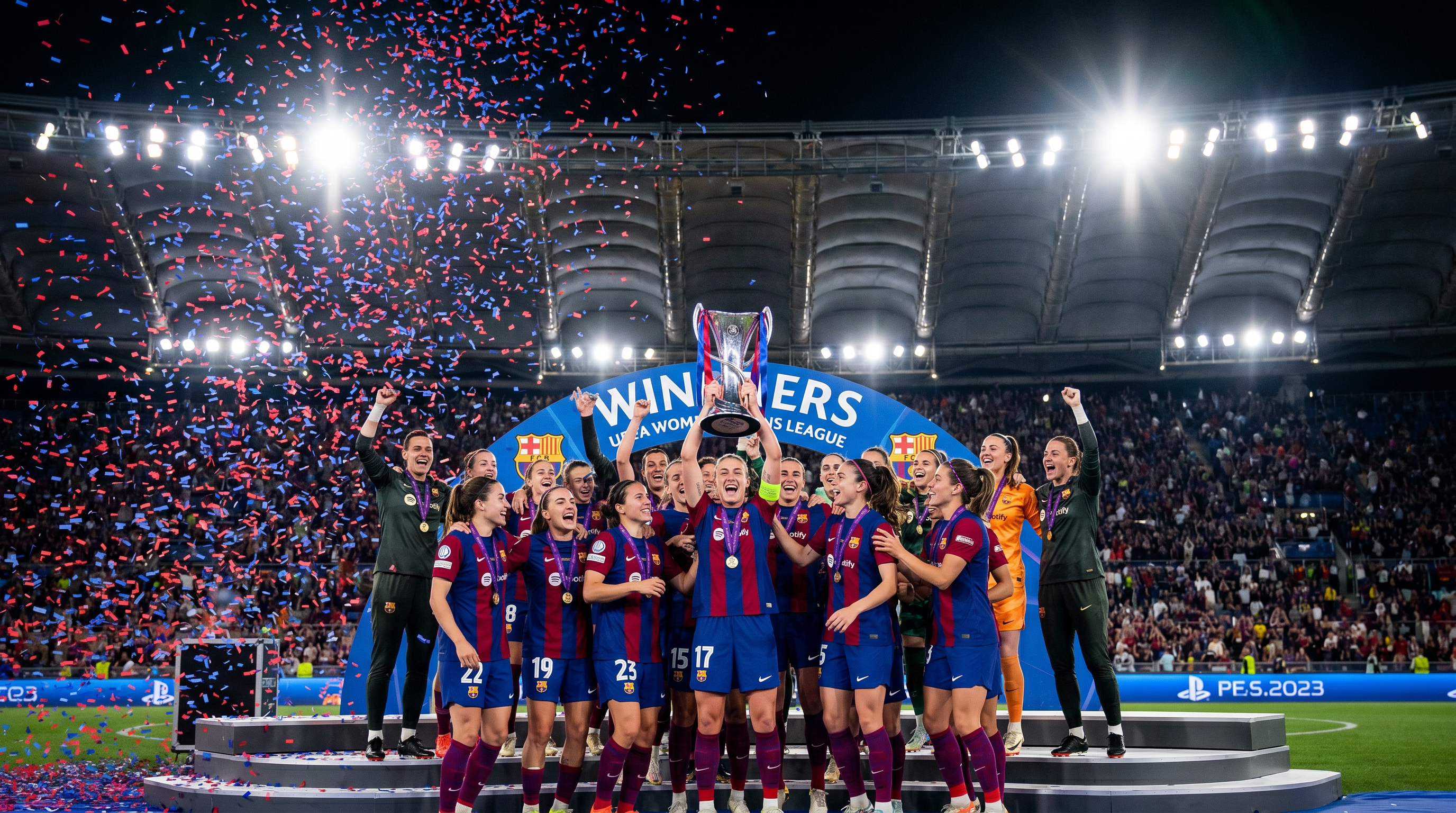
The 2025/26 UEFA Women's Champions League season saw its audience more than double to 44.5 million viewers, fueled by a revamped competitive format and expanded global broadcasts. The historic campaign culminated in a sold-out final in Oslo where FC Barcelona defeated Olympique Lyonnais.
By Factlen Editorial Team
- Tournament Organizers
- Focuses on how structural changes and the new format created a more competitive and engaging product.
- Broadcasters & Media
- Emphasizes the strategic importance of free-to-air distribution in driving mass viewership.
- Fans & Digital Observers
- Highlights the digital explosion and the cultural shift toward treating women's club soccer as a premier event.
What's not represented
- · Players from smaller clubs navigating the expanded European calendar
- · Domestic league organizers balancing their schedules with the new UEFA formats
Why this matters
The exponential growth in viewership and stadium attendance proves that strategic investments in women's sports—such as expanded broadcast access and competitive restructuring—yield massive commercial and cultural returns. It cements women's club soccer as a premier global entertainment property.
Key points
- The 2025/26 UEFA Women's Champions League season reached a projected 44.5 million viewers, more than doubling the previous year's audience.
- FC Barcelona defeated Olympique Lyonnais 4-0 in the final, setting an all-time women's soccer attendance record in Norway.
- Matches were broadcast across 207 territories, with 30 free-to-air partners carrying the championship game to maximize global reach.
- A revamped competition format significantly improved competitive balance, with 49 percent of matches decided by a single goal or drawn.
- Social media engagement exploded, generating 947 million video views and 1.49 billion impressions across official channels.
The 2025/26 UEFA Women's Champions League season has officially rewritten the record books, culminating in a landmark report released by European soccer's governing body. Driven by a revamped competitive format and an aggressive global broadcast strategy, the tournament saw its audience more than double compared to the previous year. Projected viewership for the season surpassed an astonishing 44.5 million, marking a watershed moment for women's club soccer. The surge in interest reflects a broader cultural shift, as fans across the globe increasingly tune in to watch the highest level of the women's game.[1][2]
The historic campaign reached its zenith on May 23, when FC Barcelona dismantled Olympique Lyonnais 4-0 to capture the title. The final was staged at the historic Ullevaal Stadion in Oslo, Norway, playing out in front of a sold-out crowd of over 24,000 spectators. This massive turnout not only provided a spectacular backdrop for Barcelona's triumph but also set a new all-time attendance record for a women's football match in Norway. The atmosphere in Oslo served as a physical manifestation of the tournament's skyrocketing popularity, proving that the appetite for elite women's soccer extends far beyond traditional strongholds.[3][4]
A significant driver of this unprecedented growth was a deliberate strategy to maximize accessibility. Matches were broadcast in 207 territories worldwide, ensuring that fans from nearly every corner of the globe could follow the action. Crucially, UEFA and its broadcast partners prioritized free-to-air coverage for the tournament's biggest moments. The final alone was carried by 30 free-to-air partners, making it the most widely available title match in the history of the competition. In Spain, the broadcast on RTVE reached an average audience of 1.15 million viewers, while Norwegian channel NRK captured nearly half of all television viewers in the host country at the time of kickoff.[2][5]

The European Broadcasting Union played a pivotal role in this distribution strategy, reporting exceptionally strong audiences throughout the knockout stages. By leveraging a network of 22 member broadcasters to air the final live, the EBU demonstrated the immense value of removing paywalls for major sporting events. Stefan-Eric Wildemann, the EBU's Head of Football, noted that the figures validate the organization's commitment to increasing the visibility of women's competitions. This widespread availability not only rewarded existing fans but also lowered the barrier to entry for casual viewers, effectively introducing millions of new fans to the sport.[5]
The foundation for this record-breaking season was laid early in the campaign. By the end of the newly expanded six-match group stage, UEFA had already recorded a 164 percent increase in audiences compared to the previous year. Matches during this initial phase attracted 2.6 times more live viewers than the equivalent stage in the prior season. This early momentum proved that fans were not merely tuning in for the high-stakes finals, but were deeply invested in the narrative arc of the entire tournament. The expanded group stage provided more inventory for broadcasters and more opportunities for emerging clubs to test themselves against the continent's elite.[3]
The foundation for this record-breaking season was laid early in the campaign.
Beyond broadcast accessibility, the sheer quality of the product on the pitch kept audiences engaged. The 2025/26 season marked the debut of a revamped competition structure, which introduced a new league phase designed to create more first-time matchups and greater unpredictability. UEFA's data indicates that the structural changes achieved their intended goal of enhancing competitive balance. Nearly half of all matches—49 percent—were decided by a single goal or ended in a draw, while one-third of the games featured dramatic comebacks. This reduction in lopsided victories ensured that the tension remained high from the opening group-stage matches all the way through the knockout rounds.[1][6]
As television audiences swelled, the tournament's digital footprint experienced a parallel explosion. Across official competition accounts, social media platforms generated nearly 950 million video views, representing a staggering 50 percent increase year-over-year. Impressions soared by 44 percent to reach 1.49 billion, while total fan engagements climbed to 52 million. This digital ecosystem allowed the tournament to dominate online conversations, capturing the attention of a younger, highly engaged demographic that consumes sports highlights and behind-the-scenes content as voraciously as live broadcasts.[1][4]

The momentum generated online and on television translated directly into ticket sales during the crucial knockout phases. Recognizing the growing demand, clubs increasingly moved their high-stakes matches to their primary, large-capacity stadiums. All four semi-final ties were hosted at landmark venues, including the Munich Football Arena, Arsenal Stadium, the OL Stadium, and Camp Nou. By placing these matches on the biggest possible stages, clubs not only accommodated tens of thousands of fans but also signaled that their women's teams are a central, prestigious pillar of their institutional identity.[1][3]
The success of the Champions League was further bolstered by the introduction of the UEFA Women's Europa Cup, a secondary continental competition that debuted this season. This addition broadened access for clubs across Europe, offering a second route for teams knocked out early in the Champions League qualifying rounds. By keeping more teams engaged in European competition for longer, UEFA has begun building a deeper, more robust ecosystem that drives development at the domestic level. This system-building approach ensures that the financial and developmental benefits of European football are distributed more widely across the continent's 55 member associations.[1][6]

The culmination of the tournament featured a fitting clash between two of the sport's most storied institutions. FC Barcelona and Olympique Lyonnais have defined the modern era of European women's soccer, and their meeting in the final provided the ultimate marquee matchup to draw in a global audience. Barcelona's emphatic 4-0 victory not only secured another piece of silverware for the Catalan club but also served as a statement of their current dominance over the traditional French powerhouse. The high quality of play exhibited by both squads in Oslo underscored the technical and tactical evolution of the women's game.[3][6]
As the dust settles on a transformative season, the focus now shifts to sustaining this exponential growth. UEFA's Women's Football Director, Nadine Kessler, praised the campaign for setting a new benchmark in the women's club game, both from a sporting and viewership perspective. With the 2027 FIFA Women's World Cup on the horizon and domestic leagues reporting similar spikes in attendance and investment, the 2025/26 Champions League season will likely be remembered as the tipping point. The challenge for organizers and broadcasters moving forward will be to build on this foundation, ensuring that the infrastructure, investment, and competitive balance continue to scale alongside the sport's massive global audience.[1][2]
How we got here
August 2025
The 2025/26 season kicks off featuring a newly expanded league phase designed to increase competitive balance.
February 2026
UEFA reports a 164 percent audience surge during the group stages compared to the previous year.
May 23, 2026
FC Barcelona defeats Olympique Lyonnais 4-0 in front of a sold-out crowd of over 24,000 at the Ullevaal Stadion in Oslo.
June 10, 2026
UEFA releases its end-of-season report, confirming record-breaking viewership and digital engagement metrics.
Viewpoints in depth
UEFA and Tournament Organizers
Focuses on how structural changes and the new format created a more competitive and engaging product.
For European soccer's governing body, the record-breaking numbers are a direct validation of their decision to overhaul the competition's format. By introducing a new league phase and launching the secondary UEFA Women's Europa Cup, organizers aimed to eliminate predictable, lopsided early-round matches. They argue that the resulting increase in one-goal games and dramatic comebacks is what ultimately kept fans engaged from the autumn group stages all the way to the spring final.
Broadcasters and Media Partners
Emphasizes the strategic importance of free-to-air distribution in driving mass viewership.
Media executives and broadcast partners point to the distribution strategy as the primary catalyst for the audience surge. By partnering with 30 free-to-air networks for the final, broadcasters deliberately removed paywalls to maximize reach. Organizations like the European Broadcasting Union argue that making premium women's sports easily accessible is the most effective way to convert casual observers into dedicated fans, which in turn drives up the long-term commercial value of the broadcast rights.
The Global Fanbase
Highlights the digital explosion and the cultural shift toward treating women's club soccer as a premier event.
For the fans filling landmark stadiums and driving nearly a billion social media video views, the 2025/26 season represents a long-overdue normalization of women's soccer as a top-tier entertainment property. Digital observers note that the massive online engagement—up 50 percent from the previous year—proves that the audience skews young, highly connected, and eager for content. To this camp, the sold-out final in Oslo is not an anomaly, but the new baseline for the sport.
What we don't know
- How the introduction of the secondary UEFA Women's Europa Cup will impact viewership and revenue for lower-tier clubs in the coming seasons.
- Whether the 2026/27 season can maintain this exponential growth rate, or if the audience size will begin to plateau.
- How the surge in European club viewership will translate to national team engagement ahead of the 2027 FIFA Women's World Cup.
Key terms
- UEFA Women's Champions League
- The premier club competition for women's association football in Europe, featuring the top teams from across the continent.
- Free-to-air
- Television broadcasts that are available to the general public without requiring a subscription or paywall.
- UEFA Women's Europa Cup
- A newly introduced secondary European club competition designed to broaden access for teams knocked out of Champions League qualifying.
- European Broadcasting Union (EBU)
- An alliance of public service media organizations that collaborated to broadcast the Champions League final across multiple countries.
Frequently asked
Who won the 2025/26 Women's Champions League?
FC Barcelona defeated Olympique Lyonnais 4-0 to capture the European title.
Where was the final match played?
The final took place at the Ullevaal Stadion in Oslo, Norway, in front of a sold-out crowd of over 24,000 fans.
Why did viewership increase so dramatically this season?
The surge was driven by a revamped, more competitive tournament format and expanded broadcast agreements that included 30 free-to-air partners for the final.
How many people watched the tournament?
UEFA projects that total viewership for the season surpassed 44.5 million, more than doubling the previous year's audience.
Sources
Source coverage
6 outlets
3 viewpoints surfaced





[1]UEFA.comTournament Organizers
A new era peaks in Oslo: UEFA Women's Champions League and UEFA Women's Europa Cup reshape the landscape
Read on UEFA.com →[2]The Straits TimesBroadcasters & Media
Women's Champions League hits new audience benchmark, says UEFA
Read on The Straits Times →[3]Mundo DeportivoFans & Digital Observers
Women's Champions League breaks records with huge audiences and sold out stadiums
Read on Mundo Deportivo →[4]DevdiscourseFans & Digital Observers
The Audience For The Womens Champions League Surged In The Season
Read on Devdiscourse →[5]TM BroadcastBroadcasters & Media
EBU broadcasters report strong audiences for the UEFA Women's Champions League 2026 Final
Read on TM Broadcast →[6]OneFootballTournament Organizers
UEFA hails new Women's Champions League format as audience sets new benchmark
Read on OneFootball →
More in sports
See all 309 stories →Training Science
The Zone 2 Training Revolution: Why Cyclists Are Riding Slower to Get Faster
7 sources

USWNT
USWNT Embraces Chaos in Brazil, Splitting Friendly Series Amid Eight Red Cards
6 sources
NBA Finals
New York Knicks Complete Largest Comeback in NBA Finals History to Take 3-1 Lead
7 sources
USL Super League
USL Super League Aligns Calendar with NWSL as American Women's Soccer Prepares for 2031 World Cup
8 sources
Every angle. Every day.
Get sports stories with full source coverage and perspective breakdowns delivered to your inbox.