
USWNT Embraces Chaos in Brazil, Splitting Friendly Series Amid Eight Red Cards
The U.S. Women's National Team split a grueling two-game road series against Brazil, using the hostile environment to build mental toughness ahead of the 2027 World Cup. The trip featured the return of the 'Triple Espresso' attacking trio and culminated in a tempestuous 1-0 victory marked by eight red cards.
By Factlen Editorial Team
- USWNT Management
- Argues that facing hostile crowds and physical play now is essential for building the mental toughness required to win the 2027 World Cup.
- Player Leadership
- Focuses on the need to maintain composure, adapt to unfair officiating, and execute tactically amid chaos.
- Brazilian Hosts
- Views the friendlies as a successful showcase of their intimidating home-field advantage and a statement of intent ahead of hosting the 2027 tournament.
What's not represented
- · Brazilian fans in attendance
- · Referees who officiated the chaotic second match
Why this matters
By intentionally subjecting the USWNT to hostile crowds and chaotic officiating in Brazil, head coach Emma Hayes is stress-testing the squad's mental toughness ahead of the 2027 World Cup. This grueling road trip signals a shift away from comfortable domestic friendlies toward the gritty pragmatism required to win on foreign soil.
Key points
- The USWNT split a two-game friendly series against Brazil, the hosts of the 2027 Women's World Cup.
- Head coach Emma Hayes deliberately scheduled the away matches to expose the team to hostile crowds and physical play.
- Forward Sophia Wilson scored in the second minute of the opening match, her first goal since returning from maternity leave.
- Brazil won the first match 2-1 after capitalizing on defensive miscues and overwhelming the American midfield.
- The USWNT ground out a 1-0 victory in the second match, which descended into chaos and featured eight red cards.
- The series marked the return of the 'Triple Espresso' attacking trio for the first time since the Paris Olympics.
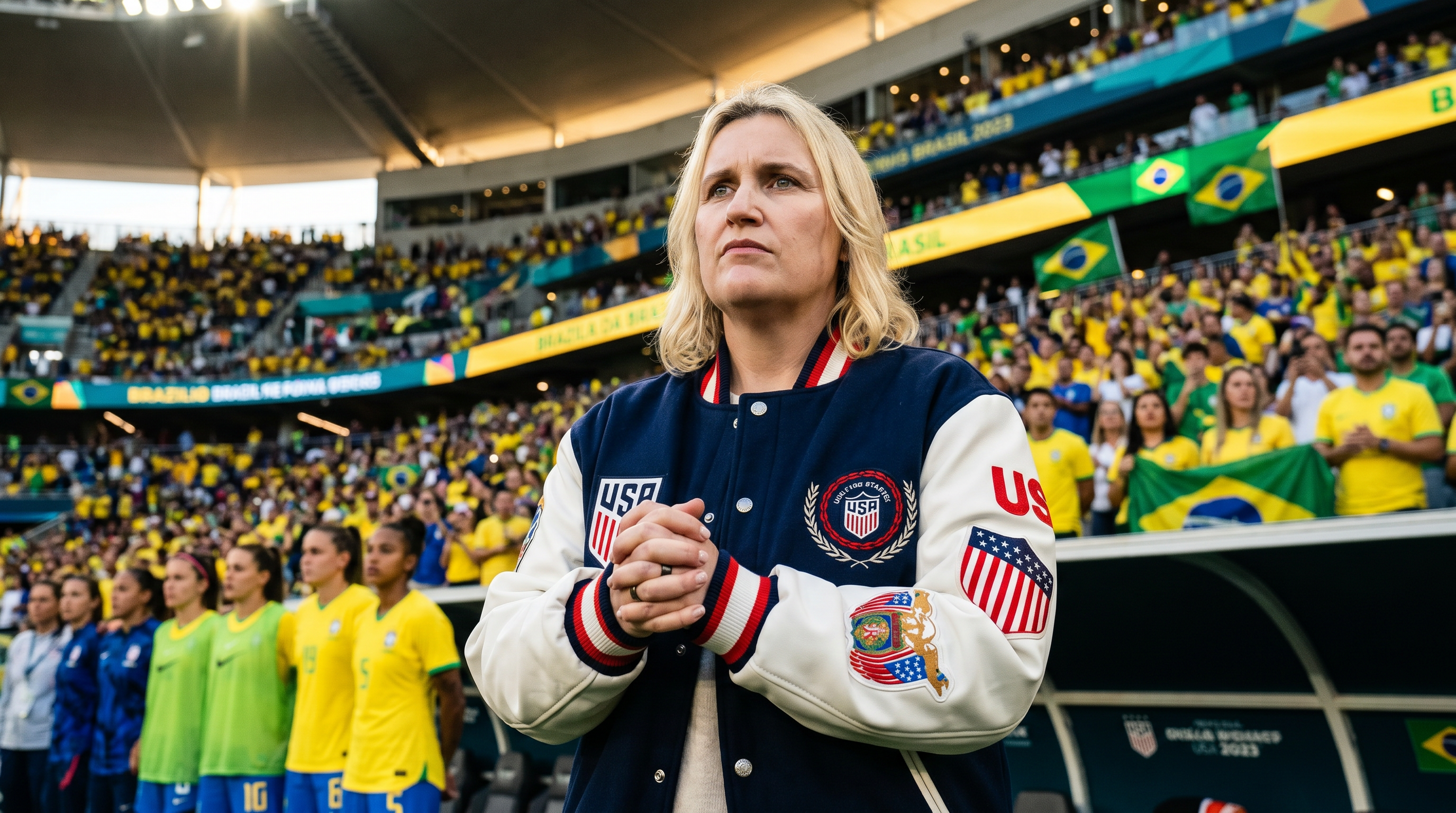
The United States Women's National Team is accustomed to playing international friendlies in a very specific, highly controlled environment. Typically, these exhibition matches take place in packed American stadiums, featuring favorable refereeing, pristine pitches, and a comfortable home-field advantage that allows the squad to dictate the tempo. But as the countdown to the 2027 FIFA Women's World Cup accelerates, newly appointed head coach Emma Hayes has decided that this familiar comfort is the enemy of progress. Recognizing that the team cannot simulate the adversity of a major tournament while playing in Los Angeles or New York, Hayes deliberately orchestrated a grueling road test.[1][4]
In a calculated move to stress-test her rebuilt squad, Hayes took the USWNT on the road this June for a two-game series against the very nation set to host the 2027 World Cup: Brazil. The objective was not merely tactical refinement, but intense psychological conditioning. Hayes wanted her players exposed to the deafening whistles, relentless jeers, and physical hostility that define South American away fixtures. By stripping away the safety net of a home crowd, the coaching staff aimed to expose the team's underlying vulnerabilities before the stakes become absolute next summer.[1][4]
"If we want things to be easy, we stay at home and play in LA or somewhere else," Hayes explained to reporters ahead of the series. "We don't want easy." She emphasized that rebuilds cannot successfully happen without genuine discomfort along the way. For many of the younger players on the roster, this trip marked their first time experiencing such a concentrated level of crowd intensity and tactical disruption. The Brazilian squad, known for their physicality and unpredictable "chaos ball," provided the exact type of grueling opposition Hayes was searching for.[1]
Beyond the environmental challenges, the Brazilian tour marked a highly anticipated roster milestone for the American side. For the first time since their triumphant gold-medal run at the 2024 Paris Olympics, the dynamic attacking trio affectionately dubbed "Triple Espresso"—Trinity Rodman, Mallory Swanson, and Sophia Wilson—finally reunited on the pitch. Injuries and personal leaves had kept the prolific trio apart for nearly two years, forcing the USWNT to rely on heavily rotated forward lines during recent international windows.[3]
Wilson's return to the starting lineup was particularly emotional and highly scrutinized, as she stepped back onto the international stage following an extended maternity leave. Questions about her match fitness and sharpness were immediately answered. It took the star forward exactly two minutes to announce her comeback to the global soccer community. In the opening match at São Paulo's Neo Química Arena on June 6, Wilson latched onto a perfectly weighted through-ball and delivered a remarkable, clinical finish to give the Americans an instant 1-0 lead.[3][5]

The early goal sparked joyful celebrations from the American bench, seemingly setting the stage for a triumphant return. However, the hostile environment quickly took its toll on the visitors. The Brazilian squad, buoyed by a raucous home crowd of over 40,000 fans, refused to capitulate. Instead, they ramped up their high-pressing dynamism, aggressively disrupting the USWNT's passing lanes and exposing severe communication cracks within the American midfield structure. The momentum shifted violently as the noise in the stadium reached a fever pitch.[1][6]
In a devastating four-minute span, Brazil completely flipped the script. The equalizer came in the 11th minute when 21-year-old rising star Taina Maranhao found herself completely unmarked in the penalty area, easily heading the ball past the American goalkeeper. Moments later, a severe lack of understanding in the U.S. midfield led to a rapid counter-attack. The American defense flubbed the recovery miserably, allowing 32-year-old veteran Beatriz Zaneratto João to slot home the winning goal with a precise near-post finish.[5]
In a devastating four-minute span, Brazil completely flipped the script.
The 2-1 defeat in São Paulo was a bitter pill for a program that prides itself on dominance, but Hayes refused to coddle her squad in the aftermath. Instead of making excuses about the travel or the officiating, she celebrated the adversity. She noted that the team created very few clear-cut chances after the opening minutes and struggled to cope with being thrown to the ground repeatedly without drawing fouls. It was exactly the kind of harsh reality check the coaching staff had hoped to engineer.[1][5]
The players absorbed the lesson with a mix of frustration and determination. Captain Lindsey Heaps acknowledged that the squad needed to drastically improve their mental capacity to stay grounded when the environment turned hostile. "It's difficult when it's a game like that, when you're being thrown to the ground multiple times and calls aren't going your way," Heaps explained. "But it's up to us—it's that mental capacity to stay in a game like that." The focus immediately shifted to how the team would respond in the second leg.[1]
That mental capacity was pushed to its absolute, breaking limit three days later during the rematch at Arena Castelão in Fortaleza. If the first game was a harsh tactical lesson, the second was an exercise in pure survival. From the opening whistle, the match devolved into a tempestuous, physical grind that severely tested the referee's control and the players' discipline. Both sides abandoned flowing possession in favor of crunching tackles and aggressive aerial duels.[2][4]

The breakthrough for the United States came not from a beautifully orchestrated team move, but from sheer, relentless pressure. Wilson, proving to be a constant menace to the Brazilian backline, made a dangerous, driving run into the penalty area. Her aggressive positioning and the resulting scramble forced a decisive Brazilian own goal, giving the Americans a hard-fought 1-0 advantage in a game where clear shooting opportunities were virtually nonexistent.[2]
Following the goal, the match descended into unprecedented chaos. Tensions that had been simmering since the first leg finally boiled over into multiple on-field conflicts. The physicality escalated beyond standard tactical fouling, resulting in an astonishing eight red cards being handed out by the official across the pitch and the touchlines. The sheer volume of ejections left the Brazilian squad with only nine eligible players on the field for the final stretches of the match.[2]
Despite the swirling madness and the deafening outrage from the Fortaleza crowd, the Americans managed to keep their composure just enough to see out the result. They absorbed wave after wave of desperate Brazilian attacks, relying on last-ditch defending and crucial saves to maintain their slim advantage. When the final whistle finally blew, the USWNT had successfully ground out a 1-0 victory, splitting the two-game series and surviving one of the most bizarre international friendlies in recent memory.[2][5]
Hayes later described the chaotic victory as an "experience I will never forget," praising her team for answering her direct call to be tougher and more cohesive under immense pressure. While the performance was far from the beautiful, fluid soccer the USWNT aspires to play, it demonstrated a gritty pragmatism that had been missing in recent years. The team proved they could win ugly when the situation demanded it, a crucial trait for any squad harboring World Cup ambitions.[2]

Ultimately, the Brazilian tour provided exactly what the USWNT needed at this stage of their development: a stark, uncompromising reminder of the grueling conditions required to win a World Cup on foreign soil. The friendlies exposed defensive frailties and midfield disconnects that can now be addressed in the film room, rather than being discovered too late during a knockout match next summer. The lessons learned in São Paulo and Fortaleza will serve as the foundational blueprint for the team's preparation over the next twelve months.[1][6]
By leaning into the hostility rather than avoiding it, Hayes has signaled a definitive new era for the American squad. The days of relying solely on overwhelming talent and comfortable home-field advantages are over. As the countdown to the 2027 tournament begins in earnest, the USWNT is actively seeking out the fire, trusting that the discomfort of today will forge the champions of tomorrow.[1]
How we got here
April 2026
US Soccer announces the two-game road series in Brazil to test the team in the 2027 World Cup host nation.
June 3, 2026
The 'Triple Espresso' attacking trio officially reunites in camp for the first time since the Paris Olympics.
June 6, 2026
Brazil defeats the USWNT 2-1 in São Paulo despite an early American goal by returning forward Sophia Wilson.
June 9, 2026
The USWNT grinds out a 1-0 victory in Fortaleza in a chaotic match featuring eight red cards across the pitch and touchlines.
Viewpoints in depth
Emma Hayes' Philosophy
The USWNT head coach is actively seeking out discomfort to forge a more resilient squad.
Rather than padding the team's win-loss record with comfortable domestic friendlies, Emma Hayes is prioritizing psychological conditioning. She argues that the only way to prepare for the 2027 World Cup is to expose her players to the deafening jeers, physical 'chaos ball,' and unpredictable officiating of South American away fixtures. By embracing the 2-1 loss in São Paulo as a necessary learning experience, Hayes is signaling a shift away from entitlement and toward gritty pragmatism.
The Players' Adaptation
Veterans and returning stars are learning to maintain their composure when the environment turns hostile.
For the players on the pitch, the Brazilian tour was a stark wake-up call regarding the mental capacity required to win on the road. Captain Lindsey Heaps and returning star Sophia Wilson emphasized the challenge of staying grounded when physical fouls go uncalled and the crowd is actively rooting for their failure. The chaotic second match, which featured eight red cards across the pitch and touchlines, served as the ultimate test of their ability to ignore the noise and grind out a result.
Brazil's Home-Field Warning
The Brazilian squad proved they will be a formidable, intimidating host for the 2027 World Cup.
From the perspective of the hosts, the June friendlies were a resounding success. Brazil demonstrated that their home stadiums will be absolute fortresses during the 2027 tournament. By overwhelming the Americans with high-pressing dynamism in the first match and dragging them into a physical brawl in the second, the Brazilian squad sent a clear message to the rest of the world: anyone hoping to lift the trophy next year will have to survive a gauntlet of immense pressure and hostility.
What we don't know
- How the USWNT will adjust their midfield structure to better handle high-pressing 'chaos ball' in future fixtures.
- Whether the eight red cards from the second friendly will result in any extended suspensions for Brazilian players.
- How the team's younger players will internalize the psychological lessons from this grueling road trip.
Key terms
- Triple Espresso
- The nickname for the USWNT's dynamic attacking trio of Trinity Rodman, Sophia Wilson, and Mallory Swanson.
- Chaos ball
- A physical, unpredictable style of play characterized by high intensity, frequent transitions, and disrupted rhythms.
- Friendlies
- Non-competitive international exhibition matches used by national teams for preparation and tactical testing.
- Maternity leave
- In professional soccer, the period a player takes off for pregnancy and childbirth, with specialized return-to-play protocols.
Frequently asked
Why did the USWNT play friendlies in Brazil?
Head coach Emma Hayes wanted to test the team in hostile, away environments ahead of the 2027 Women's World Cup, which Brazil is hosting.
Who scored for the United States?
Sophia Wilson scored in the first match, marking her first goal since returning from maternity leave. The second match was won via a Brazilian own goal forced by Wilson's aggressive run.
Why were there so many red cards in the second game?
The rematch in Fortaleza devolved into a highly physical and tempestuous grind, with escalating tensions resulting in eight red cards being shown to players and staff.
Sources
Source coverage
6 outlets
3 viewpoints surfaced






[1]Olympics.comUSWNT Management
The U.S. women's national team are learning the hard way in Brazil
Read on Olympics.com →[2]The GuardianPlayer Leadership
Hayes describes 'experience I will never forget' as Brazil given eight red cards in loss to USWNT
Read on The Guardian →[3]CBS SportsUSWNT Management
How Emma Hayes welcomed USWNT 'triple espresso' stars back after injury and maternity leave
Read on CBS Sports →[4]Just Women's SportsBrazilian Hosts
USWNT to Face Brazil in São Paulo, Fortaleza in June 2026 Friendlies
Read on Just Women's Sports →[5]The District PressBrazilian Hosts
Brazil, June 2026 Friendly: Preview, Time, and How to Watch
Read on The District Press →[6]Equalizer SoccerPlayer Leadership
World Cup atmosphere provides lessons for USWNT in loss to Brazil
Read on Equalizer Soccer →
More in sports
See all 309 stories →Training Science
The Zone 2 Training Revolution: Why Cyclists Are Riding Slower to Get Faster
7 sources

NBA Finals
New York Knicks Complete Largest Comeback in NBA Finals History to Take 3-1 Lead
7 sources
USL Super League
USL Super League Aligns Calendar with NWSL as American Women's Soccer Prepares for 2031 World Cup
8 sources
Women's Soccer
UEFA Women's Champions League Shatters Viewership Records With 44.5 Million Audience
6 sources
Every angle. Every day.
Get sports stories with full source coverage and perspective breakdowns delivered to your inbox.