
Bitcoin's Wild Ride Is Ending—And That Might Be Exactly What It Needs
As Bitcoin's price volatility drops to historic lows, economists and analysts suggest the cryptocurrency is finally transitioning from a speculative gamble into a viable medium of exchange.
By Factlen Editorial Team
- Traditional Finance Analysts
- View the drop in volatility as a sign of market maturation and institutionalization.
- Crypto Utility Advocates
- Argue that a flat, predictable price is the catalyst needed for Bitcoin to become a global currency.
- Skeptical Economists
- Maintain that low volatility does not automatically translate to widespread currency adoption.
What's not represented
- · Retail Speculators
- · Regulatory Agencies
Why this matters
A stable Bitcoin transforms the cryptocurrency from a risky investment into a practical tool for everyday commerce. If the asset's price stops swinging wildly, consumers and merchants can finally use it to buy goods, pay for services, and transfer money across borders without fear of sudden devaluation or massive tax liabilities.
Key points
- Bitcoin's historical volatility has dropped significantly, falling below that of major tech stocks like Tesla and Nvidia in early 2026.
- Economists suggest that a flattening, predictable price curve is exactly what Bitcoin needs to function as a reliable medium of exchange.
- Institutional adoption, including spot ETFs and corporate treasuries, is acting as a shock absorber against retail-driven market panic.
- A stable price removes the psychological friction and capital-gains tax fears that previously discouraged consumers from spending their cryptocurrency.
- While merchant adoption is growing, skeptics warn that actual transaction volumes must increase for Bitcoin to fully transition from "digital gold" to everyday cash.
For years, Bitcoin has been famous for making overnight millionaires and causing heart-stopping crashes. But in 2026, the world's largest cryptocurrency is doing something entirely unexpected: it is calming down. While the digital asset still experiences price swings, the wild, unpredictable fluctuations that defined its early years are fading into the rearview mirror. As institutional capital floods the market and the underlying technology matures, Bitcoin is beginning to behave less like a speculative casino and more like a traditional financial asset.[3][5]
Recent data highlights the sheer scale of this transformation. Bitcoin's historical volatility—a metric that gauges how bumpy an asset's price movements are from day to day—has plummeted by roughly half compared to its chaotic peaks in 2021. By some measures, the cryptocurrency is now significantly less volatile than several major tech stocks. In early 2026, Bitcoin's volatility rating actually ranked below that of "Magnificent 7" companies like Tesla and Nvidia, marking a profound shift in how the asset trades on global exchanges.[5]
While crypto speculators who thrive on massive, rapid price swings might mourn the end of the industry's "Wild West" era, financial analysts say this stabilization is a crucial and necessary milestone. The transition from a highly speculative token to a more predictable asset is exactly what is required for Bitcoin to gain broader acceptance among conservative investors and corporate treasuries. A calmer market environment reduces the perceived risk, allowing traditional finance to integrate the digital asset into standard portfolios without fear of catastrophic overnight drawdowns.[1][2]

This stabilization is also reshaping long-term price forecasts. According to a recent fair-value model based on Metcalfe's Law—which values a network based on the square of its active users—Bitcoin's long-term annualized return is flattening out. As the network approaches its hard cap of 21 million coins, the model suggests that the asset's future returns may eventually approach zero. Rather than signaling the death of the cryptocurrency, economists argue that this flattening curve represents the ultimate maturation of the network.[1]
In fact, a flat, predictable price is exactly what Bitcoin needs to fulfill its original white-paper promise: becoming a reliable, everyday medium of exchange. For a currency to function effectively in the real world, consumers and merchants must trust that its purchasing power will remain relatively stable from one day to the next. Hyper-volatility actively discourages spending; if a user believes their digital coins will double in value next month, they will hoard them rather than buy groceries or pay rent.[1][6]
Furthermore, rapid appreciation creates significant friction in the form of tax liabilities. "If it were to appreciate at a fast rate in coming years, Bitcoin transactions would often trigger a hefty capital-gains tax bill," notes MarketWatch. A stable price removes that psychological and financial barrier, making it practical to buy a cup of coffee or a laptop without worrying about the complex tax implications of spending an asset that is rapidly skyrocketing in value.[1]
Furthermore, rapid appreciation creates significant friction in the form of tax liabilities.
The options market is already pricing in this new, calmer reality. In mid-2026, Bitcoin's implied volatility compressed to the high-30s and low-40s—its lowest levels in years. Remarkably, this compression occurred even as traditional bond markets experienced heightened stress and macroeconomic uncertainty rippled through the global economy. Options traders, who typically bid up the cost of protection during times of market turbulence, are signaling a historic level of confidence in Bitcoin's newfound price floor.[4]
This structural compression is largely driven by the relentless pace of institutional adoption. The launch of spot exchange-traded funds (ETFs) in the United States and the steady accumulation of Bitcoin by corporate treasuries have fundamentally altered the market's dynamics. These institutional players create a massive, permanent bid that absorbs market shocks and prevents the cascading retail liquidations that historically triggered massive price collapses. As the "crypto pool" expands into a massive ocean of institutional capital, the ripples caused by macroeconomic events are becoming smaller and much more manageable for everyday investors.[2][3]

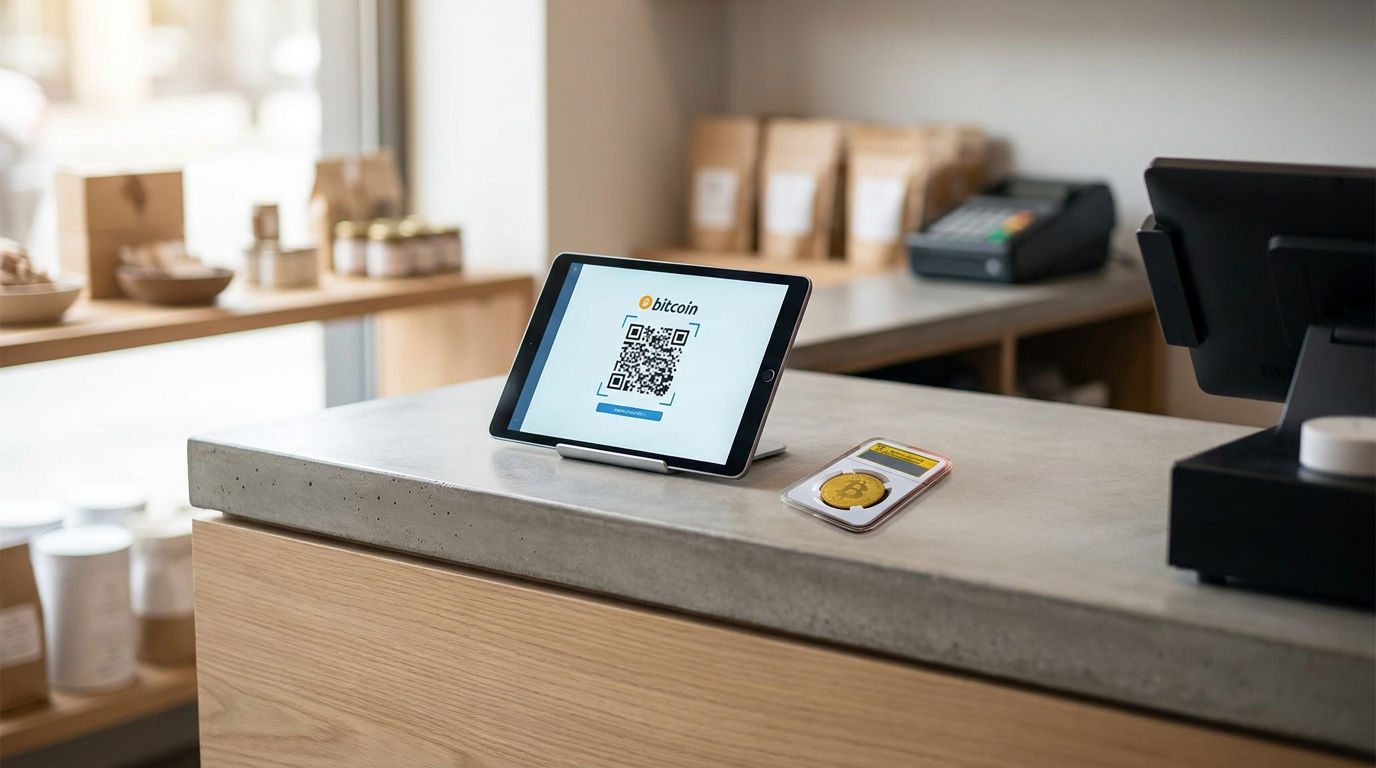
The real-world impact of this stability is already becoming visible on the ground. Merchant adoption is accelerating, with businesses increasingly willing to accept Bitcoin directly rather than relying on third-party processors to immediately convert the digital currency into fiat. From online privacy services to local cafes, a growing number of physical and digital merchants are participating in circular economies where Bitcoin is earned, held, and spent without ever touching the traditional banking system. This shift is particularly vital for digitally native consumers who prefer the seamless, borderless nature of blockchain settlements.[6]
In regions with harsh legal environments or hyperinflation, Bitcoin's utility as a censorship-resistant medium of exchange is expanding even more rapidly. Grassroots projects across Africa and Latin America are building local networks where citizens live almost entirely on Bitcoin, protecting their wealth from local currency debasement. In these communities, the cryptocurrency's stabilizing price is an absolute lifeline, offering a reliable alternative to failing fiat currencies and oppressive financial controls. As volatility drops, the risk of holding a week's wages in Bitcoin diminishes, empowering unbanked populations to participate in the global digital economy.[6]
However, skeptical economists caution that low volatility alone does not guarantee global adoption as a primary currency. Researchers point out that while the price has stabilized, Bitcoin's actual transaction volume for legitimate, everyday commerce has flatlined in recent years. The vast majority of the network's supply is still being hoarded by long-term investors rather than actively circulated in the real economy, suggesting that the psychological shift from "digital gold" to "digital cash" remains incomplete. Without a massive surge in retail usage, they argue, the network's valuation as a pure payment medium is difficult to justify.[7]
Furthermore, the network's inherent technical limitations complicate the narrative of base-layer Bitcoin serving as everyday cash for billions of people. While Layer-2 solutions like the Lightning Network offer instant, low-cost microtransactions, widespread consumer adoption of these secondary networks requires overcoming significant user-experience hurdles. Traditional financial systems still offer a level of convenience, speed, and consumer protection that decentralized networks have yet to fully replicate. Economists warn that unless these friction points are smoothed out, Bitcoin may struggle to compete with the frictionless tap-to-pay infrastructure that dominates modern retail environments.[7]

Despite these remaining hurdles, the broader narrative shift is undeniable. The era of Bitcoin functioning purely as a speculative casino is fading, replaced by the steady, methodical growth of a maturing financial network. As volatility continues to compress and institutional guardrails harden, the cryptocurrency is finally stepping out of its volatile adolescence and proving its resilience on the global stage. The wild price swings that once dominated headlines are giving way to serious discussions about utility, integration, and long-term economic impact, signaling a profound maturation for the entire digital asset industry.[2][5]
If this trend of stabilization holds, the next decade of cryptocurrency will look vastly different from its first. It won't be defined by astronomical price targets, overnight crashes, or speculative frenzy, but by quiet, boring utility. And for a technology that was explicitly designed to be a peer-to-peer electronic cash system, becoming "boring" might just be the ultimate hallmark of success. When a currency simply works—facilitating trade, preserving value, and operating reliably in the background of everyday life—it has achieved its true purpose. For Bitcoin, the end of the wild ride is just the beginning of its real-world utility.[1][6]
How we got here
2009
Bitcoin network launches, introducing the concept of a decentralized peer-to-peer electronic cash system.
2017-2021
The "Wild West" era of crypto, characterized by massive speculative bubbles and extreme annualized volatility exceeding 100%.
January 2024
The SEC approves the first US spot Bitcoin ETFs, opening the floodgates for institutional capital to enter the market.
October 2025
Bitcoin reaches its all-time high before entering a prolonged period of market cooling and consolidation.
Early 2026
Bitcoin's historical volatility drops to roughly 38%, marking its lowest level in over a decade and falling below several major tech stocks.
Viewpoints in depth
Traditional Finance Analysts
View the drop in volatility as a sign of market maturation and institutionalization.
Analysts at major financial institutions note that Bitcoin is increasingly behaving like a mature tech stock rather than a fringe speculative asset. They attribute this stabilization to the massive influx of institutional capital via spot ETFs and corporate treasuries, which act as a shock absorber against retail panic. While they acknowledge the asset still carries risk, they view the shrinking volatility as a necessary step for broader integration into traditional portfolios.
Crypto Utility Advocates
Argue that a flat, predictable price is the catalyst needed for Bitcoin to become a global currency.
For advocates of Bitcoin's original white-paper vision, the end of astronomical returns is a feature, not a bug. They argue that hyper-volatility and rapid appreciation actively discouraged people from spending Bitcoin, as users feared missing out on future gains or triggering massive capital gains taxes. With a stabilizing price, they believe merchants and consumers will finally feel comfortable using the network for everyday commerce and cross-border remittances.
Skeptical Economists
Maintain that low volatility does not automatically translate to widespread currency adoption.
Economic researchers point out that while Bitcoin's price swings have dampened, its actual transaction volume for legitimate commerce remains stagnant. They argue that a true medium of exchange requires more than just price stability; it requires ubiquity, ease of use, and a lack of friction that Bitcoin's base layer still struggles to provide. Without intrinsic value or state backing, they warn that the network could still face long-term adoption hurdles.
What we don't know
- Whether Bitcoin's transaction volume will meaningfully increase as its price stabilizes.
- How regulatory agencies will treat Bitcoin if it successfully transitions into a widely used medium of exchange.
- If Layer-2 solutions like the Lightning Network can overcome user-experience hurdles to facilitate mass consumer adoption.
Key terms
- Medium of Exchange
- An intermediary instrument or system used to facilitate the sale, purchase, or trade of goods between parties.
- Historical Volatility (HV)
- A statistical measure of the dispersion of returns for a given security or market index over a specific period.
- Metcalfe's Law
- A concept stating that the value of a network is proportional to the square of the number of connected users of the system.
- Implied Volatility
- The market's forecast of a likely movement in a security's price, often derived from the pricing of options contracts.
- Spot ETF
- An exchange-traded fund that tracks the real-time price of an asset, allowing investors to gain exposure without directly holding the underlying asset.
Frequently asked
Why is Bitcoin's price becoming less volatile?
The influx of institutional capital, the launch of spot ETFs, and corporate treasury holdings have created a deeper, more liquid market that absorbs shocks better than the retail-driven markets of the past.
Does a flat price mean Bitcoin is a bad investment?
While the era of 1,000% annual returns may be over, analysts note that a stable, predictable price makes Bitcoin far more useful as a medium of exchange and a reliable store of value.
Are people actually using Bitcoin to buy things?
Yes. Merchant adoption is growing, particularly in regions with unstable local currencies or authoritarian governments, where Bitcoin's censorship-resistant nature offers a practical alternative to traditional banking.
How does Bitcoin's volatility compare to regular stocks?
By mid-2026, Bitcoin's historical volatility had dropped below that of several "Magnificent 7" tech stocks, including Tesla and Nvidia.
Sources
Source coverage
7 outlets
3 viewpoints surfaced







[1]MarketWatchTraditional Finance Analysts
Bitcoin’s long-term return may actually be close to zero — and that could be just what it needs
Read on MarketWatch →[2]S&P GlobalTraditional Finance Analysts
Bitcoin Volatility Trends: A Deep Dive into Market Dynamics and Risk
Read on S&P Global →[3]KuCoinCrypto Utility Advocates
Crypto vs stocks: 5 years of historical volatility data in 2026
Read on KuCoin →[4]BinanceCrypto Utility Advocates
Bitcoin's Implied Volatility Hits 2026 Lows Near 42% Even as Prices Fall and Bond Stress Rises
Read on Binance →[5]Charles SchwabTraditional Finance Analysts
Bitcoin Volatility Shrinks to Magnificent 7 Levels
Read on Charles Schwab →[6]ForbesCrypto Utility Advocates
The Rise Of Bitcoin As Money Continues: Becoming A Medium Of Exchange
Read on Forbes →[7]Bank UndergroundSkeptical Economists
The quantity theory of crypto: what is Bitcoin worth as a medium of exchange?
Read on Bank Underground →
More in finance
See all 53 stories →Bitcoin Maturation
Bitcoin's price is stabilizing—and economists say that's exactly what it needs to become a true currency
7 sources
Space Economy
SpaceX Goes Public: Inside the $1.75 Trillion IPO Reshaping the Stock Market
6 sources

Digital Payments
Crypto Enters Its 'Boring' Era as Volatility Drops and Stablecoins Power Global Payments
8 sources
Space Economy
How the SpaceX IPO Works: Market Mechanics, Valuation, and Navigating the Hype
6 sources

Every angle. Every day.
Get finance stories with full source coverage and perspective breakdowns delivered to your inbox.