
How Hydrofoil Technology is Finally Making Electric Boats Viable
By lifting the hull out of the water, electric hydrofoils are eliminating drag, doubling range, and revolutionizing both recreational boating and urban ferries.
By Factlen Editorial Team
- Marine Innovators
- Believes hydrofoiling is the only viable path to marine electrification.
- Environmental Advocates
- Values the secondary ecological benefits beyond just zero emissions.
- Commercial Operators
- Focused on the economic viability of electric ferries.
- Traditional Boaters
- Skeptical of range limitations and the lack of marine charging infrastructure.
What's not represented
- · Marine Wildlife Biologists
- · Marina Infrastructure Developers
Why this matters
By solving the massive energy drain of pushing water, hydrofoil technology makes long-range electric boating viable for the first time. This breakthrough paves the way for silent, zero-emission passenger ferries that could drastically reduce both urban transit costs and marine noise pollution.
Key points
- Water's density creates massive drag on traditional boat hulls, making electrification difficult.
- Hydrofoils act like underwater wings, lifting the hull out of the water to reduce energy consumption by up to 80%.
- Aerospace-grade flight controllers adjust the foils up to 100 times per second to ensure a smooth ride.
- Hydrofoiling eliminates shoreline-damaging wakes and drastically reduces underwater noise pollution.
- Cities are beginning to adopt electric hydrofoil ferries to cut transit times and lower operating costs by 60 to 70%.
The sensory experience of traditional boating is defined by brute force—the roar of a combustion engine, the jarring slam of the hull against the waves, and the smell of exhaust. For decades, this was the accepted cost of moving fast across the water.
Electrifying this experience has proven notoriously difficult. Water is incredibly dense—roughly 800 times denser than air—creating immense drag on a traditional boat hull as it pushes through the waves.[4]
As marine engineers quickly discovered, applying automotive "fuel tank thinking" to boats simply does not work. Swapping a gas tank for a heavy lithium-ion battery results in a vessel that is sluggish, overly heavy, and severely limited in its range.[4]
The solution to this physics problem was not to add more battery power, but to remove the resistance entirely. Enter the electric hydrofoil, a technology that is fundamentally redesigning boats from the keel up.[3]
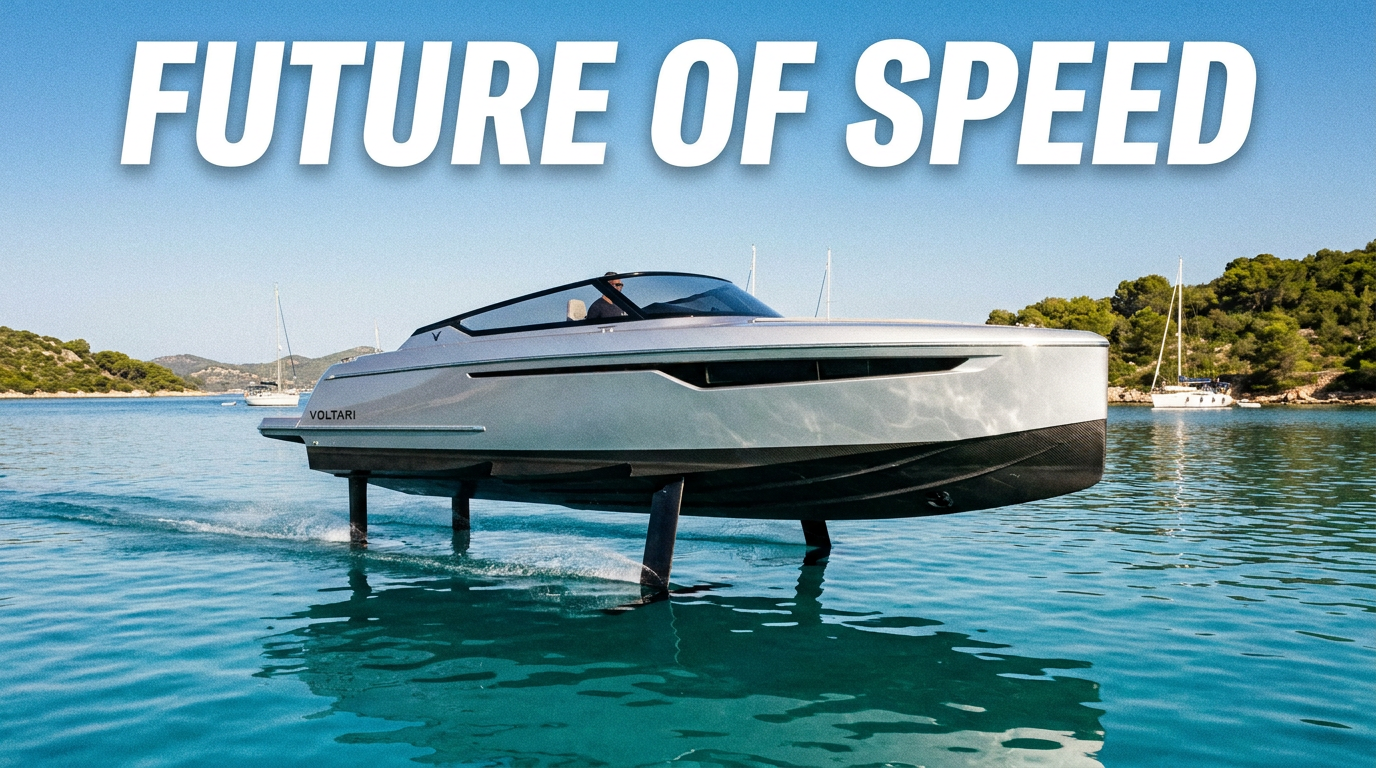
Hydrofoils are essentially underwater wings attached to struts beneath the hull. As the boat accelerates, water flows over these wings, generating upward lift in the exact same way an airplane wing generates lift in the air.[3]

Once the vessel reaches a critical speed—often around 16 to 18 knots—the entire hull rises above the surface. The boat literally flies over the water, leaving only the submerged foils and the propeller beneath the waves.[1][3]
This physical separation from the water's surface changes the entire energy equation. By eliminating the friction of the hull pushing through the water, hydrofoiling reduces energy consumption by up to 80 percent compared to a traditional planing boat.[2][5]
This drastic reduction in drag is what finally makes electric boating viable for long distances. A prime example is the Candela C-8, a Swedish-designed vessel that recently became the first electric boat to cross the Baltic Sea.[5]
During that historic crossing, the C-8 required only three charging stops. In stark contrast, the gasoline-powered chase boat trailing it had to refuel six times, burning through hundreds of euros of fossil fuels just to keep up.[5]
During that historic crossing, the C-8 required only three charging stops.
But keeping a boat balanced on underwater wings in choppy water is no simple task. It requires sophisticated, aerospace-grade technology that goes far beyond traditional marine engineering.[3]
Modern electric hydrofoils rely on advanced flight controllers and sensors that constantly read the water's surface ahead of the boat. These systems adjust the angle of the foils up to 100 times per second to maintain a perfectly level flight.[2]

The result is a radically different passenger experience. Because the hull flies above the waves rather than crashing through them, the ride is remarkably smooth, virtually eliminating the jarring impacts that cause seasickness.[2]
The environmental benefits extend far beyond zero tailpipe emissions. Traditional boats displace massive amounts of water, creating large wakes that erode shorelines and damage delicate marine ecosystems.[4]
Hydrofoiling vessels, by contrast, leave almost no wake behind them. Furthermore, the electric motors operate in near silence, drastically reducing the underwater noise pollution that disrupts the communication and navigation of marine life like whales and seals.[2][4][5]

The technology is now advancing rapidly thanks to cross-pollination with the automotive industry. Marine startups are partnering with electric vehicle manufacturers—such as Candela's collaboration with Polestar—to utilize high-capacity, automotive-grade batteries.[2][6]
Beyond luxury recreational boats, this technology is poised to revolutionize public transit. Companies like Navier and Candela are already developing and deploying electric hydrofoil passenger ferries for cities like Stockholm and San Francisco.[1][7]
These ferries promise to cut travel times by traveling at high speeds without creating damaging wakes in urban waterways. More importantly, they offer municipalities a way to cut annual operating costs by 60 to 70 percent due to the low maintenance of electric motors.[1]

Despite the rapid progress, challenges remain. The upfront cost of these vessels is currently much higher than their fossil-fueled counterparts, and marine fast-charging infrastructure is still in its infancy.[1]
How we got here
2019
Navier is founded to build America's first all-electric hydrofoiling vessel.
Aug 2022
Candela partners with Polestar to integrate automotive-grade batteries into marine vessels.
Oct 2024
The Candela C-8 becomes the first electric boat to cross the Baltic Sea.
Feb 2026
Canadian startup ENVGO secures funding for its NV1 electric hydrofoil cruiser.
2026
Anticipated launch of commercial electric hydrofoil ferry services in cities like Stockholm and Lake Tahoe.
Viewpoints in depth
Marine Innovators
Believes hydrofoiling is the only viable path to marine electrification.
This camp argues that applying automotive 'fuel tank' thinking to boats is a dead end due to water's extreme density. By removing the hull from the water entirely, they solve the range problem without needing impossibly heavy batteries. They view the integration of aerospace flight controllers as the key breakthrough that makes electric propulsion not just viable, but superior.
Environmental Advocates
Values the secondary ecological benefits beyond just zero emissions.
While cutting carbon emissions is the headline, these groups emphasize the elimination of wake and underwater noise. Traditional boat wakes erode shorelines and damage delicate ecosystems, while engine noise disrupts the communication of marine mammals like whales and seals. Hydrofoils solve both issues simultaneously, offering a truly 'leave no trace' approach to boating.
Commercial Transit Operators
Focused on the economic viability of electric ferries.
For municipalities and private ferry operators, the initial purchase price of a hydrofoil is offset by massive long-term savings. Electric hydrofoils cut annual operating costs by up to 70% due to cheaper 'fuel' and drastically lower maintenance needs for electric motors. They see this technology as a way to revitalize urban waterways without the noise and pollution of diesel ferries.
What we don't know
- How quickly marinas will adopt and install the high-speed DC fast chargers required for long-distance travel.
- Whether the high upfront manufacturing costs of carbon-fiber hydrofoils will decrease enough to reach mass-market consumers.
Key terms
- Hydrofoil
- A wing-like structure mounted below the hull of a boat that generates lift, raising the vessel out of the water.
- Drag
- The physical resistance a boat experiences as it pushes through the water, which requires significant energy to overcome.
- Flight Controller
- The onboard computer system that continuously adjusts the angle of the hydrofoils to maintain stability and altitude.
- Wake
- The waves created by a boat's hull displacing water as it moves, which can cause shoreline erosion.
Frequently asked
What is a hydrofoil boat?
A boat equipped with underwater wings that lift the hull out of the water at high speeds, significantly reducing drag.
How fast can electric hydrofoil boats go?
Many modern models cruise comfortably between 20 and 30 knots, or roughly 23 to 35 mph.
Do electric boats have enough range?
While traditional electric boats struggle with range due to water resistance, hydrofoils can travel 60 to 100 miles on a single charge by flying above the friction.
Can you get seasick on a hydrofoil?
It is much less likely, as the boat flies above the waves rather than crashing into them, creating a highly stable and smooth ride.
Sources
Source coverage
7 outlets
4 viewpoints surfaced







[1]Fast CompanyCommercial Operators
Racing along the Potomac River at 26 knots on a battery-electric Candela C-8 hydrofoil
Read on Fast Company →[2]The IndependentTraditional Boaters
Candela partners with Polestar to speed up mass market adoption of electric boats
Read on The Independent →[3]CP24Marine Innovators
A local startup is changing how boats move – by lifting them out of the water
Read on CP24 →[4]YachtWorldEnvironmental Advocates
The Future of Electric Boating: How Far Can Electric Boats Really Go?
Read on YachtWorld →[5]The Cool DownEnvironmental Advocates
Candela's C-8 hydrofoil becomes the first electric boat to cross the Baltic Sea
Read on The Cool Down →[6]Powerboat MagazineMarine Innovators
Everything Electric Sydney 2025: Marine electrification takes the spotlight
Read on Powerboat Magazine →[7]HackSummit NewsletterMarine Innovators
Navier pioneers high-performance, hydrofoiling electric boats
Read on HackSummit Newsletter →
More in automotive
See all 25 stories →EV Showdown
2026 Rivian R2 vs. Tesla Model Y: The Electric SUV Showdown
7 sources
Battery Tech
Sodium-Ion Batteries Enter Mass Production, Unlocking Cheaper, Winter-Proof EVs
7 sources

Battery Tech
Solid-State Batteries Cross the Commercial Threshold in 2026
7 sources

Battery Tech
Solid-State EV Batteries Move From Lab to Assembly Line in 2026
7 sources
Every angle. Every day.
Get automotive stories with full source coverage and perspective breakdowns delivered to your inbox.