
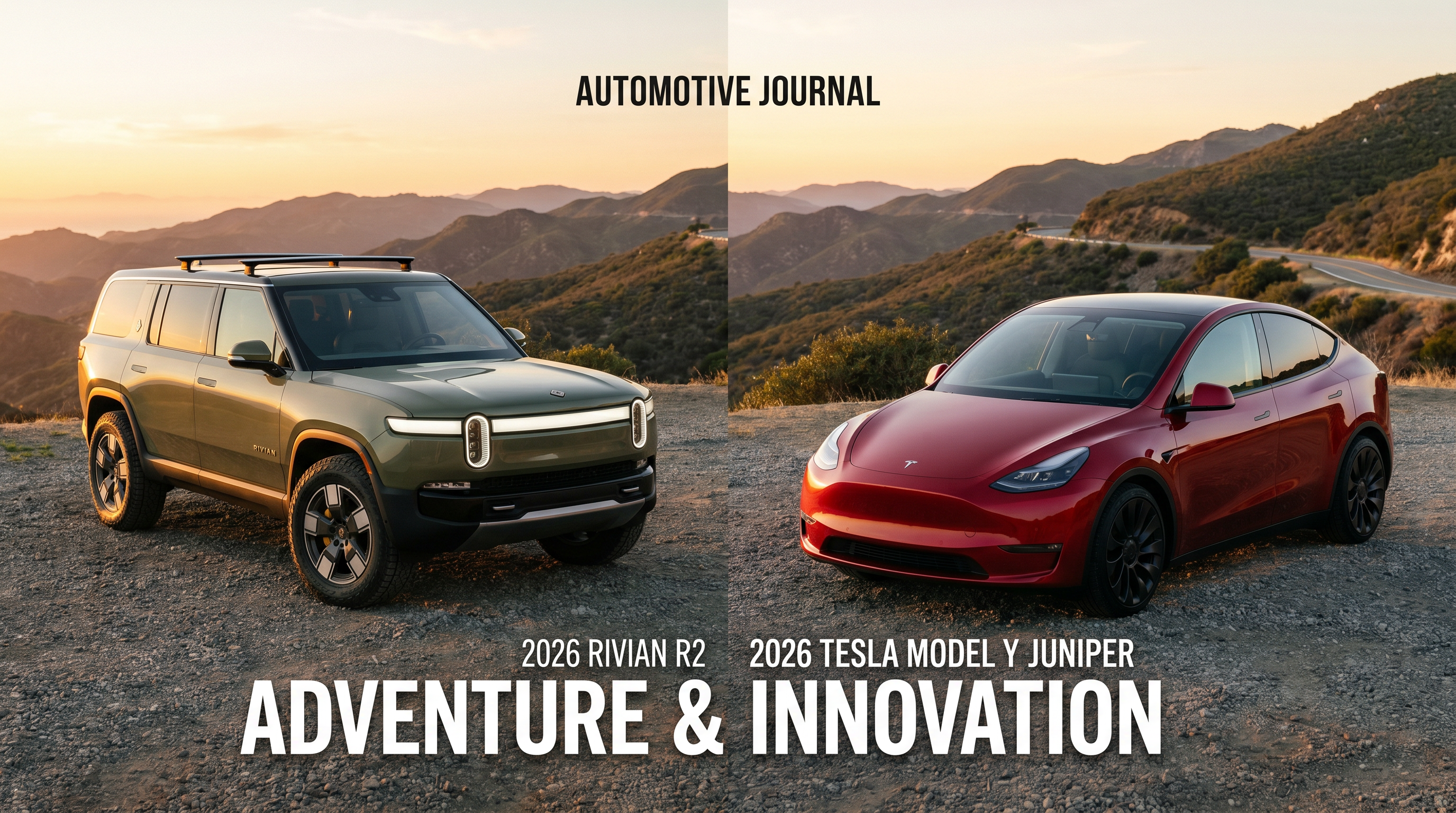
2026 Rivian R2 vs. Tesla Model Y Juniper: The Mid-Size Electric SUV Showdown
The highly anticipated 2026 Rivian R2 challenges the refreshed Tesla Model Y in a battle of rugged utility versus proven aerodynamic performance.
By Factlen Editorial Team
- Adventure & Utility Buyers
- Prioritizes off-road capability, ride comfort, and maximum interior cargo space for outdoor gear.
- Tech & Performance Loyalists
- Values sports-car handling, aerodynamic efficiency, and advanced driver-assistance software.
- Neutral Market Analysts
- Focuses on the pricing parity, charging infrastructure, and the broader market impact of Rivian challenging Tesla's dominance.
What's not represented
- · Budget-conscious buyers waiting for the $45,000 base models
- · Traditional legacy automakers losing market share to both brands
Why this matters
For years, the Tesla Model Y has been the default choice for families seeking a mid-size electric SUV, dominating global sales charts. The arrival of the Rivian R2 finally provides a viable, comparably priced alternative that trades teardrop aerodynamics for rugged utility, forcing buyers to choose between two distinct visions of the electric future.
Key points
- The 2026 Rivian R2 and Tesla Model Y Juniper Performance models both start at exactly $57,990.
- Tesla's Model Y offers sharper, sports-car-like handling and a highly refined software ecosystem.
- Rivian's R2 provides superior off-road capability, a softer ride, and a massive 90.1 cubic feet of cargo space.
- Despite its boxy shape, the R2 achieves an impressive 330 miles of range, slightly edging out the Model Y Performance.
- Both vehicles utilize a 400-volt architecture and can charge from 10% to 80% in roughly 30 minutes.
The mid-size electric SUV segment has long been a one-horse race, but the summer of 2026 has officially transformed it into a heavyweight title bout. Tesla's Model Y, fresh off its comprehensive "Juniper" update, is defending its position as the world's best-selling vehicle against a formidable new challenger: the highly anticipated Rivian R2. Both vehicles target the exact same demographic, boast nearly identical starting prices for their performance variants, and promise to handle everything from daily school runs to cross-country road trips. Yet, despite their shared mission of electrifying the American driveway, they approach the assignment from entirely different philosophical angles, setting up the most consequential automotive rivalry of the year.[2][5]
Tesla's updated Model Y Juniper refines a proven, highly successful formula, leaning heavily into aerodynamic efficiency, sports-car handling, and minimalist tech integration. Rivian, meanwhile, has scaled down its flagship R1 platform to create the R2, a boxy, trail-ready adventure vehicle that prioritizes interior space, rugged durability, and off-road capability. With the R2 Performance and the Model Y Performance both ringing in at exactly $57,990, buyers are no longer forced to choose based on budget constraints. Instead, the decision hinges entirely on lifestyle, aesthetic preferences, and how each driver weighs the specific trade-offs between on-road agility and off-road utility.[2][4][5]
When it comes to raw acceleration, both SUVs deliver staggering, supercar-level speed that completely belies their family-hauler status. The Tesla Model Y Performance utilizes an upgraded rear motor lifted directly from the new Model 3 Performance, generating 461 kilowatts of power to rocket from zero to 100 kilometers per hour in a blistering 3.5 seconds. The Rivian R2 Performance is right on its bumper, utilizing a potent dual-motor setup that produces 656 horsepower and 609 pound-feet of torque, achieving the 60 miles per hour sprint in 3.6 seconds. In real-world driving scenarios, the difference in straight-line speed is virtually imperceptible, meaning neither vehicle holds a definitive advantage when merging onto a fast-moving highway.[4][6]

However, the driving dynamics diverge sharply once the road begins to twist and the pavement quality degrades. The Model Y Juniper features a retuned suspension with adaptive dampers, stiffer bushings, and a 13-millimeter drop in ride height. It corners with flat, aggressive precision, feeling much more like a low-slung hot hatch than a two-ton utility vehicle. The trade-off is a ride quality that, while significantly improved over previous iterations, remains undeniably firm over broken pavement. The Rivian R2, by contrast, utilizes a traditional coil suspension over electronic dampers that excels at absorbing road imperfections. Reviewers consistently praise the R2 for its smooth, highly compliant ride that neatly rounds off bumps, though its slower steering ratio makes it feel noticeably less sporty on winding tarmac.[1][3][6]
The contrast in capability becomes even starker when the pavement ends and the dirt begins. The case for the Rivian R2 heavily features its impressive off-road geometry and rugged hardware. Equipped with 32-inch tires, a 115.6-inch wheelbase, and up to nine dedicated drive modes, the R2 is purpose-built to tackle challenging trail roads, steep inclines, and muddy tracks with ease. The Model Y, with its lower ground clearance, street-biased tires, and aerodynamic underbelly, is strictly a pavement performer. If your weekend plans frequently involve traversing rocky paths to reach a remote campsite or navigating deep snow, the Rivian holds an undisputed and significant advantage.[2][3][5]
The contrast in capability becomes even starker when the pavement ends and the dirt begins.
Efficiency and range present a surprising plot twist in this side-by-side comparison. Despite its boxy, aerodynamic-defying shape and heavier curb weight, the Rivian R2 Performance achieves an impressive EPA-estimated 330 miles of range when equipped with 21-inch wheels. This actually edges out the Model Y Performance, which sees its WLTP-rated range drop to roughly 360 miles (translating to a comparable EPA estimate that falls about 24 miles short of the Rivian). Rivian's powertrain engineering manages to extract remarkable efficiency from the new platform, achieving 109 MPGe and proving to skeptics that a rugged, upright aesthetic does not inherently have to ruin battery life.[2][4]
Charging infrastructure and replenishment speeds remain a critical battleground for prospective EV buyers. Both vehicles utilize a 400-volt electrical architecture, meaning neither can match the blistering 15-minute charge times of 800-volt competitors from Porsche or Hyundai. The Model Y maxes out at 250 kilowatts on a DC rapid charger, replenishing its battery from 10 to 80 percent in about 29 minutes. The Rivian R2, now natively utilizing the North American Charging Standard (NACS) port, pulls up to 240 kilowatts and achieves a similar 10 to 80 percent charge in just under 30 minutes. While Tesla's seamless Supercharger software integration remains the industry's gold standard, Rivian's direct access to the exact same network levels the playing field significantly for long-distance travel.[4][6]

Inside the cabin, the design philosophies clash once again, presenting buyers with vastly different environments. The argument for the Rivian R2 centers on its cavernous, highly flexible interior space. The R2 features seats that fold completely flat—including the front row—creating a massive 90.1 cubic feet of cargo space that practically transforms the SUV into a mobile tent. It also retains physical controls for essential functions like wipers and turn signals, features dual gloveboxes, and includes a dedicated driver's display behind the steering wheel. The resulting cabin feels light, airy, and distinctly house-like, prioritizing tactile usability.[1][2]
The evidence for the Tesla Model Y highlights its ultra-minimalist, tech-forward environment that feels more like a spaceship than a traditional car. The Juniper update introduces premium cloth fabric lining, metal speaker grilles, and wraparound RGB ambient lighting, noticeably elevating the cabin's luxury feel and sound dampening. However, it still relies almost entirely on the central 15-inch touchscreen for all vehicle functions, lacking a dedicated driver's display or physical air vent controls. While the Model Y offers a highly respectable 76 cubic feet of total cargo space, its seats do not fold as perfectly flat as the Rivian's, making it slightly less optimal for car-camping or hauling oversized furniture.[4][5]

Software and autonomous driving capabilities represent another major dividing line in this comparison. Tesla continues to double down on its camera-only Full Self-Driving (FSD) suite, which benefits from billions of miles of real-world training data and offers highly capable, albeit closely monitored, point-to-point navigation on city streets. Rivian takes a fundamentally different approach, equipping the R2 with a redundant suite of high-resolution cameras and radar sensors. Rivian argues this multi-layered hardware approach will eventually allow for safer, less supervised autonomous driving in the future, though Tesla's software currently remains more feature-rich and proven in daily operation.[4][5]
When synthesizing the trade-offs, the Tesla Model Y fits well when buyers prioritize sharp, sports-car-like handling, cutting-edge driver assistance software, and a sleek, aerodynamic aesthetic. It is the ideal choice for drivers who spend the majority of their time carving canyon roads or navigating dense urban environments, and who appreciate a minimalist, screen-centric interior. Its proven track record, ubiquitous presence, and highly refined software ecosystem offer a safe, predictable ownership experience that requires zero compromises for daily commuting. If you view your vehicle as an extension of your smartphone and rarely venture off paved roads, the Model Y remains the undisputed champion of the segment.[3][6]

Conversely, the Rivian R2 fits well when buyers demand rugged utility, superior ride comfort over broken pavement, and maximum cargo flexibility. It is the superior choice for outdoor enthusiasts who actually venture off-road, families who need cavernous interior space for bulky gear, and drivers who prefer the tactile feedback of a dedicated instrument cluster and physical stalks. The R2 proves that you no longer have to sacrifice electric efficiency to drive a vehicle that looks and acts like a traditional SUV. If your weekends involve dirt trails and you value a softer, more compliant daily ride, the R2 is the definitive upgrade.[1][2][4]
How we got here
Early 2020
Tesla begins deliveries of the original Model Y, which quickly becomes the best-selling EV globally.
March 2024
Rivian officially unveils the R2, promising a smaller, more affordable alternative to its flagship R1S.
Late 2025
Tesla rolls out the 'Juniper' update for the Model Y, featuring interior upgrades, retuned suspension, and a refreshed exterior.
June 2026
Rivian begins mass deliveries of the R2 Performance model, initiating the first direct head-to-head sales battle with the Model Y.
Viewpoints in depth
The Utility Advocate's View
Arguing that the R2's boxy design and off-road chops make it the superior everyday vehicle.
For drivers who value practicality over lap times, the Rivian R2 is seen as the long-awaited antidote to the teardrop-shaped EV crossover trend. Proponents highlight that the R2's upright greenhouse provides excellent outward visibility and a cabin that feels significantly more spacious than its footprint suggests. The ability to fold all seats completely flat turns the vehicle into a versatile tool for hauling lumber, camping gear, or even sleeping inside. Furthermore, the softer, more compliant suspension tuning is viewed as a massive advantage for daily driving on pothole-ridden city streets, where the Model Y's firm, sporty ride can become fatiguing.
The Performance Purist's View
Maintaining that the Model Y's handling and software integration remain unmatched.
Those who favor the Tesla Model Y argue that it remains the benchmark for how an electric vehicle should drive on pavement. The Juniper update's stiffer bushings and lower ride height give the Model Y a level of cornering grip and steering precision that the taller, softer Rivian simply cannot match. Beyond physical handling, this camp points to Tesla's software ecosystem as a decisive factor. The seamless integration of route planning, battery preconditioning, and the advanced capabilities of the camera-only Full Self-Driving suite create a frictionless ownership experience that newer automakers are still struggling to replicate.
What we don't know
- How the Rivian R2's long-term reliability will compare to the mature Model Y platform.
- Whether Rivian's radar-and-camera autonomous suite will eventually surpass Tesla's camera-only FSD in real-world capability.
Key terms
- NACS (North American Charging Standard)
- The charging plug design originally developed by Tesla, which has now been adopted by most major automakers, including Rivian, for seamless use of the Supercharger network.
- 400-Volt Architecture
- The electrical system standard used by both the Model Y and R2, which dictates maximum charging speeds, typically requiring about 30 minutes to charge from 10% to 80%.
- MPGe (Miles Per Gallon Equivalent)
- A metric used by the EPA to compare the energy consumption of electric vehicles to the fuel economy of traditional gas-powered cars.
- Adaptive Dampers
- Suspension components that electronically adjust their stiffness in real-time to balance ride comfort with sporty handling.
Frequently asked
Which SUV is faster from 0 to 60 mph?
The Tesla Model Y Performance is slightly faster, hitting 60 mph in 3.5 seconds, while the Rivian R2 Performance takes 3.6 seconds.
Does the Rivian R2 have more range than the Model Y?
Yes, the Rivian R2 Performance achieves an EPA-estimated 330 miles of range, which is roughly 24 miles more than the Model Y Performance.
Can the Rivian R2 use Tesla Superchargers?
Yes, the 2026 Rivian R2 natively features the North American Charging Standard (NACS) port, allowing it to plug directly into Tesla Superchargers.
Which vehicle has more cargo space?
The Rivian R2 offers up to 90.1 cubic feet of space with the seats folded flat, compared to the Model Y's 76 cubic feet.
Sources
Source coverage
6 outlets
3 viewpoints surfaced






[1]Top GearAdventure & Utility Buyers
Rivian R2 (US) Review 2026
Read on Top Gear →[2]CarBuzzNeutral Market Analysts
All The Ways The Rivian R2 Performance Beats Tesla's Top Model Y
Read on CarBuzz →[3]CarwowTech & Performance Loyalists
Rivian R2 vs Tesla Model Y: which electric SUV does Mat Watson prefer?
Read on Carwow →[4]ElectrekTech & Performance Loyalists
Rivian R2 First Drive: This is everything I need to upgrade my Model Y except...
Read on Electrek →[5]ForbesNeutral Market Analysts
Rivian R2 Is Imminent: How It Stacks Up Against The Tesla Model Y
Read on Forbes →[6]Motor1Adventure & Utility Buyers
I Drove The Rivian R2, The Model Y's First Real Threat
Read on Motor1 →
More in automotive
See all 25 stories →EV Showdown
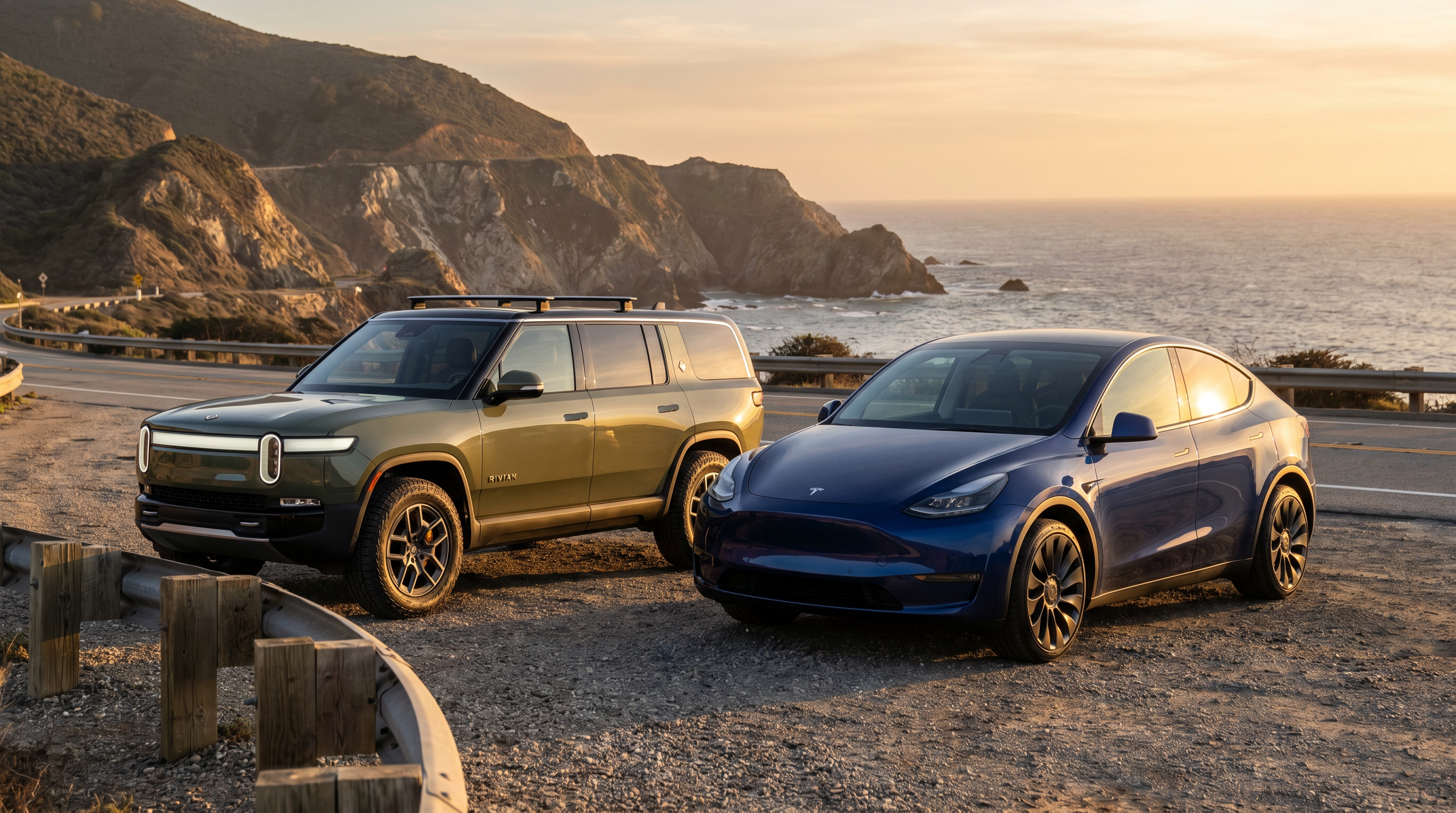
2026 Rivian R2 vs. Tesla Model Y: The Electric SUV Showdown
7 sources
Battery Tech
Sodium-Ion Batteries Enter Mass Production, Unlocking Cheaper, Winter-Proof EVs
7 sources
Battery Tech
Solid-State Batteries Cross the Commercial Threshold in 2026
7 sources

Battery Tech
Solid-State EV Batteries Move From Lab to Assembly Line in 2026
7 sources
Every angle. Every day.
Get automotive stories with full source coverage and perspective breakdowns delivered to your inbox.