
2026 Rivian R2 vs. Tesla Model Y: The Electric SUV Showdown
The highly anticipated Rivian R2 brings rugged off-road capability and massive cargo space to challenge the Tesla Model Y's dominance in the midsize electric SUV market.
By Factlen Editorial Team
- Off-Road & Adventure Enthusiasts
- Prioritizes ground clearance, cargo space, rugged styling, and trail capability.
- On-Road Performance Advocates
- Prioritizes sporty handling, aerodynamics, proven charging infrastructure, and lower ride height.
- Practical Family Buyers
- Focuses on price-per-horsepower, total cabin volume, frunk space, and everyday usability.
What's not represented
- · Legacy Automaker Executives
- · EV Service Technicians
Why this matters
For years, the Tesla Model Y has been the default choice for buyers wanting a practical electric crossover. The arrival of the Rivian R2 finally gives consumers a viable, similarly priced alternative that prioritizes rugged utility and cargo space over aerodynamic street performance.
Key points
- The Rivian R2 and Tesla Model Y occupy a similar footprint but feature vastly different designs.
- The R2 offers 9.6 inches of ground clearance, making it genuinely off-road capable.
- Despite its boxy shape, the R2 Performance slightly beats the Model Y Performance in EPA efficiency.
- The R2 provides 90.1 cubic feet of cargo space with seats folded, compared to the Model Y's 76 cubic feet.
- The Model Y retains an edge in sporty on-road handling and immediate access to the Supercharger network.
- Base $45,000 trims for the R2 are expected to launch in late 2027.
The electric SUV landscape in 2026 has officially entered a new era with a heavyweight matchup that buyers have been anticipating for years. For the better part of a decade, the Tesla Model Y has dominated the market, eventually becoming the best-selling vehicle globally across all powertrain types. It established the benchmark for range, charging convenience, and minimalist tech. But Rivian’s highly anticipated R2 has finally arrived on the streets, aiming squarely at Tesla’s crown. Priced competitively around the $45,000 mark for its base trims, the R2 represents the first genuine threat from a fellow EV pioneer rather than a legacy automaker.[6][7]
The stakes for this comparison are incredibly high. While legacy automakers have repeatedly tried and failed to produce a true "Tesla killer"—often falling short on software, efficiency, or charging infrastructure—Rivian brings a fundamentally different approach to the segment. Instead of mimicking Tesla’s teardrop aerodynamics and street-focused performance, the R2 leans heavily into rugged, traditional SUV styling. It offers a distinct alternative for buyers who want genuine adventure capability without sacrificing everyday electric efficiency. This divergence in philosophy means buyers are no longer just choosing between two brands; they are choosing between two completely different visions of what a modern electric crossover should be.[6][7]
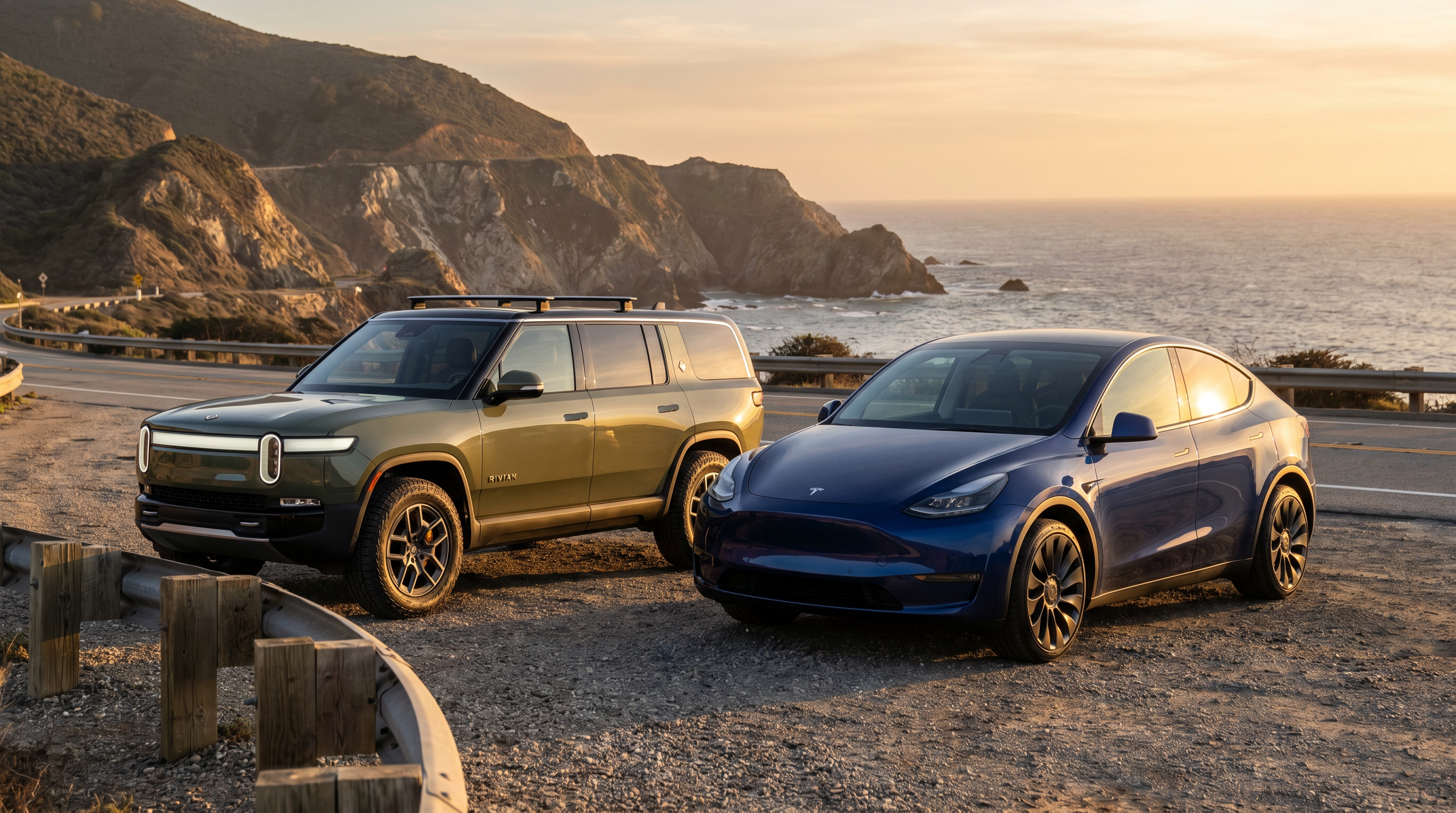
When parked side-by-side, the two vehicles occupy a strikingly similar physical footprint, sharing a nearly identical turning radius of roughly 19.9 feet and a wheelbase separated by less than two inches. However, their design philosophies dictate how that space is utilized. The Model Y prioritizes aerodynamic slipperiness with its sloped, coupe-like roofline, which helps it cut through the wind but compromises rear headroom and cargo height. The R2, meanwhile, opts for a taller, boxier greenhouse with an upright rear end. This design sacrifices some aerodynamic sleekness in exchange for a commanding driving position, significantly more interior volume, and that distinctive, rugged Rivian aesthetic.[3][4]
The most glaring physical difference between the two models is their ground clearance, which tells you everything you need to know about their intended use cases. The Rivian R2 boasts a towering 9.6 inches of clearance, representing a massive 60 percent advantage over the Model Y’s 6.0 inches. Combined with 32-inch all-terrain tires, a 25-degree approach angle, and a 26-degree departure angle, the R2 is genuinely trail-capable. It can tackle rutted dirt roads and rocky inclines with ease. The Model Y, by contrast, is strictly an on-road crossover; taking it on anything more challenging than a flat gravel driveway risks damaging its undercarriage.[2][3]

Given the R2’s boxy shape, upright stance, and an extra 370 pounds of curb weight, one might expect it to suffer a massive penalty in energy efficiency. Surprisingly, Rivian’s powertrain engineering has closed the gap. According to the EPA, the R2 Performance achieves a remarkable 109 MPGe combined rating, actually edging out the Model Y Performance’s 104 MPGe. Seeing a vehicle with real off-road geometry and a blunt front fascia beat Tesla’s notoriously efficient teardrop design is a testament to the advancements in Rivian’s new vehicle platform and battery management software.[3]
When looking at total driving range, both vehicles offer exceptional numbers that easily alleviate range anxiety. The R2 Performance, when equipped with 21-inch wheels, promises up to 330 miles on a full charge. This gives it a slight 24-mile advantage over the 2026 Model Y Performance, which tops out at 306 miles. In practical terms, the EPA estimates that both models will cost roughly $700 annually to keep charged for the average driver. While the Model Y’s Long Range variant remains a benchmark for highway cruising, the R2 proves that buyers no longer have to sacrifice range to get a rugged, off-road-capable SUV.[2]

Inside the cabin, the two EVs take radically different approaches to interior minimalism. The Model Y features a stark, ultra-clean interior centered entirely around a single 15-inch touchscreen. It has often been compared to a minimalist bachelor apartment—functional, tidy, but lacking in textural warmth. The Rivian R2 introduces a multi-layered dashboard with premium, funky materials that feel more like a designer loft. Crucially, the R2 retains a dedicated digital driver’s display behind the steering wheel, meaning drivers do not have to glance toward the center screen to check their speed or remaining range, a persistent complaint among Tesla owners.[1][5]
Inside the cabin, the two EVs take radically different approaches to interior minimalism.
When it comes to hauling gear, the Rivian’s boxy shape pays massive dividends. With the rear seats folded completely flat, the R2 offers up to 90.1 cubic feet of total cargo space, effectively transforming the SUV into a cavernous cargo van. This is a 19 percent increase over the Model Y’s 76 cubic feet of maximum cargo capacity. Furthermore, the R2 features a larger 5.2-cubic-foot frunk, compared to the Model Y’s 4.1 cubic feet. For families packing for a week-long camping trip or hauling large pieces of furniture, the R2’s superior volume and flatter load floor provide a distinct advantage.[2][3][5]
Despite trailing in sheer cargo volume, the Model Y remains an incredibly practical vehicle for everyday family duties. Its 76 cubic feet of space is still highly competitive within the midsize crossover segment, and Tesla has mastered the art of hidden storage. The Model Y features a deep sub-trunk beneath the rear cargo floor, perfect for hiding valuables or storing muddy shoes, along with deep side pockets. While it may not swallow a massive piece of plywood as easily as the R2, the Model Y’s storage solutions are more than adequate for grocery runs, sports equipment, and standard luggage.[2][3]

On the pavement, the Tesla Model Y retains the edge for drivers seeking a sporty, engaging feel. Its lower center of gravity, firmer suspension tuning, and highly direct steering make it genuinely fun to hustle down a twisty backroad. The trade-off for this athleticism is a ride quality that can feel overly stiff and unforgiving on broken pavement or potholes. The R2, by contrast, exhibits more body roll due to its taller ride height, but it offers an eerily quiet, relaxed ride that excels at ironing out highway bumps, making it a superior long-distance cruiser for those who prioritize comfort over cornering speed.[1][7]
Both vehicles are packed with cutting-edge technology and driver-assistance features, but they approach the software experience differently. Tesla’s Autopilot and its seamless integration with the ubiquitous Supercharger network remain the industry gold standard for frictionless road-tripping. Rivian counters with its new Autonomy+ AI software, utilizing a robust suite of cameras and radar for highway driving assistance. Rivian also promises blazing-fast charging speeds, claiming the R2 can reach an 80 percent charge in just 29 minutes at a DC fast charger, keeping it highly competitive with Tesla’s charging curve on long journeys.[2][6]
When weighing the arguments against the Model Y in 2026, the primary criticisms revolve around its ubiquity and ride comfort. Because it has been the best-selling car in the world, its teardrop styling blends into the crowd, lacking the standout factor that many EV buyers still desire. Additionally, its firm suspension can be jarring on rough city streets, and the absolute lack of physical buttons or a driver-facing instrument cluster continues to alienate buyers who prefer a more traditional, tactile interface for basic vehicle functions.[1][5]
Conversely, the arguments against the Rivian R2 center on availability and long-term brand infrastructure. While the high-end Performance models are hitting the streets in mid-2026, the highly anticipated $45,000 base models won't be widely available until late 2027, forcing budget-conscious buyers to wait. Furthermore, while Rivian is rapidly expanding its service centers and charging network, it still cannot match Tesla’s massive, globally established footprint. Buyers in rural areas may find Tesla’s proven service ecosystem more reassuring than Rivian’s growing but smaller network.[6]

Ultimately, the Tesla Model Y fits perfectly for buyers who prioritize sporty on-road handling, aerodynamic efficiency, and immediate access to the world’s most reliable charging network. It remains the default, frictionless choice for those who want a proven EV ownership experience, value a lower step-in height, and have no intentions of taking their vehicle off the pavement. Its zippy infotainment and unmatched Supercharger integration make it a stress-free daily driver that continues to justify its massive popularity.[1][5]
On the other hand, the Rivian R2 is the ideal choice for outdoor enthusiasts and families who need maximum cargo space, genuinely plan to venture onto dirt trails, and desire a rugged, distinct aesthetic. It successfully translates the adventure-ready spirit of the larger R1S into a more accessible, highly efficient package. If you value a comfortable highway ride, a dedicated driver's display, and the ability to confidently clear rocks and ruts, the R2 proves that you no longer have to buy a gas-guzzler to get a true utility vehicle.[1][4][7]
How we got here
2020
Tesla begins deliveries of the Model Y, which eventually becomes the world's best-selling vehicle.
March 2024
Rivian officially unveils the R2 midsize SUV, targeting the $45,000 price point.
Early 2026
First drives and EPA ratings for the Rivian R2 are released, confirming its high efficiency.
Mid 2026
Rivian begins initial customer deliveries of the higher-end R2 Performance models.
Late 2027
The entry-level $45,000 Rivian R2 trims are scheduled to become widely available.
Viewpoints in depth
Off-Road & Adventure Enthusiasts
Prioritizes ground clearance, trail capability, and rugged styling.
For this camp, the Rivian R2 is the clear winner. They point to the R2's 9.6 inches of ground clearance, 32-inch all-terrain tires, and dedicated approach and departure angles as proof that it is a true utility vehicle. They argue that the Model Y's 6.0-inch clearance makes it strictly a pavement cruiser, whereas the R2 unlocks access to trailheads, campsites, and rutted dirt roads without range anxiety.
On-Road Performance Advocates
Values sporty handling, aerodynamics, and proven charging infrastructure.
This perspective favors the Tesla Model Y for its sports-car-like driving dynamics. They highlight the Model Y's lower center of gravity, firmer suspension, and teardrop aerodynamics, which make it significantly more engaging to drive on twisty roads. Furthermore, they emphasize that Tesla's Supercharger network remains the most reliable and frictionless way to travel long distances, giving the Model Y a distinct advantage for highway road-trippers.
Practical Family Buyers
Focuses on total cabin volume, everyday usability, and value.
Family-focused buyers weigh the R2's massive 90.1 cubic feet of cargo space and larger frunk against the Model Y's immediate availability and proven reliability. While they appreciate the R2's ability to swallow large pieces of furniture or camping gear, some remain cautious about Rivian's smaller service footprint compared to Tesla's established global network, especially since the $45,000 base R2 won't be widely available until late 2027.
What we don't know
- How the Rivian R2's long-term reliability will compare to the mature Tesla Model Y platform.
- Whether Rivian's expanding charging and service network will be robust enough to support mass-market R2 adoption by 2027.
Key terms
- MPGe
- Miles Per Gallon Equivalent, a metric used by the EPA to compare the energy efficiency of electric vehicles to traditional gas cars.
- Frunk
- A front trunk, utilizing the space where a traditional gas engine would normally sit to provide extra cargo storage.
- Approach Angle
- The maximum angle of a ramp or obstacle a vehicle can climb from a flat surface without the front bumper hitting the ground.
- Teardrop Aerodynamics
- A vehicle design shape that tapers at the rear to minimize wind resistance and maximize highway efficiency.
Frequently asked
Which vehicle has more cargo space?
The Rivian R2 offers 90.1 cubic feet with the seats folded flat, compared to the Model Y's 76 cubic feet.
Is the Rivian R2 actually better off-road?
Yes. The R2 features 9.6 inches of ground clearance, 32-inch tires, and dedicated off-road geometry, whereas the Model Y is designed primarily for pavement.
Which EV is more efficient?
Surprisingly, the EPA rates the boxier R2 Performance at 109 MPGe, slightly edging out the Model Y Performance's 104 MPGe.
When can I buy the $45,000 Rivian R2?
While the more expensive Performance trims launch in mid-2026, the entry-level $45,000 models are expected to arrive in late 2027.
Sources
Source coverage
7 outlets
3 viewpoints surfaced







[1]CarwowOn-Road Performance Advocates
Rivian R2 vs Tesla Model Y: which is better?
Read on Carwow →[2]CarBuzzOff-Road & Adventure Enthusiasts
Here's Every Way The Rivian R2 Beats The Tesla Model Y
Read on CarBuzz →[3]ElectrekPractical Family Buyers
Rivian R2 vs Tesla Model Y spotted side-by-side: Detailed size comparison
Read on Electrek →[4]CarsDirectPractical Family Buyers
2027 Rivian R2 vs 2026 Tesla Model Y
Read on CarsDirect →[5]AutoblogOn-Road Performance Advocates
Rivian R2 vs Tesla Model Y: How they compare on paper
Read on Autoblog →[6]ForbesOff-Road & Adventure Enthusiasts
Rivian R2 Is Imminent: How It Stacks Up Against The Tesla Model Y
Read on Forbes →[7]Motor1Off-Road & Adventure Enthusiasts
2027 Rivian R2 First Drive Review
Read on Motor1 →
More in automotive
See all 24 stories →Battery Tech
Sodium-Ion Batteries Enter Mass Production, Unlocking Cheaper, Winter-Proof EVs
7 sources
Battery Tech
Solid-State Batteries Cross the Commercial Threshold in 2026
7 sources

Battery Tech
Solid-State EV Batteries Move From Lab to Assembly Line in 2026
7 sources
EV Battery Health
The Science of EV Battery Health: Why Your Car Will Likely Outlast Its Power Pack
9 sources
Every angle. Every day.
Get automotive stories with full source coverage and perspective breakdowns delivered to your inbox.