
How Next-Generation Geothermal Energy Works
By borrowing advanced drilling techniques from the oil and gas industry, enhanced geothermal systems are unlocking 24/7 clean energy from the Earth's crust.
By Factlen Editorial Team
- Geothermal Developers
- Argue that repurposing oil and gas technology allows geothermal to scale rapidly into a dominant baseload power source.
- Grid Planners & Researchers
- Value geothermal for its firm, 24/7 generation profile that perfectly complements intermittent renewables.
- Seismic Monitors
- Caution that injecting high-pressure fluids deep underground carries risks of induced seismicity that require strict oversight.
What's not represented
- · Local communities living near proposed geothermal drilling sites
- · Fossil fuel executives viewing geothermal as either a threat or a transition opportunity
Why this matters
As the world shifts away from fossil fuels, electrical grids desperately need a clean power source that runs 24/7. Next-generation geothermal could solve the intermittency problem of wind and solar, providing reliable baseload power from virtually anywhere on the planet.
Key points
- Traditional geothermal is limited to rare geological hotspots with natural heat, fluid, and permeability.
- Enhanced Geothermal Systems (EGS) create artificial reservoirs by fracturing hot, dry rock.
- EGS borrows horizontal drilling and fiber-optic sensing techniques from the oil and gas industry.
- Fervo Energy's Cape Station in Utah is slated to deliver 100 megawatts of EGS power by October 2026.
- Superhot rock technologies aim to reach supercritical temperatures for exponentially higher energy yields.
- Geothermal provides 24/7 baseload power, solving the intermittency problem of wind and solar.
The clean energy transition has a "firm power" problem. While solar and wind generation have plummeted in cost, they remain inherently intermittent. Batteries can bridge short gaps, but long-duration storage remains prohibitively expensive. To fully decarbonize, the electrical grid requires a clean, baseload power source that operates 24 hours a day, regardless of the weather.[7]
The solution may lie miles beneath our feet. The Earth's core acts as an inexhaustible nuclear reactor, radiating immense heat outward through the crust. Yet, despite this virtually limitless energy source, geothermal power currently supplies less than one percent of global electricity demand.[1]
Historically, geothermal plants have been constrained by a rare geological trifecta. To generate power, traditional facilities require high subsurface heat, naturally occurring underground fluid, and permeable rock to allow that fluid to flow. This limits conventional geothermal development to specific tectonic hotspots, such as Iceland or the geyser fields of California.[1][5]
Enter "next-generation" geothermal. A suite of emerging technologies is attempting to engineer the subsurface, creating artificial reservoirs where natural ones do not exist. The most prominent and commercially advanced of these approaches is the Enhanced Geothermal System, or EGS.[1][5]

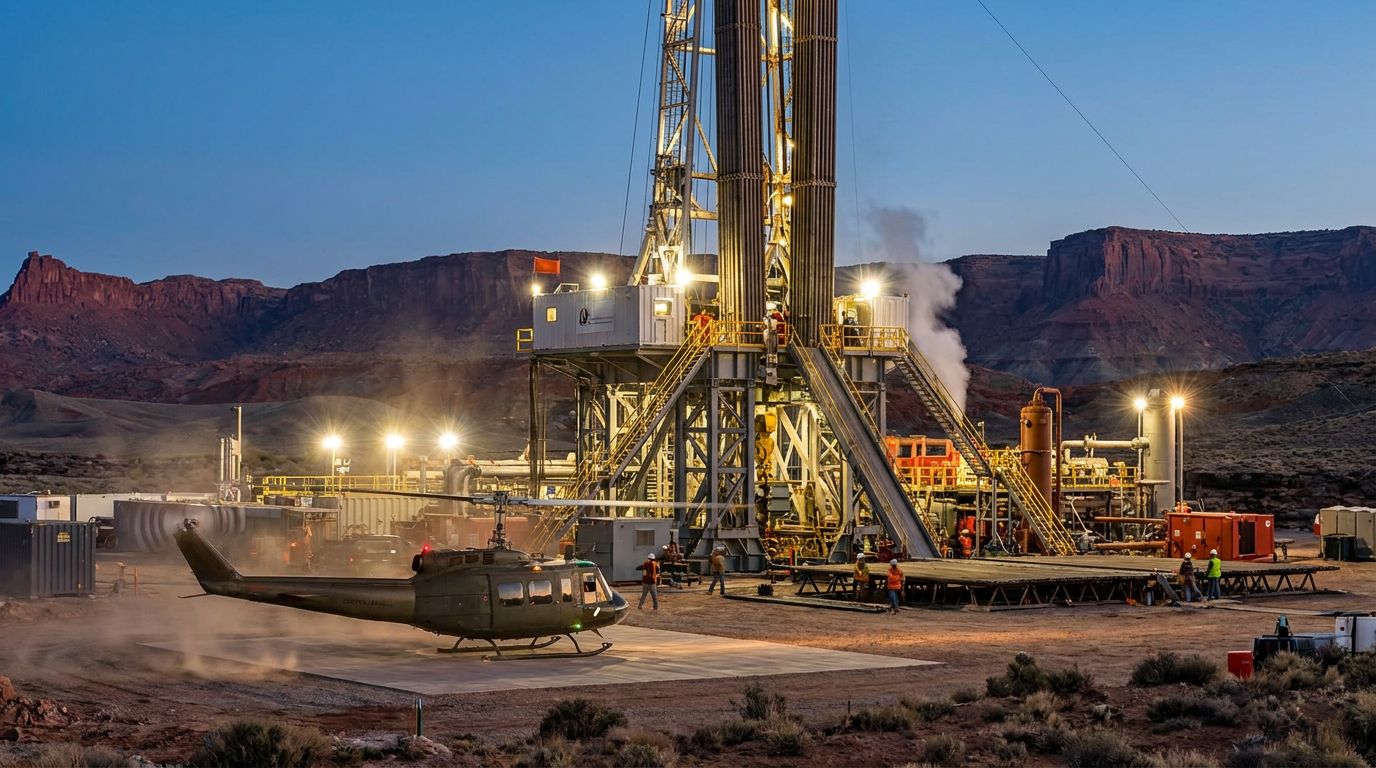
EGS borrows heavily from the technological advancements of the fossil fuel industry. Engineers drill thousands of feet down into hot, dry rock, then turn the drill bit to run horizontally for miles. Using high-pressure water, they fracture the surrounding rock to create a highly permeable, artificial network.[3][5]
Once the fracture network is established, cold water is pumped down an injection well. As the water is forced through the artificial fissures, it absorbs the Earth's ambient heat. The superheated fluid is then drawn up a parallel production well to the surface, where it spins a turbine to generate electricity before being cooled and reinjected in a continuous, closed loop.[1][5]
This concept is rapidly moving from theory to commercial reality. Fervo Energy, a Houston-based startup, is currently constructing Cape Station in Beaver County, Utah. Backed by over $1.5 billion in total funding—including a recent $421 million financing package—Cape Station is slated to deliver its first 100 megawatts to the grid in October 2026.[3][6]
This concept is rapidly moving from theory to commercial reality.
Fervo's operational success relies on fiber-optic sensing and horizontal drilling techniques perfected during the shale oil boom. By leveraging the existing oil and gas supply chain and workforce, the company has dramatically reduced the time and capital required to drill complex geothermal wells.[3][6]

Beyond EGS, the industry is also exploring Advanced Geothermal Systems (AGS). Instead of fracturing the rock to allow fluid flow, AGS functions like a massive underground radiator. Sealed, closed-loop pipes are embedded directly into hot rock, and a working fluid circulates entirely within the pipe, absorbing heat via conduction.[5]
Because AGS does not require fluid to interact directly with the rock formation, it eliminates the need for water-intensive fracturing and significantly reduces geological uncertainty. However, these closed-loop systems currently face engineering challenges regarding heat transfer efficiency compared to open-fracture models.[5][7]
The ultimate frontier for the industry is "superhot rock" geothermal. By drilling even deeper to reach temperatures exceeding 375 degrees Celsius, water enters a supercritical state—behaving simultaneously as a liquid and a gas. This supercritical fluid can carry exponentially more energy, potentially yielding up to ten times the power output of a standard geothermal well.[1][4]
Reaching those extreme depths requires entirely new drilling paradigms, as traditional mechanical bits degrade rapidly in superhot environments. MIT spinout Quaise Energy is developing millimeter-wave drilling technology, which uses directed microwave energy to literally vaporize crystalline rock, bypassing the mechanical limits of conventional drilling.[4]

If these next-generation technologies can scale, their impact on the electrical grid would be transformative. A 2025 study published by Princeton University researchers found that EGS could supply up to 20 percent of all United States electricity by 2050, deploying over 250 gigawatts of capacity if drilling costs continue their downward trajectory.[2]
However, the path forward is not without friction. EGS requires massive upfront capital, and drilling deep into the Earth's crust carries inherent financial risk if a well underperforms. Furthermore, the hydraulic fracturing process can cause induced seismicity—small earthquakes that require strict monitoring, regulatory oversight, and transparent community management.[7]
How we got here
2006
MIT publishes a seminal report outlining the massive potential of Enhanced Geothermal Systems.
2021
The U.S. Department of Energy launches major funding initiatives to commercialize EGS technology.
2023
Fervo Energy's Project Red completes a successful 30-day commercial pilot, proving the viability of horizontal geothermal drilling.
March 2026
Fervo Energy secures $421 million to expand its Cape Station project in Utah.
October 2026
Cape Station is scheduled to deliver its first 100 megawatts of commercial power to the grid.
Viewpoints in depth
Geothermal Developers
Industry pioneers believe repurposing fossil fuel technology is the key to rapid scaling.
Geothermal startups and their financial backers argue that the industry's breakthrough moment has arrived precisely because it stopped trying to invent new tools and started borrowing from the oil and gas sector. By utilizing the horizontal drilling rigs, fiber-optic sensors, and hydraulic fracturing techniques perfected during the shale boom, developers can drastically cut costs and timelines. They view EGS not as an experimental science project, but as a mature engineering challenge that can be scaled globally using an existing, highly trained workforce.
Grid Planners & Researchers
Energy experts value geothermal for its ability to stabilize a renewable-heavy grid.
For policymakers and utility operators, the appeal of next-generation geothermal lies in its generation profile. Wind and solar are cheap but intermittent, requiring massive investments in battery storage or natural gas peaker plants to keep the lights on when the weather doesn't cooperate. Geothermal provides "firm" baseload power—running 24 hours a day, 365 days a year. Researchers emphasize that even a modest deployment of EGS could significantly reduce the total cost of decarbonizing the grid by eliminating the need for expensive, long-duration energy storage.
Seismic & Environmental Monitors
Regulators emphasize the need to carefully manage the physical risks of subsurface engineering.
While the carbon benefits of EGS are clear, environmental monitors and geologists caution that engineering the subsurface carries inherent risks. Pumping high-pressure fluids deep underground to fracture rock can trigger induced seismicity—minor earthquakes that, if mismanaged, can cause surface damage and erode public trust. These voices advocate for strict regulatory oversight, continuous seismic monitoring, and transparent community engagement to ensure that the rush to deploy clean energy does not create new environmental hazards.
What we don't know
- Whether the cost of drilling deep, hard-rock wells will fall fast enough to make geothermal cost-competitive with cheap solar and wind.
- How effectively developers can mitigate the risk of induced seismicity when fracturing rock near populated areas.
- If superhot rock technologies, like millimeter-wave drilling, can successfully transition from laboratory environments to commercial deployment.
Key terms
- Enhanced Geothermal System (EGS)
- A man-made underground reservoir created by fracturing hot, dry rock to allow fluid to circulate and extract heat.
- Advanced Geothermal System (AGS)
- A closed-loop system where fluid circulates through sealed underground pipes to absorb heat via conduction, without fracturing the rock.
- Supercritical Fluid
- A state of matter achieved at extreme temperatures and pressures where a substance exhibits properties of both a liquid and a gas, allowing for massive energy transfer.
- Baseload Power
- The minimum amount of electric power needed to be supplied to the electrical grid at any given time, requiring 24/7 reliability.
- Induced Seismicity
- Minor earthquakes and tremors caused by human activity, such as injecting high-pressure fluids into the Earth's crust.
Frequently asked
What is the difference between EGS and traditional geothermal?
Traditional geothermal relies on naturally occurring underground pools of hot water and steam. Enhanced Geothermal Systems (EGS) create artificial reservoirs by fracturing hot, dry rock and pumping water through it.
Does next-generation geothermal use fracking?
Yes, EGS uses a form of hydraulic fracturing to create permeability in solid rock. However, it primarily uses water rather than the chemical cocktails often associated with oil and gas fracking.
Can geothermal energy be built anywhere?
Theoretically, the Earth's crust is hot everywhere if you drill deep enough. However, current technology focuses on regions where hot rock is closer to the surface to keep drilling costs manageable.
What is superhot rock geothermal?
It involves drilling into rock hotter than 375°C, where water becomes 'supercritical'—a state between liquid and gas that can carry significantly more energy to the surface.
Sources
Source coverage
7 outlets
3 viewpoints surfaced







[1]U.S. Department of EnergyGrid Planners & Researchers
Enhanced Geothermal Systems (EGS)
Read on U.S. Department of Energy →[2]Princeton UniversityGrid Planners & Researchers
Enhanced geothermal could supply 20% of US electricity by 2050
Read on Princeton University →[3]Canary MediaGeothermal Developers
Fervo nabs $462M to complete massive next-gen geothermal project
Read on Canary Media →[4]MIT Energy InitiativeGrid Planners & Researchers
MIT innovations advancing next-generation geothermal
Read on MIT Energy Initiative →[5]VallourecGeothermal Developers
Enhanced Geothermal Systems (EGS) Explained
Read on Vallourec →[6]Carbon CreditsGeothermal Developers
Fervo Energy's $421M Breakthrough and The Rise of Geothermal Power
Read on Carbon Credits →[7]Factlen Editorial TeamSeismic Monitors
Synthesis by Factlen editorial team
Read on Factlen Editorial Team →

More in guides
See all 5 stories →


Every angle. Every day.
Get guides stories with full source coverage and perspective breakdowns delivered to your inbox.