
U.S. and Iran Sign 14-Point Memorandum of Understanding at Versailles
President Trump and Iranian officials have signed a 14-point framework aimed at ending hostilities, triggering a drop in global oil prices but drawing sharp criticism from Israeli leadership and some U.S. lawmakers.
By Factlen Editorial Team
- U.S. Executive Branch
- Views the agreement as a major diplomatic victory that stabilizes global markets without committing U.S. troops.
- Iranian Leadership
- Frames the MoU as a strategic victory for the resistance and a formal acknowledgment of U.S. policy failure.
- Israeli Government
- Considers the bilateral deal a strategic disaster that appeases Tehran while failing to dismantle its nuclear or proxy capabilities.
- Market Analysts
- Focuses purely on the immediate reduction in geopolitical risk, pricing in the lowered threat to energy supply chains.
- U.S. Congressional Skeptics
- Argues the executive agreement is a dangerous blunder that bypasses legislative oversight and emboldens adversaries.
What's not represented
- · Lebanese Civilians
- · European Union Diplomats
Why this matters
This agreement represents a sudden shift in Middle Eastern geopolitics that immediately lowered global energy costs, but its exclusion of Israeli leadership raises the risk of unilateral military action in the region if the ceasefire fails.
Key points
- The U.S. and Iran signed a 14-point Memorandum of Understanding at the Palace of Versailles.
- Global oil prices immediately dropped 1.6% as markets priced in reduced geopolitical risk.
- The Trump administration framed the deal as a major win, while Iranian officials called it a U.S. failure.
- Israeli Prime Minister Benjamin Netanyahu was excluded from the deal, angering Israeli officials.
- Several U.S. Republican lawmakers strongly criticized the agreement as a foreign policy blunder.
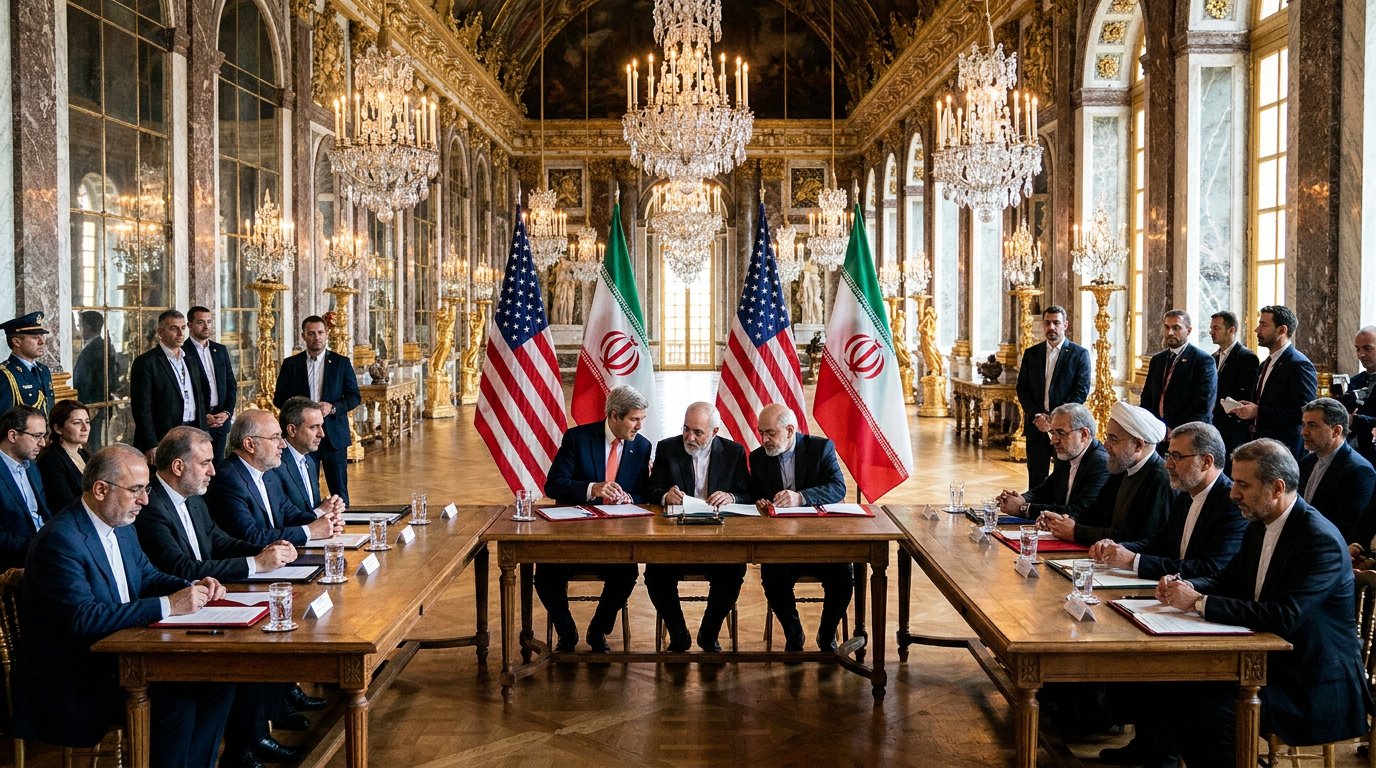
In a sudden diplomatic maneuver following the G7 summit, the United States and Iran signed a 14-point Memorandum of Understanding (MoU) at the Palace of Versailles, establishing a framework to end ongoing regional hostilities. The signing ceremony, featuring President Donald Trump and Iranian delegates, marks the most significant direct agreement between the two nations in years. The document outlines a phased de-escalation process, though the exact text of all 14 points remains subject to varying interpretations by the signatory parties.[4][6]
The strongest immediate evidence of the agreement's impact emerged in global financial markets. Brent crude oil prices dropped by as much as 1.6 percent within hours of the announcement, reflecting a sudden reduction in the geopolitical risk premium attached to Middle Eastern energy supplies. Simultaneously, key stock indices in heavily oil-dependent Asian economies—including Japan, South Korea, and Taiwan—rallied sharply, indicating that institutional investors view the MoU as a credible, if preliminary, step toward regional stability.[1]

However, an examination of the diplomatic framing reveals deeply contested narratives regarding the agreement's substance. The Trump administration has aggressively marketed the MoU as a "major win" that successfully neutralizes a critical global threat without committing U.S. troops to a protracted conflict. This framing relies on the premise that the 14 points contain verifiable mechanisms to halt Iranian-backed proxy attacks and stabilize shipping lanes.[2][4]
Conversely, Iranian leadership and its allied networks have presented the exact same document as a capitulation by the West. Iran’s chief negotiator, Mohammad Bagher Ghalibaf, publicly declared the agreement a "record of US failure," urging the public to judge the text for themselves. Corroborating this stance, Hezbollah's deputy chief, Naim Qassem, proclaimed a "great victory" following the signing, suggesting that the "Axis of Resistance" believes the framework preserves their strategic infrastructure while alleviating economic pressure.[2][8]

The most glaring vulnerability in the evidence supporting a lasting peace is the explicit exclusion of Israel from the negotiations. Israeli Prime Minister Benjamin Netanyahu, who had previously promised the Israeli public "total victory" against Iranian forces and proxies, was reportedly cut out of the final agreement process. Israeli officials have characterized the MoU as a "strategic and political disaster," pointing to the lack of binding constraints on Iran's nuclear enrichment and ballistic missile programs.[3][7]
The most glaring vulnerability in the evidence supporting a lasting peace is the explicit exclusion of Israel from the negotiations.
This exclusion creates a high degree of uncertainty regarding the agreement's durability. Without Israeli buy-in, the MoU lacks a mechanism to prevent unilateral preemptive strikes by the Israel Defense Forces (IDF). Security analysts note that while the U.S. and Iran may adhere to their bilateral commitments, an independent Israeli military operation against Iranian assets could instantly void the 14-point framework, rendering the Versailles signing largely symbolic.[3][6]

Domestic U.S. political reaction provides further evidence of the agreement's fragile foundation. The MoU has drawn immediate and severe backlash from traditional defense hawks within the Republican Party. Louisiana Senator Bill Cassidy publicly blasted the framework as the "worst foreign policy blunder in decades," indicating that the Trump administration will face significant friction in securing any necessary congressional funding or legislative support to implement the deal's provisions.[5]
From a legal and structural standpoint, a Memorandum of Understanding is inherently weak evidence of long-term policy change. Unlike a formal treaty, which requires a two-thirds majority ratification by the U.S. Senate, an MoU is an executive agreement that relies entirely on the continued political will of the sitting administration. It does not carry the binding force of international law, making it highly susceptible to reversal by future administrations or sudden shifts in executive priority.[6]

The specific enforcement mechanisms within the 14 points remain the subject of intense scrutiny. While the broad strokes mandate a cessation of direct hostilities, the text reportedly relies on third-party verification for compliance, a system that has historically failed in the region. The lack of transparent, independent auditing for proxy disarmament leaves a massive evidentiary gap in the U.S. administration's claim that the region is now secure.[2][6]
Despite these structural weaknesses, the economic data suggests that corporate entities are pricing in at least a temporary cessation of violence. Shipping conglomerates, which had rerouted vessels away from the Red Sea and the Strait of Hormuz at immense cost, are closely monitoring the implementation phase. A sustained drop in maritime insurance premiums over the next 30 days will serve as the primary empirical test of whether the MoU is actually altering behavior on the ground.[1][6]
Ultimately, the Versailles framework operates less as a definitive peace treaty and more as a mutual pause button. Both Washington and Tehran have secured immediate domestic and economic breathing room, but the underlying geopolitical architecture of the Middle East remains fundamentally unchanged. The true test of the agreement will not be the signatures in France, but the actions of excluded stakeholders in the weeks to come.[3][8]
How we got here
Early June 2026
Escalating regional hostilities threaten major disruptions to global shipping lanes and energy markets.
Mid-June 2026
World leaders gather for the G7 summit, with Middle Eastern stability dominating sideline discussions.
June 17, 2026
Following a post-G7 dinner, U.S. and Iranian delegations finalize the text of a 14-point framework.
June 18, 2026
President Trump and Iranian officials officially sign the Memorandum of Understanding at the Palace of Versailles.
Viewpoints in depth
U.S. Administration
Frames the agreement as a pragmatic victory that secures American interests without war.
The executive branch argues that the 14-point framework achieves the primary U.S. objective: stabilizing the Middle East and protecting global commerce without deploying American troops into a ground war. By securing an immediate de-escalation, the administration points to the instant drop in oil prices as proof that their diplomatic strategy yields tangible economic benefits for American consumers. They maintain that an executive MoU provides the necessary flexibility to hold Iran accountable without getting bogged down in Senate treaty ratification fights.
Iranian & Allied Leadership
Views the signing as a capitulation by Washington and a validation of their resistance strategy.
Iranian officials, alongside allied groups like Hezbollah, are broadcasting the agreement to their domestic audiences as a historic victory. They argue that the U.S. was forced to the negotiating table because it could no longer sustain the economic and military costs of countering the 'Axis of Resistance.' By framing the MoU as a "record of US failure," Tehran signals to its proxies that their sustained pressure campaigns successfully forced Western concessions without requiring Iran to dismantle its core military infrastructure.
Israeli Government
Considers the bilateral framework a dangerous appeasement that ignores existential security threats.
Israeli leadership views their exclusion from the Versailles negotiations as a profound betrayal. Officials argue that any agreement that halts hostilities without dismantling Iran's nuclear enrichment capabilities or disarming proxy militias on Israel's borders is merely a delay tactic. The Israeli defense establishment fears the MoU provides Tehran with economic relief and time to regroup, ultimately forcing Israel into a position where it may have to take unilateral, preemptive military action to ensure its own survival.
Skeptical U.S. Lawmakers
Criticizes the deal as a weak, non-binding framework that rewards aggression.
Defense-oriented lawmakers, particularly within the Republican party, argue that the MoU is a catastrophic blunder. They point out that because it is not a ratified treaty, it lacks rigorous, legally binding enforcement mechanisms. Skeptics argue that signing an agreement with Tehran while its proxies are still active rewards hostile behavior and undermines U.S. credibility with traditional allies in the region, particularly Israel and the Gulf states.
What we don't know
- Whether Israel will abide by the terms of a ceasefire it did not sign.
- The specific, declassified text of all 14 points within the Memorandum.
- How the U.S. plans to verify Iranian compliance regarding the disarmament or stand-down of proxy militias.
Key terms
- Memorandum of Understanding (MoU)
- A formal agreement between two or more parties that outlines a framework for cooperation, but generally lacks the binding legal power of a ratified treaty.
- Brent Crude
- A major trading classification of sweet light crude oil that serves as a benchmark price for purchases of oil worldwide.
- Axis of Resistance
- An informal political and military coalition led by Iran, which includes state and non-state actors across the Middle East opposed to Western and Israeli influence.
Frequently asked
Is this agreement a formal peace treaty?
No. It is a Memorandum of Understanding (MoU), which is an executive agreement. It does not require U.S. Senate ratification and is not strictly binding under international law.
How did global markets react to the news?
Markets reacted positively to the reduction in geopolitical risk. Brent crude oil prices dropped by 1.6%, and major Asian stock indices rallied.
Was Israel involved in the negotiations?
No. Israeli leadership was excluded from the final agreement process, leading Israeli officials to condemn the deal as a strategic disaster.
Does this agreement end U.S. sanctions on Iran?
While the full 14 points have not been entirely declassified, the framework focuses on halting hostilities rather than a comprehensive lifting of all economic sanctions.
Sources
Source coverage
8 outlets
5 viewpoints surfaced







[1]Al JazeeraU.S. Congressional Skeptics
Oil prices fall, stocks rally as US, Iran sign framework to end war
Read on Al Jazeera →[2]The GuardianIranian Leadership
Trump news at a glance: Donald Trump surrenders himself to Iran deal
Read on The Guardian →[3]AxiosIsraeli Government
Netanyahu fumes, allies rage over Trump's Iran deal
Read on Axios →[4]BBCU.S. Executive Branch
Moment Trump signs US-Iran agreement at Palace of Versailles
Read on BBC →Trump’s MoU with Iran draws backlash from some Republicans
Read on Al Jazeera →[6]ReutersU.S. Executive Branch
U.S. and Iran sign 14-point memorandum to halt hostilities
Read on Reuters →[7]Times of IsraelIsraeli Government
Netanyahu sidelined as US and Iran reach agreement in France
Read on Times of Israel →[8]Tehran TimesIranian Leadership
Ghalibaf: Agreement exposes US failure as 14-point MoU signed
Read on Tehran Times →
More in news politics
See all 5 stories →School Nutrition
The Evidence on Universal Free School Meals: What the Data Shows Three Years In
8 sources

Ranked Choice Voting
Fact-Checking Ranked Choice Voting: Does It Actually Fix Polarization and Turnout?
9 sources
US Foreign Policy
US and Iran Sign 14-Point Peace Memorandum, Triggering Market Rally and Political Backlash
7 sources
Every angle. Every day.
Get news politics stories with full source coverage and perspective breakdowns delivered to your inbox.