
James Webb Space Telescope Solves the 'Little Red Dot' Mystery of the Early Universe
The deepest spectrum ever captured of a mysterious early-universe object confirms it is a supermassive black hole hidden inside a dense cocoon of gas, resolving a major crisis in cosmology.
By Factlen Editorial Team
- Cosmological Theorists
- Relieved that the standard model of the universe remains intact without the need for impossibly massive early galaxies.
- Observational Astronomers
- Focused on the triumph of JWST's spectroscopic capabilities and the clever use of gravitational lensing.
- Black Hole Researchers
- Intrigued by the extreme feeding rate of the central black hole, which challenges existing growth models.
What's not represented
- · Alternative Cosmology Proponents
- · Next-Generation Telescope Engineers
Why this matters
This discovery resolves a major crisis in modern cosmology. By proving these objects are obscured black holes rather than impossibly massive early galaxies, the findings confirm that our fundamental understanding of how the universe evolved remains intact.
Key points
- JWST captured the deepest spectrum ever of an early-universe object known as a 'Little Red Dot.'
- The data confirms the object, GLIMPSE-17775, is a supermassive black hole hidden inside a dense gas cocoon.
- Gravitational lensing from a foreground galaxy cluster magnified the object, turning 30 hours of observation into 80 hours of effective telescope time.
- The discovery resolves a crisis in cosmology by proving these objects are not impossibly massive early galaxies.
- The central black hole appears to be consuming gas at twice the theoretical maximum rate.
When the James Webb Space Telescope (JWST) opened its infrared eyes to the cosmos in the summer of 2022, it immediately spotted something that made astrophysicists deeply uncomfortable. Scattered across the early universe, roughly 600 million years after the Big Bang, were abundant, compact, and intensely red objects. These anomalies quickly earned the nickname "Little Red Dots" (LRDs). The problem was their apparent mass. If these glowing red smudges were standard galaxies, they were forming stars at a rate and scale that defied the standard model of cosmology. Some researchers half-joked that these tiny red dots had "broken" our understanding of how the universe evolved, as there simply had not been enough time since the Big Bang for galaxies to grow so massive.[3][4][5]
For nearly four years, the true nature of these objects remained one of the most hotly debated mysteries in modern astronomy. Were they impossibly dense galaxies bursting with unprecedented star formation, or were they something else entirely—perhaps supermassive black holes shrouded in thick veils of cosmic dust? The debate hinged on a lack of detailed data. Because the Little Red Dots are so distant and faint, early observations could only capture their broad colors rather than the precise chemical fingerprints needed to determine their internal physics. Without that granular data, theorists were left to argue over competing models, waiting for the universe to offer up a perfect test case.[4][5]
That definitive test case has finally arrived. In a landmark paper published on June 10, 2026, in The Astrophysical Journal, a team of astronomers led by Vasily Kokorev at the University of Texas at Austin presented the deepest and most detailed spectrum ever captured of a Little Red Dot. The data provides overwhelming evidence that these objects are not universe-breaking galaxies, but rather supermassive black holes enveloped in dense, opaque cocoons of gas. By meticulously mapping the object's light, the researchers have effectively solved the mystery, bringing a collective sigh of relief to cosmologists worldwide.[1][2][6]

The breakthrough centers on a specific Little Red Dot carrying the unglamorous designation GLIMPSE-17775. Existing roughly 1.8 billion years after the Big Bang—at a cosmological redshift of 3.5—this particular object was caught almost serendipitously. JWST had been pointing its Near-Infrared Camera (NIRCam) and Near-Infrared Spectrograph (NIRSpec) at a massive foreground galaxy cluster known as Abell S1063. The primary goal of that observation was to hunt for the universe's very first generation of stars. However, GLIMPSE-17775 happened to be sitting in the distant background, perfectly aligned for a cosmic stroke of luck.[1][5][6]
That stroke of luck was gravitational lensing. The immense mass of the Abell S1063 galaxy cluster warped the fabric of spacetime, acting as a natural magnifying glass that amplified the faint light of GLIMPSE-17775. JWST stared at the target for a grueling 30 hours, but thanks to the gravitational lensing effect, the resulting data was equivalent to 80 hours of continuous telescope time. This unprecedented magnification transformed a faint, ambiguous smudge into a treasure trove of high-resolution spectroscopic data, allowing astronomers to split the object's starlight into its component colors with astonishing clarity.[2][4][5]
The resulting spectrum is the richest ever gathered from an object of this type, featuring more than 40 distinct spectral emission lines. In astronomy, a spectrum acts as a chemical and physical fingerprint; the specific wavelengths where light is absorbed or emitted tell researchers exactly what elements are present, how fast they are moving, and how hot they are. According to Kokorev, seeing the spectrum for the first time was like finding the pieces of a complex puzzle scattered across the floor. As the team measured each line and combined the pieces, a remarkably clear and unified picture began to emerge.[4][5][6]

The resulting spectrum is the richest ever gathered from an object of this type, featuring more than 40 distinct spectral emission lines.
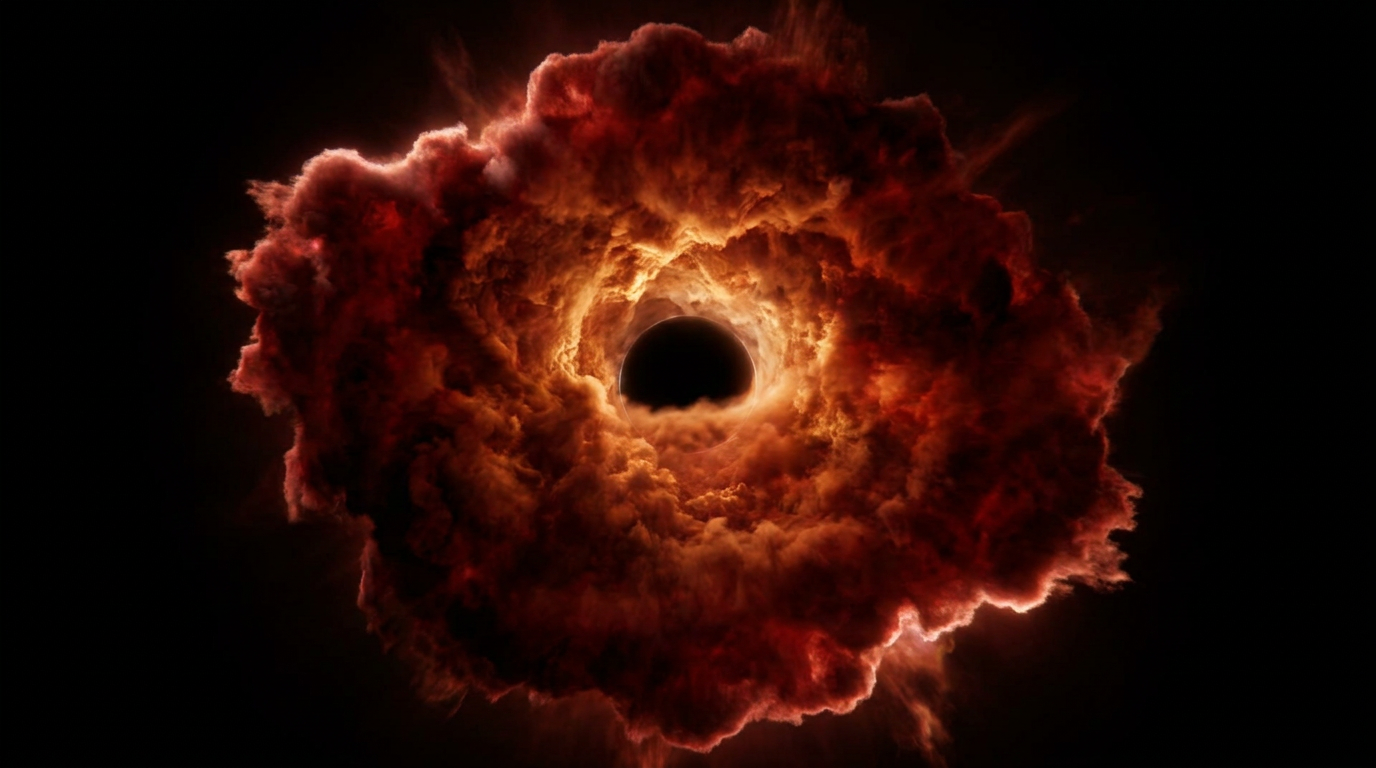
The evidence points squarely to a theoretical framework known as the "Black Hole Star" (BH*) scenario. Despite the name, a black hole star is not a star at all. It describes a rapidly feeding, or accreting, supermassive black hole that is entirely wrapped in a thick, dense cloud of partially ionized gas. In this model, the black hole at the center is generating ferocious amounts of high-energy radiation as it tears apart and consumes surrounding material. However, that brutal radiation never makes it out into the open universe. Instead, it crashes into the dense gaseous shroud surrounding the black hole.[1][4][6]
This dense shroud acts as a cosmic reprocessing plant. It soaks up the intense ultraviolet and X-ray radiation streaming from the central engine and re-emits it in softer, redder infrared tones. From billions of light-years away, this reprocessed light makes the entire violently churning system masquerade as a gentle, almost star-like red dot. This mechanism perfectly explains why Little Red Dots are so remarkably faint in X-ray observations. The high-energy X-rays that typically give away the presence of a feeding supermassive black hole are entirely absorbed by the opaque cocoon before they can escape.[1][4]
The smoking gun in the GLIMPSE-17775 spectrum lies in the specific behavior of helium. The JWST data revealed distinct signatures of both helium fluorescence and helium absorption. In astrophysics, these specific helium lines are highly diagnostic; they only appear when a tremendously powerful radiation source is actively bombarding a very dense surrounding medium. This chemical fingerprint cannot be easily explained by the gentle glow of billions of stars in a standard galaxy, firmly ruling out the idea that Little Red Dots are simply over-massive early galaxies bursting with star formation.[1][6]
While the Black Hole Star model fits the vast majority of the data beautifully, the evidence pack does contain transparent areas of uncertainty that researchers are still working to resolve. One notable anomaly in the GLIMPSE-17775 spectrum involves a feature known as the Balmer break. The Balmer break is a characteristic dip in emitted light at specific wavelengths, typically used to gauge the age of stellar populations. In this exceptionally detailed spectrum, the Balmer break is noticeably weaker than what theoretical models of Little Red Dots normally predict.[1][5]

Astronomers hypothesize that this weakened Balmer break is the result of a surrounding host galaxy diluting the signal. If the cocooned supermassive black hole is embedded within a larger, star-filled galaxy, the bluer light radiating from those surrounding stars could "fill in" the dip of the Balmer break, making it appear weaker to JWST's sensors. Both JWST and Hubble Space Telescope observations hint at the presence of this host galaxy, but isolating its exact starlight from the overwhelming glare of the central black hole remains a complex observational challenge.[5]
A second, perhaps more profound mystery unearthed by the data is the sheer speed at which this black hole is growing. The spectral lines indicate that the central engine of GLIMPSE-17775 is guzzling gas at a rate nearly twice the theoretical maximum, known as the Eddington limit. The Eddington limit is the point at which the outward pressure of a black hole's radiation should blow away the very gas it is trying to consume, effectively choking off its own food supply. How this supermassive black hole is managing to feed so rapidly without starving itself is a question that now sits at the frontier of early-universe astrophysics.[5]

Despite these lingering questions regarding its feeding rate and host galaxy, the overarching mystery of the Little Red Dots appears to be solved. The scientific community is rapidly converging on the Black Hole Star model, relieved that the foundational theories of cosmic evolution remain intact. By proving that these objects are heavily obscured black holes rather than impossibly mature galaxies, JWST has restored order to the cosmological timeline. The universe is not broken; it is simply better at hiding its most extreme monsters than astronomers previously realized.[1][3][6]
Looking ahead, the goal for observational astronomers is to replicate this success. While GLIMPSE-17775 provides a flawless test case, researchers need to capture similarly deep spectra from other Little Red Dots to confirm that this mechanism is universal across the entire population. As JWST continues its mission, aided by the natural magnifying glasses of galaxy clusters, astronomers are confident they will uncover more of these hidden supermassive black holes, slowly peeling back the dense cosmic veils that shrouded the dawn of the universe.[4][6]
How we got here
Summer 2022
The James Webb Space Telescope begins science operations and immediately discovers an abundance of mysterious 'Little Red Dots' in the early universe.
2022–2025
Astrophysicists debate whether the objects are impossibly massive early galaxies or supermassive black holes hidden by cosmic dust.
June 10, 2026
Astronomers publish the deepest spectrum ever captured of a Little Red Dot, confirming the objects are obscured black holes.
Viewpoints in depth
Cosmological Theorists
Relieved that the standard model of the universe remains intact.
For theorists, the confirmation of the Black Hole Star model is a massive relief. If Little Red Dots had turned out to be standard galaxies, their immense apparent mass would have meant that galaxies formed much faster than the laws of physics currently allow. By proving that the bright red glow comes from a central black hole rather than billions of mature stars, this evidence preserves the foundational timeline of how the universe evolved after the Big Bang.
Observational Astronomers
Focused on the triumph of JWST's spectroscopic capabilities.
Observational teams view this discovery as a masterclass in utilizing JWST's advanced instruments combined with natural cosmic phenomena. The ability to extract over 40 distinct emission lines from an object 1.8 billion years after the Big Bang—made possible only by the serendipitous gravitational lensing of a foreground galaxy cluster—demonstrates the sheer power of modern spectroscopy to definitively solve debates that once relied purely on theoretical modeling.
Black Hole Researchers
Intrigued by the extreme feeding rate of the central black hole.
While one mystery is solved, black hole specialists are now focused on a new anomaly buried in the data. The spectrum indicates that the supermassive black hole inside GLIMPSE-17775 is consuming gas at nearly twice the Eddington limit—the theoretical threshold where a black hole's own radiation should blow away its food supply. Understanding how these early black holes managed to gorge themselves so rapidly without starving is the next major frontier in astrophysics.
What we don't know
- How the supermassive black hole is managing to consume gas at twice the theoretical Eddington limit without choking off its own food supply.
- The exact properties of the host galaxy surrounding the black hole, as its starlight is difficult to isolate from the central glare.
- Whether the Black Hole Star model perfectly describes every Little Red Dot, or if some might still turn out to be unusual galaxies.
Key terms
- Little Red Dots (LRDs)
- Faint, compact, red-hued objects found in the early universe by the James Webb Space Telescope, initially thought to be massive galaxies.
- Gravitational Lensing
- A phenomenon where the gravity of a massive foreground object, like a galaxy cluster, bends and magnifies the light of a more distant object behind it.
- Spectroscopy
- An astronomical technique that splits light into its component wavelengths to reveal the chemical makeup, temperature, and motion of an object.
- Balmer Break
- A characteristic dip in the light spectrum of a galaxy, typically used by astronomers to gauge the age of its stellar population.
Frequently asked
Did Little Red Dots break the standard model of cosmology?
No. While they initially appeared to be impossibly massive early galaxies, this new evidence proves they are actually obscured black holes, which fits perfectly within existing cosmological models.
How did astronomers get such a clear view of GLIMPSE-17775?
The object happened to sit behind a massive galaxy cluster. The cluster's immense gravity acted as a natural magnifying glass, amplifying the faint red dot's light.
What is a 'Black Hole Star'?
It is a theoretical model describing a rapidly growing supermassive black hole that is entirely wrapped in a dense, opaque cocoon of gas, which absorbs its high-energy radiation and re-emits it as a red glow.
Sources
Source coverage
6 outlets
3 viewpoints surfaced






[1]NASAObservational Astronomers
NASA's Webb Solves the 'Little Red Dot' Mystery
Read on NASA →[2]ESA WebbObservational Astronomers
Webb spectrum of little red dot GLIMPSE-17775
Read on ESA Webb →[3]Space.comCosmological Theorists
James Webb Space Telescope solves 'little red dot' mystery
Read on Space.com →[4]Universe TodayCosmological Theorists
JWST cracks open the mystery of GLIMPSE-17775
Read on Universe Today →[5]Sky & TelescopeBlack Hole Researchers
'Little Red Dot' Is a Cocooned Black Hole
Read on Sky & Telescope →[6]Sci.NewsObservational Astronomers
Webb Obtains Deepest Spectrum of Little Red Dot
Read on Sci.News →

More in science
See all 6 stories →Neuroprotection
Two-Drug Combination Induces Chemical Hypothermia to Limit Brain Damage from Stroke
4 sources

Quantum Computing
A 98-Qubit Breakthrough Challenges How We Build Quantum Computers
6 sources
Offshore Wind
US Government Pays $765 Million to Cancel Four Major Offshore Wind Projects
7 sources

Photonic AI
How 'Speed of Light' Metasurfaces Are Rewriting the Rules of Machine Vision
6 sources
Every angle. Every day.
Get science stories with full source coverage and perspective breakdowns delivered to your inbox.