
A 98-Qubit Breakthrough Challenges How We Build Quantum Computers
A new trapped-ion processor achieves unprecedented accuracy by physically moving atoms across a microchip, proving that qubit quality may matter more than sheer quantity.
By Factlen Editorial Team
- Trapped-Ion Advocates
- Argue that using perfect, identical atomic qubits with all-to-all connectivity is the fastest path to fault tolerance, despite slower clock speeds.
- Superconducting Proponents
- Argue that solid-state, semiconductor-like manufacturing is the only viable way to scale to the millions of qubits needed for commercial utility.
- Quantum Pragmatists
- Warn that both architectures still face massive, unresolved engineering hurdles before delivering practical commercial value beyond scientific simulations.
What's not represented
- · Classical Supercomputing Industry
- · Cybersecurity Experts
Why this matters
By proving that a smaller number of highly accurate, interconnected qubits can outperform larger, noisier systems, this breakthrough dramatically accelerates the timeline for quantum computers to solve real-world problems in medicine, battery tech, and materials science.
Key points
- Quantinuum and Duke University unveiled Helios, a 98-qubit trapped-ion quantum computer.
- The system achieved record-breaking accuracy, with single-qubit fidelity reaching 99.9975%.
- Unlike superconducting chips, Helios physically moves atoms across the processor to process data.
- This mobility allows 'all-to-all connectivity,' letting any qubit interact directly with another.
- High fidelity reduces the overhead needed for future error correction, accelerating the path to fault tolerance.
In the high-stakes race to build a practical, commercially viable quantum computer, the technology industry has long been obsessed with a single, highly publicized metric: the total qubit count. For years, companies have generated headlines by cramming ever-larger numbers of quantum bits onto single chips. But a landmark milestone published this week in the peer-reviewed journal Nature suggests that raw quantity is only half the battle. Quality, stability, and connectivity may ultimately prove to be the true keys to unlocking the quantum era, fundamentally shifting how researchers approach hardware design.[1]
Researchers from the quantum hardware firm Quantinuum, working in collaboration with scientists at Duke University, have officially unveiled 'Helios.' This 98-qubit quantum processor achieves performance and accuracy levels that many in the field previously thought to be years away. While competing systems currently boast hundreds or even thousands of qubits, Helios operates with an unprecedented degree of fidelity. By prioritizing the perfection of a smaller number of qubits over the rapid scaling of noisy ones, the Helios architecture fundamentally challenges the prevailing wisdom on how to build a fault-tolerant quantum machine.[1][3][4]
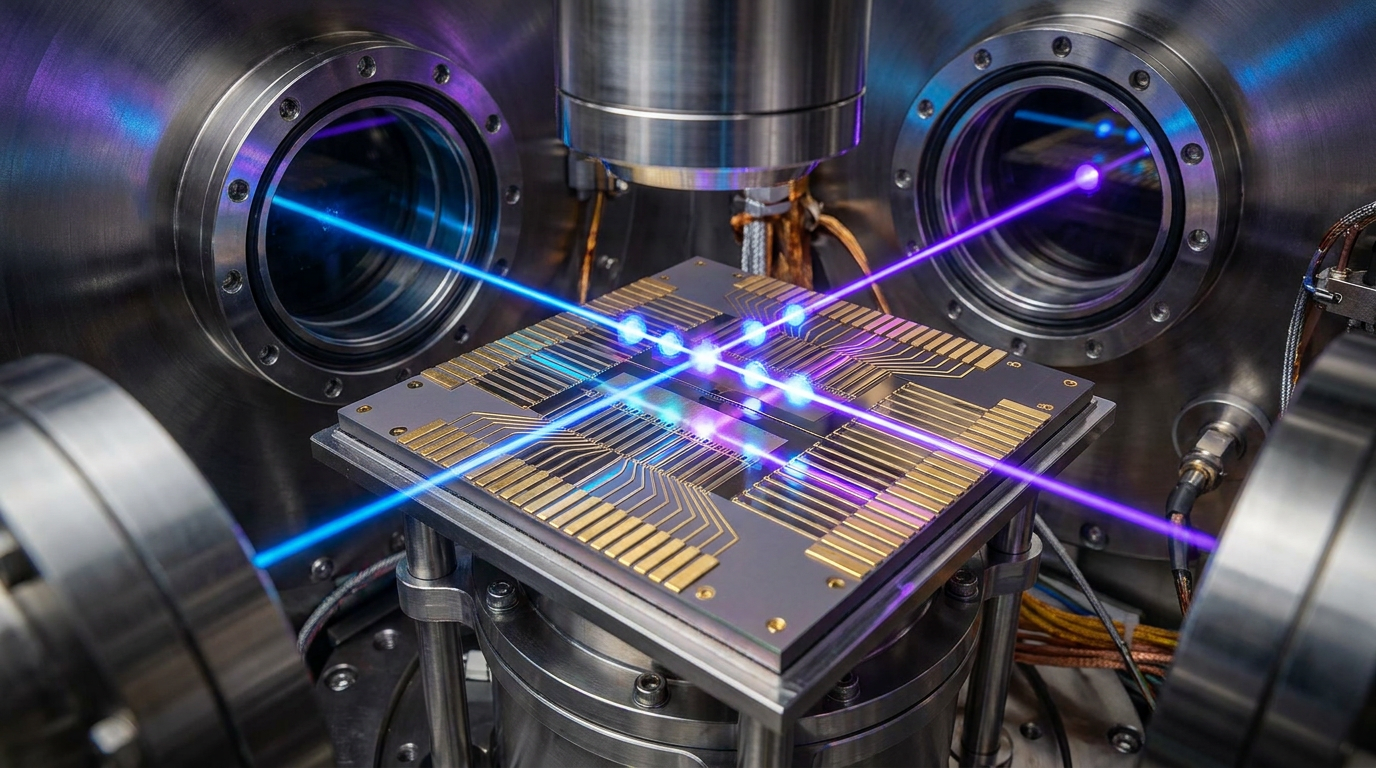
The breakthrough centers on a specific hardware architecture known as trapped-ion quantum computing. Unlike the solid-state chips found in modern laptops, smartphones, and most competing quantum devices, a trapped-ion system does not rely on manufactured circuits. Instead, it uses individual, naturally occurring atoms as its computational building blocks. In the case of the Helios processor, the engineering team utilized 98 individual ions of a specific barium isotope, Barium-137. These atoms are stripped of an electron to give them a positive charge, allowing them to be suspended in a pristine vacuum chamber using highly precise electromagnetic fields.[2][6]
The performance results published in Nature are staggering. The Helios system achieved a single-qubit gate fidelity of 99.9975% and a two-qubit gate fidelity of 99.921% across all possible pairs of qubits. In the incredibly fragile world of quantum mechanics, where the slightest fluctuation in temperature or stray magnetic field can cause 'decoherence' and destroy a calculation, these numbers represent a monumental leap forward. They push the hardware past the critical threshold where complex, error-corrected algorithms become theoretically possible, rather than just mathematically hypothetical.[2][3]
To fully grasp why this fidelity matters, it helps to look at the broader quantum computing landscape. For the past decade, the field has been heavily dominated by a different approach: superconducting qubits. This is the architecture favored and heavily funded by tech giants like IBM and Google. Superconducting systems use artificial, super-cooled electrical circuits etched onto silicon wafers to mimic the quantum behavior of natural atoms. Because they rely on existing semiconductor manufacturing techniques, they are relatively easy to print in large numbers.[5][6]

Superconducting chips have distinct and powerful advantages. Beyond their manufacturability, their computational operations are incredibly fast, with gate speeds measured in nanoseconds. IBM, for instance, has already successfully deployed processors containing well over 1,000 qubits, adhering to an aggressive scaling roadmap. However, because these qubits are artificial constructs, no two are exactly identical at the microscopic level. They are inherently noisy, and their operational error rates typically hover around 99.5%—meaning they make a mistake roughly once every 200 operations.[5]
Trapped ions offer a fundamentally different value proposition based on the laws of physics. Because every Barium-137 atom in the universe is perfectly identical to every other Barium-137 atom, the qubits themselves are inherently flawless. The engineering challenge lies not in manufacturing the qubits, but in controlling them without disturbing their delicate states. To execute calculations, researchers use highly calibrated, tightly focused lasers to manipulate the ions' electron states, effectively writing, processing, and reading quantum data with pulses of light.[2][4]
Trapped ions offer a fundamentally different value proposition based on the laws of physics.
But Helios's true innovation—and the key to its record-breaking performance—is its physical layout, known as a Quantum Charge-Coupled Device (QCCD) architecture. In a standard superconducting chip, qubits are wired into fixed, static positions; they can only interact directly with their immediate physical neighbors. If a qubit on one side of the chip needs to share information with a qubit on the far side, the data must be clumsily swapped across a long chain of intermediaries, introducing a high probability of error at every single step.[2][5][6]
The QCCD architecture solves this connectivity bottleneck by making the qubits mobile. The Helios chip features a microscopic, two-dimensional track system—resembling a tiny, futuristic transit grid. By rapidly and precisely adjusting the electromagnetic fields that hold the ions in place, the system can physically shuttle the Barium atoms across the surface of the chip to wherever their data is needed. This allows the computer to dynamically reconfigure itself on the fly during a calculation.[2][3][6]
This unprecedented mobility is enabled by a first-of-its-kind 'junction' built directly into the chip, which acts as a microscopic traffic intersection for the atoms. Ions can be grouped together in specific operational zones, entangled using targeted laser pulses to perform logic gates, and then separated and routed down different paths to other areas of the processor. Managing this atomic traffic without the ions colliding or losing their quantum information requires an immensely sophisticated classical control system operating in real-time.[2][3][6]
The ultimate result of this moving architecture is 'all-to-all connectivity.' Any of the 98 qubits in the Helios system can interact directly with any other qubit, regardless of where they initially started on the chip. This flexibility is a massive boon for quantum software developers, allowing them to run highly complex, densely entangled algorithms that would be functionally impossible to execute on a fixed-grid superconducting architecture of the same size without being overwhelmed by swapping errors. It bridges the gap between theoretical quantum software and physical hardware capabilities.[1][3]

Naturally, this mobile approach comes with significant engineering trade-offs. Physically moving atoms across a microchip takes a comparatively long time in the context of computing. While superconducting logic gates operate in blistering nanoseconds, trapped-ion gates and their associated physical transport mechanisms operate in the realm of microseconds or even milliseconds. Consequently, trapped-ion systems are, by design, much slower at executing individual computational instructions. For tasks that require massive numbers of sequential operations, this slower clock speed means algorithms take noticeably longer to run from start to finish.[5][6]
Furthermore, scaling a trapped-ion system to the thousands of qubits required for commercial dominance presents unique and daunting hurdles. While adding more qubits to a superconducting chip is largely a matter of expanding the silicon real estate and cooling capacity, adding more ions to a QCCD system requires exponentially more complex laser arrays, optical routing, and vacuum control. Managing the physical traffic of thousands of moving atoms without them heating up, colliding, or losing their quantum states is one of the most difficult physics challenges of the decade.[4][6]
Yet, the sheer fidelity of the Helios system may render those scaling challenges entirely worthwhile. The ultimate, long-term goal of the entire quantum computing industry is 'fault tolerance'—the ability to group multiple noisy physical qubits together to form a single, perfectly reliable 'logical qubit' through advanced error correction codes. Until a system can reliably correct its own errors faster than they occur, quantum computers will remain limited to narrow, experimental applications. High fidelity is the prerequisite for making error correction mathematically possible.[5][6]
Because quantum error correction requires massive amounts of redundancy, a noisy superconducting system might need 1,000 or more physical qubits to create just one stable logical qubit. This overhead is why companies are racing to build chips with millions of qubits. But with the extreme accuracy demonstrated by the Helios processor, that overhead ratio drops dramatically. By starting with qubits that rarely make mistakes, a smaller, highly accurate machine could theoretically achieve fault tolerance and deliver commercially useful logical qubits long before a massive, noisy system reaches the same milestone.[2][5][6]

The implications of this milestone for science and heavy industry are profound. Even with just 98 high-fidelity qubits, researchers can begin simulating complex molecular interactions and chemical catalysts that are currently too difficult for the world's most powerful classical supercomputers. Because quantum computers process information using the same quantum mechanical rules that govern molecules, they are uniquely suited for chemistry. This specific capability is widely considered the foundational step toward discovering new life-saving pharmaceuticals, optimizing next-generation battery materials, and developing vastly more efficient agricultural fertilizers.[3][4]
The peer-reviewed publication of the Helios results marks a pivotal, clarifying moment in the global quantum race. It proves definitively that the path to a useful, world-changing quantum computer is not simply a brute-force numbers game. By mastering the delicate, microscopic choreography of individual atoms and prioritizing pristine connectivity over rapid expansion, physicists have demonstrated that precision may ultimately triumph over sheer scale. As the industry digests these findings, the focus is shifting from how many qubits a company can build, to what those qubits can actually do, bringing the promise of the quantum era one step closer to reality.[1][6]
How we got here
1995
Physicists Ignacio Cirac and Peter Zoller publish the first proposal for a trapped-ion quantum computer.
2015
Startups like IonQ are founded to begin commercializing trapped-ion technology outside of academic labs.
2023
IBM breaks the 1,000-qubit barrier with its Condor superconducting processor, highlighting the rapid scaling of solid-state chips.
Nov 2025
Quantinuum first unveils the 98-qubit Helios architecture and its performance metrics in a technical preprint.
Jun 2026
The Helios breakthrough is peer-reviewed and officially published in the journal Nature.
Viewpoints in depth
Trapped-Ion Advocates
Proponents believe that starting with perfect qubits is the only viable path to fault tolerance.
Researchers working with trapped ions argue that the inherent perfection of natural atoms gives them an insurmountable advantage over manufactured circuits. Because every Barium-137 atom is identical, engineers do not have to constantly calibrate their systems to account for manufacturing defects. Furthermore, they argue that the 'all-to-all connectivity' provided by moving ions around a chip drastically reduces the number of operations needed to run an algorithm, meaning the slower clock speeds of trapped-ion gates are offset by the sheer efficiency of the architecture.
Superconducting Proponents
Advocates argue that solid-state manufacturing is required to reach the millions of qubits needed for commercial utility.
Engineers backing superconducting qubits acknowledge the higher error rates of their systems, but point to the massive scalability of silicon manufacturing. They argue that building a quantum computer with millions of qubits will require leveraging the existing, multi-trillion-dollar semiconductor supply chain. In their view, while trapped-ion systems perform beautifully at small scales, managing the lasers, optics, and vacuum chambers required to control millions of moving atoms will eventually hit an insurmountable physical roadblock, making solid-state chips the only long-term winner.
Quantum Pragmatists
Skeptics caution that all architectures are still years away from delivering practical commercial value.
Independent physicists and industry analysts often warn against the hype generated by both camps. They note that while 98 highly accurate qubits is a remarkable scientific achievement, it is still orders of magnitude away from the thousands of logical qubits required to break encryption or design complex new drugs. Pragmatists emphasize that both trapped-ion and superconducting systems still require fundamental, Nobel-level breakthroughs in error correction and hardware engineering before quantum computers can reliably outperform classical supercomputers on useful, everyday tasks.
What we don't know
- Whether the QCCD architecture can successfully scale to thousands of qubits without the laser control systems becoming too complex.
- Exactly when quantum error correction will become efficient enough to create commercially viable 'logical qubits.'
- Which quantum architecture—trapped-ion, superconducting, or neutral atom—will ultimately dominate the commercial market.
Key terms
- Qubit
- The fundamental unit of quantum information, capable of existing in multiple states simultaneously.
- Trapped-Ion
- A quantum computing architecture that uses individual charged atoms, suspended by electromagnetic fields, as qubits.
- Superconducting Qubit
- A quantum architecture that uses super-cooled, artificial electrical circuits to mimic the behavior of atoms.
- Fidelity
- A measure of accuracy in quantum computing; the percentage of time a quantum operation performs exactly as intended without errors.
- QCCD
- Quantum Charge-Coupled Device; an architecture that physically moves ion qubits around a microchip to allow them to interact with one another.
- Logical Qubit
- A highly reliable, error-free qubit created by grouping together multiple noisy 'physical' qubits through error correction.
Frequently asked
Why use Barium-137 for qubits?
Barium-137 ions have specific energy levels that make them highly stable and immune to certain types of magnetic interference, drastically reducing computational errors.
Why does all-to-all connectivity matter?
It allows any qubit to interact directly with any other, reducing the number of steps—and potential errors—needed to run complex algorithms compared to fixed-grid chips.
When will quantum computers replace classical ones?
They likely won't replace them entirely. Instead, they will act as specialized co-processors for specific tasks like chemistry simulation and cryptography, likely reaching commercial maturity in the 2030s.
Is 98 qubits enough to do useful work?
While not enough to break modern encryption, 98 highly accurate qubits can begin simulating complex molecular interactions that challenge the world's best classical supercomputers.
Sources
Source coverage
6 outlets
3 viewpoints surfaced






[1]NatureQuantum Pragmatists
Reconfigurable quantum computer juggles 98 qubits
Read on Nature →[2]arXiv
Helios: A 98-qubit trapped-ion quantum computer
Read on arXiv →[3]QuantinuumTrapped-Ion Advocates
Helios: The Most Accurate Quantum Computer in the World
Read on Quantinuum →[4]Duke UniversityTrapped-Ion Advocates
Quantum Computing with Trapped Ions
Read on Duke University →[5]IBM QuantumSuperconducting Proponents
The IBM Quantum Development Roadmap
Read on IBM Quantum →[6]Factlen Editorial TeamQuantum Pragmatists
Synthesis by Factlen editorial team
Read on Factlen Editorial Team →


Every angle. Every day.
Get science stories with full source coverage and perspective breakdowns delivered to your inbox.