
The Quiet Resurgence of Classical Education: Inside the K-12 Disruption
A 2,500-year-old educational model focused on the Trivium and the Great Books is experiencing explosive growth, expanding from niche homeschools into a multi-billion-dollar public charter movement.
By Factlen Editorial Team
- Classical Education Proponents
- Argue the Trivium and Great Books cultivate critical thinking, virtue, and human flourishing.
- Conservative Advocates
- View the model as a vital return to Western heritage and an antidote to progressive public schooling.
- Public Education Defenders
- Warn that classical charters divert public funds and serve as vehicles for right-wing ideology and Eurocentrism.
- Trend & Market Analysts
- Focus on the rapid enrollment growth, market disruption, and the broad appeal of rigorous, screen-free academics.
What's not represented
- · Students currently enrolled in classical academies
- · Progressive educators advocating for diverse, modern curricula
Why this matters
As classical education rapidly expands from private homeschooling into taxpayer-funded public charter networks, it is fundamentally reshaping the K-12 landscape. Understanding this 2,500-year-old model is essential for parents navigating school choice and citizens tracking the future of American civic education.
Key points
- Classical education enrollment reached over 677,000 students in 2023, with projections hitting 1.4 million by 2035.
- The pedagogy relies on the 'Trivium,' a three-stage model consisting of grammar, logic, and rhetoric.
- Classrooms heavily restrict screens and technology, favoring physical books, handwriting, and Socratic dialogue.
- The curriculum is anchored in the 'Great Books' of Western civilization, prioritizing primary texts over modern textbooks.
- While championed by conservative leaders as an antidote to progressive schooling, the model also attracts diverse parents seeking academic rigor.
- Critics argue the movement's expansion into public charter schools serves as a vehicle for right-wing ideology and Eurocentrism.
A 2,500-year-old educational model is quietly disrupting the modern K-12 landscape. Across the United States, classical education is experiencing a massive resurgence, growing from a niche homeschooling philosophy into a multi-billion-dollar sector. For the 2023–2024 school year, more than 677,000 students were enrolled in classical programs, a figure projected to double to 1.4 million by 2035.[1]
This boom is visible across private academies, microschools, and, increasingly, taxpayer-funded public charter networks. Aided by parental frustration during pandemic-era school closures, the number of classical schools rose by nearly 5 percent annually between 2019 and 2023. Today, waiting lists for classical charter schools in cities like the South Bronx stretch into the thousands, reflecting a diverse coalition of parents seeking an alternative to the modern educational status quo.[3][7]
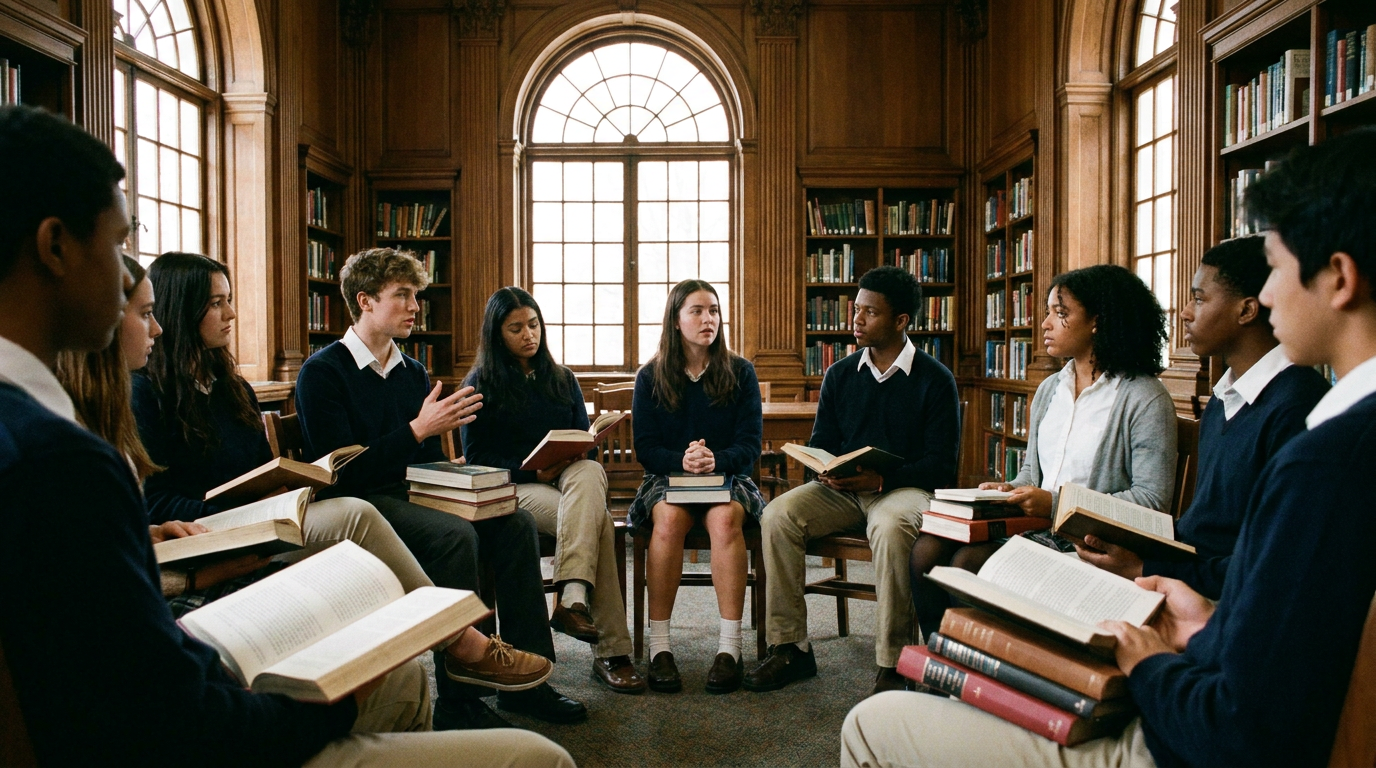
To understand the appeal, one must look at the mechanism. Classical education deliberately rejects the hallmarks of contemporary progressive schooling. There are no 1:1 iPad programs, no shifting pedagogical fads, and no emphasis on "teaching to the test." Instead, the model relies on physical books, rigorous memorization, and face-to-face Socratic dialogue, tracing its roots back to ancient Greece and Rome.[5]
At the core of this pedagogy is the "Trivium," a three-stage framework designed to align with a child's natural cognitive development. The first phase, the Grammar Stage, spans kindergarten through sixth grade. Because young children are natural sponges who enjoy repetition, this stage focuses heavily on absorbing facts. Students memorize phonics rules, math tables, poetry, and historical timelines, laying the foundational building blocks for all future learning.[5]

As students enter middle school, they naturally become more argumentative and interested in cause and effect. Classical education channels this into the Logic Stage, typically covering grades seven and eight. Here, the focus shifts from memorizing facts to analyzing them. Students are taught formal logic, learning how to construct valid arguments, identify fallacies, and understand the intricate relationships between different fields of knowledge.[5]
The final phase is the Rhetoric Stage, spanning high school. Having acquired knowledge during the Grammar Stage and the ability to analyze it during the Logic Stage, students are now taught how to express their conclusions persuasively and eloquently. Classrooms transform into Socratic seminars where students defend theses, debate complex ideas, and develop their own distinct voices.[5]
The content of a classical education is as distinct as its structure. The curriculum is anchored in the "Great Books" of Western civilization—the enduring works of literature, philosophy, and history that have shaped human thought. Students read Homer, Shakespeare, and Plato in their entirety, rather than relying on textbook summaries or disjointed excerpts. This approach invites students into what classical educators call the "Great Conversation" of humanity.[5][7]
The content of a classical education is as distinct as its structure.
In an era dominated by artificial intelligence and ubiquitous screens, classical schools are fiercely protective of analog learning. Proponents argue that heavy reliance on technology allows the mind to become passive. By forcing students to translate symbols on a physical page into abstract concepts, and by requiring them to write out arguments by hand, classical education aims to build intellectual stamina and immunize the mind against digital distraction.[3][5]
While the pedagogy is ancient, its modern resurgence has become deeply intertwined with American politics. The classical education movement has been enthusiastically championed by the conservative movement and Republican policymakers. For many on the political right, classical schools offer a vital return to civic virtue, Western heritage, and traditional character formation.[2]
Conservative leaders view the classical model as an antidote to what they see as the ideological capture of traditional public schools. By focusing on universal truths and historical primary documents, classical schools bypass contemporary culture wars over progressive curricula. This alignment has led several Republican-led states to actively promote the expansion of classical charter schools, sometimes in partnership with conservative institutions like Hillsdale College.[2][6]
This political embrace has inevitably sparked fierce pushback. Critics and public education advocacy groups argue that the classical charter boom is a Trojan horse for right-wing ideology. Organizations like the Network for Public Education have published reports characterizing classical schools as "conservative dog whistles" designed to attract white, Christian families and divert taxpayer money away from traditional public schools.[4]

Skeptics also raise concerns about the curriculum itself. Critics argue that an exclusive focus on the Western canon and the "Great Books" promotes a myopic, Eurocentric worldview that fails to reflect the diverse experiences of modern American students. They warn that reading lists designed to promote reverence for Western civilization risk inculcating chauvinism rather than genuine intellectual curiosity.[2][8]
Classical educators, however, strongly reject the notion that their classrooms are political weapons. Many teachers and administrators within the movement emphasize that their goal is human flourishing, not partisan victory. They argue that teaching students how to think through logic and rhetoric naturally inoculates them against indoctrination from any political extreme.[3][6]
Furthermore, the appeal of classical education extends far beyond conservative circles. Many pragmatic parents are drawn to the schools simply because they offer rigorous academics, disciplined environments, and a break from screen-heavy instruction. Despite ignoring state-mandated standardized test prep, classical charter students consistently outperform their peers on national metrics, proving the efficacy of the Trivium.[3][7]

The movement's infrastructure is now expanding beyond K-12 schooling. The Classic Learning Test (CLT) has emerged as a viable alternative to the College Board's SAT and ACT. Testing students on reading comprehension of classic texts and logical reasoning, the CLT is increasingly being accepted by state university systems and service academies, creating a direct pipeline from classical high schools to higher education.[2]
As the classical education sector marches toward a projected $10 billion market size, its impact on the broader culture is likely to deepen. By reviving a 2,500-year-old model, this movement is producing a growing cohort of graduates uniquely trained in analytical reasoning, persuasive rhetoric, and deep cultural literacy—skills that may prove increasingly rare and valuable in the modern workforce.[1]
How we got here
Ancient Greece & Rome
The foundational Trivium and Socratic methods are established as the standard for cultivating civic virtue.
Middle Ages & Renaissance
The classical model is preserved and revitalized, forming the basis of Western liberal arts education.
Early 20th Century
Classical education diminishes in the U.S. as progressive, vocational-focused public schooling becomes the norm.
1990s
A grassroots revival begins among homeschoolers and private Christian academies seeking rigorous, text-based learning.
2010s
The movement expands into the public sector with the launch of classical charter school networks like Great Hearts.
2020–2024
Pandemic disruptions fuel a massive surge in enrollment, with the sector growing by nearly 5% annually.
Viewpoints in depth
Classical Educators' View
The model cultivates wisdom and virtue by teaching students how to think.
Educators within the movement argue that the Trivium aligns perfectly with a child's natural cognitive development. By grounding students in the Great Books and forcing them to grapple with complex, timeless ideas through Socratic dialogue, classical schools build intellectual stamina. Proponents firmly reject the idea that their classrooms are political, insisting that a true classical education inoculates students against indoctrination by demanding rigorous logical analysis of all claims.
Conservative Advocates' View
Classical schools offer a necessary return to Western heritage and civic virtue.
For many conservative policymakers and parents, the classical resurgence is a vital lifeboat. They view modern progressive public education as overly focused on shifting cultural trends and vocational skills at the expense of moral formation. By anchoring the curriculum in the foundational texts of Western civilization and American history, conservatives believe classical schools are preserving the cultural literacy required to maintain a healthy republic.
Public Education Defenders' View
The classical charter boom diverts funds and promotes a myopic worldview.
Critics, including teachers' unions and public education advocacy groups, view the expansion of taxpayer-funded classical charters with deep suspicion. They argue that the heavy emphasis on the Western canon inherently marginalizes the histories and contributions of non-European cultures. Furthermore, organizations like the Network for Public Education warn that the movement is heavily backed by right-wing politicians seeking to dismantle traditional public schools and blur the line between church and state.
What we don't know
- How the rapid scaling of classical charter schools will impact the quality and fidelity of the traditional Trivium model.
- Whether the Classic Learning Test (CLT) will achieve mainstream parity with the SAT and ACT nationwide.
- How traditional public schools might adapt their own curricula in response to the growing market share of classical academies.
Key terms
- Trivium
- The foundational three-stage model of classical education, consisting of grammar, logic, and rhetoric.
- Socratic Method
- A form of cooperative argumentative dialogue based on asking and answering questions to stimulate critical thinking.
- The Great Books
- A curriculum focused on the foundational texts of Western civilization, spanning literature, philosophy, and science.
- Classic Learning Test (CLT)
- A standardized college admissions test designed as an alternative to the SAT, focusing on reading comprehension of classic texts and logical reasoning.
Frequently asked
What is the Trivium?
The Trivium is the foundational three-stage model of classical education, consisting of the Grammar stage (absorbing facts), the Logic stage (analytical thinking), and the Rhetoric stage (persuasive expression).
Are classical schools religious?
Many are private Christian schools, but a rapidly growing segment consists of secular, taxpayer-funded public charter schools that focus on civic virtue rather than theology.
What is the Classic Learning Test (CLT)?
The CLT is a standardized college admissions test designed as an alternative to the SAT and ACT, focusing on reading comprehension of classic texts and logical reasoning.
Do classical schools use technology?
Most classical schools severely restrict screens and digital devices, emphasizing physical books, handwriting, and face-to-face Socratic dialogue to build intellectual stamina.
Sources
Source coverage
8 outlets
4 viewpoints surfaced







[1]ForbesTrend & Market Analysts
The Business Case For Classical Christian Education Market Growth
Read on Forbes →[2]The Washington PostTrend & Market Analysts
The classical education movement goes beyond schools
Read on The Washington Post →[3]The Free PressTrend & Market Analysts
The Curious Resurgence of Classical Education
Read on The Free Press →[4]Network for Public EducationPublic Education Defenders
A Sharp Turn Right: A New Breed of Charter Schools Delivers the Conservative Agenda
Read on Network for Public Education →[5]Well-Trained MindClassical Education Proponents
What is Classical Education?
Read on Well-Trained Mind →[6]First ThingsClassical Education Proponents
The Classical Education Movement
Read on First Things →[7]John Locke FoundationConservative Advocates
Charting the rise of classical ed in US, North Carolina
Read on John Locke Foundation →[8]The New RepublicPublic Education Defenders
The Conservative Vision for Tomorrow's Schools
Read on The New Republic →

Every angle. Every day.
Get perspectives stories with full source coverage and perspective breakdowns delivered to your inbox.