
The Economics and Mechanics of 'Coolcationing': How Northern Europe is Adapting to the Summer Tourism Shift
As extreme heatwaves disrupt traditional Mediterranean holidays, travelers are increasingly flocking to cooler northern latitudes, reshaping the global tourism economy.
By Factlen Editorial Team
- Climate-Adaptive Travelers
- Tourists prioritizing thermal comfort, nature, and wellness over traditional beach holidays.
- Northern Destination Boards
- Tourism authorities capitalizing on the influx while managing sustainable growth.
- Traditional Mediterranean Markets
- Southern European destinations adapting to retain visitors amid rising temperatures.
- Tourism Researchers
- Academics and industry analysts studying the long-term structural reallocation of global leisure economies.
What's not represented
- · Local Northern European Residents
- · Aviation Industry Planners
Why this matters
As extreme summer heatwaves become the new normal, the global travel industry is undergoing a massive structural shift toward northern latitudes. Understanding this trend helps travelers plan safer, more comfortable vacations while highlighting how economies are successfully adapting to climate realities.
Key points
- Global booking searches for cooler, temperate destinations have surged by 74% year-on-year as travelers seek to avoid extreme summer heat.
- Scandinavian countries, including Sweden and Norway, recorded their highest-ever numbers of commercial guest nights in 2025.
- The shift is driven by 'thermal discomfort' and a growing desire for outdoor wellness activities like hiking and cold-water swimming.
- Traditional Mediterranean markets are adapting by promoting 'shoulder season' travel and investing in urban cooling infrastructure.
For decades, the global travel industry operated on a foundational, almost unquestioned model: when summer arrived, vacationers migrated south. The Mediterranean sun-and-sand holiday was the bedrock of European leisure. But as global temperatures consistently shatter records and extreme heatwaves become the new normal, a massive structural reallocation is underway.[8]
Enter "coolcationing"—a portmanteau of "cool" and "vacation" that has rapidly evolved from a niche demographic preference into a dominant market strategy. Rather than enduring 40-degree Celsius (104°F) days on crowded beaches, a growing cohort of travelers is deliberately seeking out northern latitudes, high altitudes, and temperate climates.[1][7][8]
The shift is driven by a combination of climate anxiety, thermal discomfort, and a desire to escape the compounding pressures of overtourism in traditional hotspots. Academic models of climate-induced tourist mobility now recognize that temperature is no longer just a backdrop for a holiday; it is a decisive factor in destination selection.[9]
The data supporting this migration is stark. According to industry tracking, global booking searches for designated cooler destinations have escalated by 74% year-on-year heading into the 2026 summer season. Furthermore, sentiment surveys indicate that 22% of European travelers are now actively avoiding high-temperature destinations during the peak summer months.[2][7]

The primary beneficiaries of this climate-adaptive travel are the Nordic countries, the Baltics, and regions like the Scottish Highlands. Scandinavia, in particular, has transformed from a secondary summer market into a primary refuge for those seeking clean air, predictable itineraries, and physical comfort.[1][6][8]
In 2025, the Scandinavian peninsula witnessed unprecedented tourism volumes. Sweden recorded 30.8 million guest nights at commercial accommodations during the summer months—the highest level in its history. This boom was heavily driven by international demand, with foreign guest nights rising by nearly 9%.[3]
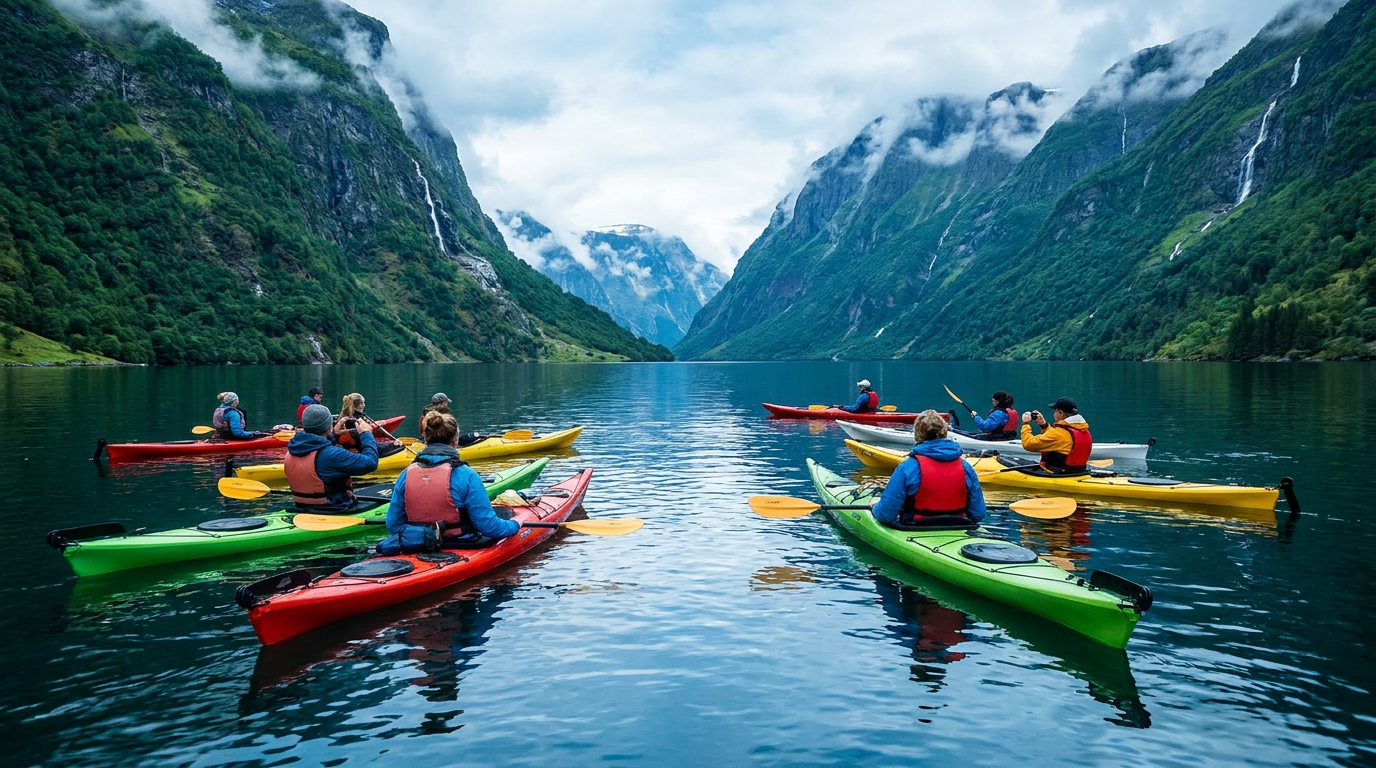
Norway experienced a similar surge, crossing the 40 million total guest night threshold for the first time in 2025. Denmark also reached all-time highs, adding over a million new hotel nights compared to the previous year. Travelers are swapping the Mediterranean Sea for Norwegian fjords, Swedish lakes, and Danish coastal towns.[4][8]

Norway experienced a similar surge, crossing the 40 million total guest night threshold for the first time in 2025.
The luxury travel sector is acting as a leading indicator for this broader market shift. Travel advisor networks report that over 80% of their high-end clients are now factoring climate and milder weather into their vacation planning. This has yielded unprecedented demand for properties like remote luxury fjord resorts and alpine wellness retreats.[1][7][10]
This reallocation carries profound economic implications. A study by the European Commission projects a widening tourism divide due to the uneven impact of climate change. Under current warming scenarios, northern coastal regions could see summer demand increase by more than 5%, while parts of southern Europe could lose nearly 10% of their peak-season tourists.[5][6]
In response, traditional warm-weather destinations are being forced to adapt their marketing and infrastructure. Countries like Spain, Greece, and Italy are increasingly promoting "summer in reverse," encouraging tourists to visit during the spring and autumn shoulder seasons when temperatures are milder.[1][5][6]
Urban centers are also investing heavily in climate resilience to retain summer visitors. Paris, for example, has responded to heatwave-induced closures of major attractions by creating over 800 "cool islands"—shaded parks, forests, and public pools—connected by tree-lined walkways.[6]

Meanwhile, Copenhagen is actively rewarding climate-friendly tourist behavior. Through initiatives like CopenPay, the city offers free excursions and discounts to travelers who use public transit or participate in environmental cleanups, blending the coolcation appeal with sustainable travel practices.[6]
The coolcation trend is also intersecting with adjacent shifts in traveler behavior, such as "Blue Health Travel" and "Silent Travel." Tourists are increasingly seeking the therapeutic benefits of cold-water swimming in Nordic lakes or the mental clarity found in the quiet, uncrowded expanses of the Slovenian Alps.[1]
Despite the rapid influx of visitors, Northern Europe has largely avoided the overtourism crises plaguing the south. In Sweden, for instance, the summer bed occupancy rate hovered around 51.5% in 2025, indicating that the region still has substantial capacity to absorb future growth without straining local resources.[3]

Ultimately, coolcationing represents a permanent recalibration of the global tourism calendar. As extreme weather events become more frequent, the definition of an ideal summer holiday is fundamentally changing. For a growing segment of the traveling public, the ultimate luxury is no longer a sun-drenched beach, but a cool, refreshing breeze.[1][8][9]
How we got here
Summer 2023
Record global temperatures prompt the first widespread media usage of the term 'coolcationing'.
Early 2024
Luxury travel networks report a massive spike in client requests for milder summer destinations.
Summer 2025
Sweden, Norway, and Denmark record their highest-ever numbers of commercial guest nights.
Spring 2026
Industry reports confirm 'coolcationing' has transitioned from a niche preference to a dominant market strategy.
Viewpoints in depth
Climate-Adaptive Travelers
Tourists prioritizing thermal comfort, nature, and wellness over traditional beach holidays.
This demographic is fundamentally rethinking the value proposition of a vacation. Driven by both climate anxiety and a desire to avoid the physical toll of 40°C heatwaves, these travelers are willing to trade guaranteed sunshine for predictable, comfortable weather. They increasingly view northern destinations not as backup plans, but as premium experiences that offer outdoor activities—like hiking and cold-water swimming—without the risk of heat exhaustion.
Northern Destination Boards
Tourism authorities capitalizing on the influx while managing sustainable growth.
For countries like Sweden, Norway, and Finland, the coolcation boom presents a historic economic opportunity. However, these tourism boards are acutely aware of the overtourism crises that have plagued Southern Europe. Their strategy focuses on dispersing visitors across lesser-known regions and maintaining sustainable bed occupancy rates (currently around 50%), ensuring that the economic windfall does not degrade the natural environments that attract these tourists in the first place.
Traditional Mediterranean Markets
Southern European destinations adapting to retain visitors amid rising temperatures.
Nations historically reliant on summer sun-and-sand tourism are pivoting their economic models. Recognizing that peak summer months are becoming dangerously hot, tourism ministries in Spain, Greece, and Italy are heavily promoting "shoulder season" travel in spring and autumn. Simultaneously, they are investing in urban cooling infrastructure—such as shaded walkways and public water features—to make their cities habitable for the tourists who still arrive in July and August.
What we don't know
- Whether Northern European infrastructure and housing markets can sustainably handle a multi-decade influx of summer tourists without triggering local backlash.
- How severely the economies of Southern European nations will be impacted if the shift to shoulder-season travel fails to offset peak summer losses.
Key terms
- Coolcationing
- The practice of selecting northern latitudinal or high-altitude destinations with cooler summer climates to avoid extreme heatwaves.
- Climate-Adaptive Tourism
- The structural shift in the travel industry to accommodate changing global temperatures, including altering peak seasons and developing cooling infrastructure.
- Thermal Discomfort
- The physiological and psychological stress experienced by travelers in extreme heat, which increasingly drives destination abandonment.
- Shoulder Season
- The travel periods between peak and off-peak seasons (typically spring and autumn), which are seeing increased demand as summers become too hot.
Frequently asked
What is a coolcation?
A vacation deliberately taken in a cooler climate or higher latitude to escape extreme summer heat.
Which countries are benefiting most from this trend?
Scandinavia, Iceland, the Baltics, and the Scottish Highlands are seeing record visitor numbers.
Are traditional summer destinations losing tourists?
Yes, projections suggest parts of Southern Europe could lose up to 10% of summer tourists, though many are shifting to spring and autumn visits.
Is Northern Europe experiencing overtourism now?
Not yet. Despite record growth, countries like Sweden report summer bed occupancy rates around 51%, indicating ample remaining capacity.
Sources
Source coverage
10 outlets
4 viewpoints surfaced









[1]Factlen Editorial TeamTourism Researchers
Synthesis by Factlen editorial team
Read on Factlen Editorial Team →[2]European Travel CommissionTourism Researchers
Monitoring Sentiment for Domestic and Intra-European Travel 2025-2026
Read on European Travel Commission →[3]Statistics Sweden (SCB)Northern Destination Boards
Accommodation statistics: Record summer for Swedish tourism in 2025
Read on Statistics Sweden (SCB) →[4]Statistics Norway (SSB)Northern Destination Boards
Accommodation statistics 2025: Record high guest nights
Read on Statistics Norway (SSB) →[5]European CommissionTraditional Mediterranean Markets
Regional impacts of climate change on European tourism demand
Read on European Commission →[6]The Straits TimesTraditional Mediterranean Markets
Record heat waves transform global tourism as holidaymakers seek 'coolcations'
Read on The Straits Times →[7]Trip.com GroupClimate-Adaptive Travelers
2026 Global Travel Trends Report: The Shift to Climate-Adaptive Tourism
Read on Trip.com Group →[8]Condé Nast TravelerClimate-Adaptive Travelers
Why 'Coolcationing' is the Biggest Travel Trend of the Year
Read on Condé Nast Traveler →[9]ResearchGateTourism Researchers
A Conceptual Model of Climate-Induced Tourist Mobility: Understanding the Coolcation Shift
Read on ResearchGate →[10]VirtuosoClimate-Adaptive Travelers
Luxury Travel Trends: The Rise of the Coolcation
Read on Virtuoso →
Every angle. Every day.
Get travel stories with full source coverage and perspective breakdowns delivered to your inbox.