
The End of Range Anxiety: How Solid-State Batteries Are Finally Moving from Lab to Assembly Line
After decades of laboratory promises, major automakers and startups are locking in 2027–2028 mass production dates for true solid-state EV batteries, promising 700-mile ranges and 10-minute charge times.
By Factlen Editorial Team
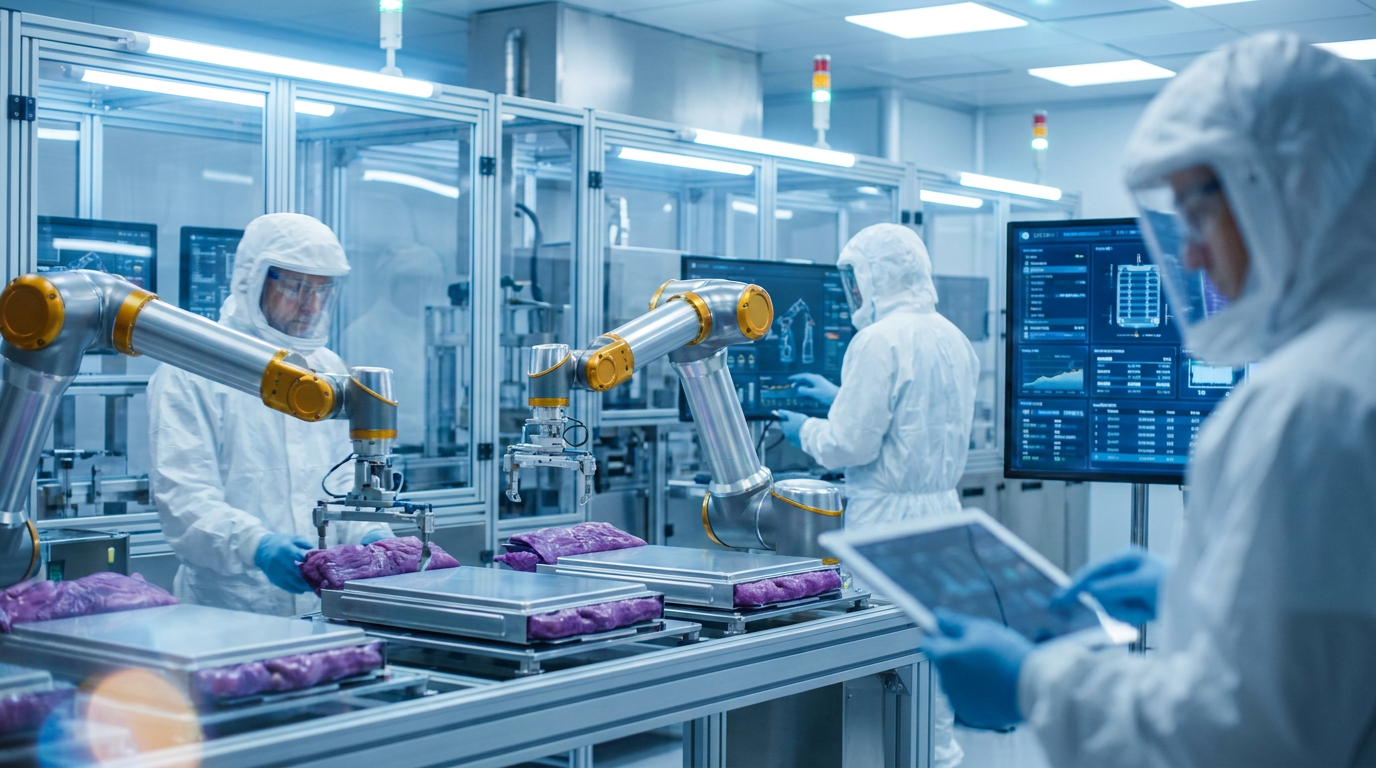
- Legacy Automakers
- Focused on in-house manufacturing, dry electrode processes, and long-term reliability, targeting 2027-2028 for flawless mass production.
- Battery Tech Startups
- Focused on pure R&D and licensing breakthrough ceramic separator technology to existing manufacturing giants.
- Chinese EV Manufacturers
- Focused on rapid, iterative deployment, utilizing 'semi-solid' batteries in 2026 as a stepping stone to capture market share.
- Manufacturing Skeptics
- Focused on the brutal economics of scale, warning that the massive capital expenditure required for new factories will delay mass adoption.
What's not represented
- · Raw Material Miners
- · Independent Safety Regulators
Why this matters
Solid-state batteries represent the biggest leap in automotive technology since the invention of the lithium-ion cell. By doubling driving range and eliminating battery fire risks, this breakthrough is poised to remove the final barriers to mass electric vehicle adoption and reshape global supply chains.
Key points
- Solid-state batteries replace flammable liquid electrolytes with stable solid materials, eliminating fire risks.
- The technology promises to double EV driving ranges and cut fast-charging times to under 10 minutes.
- Toyota and Nissan are targeting 2027 and 2028 for mass-market commercialization of true solid-state EVs.
- Many 2026 batteries marketed as 'solid-state' are actually semi-solid hybrids that still contain liquid.
- Building true solid-state manufacturing lines requires entirely new factories, costing up to $112 million per gigawatt-hour.
For more than a decade, the solid-state electric vehicle battery has been the automotive industry's holy grail—a technology perpetually promised to be just five years away. But in the first half of 2026, the narrative has definitively shifted from laboratory breakthroughs to industrial receipts. Major automakers and battery startups are no longer just publishing research papers; they are pouring billions into pilot plants, securing raw material supply chains, and locking in hard dates for mass production.[7]
The stakes for this transition are existential for legacy automakers. A true solid-state battery promises to double the driving range of current EVs, cut charging times to under ten minutes, and entirely eliminate the risk of battery fires. It represents a fundamental reimagining of electrochemical architecture that could finally push electric vehicle adoption past the tipping point of consumer hesitation.[4][7]
To understand the leap, one must look at the vulnerability of the lithium-ion batteries powering today's EVs. Current architectures rely on a liquid electrolyte to shuttle ions back and forth between the cathode and the anode. This liquid is highly volatile and flammable. If a cell is punctured in a crash or overheats, it can trigger a catastrophic chain reaction known as thermal runaway.[4]
Furthermore, liquid electrolytes are susceptible to the growth of dendrites—microscopic, needle-like structures of lithium metal that can pierce the battery's internal separator over time, causing a short circuit. A solid-state battery replaces that volatile liquid with a stable solid material, such as a ceramic or sulfide separator. This solid barrier physically blocks dendrite growth and cannot catch fire, allowing engineers to safely use energy-dense lithium-metal anodes.[4][5]

The performance gains are staggering. Toyota, which has committed $13.5 billion to its battery development program, has achieved an energy density of 450 to 500 watt-hours per kilogram (Wh/kg) with its sulfide-based solid-state cells. For context, standard lithium-ion batteries top out around 250 to 300 Wh/kg. Toyota's prototypes demonstrate a driving range of 745 miles (1,200 kilometers) and the ability to fast-charge from zero to 80 percent in just ten minutes.[4]
Toyota is aggressively targeting 2027 or 2028 for mass production. To meet this deadline, the automaker's key partner, Idemitsu Kosan, broke ground in early 2026 on a large-scale solid electrolyte pilot plant in Chiba Prefecture. This facility represents the critical raw material infrastructure required to move the technology out of the prototype phase and into consumer driveways.[4][7]
Nissan is executing a similarly rigid timeline under its "2028 Masterplan." The company opened its all-solid-state EV battery production line at its Yokohama plant in January 2025. By April 2026, Nissan achieved a crucial engineering milestone: successfully validating a 23-layer cell stack. This proved the architecture is ready for actual vehicle integration, paving the way for a functional prototype in 2027 and full retail availability in 2028.[1]
By April 2026, Nissan achieved a crucial engineering milestone: successfully validating a 23-layer cell stack.
But Nissan's strategy extends beyond just the chemistry; it is fundamentally about manufacturing economics. The automaker has partnered with US-based LiCAP Technologies to implement an "Activated Dry Electrode" process. Traditional battery manufacturing requires mixing chemicals with toxic solvents and baking them in massive, energy-intensive drying ovens. The dry process eliminates these ovens entirely, drastically shrinking the factory footprint and slashing capital expenditures.[1]
Simultaneously, Nissan is collaborating with the British firm Gelion and the University of Oxford to develop lithium-sulfur solid-state cells. By utilizing widely abundant, low-cost sulfur instead of expensive nickel and cobalt, Nissan aims to decouple its supply chain from volatile rare-earth metals and directly challenge China's dominance in battery material processing.[1][7]
While legacy automakers build their own factories, Silicon Valley's QuantumScape is pursuing a different route. In February 2026, the company inaugurated its "Eagle Line" in San Jose, California. Rather than attempting to become a mass manufacturer, QuantumScape intends to license its proprietary ceramic separator technology to existing giants. The Eagle Line serves as a highly automated blueprint, producing cells that have successfully completed 400 consecutive 15-minute fast-charge cycles while retaining over 80 percent of their capacity.[2][5]
Meanwhile, the Chinese automotive sector is moving at a blistering pace, with companies like Dongfeng announcing mass production of "solid-state" batteries for the second half of 2026. Dongfeng claims its new cells hit 350 Wh/kg and will enable a 1,000-kilometer driving range. However, these 2026 launches come with a significant technical asterisk that has clouded the global battery narrative.[3][7]

Industry analysts note that virtually every EV claiming to feature a solid-state battery in 2026 is actually utilizing a "semi-solid" or solid-liquid hybrid architecture. These transitional batteries still contain 5 to 15 percent liquid electrolyte to facilitate ion movement. To address the widespread marketing confusion, the Chinese government is preparing to release a strict new standard in July 2026 that will legally define and categorize liquid, semi-solid, and all-solid-state batteries.[1][6]
The distinction between semi-solid and true all-solid-state is not just semantic; it dictates the economics of global manufacturing. Upgrading an existing lithium-ion factory to produce semi-solid batteries requires an equipment investment of roughly $1.4 million to $2.1 million per gigawatt-hour (GWh)—about 10 to 15 percent of the original line cost.[6][7]

In stark contrast, true all-solid-state batteries are entirely incompatible with current manufacturing lines. Building a brand-new solid-state facility from scratch costs between $70 million and $112 million per GWh. This massive capital expenditure is the final, formidable moat separating the laboratory from the highway.[6][7]
As the industry races toward the 2027–2028 commercialization window, the engineering focus has shifted entirely from proving the chemistry to perfecting the assembly line. The companies that can successfully scale these complex manufacturing processes will not just eliminate range anxiety; they will define the next century of global transportation.[7]
How we got here
April 2022
Nissan opens its initial solid-state prototype production line.
January 2025
Nissan's all-solid-state EV battery production line becomes operational in Yokohama.
February 2026
QuantumScape inaugurates its 'Eagle Line' pilot facility in San Jose.
April 2026
Nissan achieves its 23-layer cell stack milestone, proving the architecture for vehicle use.
July 2026
China is expected to release its first official standard defining solid-state and semi-solid batteries.
2027–2028
Target window for Toyota and Nissan to launch their first mass-market EVs powered by true solid-state batteries.
Viewpoints in depth
Legacy Automakers
Focused on in-house manufacturing, dry electrode processes, and long-term reliability.
Companies like Toyota and Nissan are willing to wait until 2027 or 2028 to ensure the technology is flawless and mass-producible without liquid compromises. They are investing heavily in new manufacturing techniques, such as dry electrode processing, to drastically reduce factory footprints and capital expenditures, ensuring the final product is economically viable for the mass market.
Battery Tech Startups
Focused on pure R&D and licensing breakthrough chemistry to existing manufacturing giants.
Firms like QuantumScape believe the fastest way to scale is to perfect the core technology—such as proprietary ceramic separators—and license the blueprint. Instead of spending billions to build their own gigafactories, they aim to integrate their innovations into the existing supply chains of major automotive partners like Volkswagen.
Chinese EV Manufacturers
Focused on rapid, iterative deployment via semi-solid stepping stones.
Automakers like Dongfeng and BYD favor launching 'semi-solid' batteries in 2026 as a practical intermediate step. By retaining a small percentage of liquid electrolyte, they can retrofit existing factory lines cheaply and capture market share immediately, gathering real-world data while gradually reducing the liquid content in future iterations.
Manufacturing Skeptics
Focused on the brutal economics of scale and the massive capital expenditure required.
Industry analysts point out that while the chemistry of true solid-state batteries is proven, the economics are daunting. Because true solid-state cells are incompatible with current lithium-ion assembly lines, building entirely new factories costs up to $112 million per gigawatt-hour. Skeptics warn this massive upfront cost will keep solid-state batteries restricted to ultra-luxury vehicles for years after their initial launch.
What we don't know
- Whether the massive capital costs of building new solid-state factories will keep the technology restricted to luxury vehicles in its early years.
- How quickly global supply chains can scale the production of specialized solid electrolytes like sulfides and ceramics.
Key terms
- Electrolyte
- The medium inside a battery that allows electrical charge (ions) to flow between the cathode and anode.
- Thermal Runaway
- A dangerous chain reaction where a battery cell overheats and catches fire, a risk primarily associated with liquid electrolytes.
- Energy Density
- The amount of energy a battery can store relative to its weight, typically measured in watt-hours per kilogram (Wh/kg).
- Semi-Solid Battery
- A transitional battery technology that uses a mostly solid framework but retains a small percentage of liquid electrolyte to aid ion flow.
- Dendrites
- Microscopic, needle-like structures of lithium that can grow inside a battery during charging, potentially causing short circuits.
Frequently asked
What is the difference between a solid-state and a traditional EV battery?
Traditional batteries use a flammable liquid electrolyte to move ions. Solid-state batteries replace this with a stable solid material, like ceramic or sulfide, eliminating fire risk and allowing for more energy storage.
Can I buy a car with a solid-state battery today?
Not a true all-solid-state one. While some 2026 vehicles in China claim to have them, these are 'semi-solid' batteries that still contain 5% to 15% liquid. True solid-state EVs are expected around 2027 or 2028.
Why are they taking so long to reach the market?
While the chemistry works in a lab, manufacturing them at scale is incredibly difficult. True solid-state batteries require entirely new, highly controlled factory lines that cost up to $112 million per gigawatt-hour to build.
Sources
Source coverage
7 outlets
4 viewpoints surfaced







[1]ElectrekLegacy Automakers
Nissan takes aim at China with solid-state EV batteries
Read on Electrek →[2]Battery Tech OnlineBattery Tech Startups
QuantumScape Details Solid-State Battery Commercialization Strategy
Read on Battery Tech Online →[3]CarNewsChinaChinese EV Manufacturers
Dongfeng's new solid-state battery set for mass production in H2 2026
Read on CarNewsChina →[4]Live ScienceLegacy Automakers
Toyota announces plans to mass-produce solid-state EV batteries
Read on Live Science →[5]QuantumScapeBattery Tech Startups
QuantumScape Inaugurates Eagle Line Pilot for Solid-State Battery Production
Read on QuantumScape →[6]Bonnen BatteriesManufacturing Skeptics
Don't Get Fooled by Solid-State Hype: In 2026, Only Semi
Read on Bonnen Batteries →[7]Factlen Editorial Team
Synthesis by Factlen editorial team
Read on Factlen Editorial Team →
Every angle. Every day.
Get automotive stories with full source coverage and perspective breakdowns delivered to your inbox.