
The Solid-State Battery Era Begins: How the 'Holy Grail' of EVs is Finally Reaching Production
After decades of laboratory research, solid-state battery technology is finally entering pilot production in 2026. Automakers and tech firms are racing to commercialize the breakthrough, promising electric vehicles that can travel over 700 miles on a single, rapid charge.
By Factlen Editorial Team
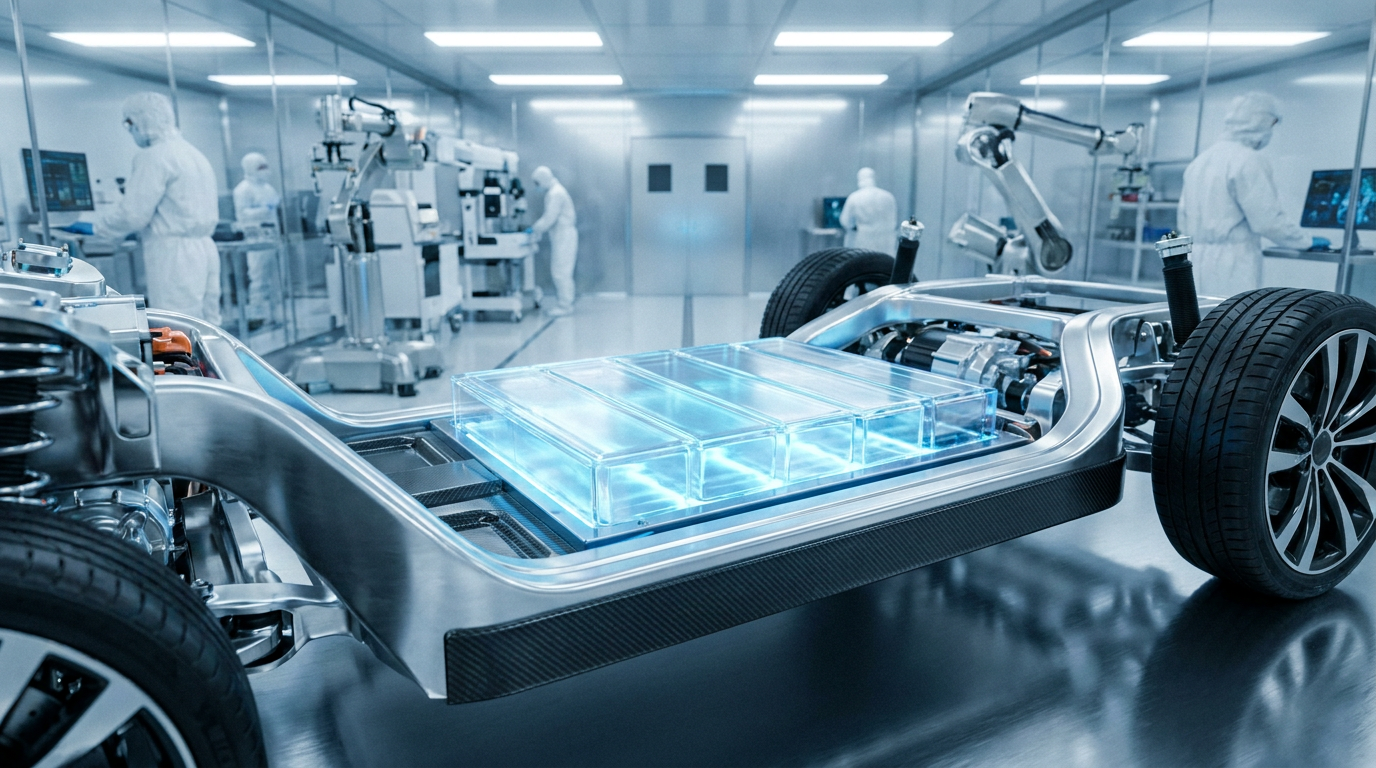
- Solid-State Pioneers
- Argue that the technology is ready to scale now, highlighting active pilot lines and successful real-world range tests.
- Pragmatic Incumbents
- Emphasize that while the chemistry works, manufacturing scale, interface resistance, and cost premiums will delay mass-market adoption until 2030.
- Alternative Chemistry Advocates
- Focus on bypassing supply chain bottlenecks by using solid-state lithium-sulfur designs rather than relying on traditional nickel and cobalt.
What's not represented
- · Lithium-Ion Manufacturers
- · Raw Material Miners
- · Consumer EV Advocates
Why this matters
Solid-state batteries represent the biggest leap in energy storage since the invention of lithium-ion. By doubling driving range, cutting charge times to under 10 minutes, and eliminating fire risks, this technology will finally remove the remaining barriers to mass electric vehicle adoption and reshape the global automotive supply chain.
Key points
- Solid-state batteries replace flammable liquid electrolytes with stable solid materials, enabling the use of energy-dense lithium-metal anodes.
- The technology promises to double EV driving ranges to over 700 miles while cutting charging times to under 10 minutes.
- Companies like QuantumScape and Nissan have launched automated pilot production lines in 2026 to scale manufacturing.
- Early real-world tests are succeeding, including a modified Mercedes-Benz that drove 745 miles on a single charge.
- Despite the progress, true mass-market adoption is likely delayed until 2030 due to high production costs and engineering hurdles.
For decades, the electric vehicle industry has chased a singular holy grail: the solid-state battery. Promising to double driving range, slash charging times, and eliminate the risk of battery fires, the technology has long been dismissed as a perpetual "five years away." But in 2026, the narrative is finally shifting from laboratory theory to industrial reality. Across the globe, pilot production lines are spinning up, real-world road tests are shattering range records, and billions of dollars in capital are flowing into specialized manufacturing facilities.[4]
To understand the magnitude of this breakthrough, one must look inside the conventional lithium-ion batteries that power today's electric vehicles. Traditional cells rely on a liquid electrolyte—a chemical solvent that acts as a highway, shuttling lithium ions back and forth between the anode and the cathode during charging and discharging. While effective, this liquid is highly volatile and flammable.[2][5]
Because of this flammability, engineers must heavily armor the battery packs and install complex cooling systems to prevent thermal runaway—the chain reaction that causes battery fires. Furthermore, the liquid electrolyte limits the types of materials that can be used inside the cell, effectively capping the maximum energy the battery can safely store.[5]
Solid-state batteries solve this by replacing the volatile liquid with a stable, non-flammable solid material, such as advanced ceramics, sulfides, or polymers. This seemingly simple material swap is a foundational physics change. Without a combustible liquid, the battery becomes inherently safe, even if punctured or subjected to extreme heat.[4][5]

More importantly, the solid electrolyte allows engineers to completely redesign the cell's architecture. In a traditional battery, the anode is made of bulky graphite, which safely absorbs lithium ions. With a solid separator, manufacturers can discard the graphite entirely and use a pure lithium-metal anode. This swap dramatically shrinks the size of the cell while vastly increasing its capacity.[1][2]
The result is a massive leap in energy density—measured in watt-hours per kilogram (Wh/kg). Today's best lithium-ion cells hover around 250 Wh/kg. Solid-state designs are targeting 400 to 500 Wh/kg. In practical terms, this means an electric vehicle could travel 600 to 750 miles on a single charge using a battery pack that is lighter and smaller than those on the market today.[1][4]
The race to commercialize this chemistry is accelerating rapidly. In early 2026, California-based QuantumScape inaugurated its "Eagle Line" in San Jose, moving its proprietary anode-free, lithium-metal cells out of the lab and into automated pilot production. Utilizing a unique manufacturing technique called the Cobra process to produce ceramic separators, the company is now supplying sample cells to automotive partners for real-world integration.[1][2]
The race to commercialize this chemistry is accelerating rapidly.
Real-world validation is already yielding staggering results. Factorial Energy, a solid-state developer that recently went public on the Nasdaq, supplied advanced cells for a modified Mercedes-Benz EQS. During testing, the vehicle successfully drove over 745 miles (1,200 kilometers) on a single charge, proving that the chemistry can endure the rigors of actual highway driving.[4]

Legacy automakers are anchoring their future lineups to the technology. Toyota has committed to launching its first solid-state electric vehicles by 2027 or 2028. To secure the massive volume of new materials required, the automaker partnered with Japanese energy giant Idemitsu Kosan, which recently broke ground on a dedicated solid-electrolyte manufacturing facility in Chiba.[3][5]
Nissan is aggressively targeting a similar 2028 commercialization window. The automaker has already established a pilot production line in Yokohama to refine its manufacturing techniques. In June 2026, Nissan expanded its solid-state ambitions by launching a £3.4 million collaborative project with the University of Oxford and Gelion.[7][8]
The Nissan-Gelion project highlights a secondary benefit of solid-state research: supply chain resilience. The collaboration focuses on solid-state lithium-sulfur batteries, a chemistry that replaces expensive, supply-constrained metals like nickel and cobalt with abundant, ultra-low-cost sulfur, potentially democratizing the price of future EVs.[8]
Despite the immense momentum, a crucial distinction separates the optimistic 2026 headlines from immediate showroom reality. Many of the vehicles currently hitting the road in early markets with "solid-state" branding are actually utilizing semi-solid batteries. These hybrid designs retain 5 to 15 percent liquid electrolyte to maintain ion flow, serving as a stepping stone rather than the final destination.[4][6]

True all-solid-state cells still face severe manufacturing hurdles before they can reach mass-market scale. The primary engineering bottleneck is interface resistance. As a battery charges and discharges, its internal components physically expand and contract. Maintaining perfect, microscopic contact between a rigid solid electrolyte and the electrodes over thousands of cycles is incredibly difficult outside of a controlled laboratory.[6]
Then there is the financial reality. Currently, manufacturing true solid-state cells requires ultra-dry cleanrooms and heavy structural press tools, resulting in a production cost premium of three to five times that of conventional lithium-ion batteries.[6]

Industry giants are carefully managing expectations regarding timelines. Robin Zeng, chairman of CATL—the world's largest battery manufacturer—recently cautioned that true all-solid-state commercialization remains restricted to premium, small-batch vehicle platforms. For the everyday consumer, mass-market adoption at price parity is likely waiting until after 2030.[6]
The transition to solid-state energy will not be an overnight flip of the switch, but rather a phased, decade-long rollout. Yet, the milestones achieved in 2026—automated pilot lines activating, real-world range records falling, and novel chemistries bypassing legacy supply chains—prove that the technology is no longer a distant mirage. The foundation for the next generation of electric mobility is officially being poured, promising a future where range anxiety and charging delays are relics of the past.[1][4][8]
How we got here
2020
Toyota demonstrates early solid-state prototype vehicle.
2025
Factorial Energy and Stellantis validate 77 Ah solid-state cells.
Early 2026
QuantumScape inaugurates 'Eagle Line' pilot production in California.
June 2026
Nissan and Oxford launch £3.4M solid-state lithium-sulfur project.
2027–2028
Target window for first commercial solid-state EVs from Toyota and Nissan.
2030+
Projected timeline for true mass-market adoption and cost parity.
Viewpoints in depth
Solid-State Pioneers
Argue that the technology is ready to scale now, highlighting pilot lines and real-world range tests.
Companies like QuantumScape and Factorial Energy represent the vanguard of the solid-state movement. They argue that the fundamental chemistry has been solved and that the focus is now purely on scaling manufacturing. By pointing to successful real-world tests—such as Factorial's 745-mile run in a modified Mercedes EQS—and the activation of automated pilot lines, these pioneers assert that the technology is ready for commercial vehicle integration by 2027 or 2028. They view the transition as an immediate, disruptive leap that will rapidly render traditional lithium-ion batteries obsolete.
Pragmatic Incumbents
Emphasize that while the chemistry works, manufacturing scale, interface resistance, and cost premiums will delay mass-market adoption until 2030.
Established battery giants like CATL and legacy automakers take a more measured approach. While they acknowledge the superior physics of solid-state cells, they emphasize the immense difficulty of manufacturing them at scale. Pragmatists point to 'interface resistance'—the challenge of keeping solid materials in perfect contact as the battery expands and contracts—and the requirement for ultra-dry cleanrooms, which currently drive production costs up to five times higher than lithium-ion. They argue that while premium, low-volume solid-state vehicles will appear soon, true mass-market adoption at price parity won't happen until after 2030, with semi-solid batteries serving as the interim solution.
Alternative Chemistry Advocates
Focus on bypassing supply chain bottlenecks by using solid-state lithium-sulfur designs rather than relying on traditional nickel and cobalt.
A growing subset of researchers and companies, such as Gelion and its partners at the University of Oxford, are looking past the immediate performance gains of solid-state technology to address its supply chain vulnerabilities. They advocate for solid-state lithium-sulfur batteries, which replace expensive, geographically constrained metals like nickel and cobalt with sulfur—an abundant, ultra-low-cost byproduct of other industries. This camp argues that the true revolution of solid-state technology won't just be longer driving ranges, but the ability to democratize EV pricing and secure western supply chains against geopolitical shocks.
What we don't know
- Exactly how quickly the manufacturing cost of solid-state cells can be reduced to match current lithium-ion prices.
- Whether solid-state batteries will maintain their performance and cycle life in extreme real-world weather conditions over a 10-to-15-year vehicle lifespan.
- Which solid electrolyte material—ceramics, sulfides, or polymers—will ultimately become the industry standard.
Key terms
- Solid Electrolyte
- A stable, non-flammable solid material (like ceramic or sulfide) that shuttles ions inside a battery, replacing volatile liquids.
- Lithium-Metal Anode
- A battery component made of pure lithium that stores vastly more energy than traditional graphite, made possible by solid electrolytes.
- Energy Density
- A measure of how much energy a battery can store relative to its weight, typically expressed in watt-hours per kilogram (Wh/kg).
- Interface Resistance
- An engineering challenge where the solid internal components of a battery struggle to maintain perfect physical contact as they expand and contract.
- Semi-Solid Battery
- A transitional battery design that uses mostly solid materials but retains a small amount of liquid electrolyte to help ions flow.
Frequently asked
What makes a solid-state battery different?
It replaces the flammable liquid chemical inside traditional batteries with a stable solid material, making the battery safer and capable of holding much more energy.
How far can a solid-state EV drive?
Current targets and early real-world tests show solid-state batteries can deliver between 600 and 750 miles (1,000 to 1,200 km) on a single charge.
Can I buy a solid-state electric vehicle today?
Not yet. While pilot production has begun in 2026, true all-solid-state vehicles are not expected to reach consumers until 2027 or 2028 at the earliest.
Why is it taking so long to release them?
Manufacturing them requires ultra-dry cleanrooms and complex engineering to keep the solid materials in perfect contact, making them currently three to five times more expensive to produce.
Sources
Source coverage
8 outlets
3 viewpoints surfaced








[1]ElectrekSolid-State Pioneers
QuantumScape inaugurates Eagle Line pilot for solid-state battery production
Read on Electrek →[2]InsideEVsSolid-State Pioneers
QuantumScape Kicked Off Solid-State Battery Pilot Production. The Hard Part's Next
Read on InsideEVs →[3]Green Car ReportsPragmatic Incumbents
Toyota EV plans: Tenfold boost by 2026, solid-state batteries
Read on Green Car Reports →[4]Intelligent LivingPragmatic Incumbents
Solid-State Battery Scoreboard 2025–2026: Who Shipped, Who Tested, and Who is Scaling Next
Read on Intelligent Living →[5]EVWorldPragmatic Incumbents
Toyota's Solid-State Battery Roadmap: Reality vs. Rumor
Read on EVWorld →[6]Caijing MagazinePragmatic Incumbents
CATL boss drops solid-state battery reality check: Years away from mass market
Read on Caijing Magazine →[7]CarBuzzSolid-State Pioneers
Nissan Remains Committed To Solid-State Batteries By 2028
Read on CarBuzz →[8]Gelion CorporateAlternative Chemistry Advocates
Nissan, University of Oxford and Gelion collaborate for solid-state EV batteries
Read on Gelion Corporate →
Every angle. Every day.
Get automotive stories with full source coverage and perspective breakdowns delivered to your inbox.