
Inside the 14-Point U.S.-Iran Peace Deal: Nuclear Limits, a $300 Billion Fund, and Global Market Relief
The United States and Iran have signed a preliminary 14-point agreement to end their three-month conflict, lifting a U.S. naval blockade in exchange for the reopening of the Strait of Hormuz. The deal establishes a 60-day window to finalize nuclear constraints and regional demilitarization, immediately easing global inflation fears.
By Factlen Editorial Team
- U.S. Administration & Negotiators
- Views the deal as an absolute necessity to prevent a catastrophic global economic collapse and secure the Strait of Hormuz.
- Security Skeptics & Hardliners
- Argues the agreement leaves Iran's nuclear infrastructure dangerously intact while rewarding aggression with financial concessions.
- Global Markets & Economists
- Celebrates the ceasefire as a vital pressure release valve that removes a massive stagflationary threat from the global economy.
- Regional Stakeholders
- Focuses on the immediate cessation of hostilities across the Middle East and the influx of reconstruction capital.
What's not represented
- · Lebanese civilians affected by the ceasefire
- · European energy consumers
- · Commercial shipping crews
Why this matters
This agreement halts a conflict that threatened to trigger a global recession by choking off one of the world's most critical oil arteries. For consumers, the immediate reopening of the Strait of Hormuz has already caused oil prices to drop, easing inflationary pressures that dictate everything from household energy bills to central bank interest rates.
Key points
- The U.S. and Iran signed a 14-point memorandum of understanding to halt hostilities.
- The U.S. will lift its naval blockade in exchange for Iran reopening the Strait of Hormuz.
- Iran will receive billions in unfrozen assets and a $300 billion reconstruction fund.
- Iran agreed to down-blend its highly enriched uranium under IAEA supervision.
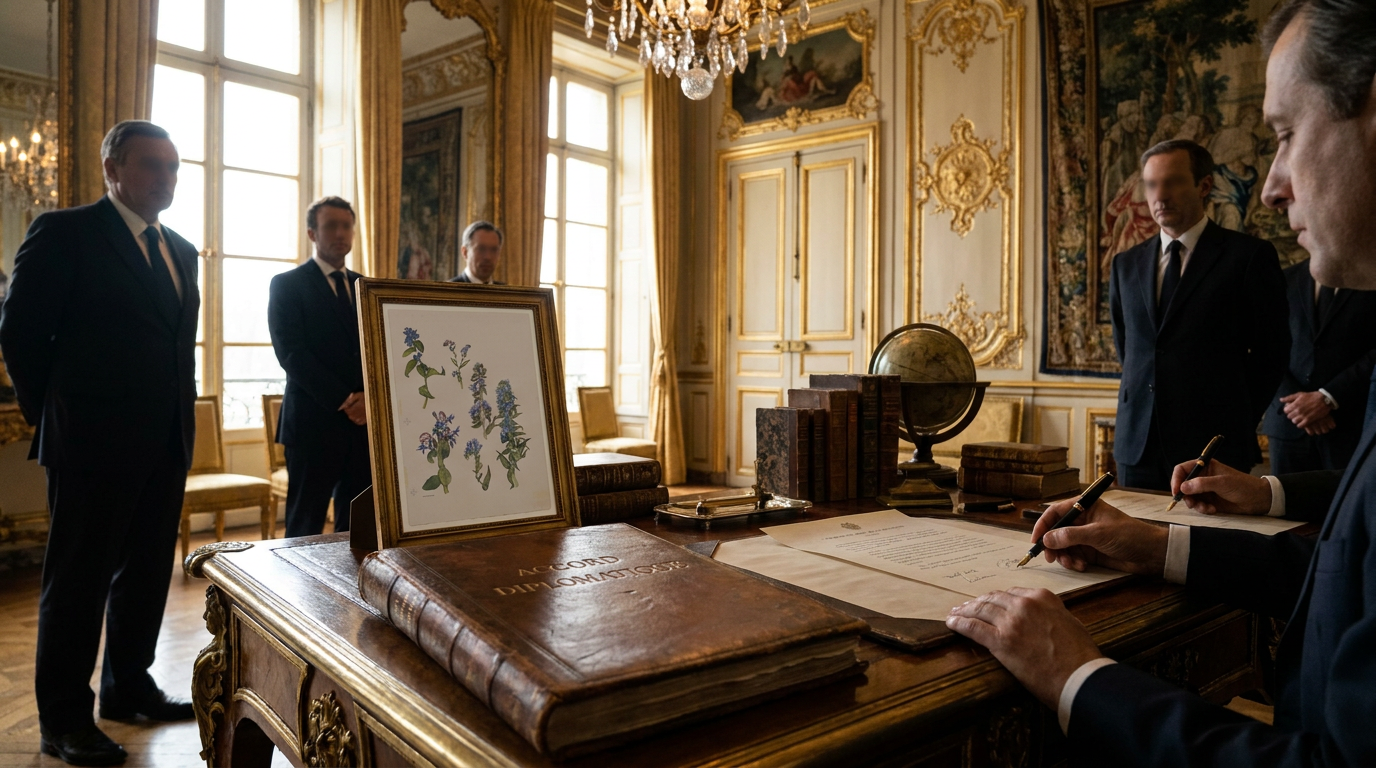
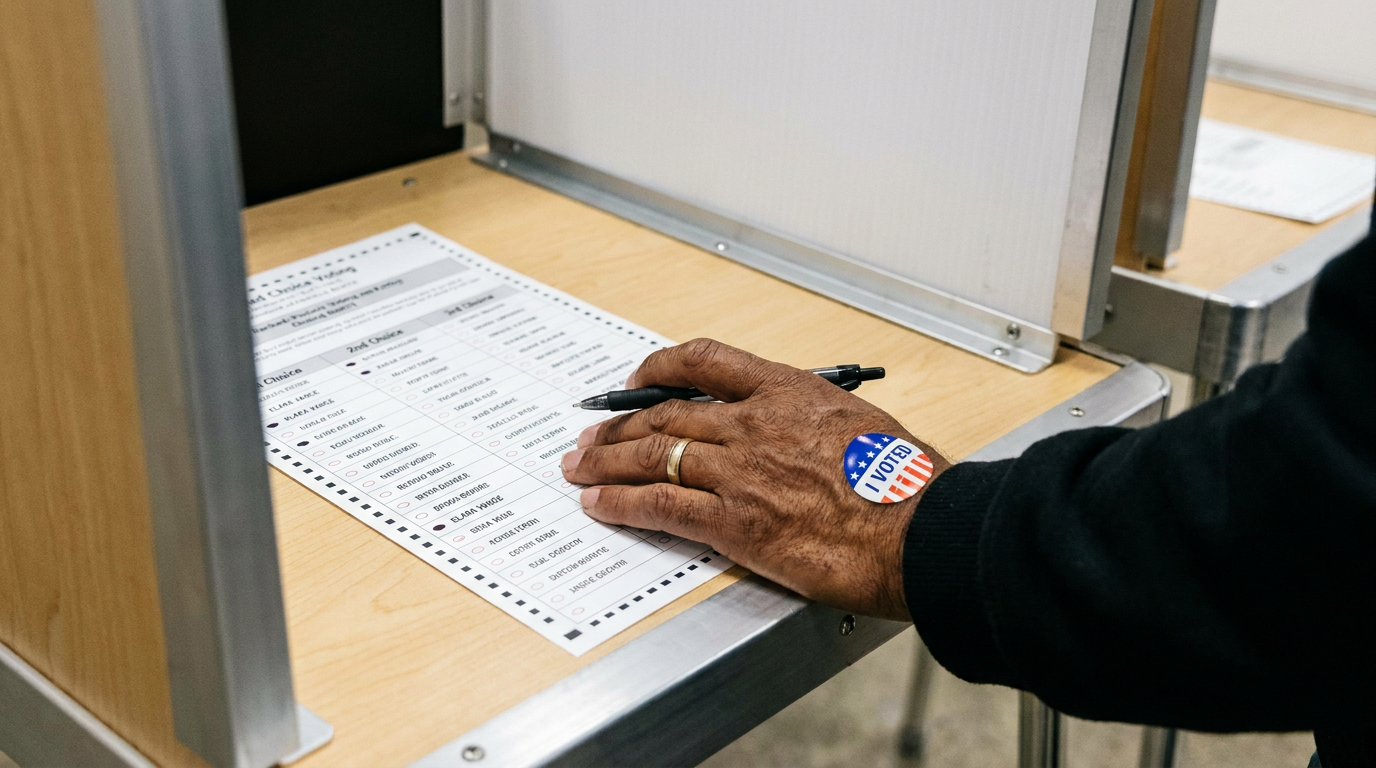
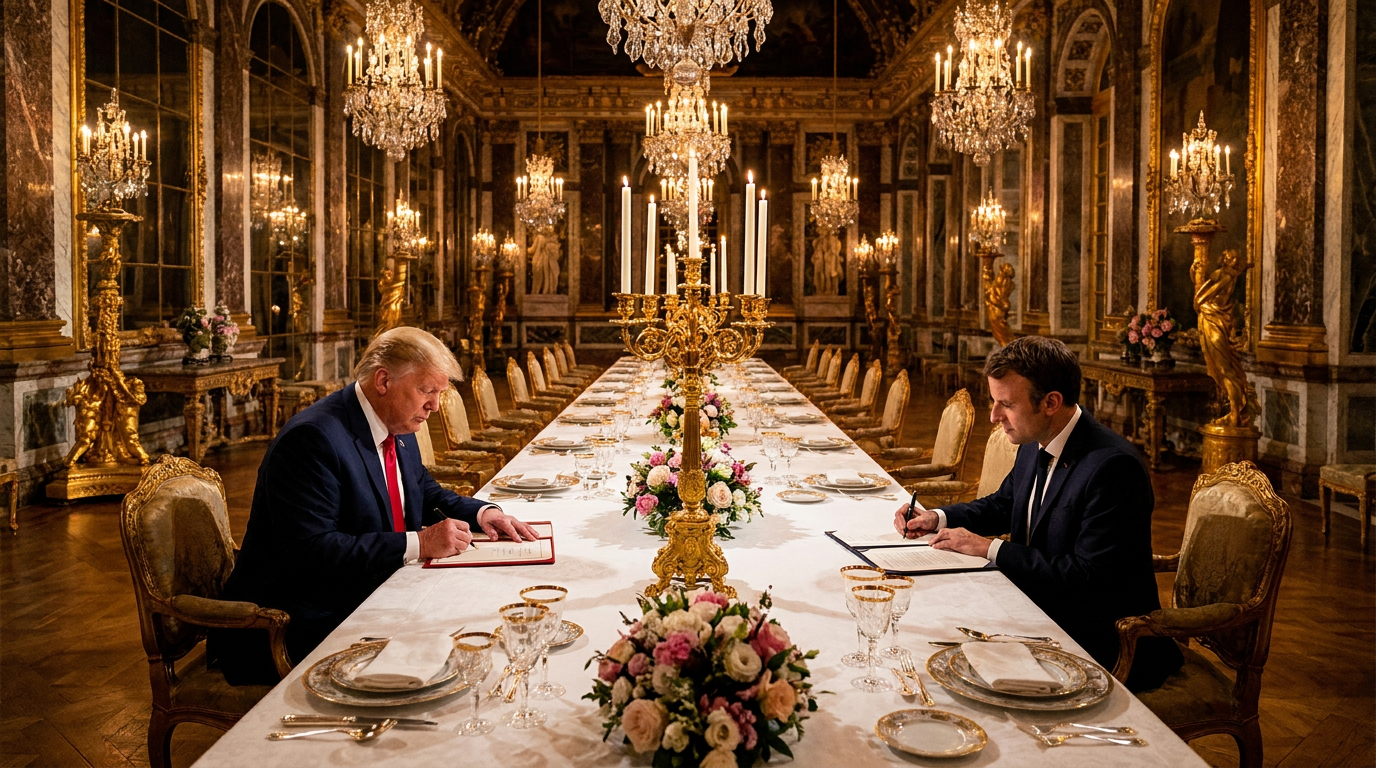
President Donald Trump and Iranian President Masoud Pezeshkian have signed a historic 14-point memorandum of understanding, establishing a 60-day framework to end a three-month conflict that threatened to plunge the global economy into recession. Trump signed the document during a dinner with French President Emmanuel Macron at the Palace of Versailles, while Pezeshkian signed remotely in Tehran.[1][2]
The preliminary agreement mandates an immediate and permanent cessation of hostilities across all fronts, effectively halting a war that had severely disrupted global shipping and energy markets. The text of the deal, dictated to journalists by senior U.S. administration officials, outlines a sweeping set of compromises designed to de-escalate military tensions while addressing the core economic and nuclear disputes between the two nations.[2][3]
At the center of the agreement is a critical economic trade-off: the United States will immediately begin lifting its naval blockade of Iranian ports, and in exchange, Iran will instantly reopen the Strait of Hormuz. The strait, a narrow waterway through which roughly a fifth of the world's oil supply flows, had been choked off by Iranian forces, triggering widespread panic in global commodities markets.[2][3]
Under the terms of the memorandum, Iran has committed to ensuring the safe, toll-free passage of commercial vessels through the Persian Gulf and the Sea of Oman for an initial 60-day period. The U.S. has pledged to fully end its naval blockade within 30 days, allowing maritime traffic to return to pre-war levels.[3]

To secure these concessions, the United States agreed to a massive package of financial relief for Tehran. The deal includes the immediate unfreezing of billions of dollars in Iranian assets that had been locked in international accounts. Furthermore, the U.S. and its regional partners have committed to developing a definitive plan for a $300 billion reconstruction and economic development fund for the Islamic Republic.[2][3][6]
Defending the sweeping financial concessions, President Trump argued that the alternative to the deal was a worldwide depression. He emphasized that the market demanded a resolution to the crisis, stating that the U.S. was going to have to return the frozen assets to ensure the Strait of Hormuz remained open and global oil could flow freely once again.[2]
On the critical issue of nuclear proliferation, the agreement strikes a delicate compromise. Iran formally reaffirmed that it will not procure or develop nuclear weapons, agreeing to maintain the status quo of its civilian nuclear program. However, the deal stops short of the complete dismantlement of Iran's nuclear infrastructure that Washington had previously demanded.[4][6]
Instead, the two sides agreed to resolve the disposition of Iran's stockpiled enriched material through dilution. Iran will place portions of its 440-kilogram stockpile of highly enriched uranium under the strict supervision of the International Atomic Energy Agency (IAEA). This material will be down-blended on-site to a lower purity level, rendering it unusable for a nuclear weapon.[2][6]

Instead, the two sides agreed to resolve the disposition of Iran's stockpiled enriched material through dilution.
This nuclear compromise has already sparked intense criticism from Israeli officials and hardline U.S. lawmakers. Skeptics argue that by allowing Iran to retain its enrichment facilities and keep large amounts of lower-level uranium, the agreement merely pauses the nuclear threat rather than eliminating it. They fear the $300 billion reconstruction fund will ultimately subsidize Iran's regional ambitions.[2][4]
Beyond the nuclear portfolio, the memorandum addresses the broader proxy conflicts that have plagued the Middle East. The text explicitly calls for a permanent end to military operations by both nations and their allies on all fronts, including in Lebanon, signaling an effort to rein in Hezbollah and stabilize Israel's northern border.[3][4]
In a significant strategic shift, the United States also undertook a commitment to remove its military forces from the immediate proximity of the Islamic Republic within 30 days after a final, binding treaty is signed. This concession addresses a long-standing Iranian demand to reduce the American military footprint in the Persian Gulf.[3]
The immediate impact of the signing was felt most acutely in global financial markets, where the threat of a prolonged energy crisis had loomed large. Following the announcement, global oil prices dropped by more than five percent, and the British pound climbed to its highest level since early June as investors shifted toward riskier assets.[7]
The easing of hostilities effectively neutralized fears of a stagflationary shock—a devastating economic scenario characterized by stagnant growth and skyrocketing inflation. For months, economists had warned that a sustained closure of the Strait of Hormuz could push oil to $120 a barrel, forcing central banks to take drastic action.[5][7]

The relief was immediately evident in London, where the Bank of England opted to hold its main interest rate steady at 3.75%. Central bank officials noted that the inflationary pressures on the British economy had become significantly more benign following the U.S.-Iran agreement, allowing them to avoid a painful rate hike.[5]
U.K. inflation data released the same week showed consumer prices holding steady at 2.8%, defying expectations of a sharp increase. Bank of England Governor Andrew Bailey called the recent fall in oil prices encouraging, though he cautioned that the energy spikes of the past three months still left some inflationary pressure in the pipeline.[5]
While Western markets celebrated the reprieve, the political framing of the deal remains fiercely contested. In Lebanon, Hezbollah leadership hailed the agreement as a great victory, while Iranian state media circulated images of the signed document as proof that Tehran had successfully forced Washington to back down from its maximum pressure campaign.[2]
The memorandum signed at Versailles is not the final word. It serves as a preliminary framework, establishing a strict 60-day window for U.S. and Iranian negotiators to hammer out the granular details of a binding treaty. This includes finalizing the mechanisms for the $300 billion fund and the exact schedule for lifting all international sanctions.[3][4]
If the two sides fail to reach a comprehensive agreement within the two-month timeframe, the interim deal allows for an extension by mutual consent. However, with deep-seated mistrust on both sides and domestic political pressure mounting in Washington, Tehran, and Jerusalem, the path from this preliminary ceasefire to a permanent peace remains fraught with uncertainty.[3][4]

How we got here
March 2026
Conflict escalates, leading to a U.S. naval blockade and Iran choking off the Strait of Hormuz.
Mid-June 2026
Secret negotiations yield a 14-point preliminary framework to halt hostilities.
June 17, 2026
President Trump signs the memorandum of understanding at the Palace of Versailles; Iranian President Pezeshkian signs in Tehran.
August 2026
The 60-day deadline for the U.S. and Iran to finalize the binding peace treaty and fully implement the reconstruction fund.
Viewpoints in depth
The U.S. Administration's View
The deal was an absolute necessity to prevent a catastrophic global economic collapse.
President Trump and senior U.S. officials argue that the agreement is a 'major win' because it achieves the primary goal of reopening the Strait of Hormuz without committing the U.S. to a protracted, unwinnable ground war. By securing Iran's pledge to down-blend its highly enriched uranium and halt regional military operations, the administration claims it has neutralized the immediate nuclear and conventional threats. Furthermore, officials emphasize that the alternative—a prolonged closure of the strait—would have triggered a 'worldwide depression' driven by skyrocketing energy costs.
Israeli and Hardline Skeptics' View
The agreement leaves Iran's nuclear infrastructure dangerously intact while rewarding aggression.
Critics, including Israeli officials and Republican hardliners, view the financial concessions as a historic capitulation. They argue that unfreezing billions in assets and establishing a $300 billion reconstruction fund will ultimately finance Iran's proxy networks across the Middle East. More alarmingly, skeptics point out that the deal allows Iran to maintain its baseline nuclear enrichment capabilities rather than forcing a complete dismantlement. By stopping short of total removal of nuclear material, critics fear the U.S. has only delayed, rather than eliminated, Iran's path to a bomb.
Global Markets' View
The ceasefire removes a massive stagflationary threat from the global economy.
For central bankers and commodity traders, the geopolitical nuances of the deal are secondary to the immediate resumption of global trade. The conflict had priced a severe risk premium into energy markets, threatening to reverse years of work fighting post-pandemic inflation. The preliminary agreement instantly triggered a drop in oil prices and allowed institutions like the Bank of England to hold interest rates steady. From a macroeconomic perspective, the deal is a vital pressure release valve that averts a severe global recession.
What we don't know
- Whether the U.S. and Iran can successfully negotiate the granular details of a binding treaty within the 60-day window.
- Exactly which 'regional partners' will provide the capital for the $300 billion reconstruction fund.
- How Israeli leadership will respond to an agreement that leaves Iran's baseline nuclear infrastructure intact.
Key terms
- Memorandum of Understanding (MOU)
- A formal, non-binding agreement outlining the broad terms of a deal before a final, legally binding treaty is drafted.
- Strait of Hormuz
- A narrow waterway between the Persian Gulf and the Gulf of Oman through which roughly 20% of the world's global oil consumption passes.
- Down-blending
- The process of mixing highly enriched uranium with natural or depleted uranium to reduce its concentration, making it unusable for nuclear weapons.
- IAEA
- The International Atomic Energy Agency, the United Nations watchdog responsible for monitoring and verifying nuclear programs.
Frequently asked
Is the war between the U.S. and Iran officially over?
The agreement signed is an interim ceasefire and framework, halting all hostilities immediately. The two nations now have 60 days to negotiate and sign a final, permanent peace treaty.
What happens to Iran's nuclear program?
Iran has committed to not pursuing nuclear weapons and will allow the IAEA to supervise the down-blending of its highly enriched uranium, though it will retain the right to enrich uranium for civilian use.
Who is paying for the $300 billion reconstruction fund?
The text of the agreement states that the United States and 'regional partners' will develop the fund, heavily implying that wealthy Gulf nations will provide the bulk of the capital.
Why did the Bank of England hold interest rates?
The reopening of the Strait of Hormuz caused global oil and gas prices to drop significantly, easing the inflationary pressures that had previously threatened the UK economy.
Sources
Source coverage
7 outlets
4 viewpoints surfaced







[1]Fox NewsU.S. Administration & Negotiators
Trump personally signs Iran deal in major diplomatic breakthrough
Read on Fox News →[2]The GuardianSecurity Skeptics & Hardliners
Details of the 14-point agreement revealed as senior US officials claim 'major win'
Read on The Guardian →[3]CBS NewsU.S. Administration & Negotiators
US releases text of Iran peace plan as Trump says deal averts 'worldwide depression'
Read on CBS News →[4]Council on Foreign RelationsSecurity Skeptics & Hardliners
Where the U.S.-Iran Deal Lands on Core Issues
Read on Council on Foreign Relations →[5]AP NewsGlobal Markets & Economists
Bank of England holds main interest rate at 3.75% as inflation pressures ease
Read on AP News →[6]The NationalRegional Stakeholders
Pact includes sanctions relief, nuclear limits and $300bn reconstruction fund
Read on The National →[7]Trading EconomicsGlobal Markets & Economists
Pound Rises as US-Iran Deal Lifts Risk Sentiment
Read on Trading Economics →
More in news politics
See all 7 stories →Nuclear Diplomacy
Full Text of U.S.-Iran Memorandum of Understanding Released, Outlining Ceasefire and Nuclear Framework
7 sources

Iran Peace Deal
U.S. and Iran Sign 14-Point Memorandum to Halt War and Reopen Strait of Hormuz
8 sources
Ranked-Choice Voting
Evidence Pack: Does Ranked-Choice Voting Actually Reduce Political Polarization?
7 sources
US-Iran Deal
U.S. and Iran Sign 14-Point Memorandum to End War and Reopen Strait of Hormuz
7 sources
Every angle. Every day.
Get news politics stories with full source coverage and perspective breakdowns delivered to your inbox.