
How Indigenous Food Sovereignty is Reshaping North American Culinary Tourism
A booming movement of Native American chefs and food sovereignty advocates is decolonizing the continent's menus, turning Indigenous culinary traditions into a major driver of cultural tourism.
By Factlen Editorial Team
- Indigenous Chefs & Restaurateurs
- Culinary leaders focused on reclaiming pre-contact ingredients and decolonizing the modern diet.
- Food Sovereignty Advocates
- Policy experts and community leaders fighting for systemic control over Native food systems.
- Tourism & Economic Developers
- Industry professionals leveraging culinary interest to build community wealth.
- Factlen Analysts
- Editorial synthesis of the cultural, economic, and historical threads of the movement.
What's not represented
- · Everyday residents of reservation communities who may face food deserts and lack access to high-end decolonized cuisine.
- · Conventional agricultural producers who currently supply federal food programs on reservations.
Why this matters
By choosing to spend travel dollars at Indigenous-owned restaurants and cultural centers, visitors are directly funding the preservation of ancestral knowledge, supporting sustainable agriculture, and helping Native communities reclaim their health and economic independence.
Key points
- Indigenous culinary tourism is rapidly expanding across North America, driven by a desire for authentic, pre-contact foodways.
- Leading chefs are 'decolonizing' their menus by removing colonial ingredients like wheat, dairy, and beef.
- The movement is closely tied to 'food sovereignty,' which seeks to restore Native control over food production and health.
- Federal agencies and tourism boards are increasingly funding and promoting Indigenous culinary initiatives.
- Scaling the hyper-local supply chain sustainably remains the movement's primary logistical challenge.
For generations, North American culinary tourism was defined by European imports: French bistros in Quebec, Italian enclaves in New York, or wine-tasting routes modeled after Bordeaux. Today, a profound shift is redrawing the continent's culinary map. Travelers are increasingly charting their itineraries around reservations, urban cultural centers, and Native-owned restaurants to experience the original flavors of the Americas. This rising wave of Indigenous culinary tourism is more than a hospitality trend; it is a vibrant reclamation of culture, history, and health.[1][3][8]
At the heart of this movement is the concept of "decolonized cuisine." For many leading Indigenous chefs, this means strictly eliminating ingredients introduced to the continent after European contact. Menus at these vanguard restaurants deliberately exclude beef, pork, chicken, dairy, wheat flour, and refined cane sugar. Instead, they celebrate a rich, hyper-local pantry that sustained Native populations for millennia.[2][3][8]
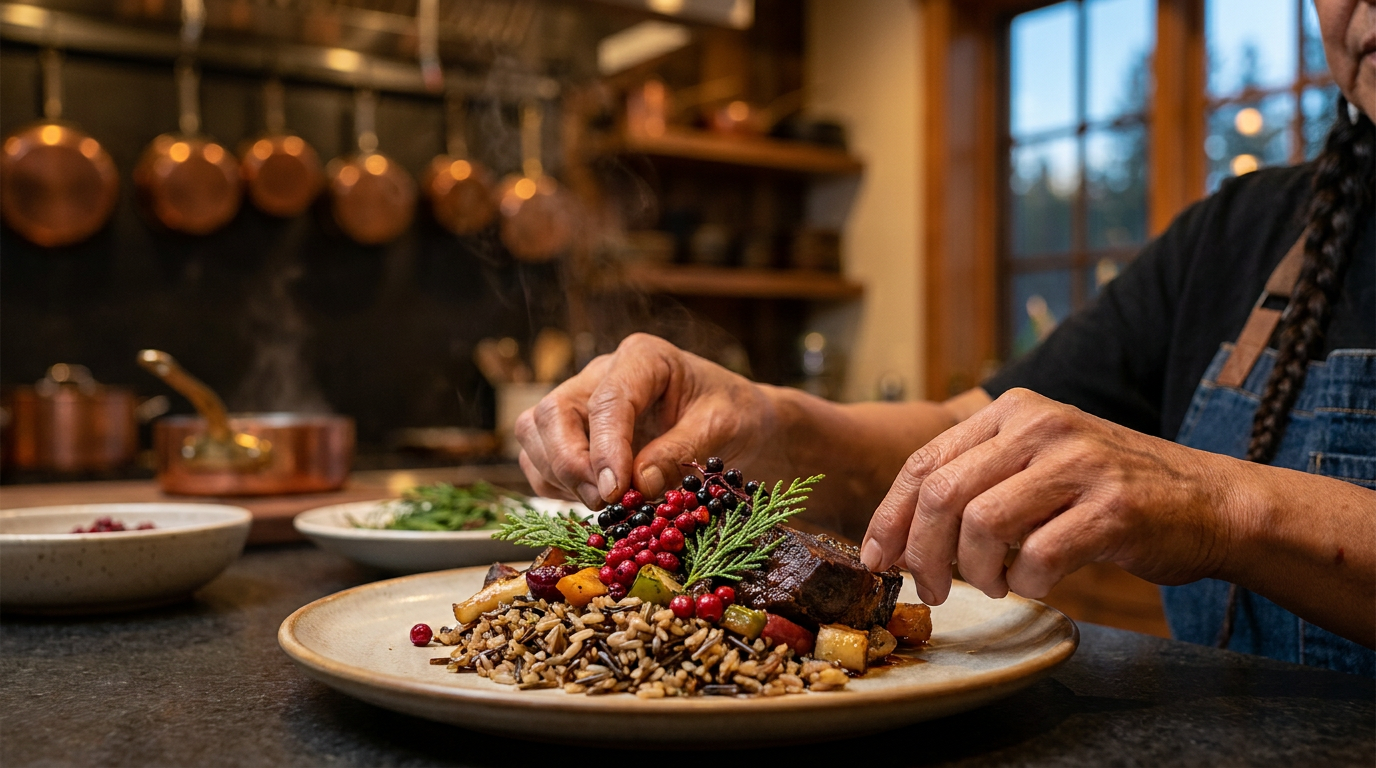
Diners seeking out these experiences are introduced to pre-contact ingredients that reflect the deep ecological diversity of North America. Plates feature cedar-braised bison, open-faced elk sandwiches on heirloom corn tortillas, and sumac iced tea. In the Midwest, dishes highlight wild rice (manoomin) and walleye; in the Southwest, tepary beans and native squash take center stage; and on the West Coast, menus incorporate acorn flour, venison backstrap, and local seaweed.[2][8]
The watershed moment for this culinary renaissance occurred when Owamni, a Minneapolis restaurant founded by Oglala Lakota chef Sean Sherman (known as The Sioux Chef), won the prestigious James Beard Award for Best New Restaurant. The accolade catapulted Indigenous cuisine into the national spotlight, proving that pre-colonial foodways could command the highest levels of gastronomic respect. Sherman's mission extends beyond fine dining; it is a concerted effort to raise awareness about the importance of culturally relevant foods.[1][3]

The success of Owamni has illuminated a broader network of Indigenous culinary destinations. In Oakland, California, Kickapoo chef Crystal Wahpepah draws crowds to Wahpepah's Kitchen for smoked salmon tostadas and blackberry-sumac drinks. On Madeline Island in Wisconsin, Miijim serves traditional Ojibwe dishes, while the Indian Pueblo Kitchen in Albuquerque offers a full celebration of the culinary traditions of the 19 Pueblo Nations.[2][8]
This tourism boom is inextricably linked to the broader "Indigenous Food Sovereignty" movement. Food sovereignty is a policy approach and grassroots effort aimed at addressing the underlying issues that impact Indigenous peoples' ability to access healthy, culturally adapted foods. It asserts that the right to food is sacred and emphasizes the ability of communities to control their own food production and distribution, free from dependence on industrialized, corporately controlled systems.[6]
Understanding food sovereignty requires acknowledging a painful history. Generations of harmful federal policies forcibly removed Indigenous people from their traditional homelands and severed their access to ancestral food sources. During forced relocations, such as the Navajo's "Long Walk" in 1864, the U.S. government provided rations of refined flour, lard, salt, and sugar.[1][6]
Understanding food sovereignty requires acknowledging a painful history.
From those meager survival rations emerged "fry bread," a staple that remains a complex symbol within Native communities today. While many decolonized restaurants intentionally exclude fry bread due to its colonial origins and associated health impacts, others continue to celebrate it—often serving it as the base for "Indian Tacos"—as a profound testament to Indigenous resilience and survival.[2][8]

The push for food sovereignty is now gaining institutional backing. The U.S. Department of Agriculture (USDA) recently launched the Indigenous Food Sovereignty Initiative, partnering with tribal-serving organizations to reimagine federal food programs from an Indigenous perspective. The initiative promotes traditional foodways, supports Native agriculture markets, and produces guides on sustainable foraging for ingredients like wild onion, milkweed, and nettles.[5]
Simultaneously, the tourism industry is recognizing the massive economic and cultural value of these experiences. The American Indigenous Tourism Association recently introduced specific culinary categories to its Excellence in Indigenous Tourism Awards, honoring Wahpepah's Kitchen as the Best Indigenous Culinary Tourism Experience. These awards highlight the sector's contribution to an $11.6 billion annual economic impact generated by Indigenous tourism in the United States.[4]

The momentum crosses international borders. In Canada, Indigenous Tourism Ontario (ITO) partnered with the Tourism Innovation Lab to launch the Skode program, an initiative specifically focused on developing Indigenous culinary tourism. The program provides funding and mentorship to Indigenous entrepreneurs, aiming to spark new, authentic culinary experiences that celebrate Native foodways in the province.[7]
However, scaling this movement presents unique logistical challenges. Unlike conventional restaurants that rely on massive, industrialized supply chains, decolonized kitchens depend on hyper-local sourcing. Chefs must build relationships with Native farmers, ethical foragers, and specialized nonprofits—such as the Native Seeds/SEARCH foundation, which preserves ancient, Indigenous seeds that might otherwise be lost.[1][3]
This sourcing model is deeply intertwined with Traditional Ecological Knowledge (TEK). Indigenous agricultural practices prioritize regenerative economies and a system of reciprocity between people and the planet. By supporting these food systems, culinary tourists are indirectly funding environmental conservation, biodiversity preservation, and climate resilience.[1][6]
The primary uncertainty facing the movement is whether these delicate, localized supply chains can withstand the surging demand of global tourism. There is a delicate balance between welcoming visitors to experience Indigenous cuisine and ensuring that traditional ingredients are not over-harvested or priced out of reach for the communities that rely on them.[1][6]

To address these bottlenecks and build long-term infrastructure, leaders are focusing on education. Initiatives like the Indigenous Food Lab—a project under the nonprofit North American Traditional Indigenous Food Systems (NāTIFS)—are working to train a new generation of Native chefs and establish support networks across the continent. The goal is to open similar labs across North America, ensuring the movement's growth is sustainable and community-led.[3]
Ultimately, the rise of Indigenous culinary tourism offers travelers a profoundly different way to experience North America. It transforms dining from a mere transaction into an act of learning, respect, and participation in a living history. By pulling up a chair at the tribal table, visitors are not just tasting the continent's true original flavors; they are supporting a restorative framework that heals communities and honors the land.[1][3][6]
How we got here
1864
The Navajo 'Long Walk' results in forced relocation and the creation of fry bread from government rations.
1996
The global food sovereignty movement officially emerges, providing a framework for Indigenous food reclamation.
2022
Owamni by The Sioux Chef wins the James Beard Award for Best New Restaurant, bringing national attention to decolonized cuisine.
2024
The USDA launches the Indigenous Food Sovereignty Initiative to reimagine federal food programs.
2025
The American Indigenous Tourism Association introduces dedicated culinary categories to its Excellence in Indigenous Tourism Awards.
Viewpoints in depth
Indigenous Chefs & Restaurateurs
Culinary leaders focused on reclaiming pre-contact ingredients and decolonizing the modern diet.
This camp views the kitchen as a site of cultural reclamation and healing. By strictly utilizing ingredients native to North America—such as bison, wild rice, and heirloom squash—they aim to undo the health damages caused by colonial diets. They argue that Indigenous cuisine is the true original American food and deserves the same gastronomic respect as French or Italian traditions.
Food Sovereignty Advocates
Policy experts and community leaders fighting for systemic control over Native food systems.
For these advocates, the culinary tourism boom is a vehicle for a much larger political and ecological goal: food sovereignty. They emphasize that true success isn't just a popular restaurant, but the restoration of Indigenous land rights, the protection of ancestral seeds, and the integration of Traditional Ecological Knowledge into federal agricultural policies.
Tourism & Economic Developers
Industry professionals leveraging culinary interest to build community wealth.
This perspective focuses on the economic engine of hospitality. They view the rising interest in Indigenous food as a vital opportunity to capture a share of the multi-billion-dollar tourism market. Their priority is building infrastructure, providing grants, and ensuring that the economic benefits of this tourism boom remain within Native communities rather than being extracted by outside corporations.
What we don't know
- Whether hyper-local Indigenous supply chains can scale sufficiently to meet the booming demand of global culinary tourism without compromising ecological sustainability.
- How climate change will impact the availability of delicate, wild-foraged ingredients central to pre-contact menus.
- The long-term impact of these high-profile culinary initiatives on the everyday dietary health and food security of broader reservation communities.
Key terms
- Food Sovereignty
- The right of peoples to healthy and culturally appropriate food produced through ecologically sound and sustainable methods, and their right to define their own food systems.
- Decolonized Cuisine
- A culinary approach that strictly utilizes pre-contact, native ingredients while eliminating foods introduced by European colonizers.
- Traditional Ecological Knowledge (TEK)
- The evolving knowledge acquired by Indigenous peoples over hundreds or thousands of years through direct contact with the environment.
- Manoomin
- The Ojibwe word for wild rice, a sacred and staple food harvested from the lakes and rivers of the Great Lakes region.
- The Three Sisters
- A traditional Native American companion planting technique and culinary trio consisting of corn, beans, and squash.
Frequently asked
What makes a restaurant menu 'decolonized'?
A decolonized menu focuses exclusively on ingredients native to the Americas before European contact. It intentionally excludes introduced items like wheat flour, dairy, beef, pork, and refined cane sugar.
Why is fry bread controversial in Indigenous cuisine?
While fry bread is a beloved comfort food and symbol of survival, it originated from unhealthy government rations (flour, lard, sugar) provided during forced relocations. Some health-conscious chefs exclude it to focus on pre-contact nutrition.
How does culinary tourism help Indigenous communities?
It provides a platform for cultural storytelling, supports local Native farmers and foragers economically, and helps fund the broader movement for food sovereignty and health education.
What is an Indigenous Food Lab?
It is a training center and initiative designed to educate the next generation of Native chefs, develop sustainable supply chains, and help establish Indigenous kitchens across North America.
Sources
Source coverage
8 outlets
4 viewpoints surfaced








[1]Factlen Editorial TeamFactlen Analysts
Synthesis by Factlen editorial team
Read on Factlen Editorial Team →[2]AFARIndigenous Chefs & Restaurateurs
8 Native American–Owned Restaurants to Visit in the U.S.
Read on AFAR →[3]InsideHookIndigenous Chefs & Restaurateurs
The Indigenous Food Movement Is Finally Getting Its Due
Read on InsideHook →[4]ICT NewsTourism & Economic Developers
Excellence in Indigenous Tourism Awards announced
Read on ICT News →[5]U.S. Department of AgricultureFood Sovereignty Advocates
USDA Indigenous Food Sovereignty Initiative
Read on U.S. Department of Agriculture →[6]Indigenous Food Systems NetworkFood Sovereignty Advocates
Indigenous Food Sovereignty
Read on Indigenous Food Systems Network →[7]Foodservice and HospitalityTourism & Economic Developers
New Skode Program Focused on Developing Indigenous Culinary Tourism in Ontario
Read on Foodservice and Hospitality →[8]Gastro ObscuraIndigenous Chefs & Restaurateurs
The Native American Restaurants Decolonizing North American Cuisine
Read on Gastro Obscura →

Every angle. Every day.
Get travel stories with full source coverage and perspective breakdowns delivered to your inbox.