
Bioluminescent Beaches: The Science Behind the Ocean's Glowing Shores
Microscopic plankton transform ordinary coastlines into neon-blue light shows, driving a surge in nocturnal eco-tourism. Here is the chemistry, evolutionary purpose, and optimal conditions behind the ocean's most magical phenomenon.
By Factlen Editorial Team
- Marine Biologists
- Focused on decoding the evolutionary purpose and chemical mechanics of the light.
- Eco-Tourism Operators
- Focused on optimizing the visitor experience and tracking bloom conditions.
- Conservationists
- Focused on protecting fragile bays from light pollution and chemical runoff.
What's not represented
- · Local coastal residents dealing with noctourism traffic
- · Commercial fisheries affected by toxic red tide blooms
Why this matters
Understanding bioluminescence transforms a beautiful beach vacation into a deeper appreciation of marine biology and ecosystem health. Knowing how these fragile organisms operate helps travelers make sustainable choices that protect the world's few remaining glowing bays from chemical runoff and light pollution.
Key points
- Bioluminescent beaches glow neon blue due to high concentrations of dinoflagellates, a type of microscopic marine plankton.
- The glow is produced by a chemical reaction where the molecule luciferin reacts with oxygen, catalyzed by the enzyme luciferase.
- Plankton emit light when mechanically disturbed by waves or movement, likely acting as a 'burglar alarm' to startle predators.
- Optimal viewing requires a dark new moon, warm water temperatures between 68 and 78 degrees Fahrenheit, and high salinity.
- Puerto Rico, the Maldives, and Florida's Space Coast are among the world's most reliable hotspots for bioluminescent noctourism.
- Conservationists warn that light pollution and chemical runoff from sunscreens threaten the survival of these fragile ecosystems.
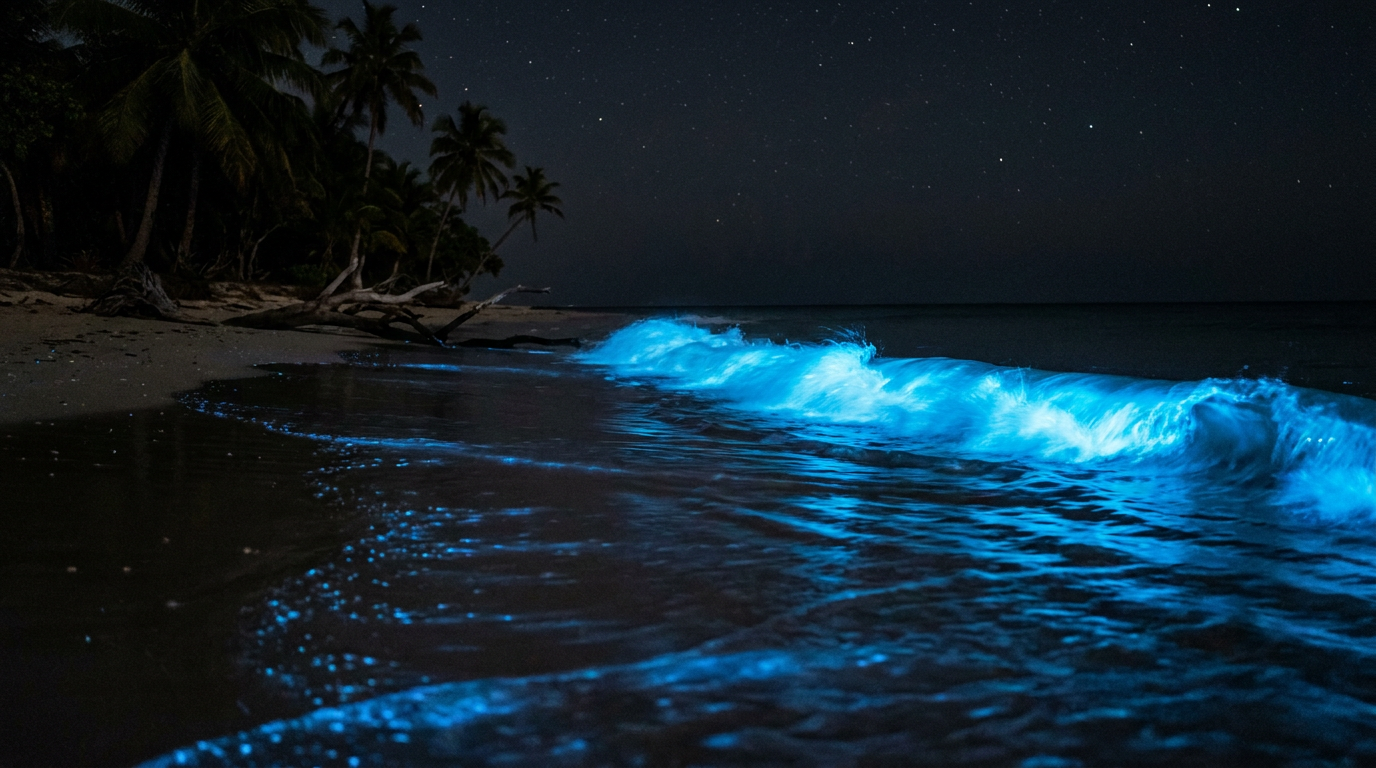
Imagine walking along a dark shoreline, the night sky devoid of moonlight, when a wave crashes against the sand and suddenly erupts into a brilliant, neon-blue glow. With every step taken in the wet sand, glowing footprints trail behind, and a hand swiped through the water leaves a sparkling, electric wake. This is not a digital special effect or a scene from a science fiction film; it is the very real, naturally occurring phenomenon of bioluminescent beaches. Found in select coastal pockets around the globe, these glowing shores represent one of the ocean's most enchanting visual displays, transforming ordinary saltwater into a shimmering, interactive light show.[4][6]
The allure of these glowing waters has given rise to a niche travel trend known as "noctourism," where visitors specifically seek out destinations for their nighttime natural wonders. Much like chasing the aurora borealis in the high latitudes, hunting for bioluminescent beaches requires a mix of geographical precision, perfect weather conditions, and a bit of luck. From the warm lagoons of the Caribbean to the episodic blooms along the Pacific coast, travelers are increasingly prioritizing these nocturnal marine encounters, drawn by the sheer magic of swimming through liquid starlight.[4]
To understand the spectacle, it is necessary to distinguish between different types of marine light. While biofluorescence involves an organism absorbing external light and re-emitting it at a different wavelength, bioluminescence is entirely self-generated. It is a chemical reaction that occurs within the organism itself, producing light without requiring any external light source. In the deep ocean, an estimated 75 percent of marine animals possess some form of bioluminescence, using it to hunt, hide, or find mates in the pitch-black abyss. But on the surface, the glowing beaches are driven by a much smaller, microscopic cast of characters.[3]
The primary architects of these glowing shorelines are dinoflagellates, a type of single-celled marine plankton that float near the ocean's surface. Depending on the species, these tiny organisms measure anywhere from two millimeters down to just two-thousandths of a millimeter, making them entirely invisible to the naked eye under normal daylight conditions. Yet, when they gather in massive concentrations—sometimes numbering in the millions per bucket of seawater—their collective light-producing capabilities become powerful enough to illuminate entire bays and coastlines.[2][7]
The neon-blue glow is the result of a highly efficient internal chemical reaction. Inside the dinoflagellate, a light-emitting molecule called luciferin reacts with oxygen. This oxidation process is catalyzed by an enzyme known as luciferase, which speeds up the reaction and converts chemical energy directly into light energy. Unlike the light produced by a traditional incandescent bulb, which wastes immense amounts of energy as heat, bioluminescence is a "cold light," meaning nearly 100 percent of the energy is released as visible light.[2][5]

This chemical reaction does not happen randomly; it requires a specific physical trigger. Dinoflagellates emit light when they are subjected to mechanical stress or agitation in the water. When a wave tumbles, a kayak paddle slices through the surface, or a fish darts through a dense patch of plankton, the physical movement forces positively charged protons to pass through channels in the dinoflagellates' cell membranes. This sudden influx creates an electrical pulse that immediately activates the luciferase enzyme, resulting in a brilliant flash of blue light.[5][7]
What appears to the human eye as a continuous, glowing aura is actually an optical illusion born of sheer numbers. A single dinoflagellate's flash of light is incredibly brief, lasting only about 0.5 microseconds—a fraction of a second so small it is barely perceptible on its own. However, because millions of these organisms are packed tightly together in the water column and are triggered simultaneously by the same wave or movement, their individual microscopic flashes blend together to create a sustained, radiant glow across the water's surface.[2]
What appears to the human eye as a continuous, glowing aura is actually an optical illusion born of sheer numbers.
From an evolutionary standpoint, expending energy to create light must serve a vital survival purpose. For dinoflagellates, marine biologists widely support the "burglar alarm" hypothesis. Because these microscopic algae are constantly preyed upon by small crustaceans and other zooplankton, the sudden flash of light acts as a defense mechanism. When disturbed by a grazing predator, the dinoflagellate lights up, effectively acting as a spotlight that illuminates the attacker. This sudden flash startles the immediate predator and, more importantly, attracts the attention of larger, secondary predators that will swoop in to eat the crustacean, thereby saving the dinoflagellate.[7]
While the burglar alarm theory neatly explains the behavior of surface-dwelling dinoflagellates, researchers acknowledge that the broader applications of marine bioluminescence remain shrouded in uncertainty. In the deeper ocean, where the vast majority of bioluminescent species reside, the language of light is incredibly complex. Scientists are still working to decode how different flash patterns, colors, and intensities are used for species-specific communication, reproductive signaling, and advanced camouflage techniques like counter-illumination. The surface blooms, however, remain the most accessible window into this glowing biological world.[1][3]
For travelers hoping to witness the phenomenon, certain global hotspots offer highly reliable viewing opportunities. Puerto Rico is widely considered the bioluminescence capital of the world, boasting three year-round glowing bays. The most famous of these is Mosquito Bay on the island of Vieques, which holds the Guinness World Record for the brightest bioluminescent bay on Earth. Its narrow opening to the sea and dense surrounding mangrove forests trap the dinoflagellates inside, allowing their populations to concentrate to extraordinary levels.[6]

Halfway across the world, the Maldives offers a different but equally stunning iteration of the phenomenon, often referred to locally as the "Sea of Stars." On islands like Vaadhoo, the ring-shaped coral atolls create shallow, protected pools where warm waters allow the plankton to thrive without being swept away by harsh ocean currents. Here, the glowing plankton wash up directly onto the white sand beaches, making it look as though the night sky has physically fallen onto the shoreline.[6][8]
In the United States, Florida's Space Coast—specifically the Indian River Lagoon and Mosquito Lagoon—experiences intense bioluminescent blooms during the peak summer months. Meanwhile, the Pacific coast of California, particularly around San Diego and Swami's Beach, periodically witnesses massive red tide events. During the day, these dense blooms of dinoflagellates turn the ocean a murky reddish-brown, but at night, the crashing surf transforms into a spectacular, rolling display of neon blue.[4][5]
Regardless of the destination, experiencing bioluminescence at its peak requires specific environmental conditions. The most critical factor is the absence of ambient light. Full moons cast too much light onto the water, washing out the subtle blue glow of the plankton. Consequently, eco-tour operators strongly advise booking trips during a new moon, when the sky is at its darkest. Additionally, the most vibrant tropical displays require warm water temperatures, typically hovering between 68 and 78 degrees Fahrenheit, which allows the dinoflagellates to metabolize and reproduce optimally.[4][6]

Another strict requirement for these glowing displays is high salinity. Bioluminescent dinoflagellates are almost exclusively marine organisms, meaning they cannot survive in freshwater lakes or rivers. The specific chemical reactions that power their light production rely on elements and osmotic balances found only in saltwater environments. Heavy, prolonged rainstorms can sometimes ruin a viewing experience not just by muddying the water, but by temporarily diluting the salinity of a protected bay, causing the plankton to dim or die off.[5]
As noctourism grows in popularity, conservationists are increasingly concerned about the fragility of these glowing ecosystems. Bioluminescent bays are highly sensitive to chemical runoff, including the insect repellents, lotions, and sunscreens worn by tourists. In places like Puerto Rico's Laguna Grande, operators have banned swimming and gasoline-powered boats, restricting access to clear-bottom kayaks to minimize human impact. Furthermore, coastal light pollution from nearby developments threatens to permanently outshine the natural glow, making dark-sky preservation a crucial component of protecting these bays.[6]
It is also important for visitors to distinguish between harmless bioluminescent displays and toxic algal blooms. While the dinoflagellates in places like Mosquito Bay are safe to paddle through, certain species that cause red tides can produce harmful toxins. These toxic blooms can cause respiratory irritation in humans and result in massive fish kills. Local authorities and tour operators constantly monitor water quality to ensure that the glowing waters remain a safe, magical experience rather than a public health hazard.[6][7]

Ultimately, bioluminescent beaches sit at the perfect intersection of rigorous marine biology and awe-inspiring travel. They offer a rare, tangible connection to the microscopic engines that drive the ocean's ecosystems. By understanding the delicate chemistry and evolutionary arms races occurring in every drop of glowing water, travelers can appreciate these neon shores not just as a beautiful photo opportunity, but as a testament to the ocean's profound and enduring mysteries.[8]
How we got here
Nutrient Influx
Heavy rains or ocean upwelling bring nitrogen and phosphorus into a coastal bay.
Rapid Multiplication
Warm water and abundant nutrients cause dinoflagellates to reproduce exponentially.
Peak Concentration
The plankton reach millions of cells per gallon, sometimes turning the water reddish-brown by day.
Nocturnal Displays
For several weeks, mechanical agitation causes brilliant blue flashes at night.
Bloom Dissipation
Nutrients deplete or currents shift, dispersing the plankton and ending the concentrated glow.
Viewpoints in depth
Marine Biologists
Focused on decoding the evolutionary purpose of the light.
Researchers view bioluminescence not merely as a beautiful display, but as a brutal survival mechanism. They emphasize the 'burglar alarm' hypothesis, noting that the light is an act of desperation to attract secondary predators when a dinoflagellate is under attack. Their current frontier is understanding how these complex chemical pathways evolved independently across dozens of different marine lineages.
Eco-Tourism Operators
Focused on optimizing the visitor experience while maintaining access.
Tour guides and local outfitters prioritize the logistics of the glow. They track lunar cycles, water temperatures, and salinity to guarantee sightings for travelers. While they rely on the phenomenon for their livelihood, they increasingly advocate for sustainable viewing methods—like clear-bottom kayaks over motorized boats—to ensure the bays remain healthy enough to attract future visitors.
Conservationists
Focused on protecting the fragile ecosystems from human interference.
Environmental advocates warn that bioluminescent bays are highly susceptible to 'death by a thousand cuts.' They point to coastal light pollution washing out the displays and chemical runoff from sunscreens altering the water's delicate pH. Their primary goal is establishing strict marine protected areas and limiting daily visitor caps to prevent the plankton populations from collapsing.
What we don't know
- How bioluminescence evolved independently across dozens of different marine lineages.
- The exact communication and mating signals encoded in the flash patterns of deep-sea bioluminescent creatures.
- The long-term impact of rising global ocean temperatures on the frequency and toxicity of coastal dinoflagellate blooms.
Key terms
- Dinoflagellate
- A type of single-celled marine plankton responsible for the glowing surface waters of bioluminescent beaches.
- Luciferin
- The light-emitting molecule inside the organism that reacts with oxygen to produce a glow.
- Luciferase
- The enzyme that catalyzes the oxidation of luciferin, dramatically speeding up the light-producing reaction.
- Noctourism
- A travel trend focused on visiting destinations specifically to witness nighttime natural phenomena.
- Counter-illumination
- A camouflage strategy where deep-sea marine animals produce light on their bellies to match the sunlight filtering down from above, hiding their silhouettes from predators below.
Frequently asked
Can you swim in bioluminescent water?
Yes, but it is restricted in many protected bays (like Mosquito Bay) to prevent chemical contamination from lotions and sunscreens. Swimming is still permitted in select locations like La Parguera.
Why is the bioluminescent light always blue?
Blue-green light has shorter wavelengths that travel furthest through seawater, making it the most effective color for marine signaling and visibility.
Can I see bioluminescence in freshwater lakes?
No, the specific chemical reaction that powers dinoflagellate bioluminescence requires elements and osmotic balances found exclusively in saltwater environments.
Sources
Source coverage
8 outlets
3 viewpoints surfaced








[1]NOAAMarine Biologists
Bioluminescence in the Ocean
Read on NOAA →[2]American Chemical SocietyMarine Biologists
The Chemistry of Bioluminescent Dinoflagellates
Read on American Chemical Society →[3]Monterey Bay AquariumMarine Biologists
Discover the who, what, why, and how of deep-sea bioluminescence
Read on Monterey Bay Aquarium →[4]Marine Biological LaboratoryConservationists
America's 5 Best Bioluminescent Beaches
Read on Marine Biological Laboratory →[5]Business InsiderEco-Tourism Operators
These beaches glow neon blue in the middle of the night — here's why
Read on Business Insider →[6]Global RescueEco-Tourism Operators
A Guide to Bioluminescent Beaches
Read on Global Rescue →[7]Harte Research InstituteMarine Biologists
Bioluminescence: Small creatures put on a big show in nighttime beach waters
Read on Harte Research Institute →[8]Factlen Editorial TeamMarine Biologists
Synthesis by Factlen editorial team
Read on Factlen Editorial Team →

Every angle. Every day.
Get travel stories with full source coverage and perspective breakdowns delivered to your inbox.