
The Science of Flavor: How the Maillard Reaction and Caramelization Transform Home Cooking
Understanding the chemistry behind browning can elevate everyday cooking. Here is how heat, proteins, and sugars interact to create complex flavors, and how to master these reactions in your kitchen.
By Factlen Editorial Team
- Culinary Scientists
- Focuses on the exact chemical pathways and manipulating variables like pH and pressure to engineer specific flavor profiles.
- Traditional Chefs
- Focuses on sensory cues and practical kitchen techniques to achieve optimal browning without relying on scientific instruments.
- Food Chemists & Health Researchers
- Focuses on the molecular origins of the reaction and the balance between flavor creation and potential byproducts.
What's not represented
- · Vegetarian/Vegan recipe developers adapting browning techniques for plant-based proteins
- · Industrial food manufacturers scaling flavor production
Why this matters
Mastering the science of browning allows home cooks to intentionally build deep, restaurant-quality flavors without relying on extra salt or fat. Understanding the mechanics of heat and moisture is the difference between a pale, bland meal and a perfectly seared, aromatic dish.
Key points
- The Maillard reaction is a chemical process between amino acids and sugars that creates complex flavors and brown pigments.
- Rapid browning requires temperatures above 140°C (285°F), making surface moisture the primary obstacle to a good sear.
- Caramelization is a distinct process that involves the thermal breakdown of sugars alone, without the presence of proteins.
- Alkaline environments, such as those created by baking soda or lye, dramatically accelerate the Maillard reaction.
- Pressure cookers can achieve browning in wet environments by raising the boiling point of water above normal atmospheric limits.
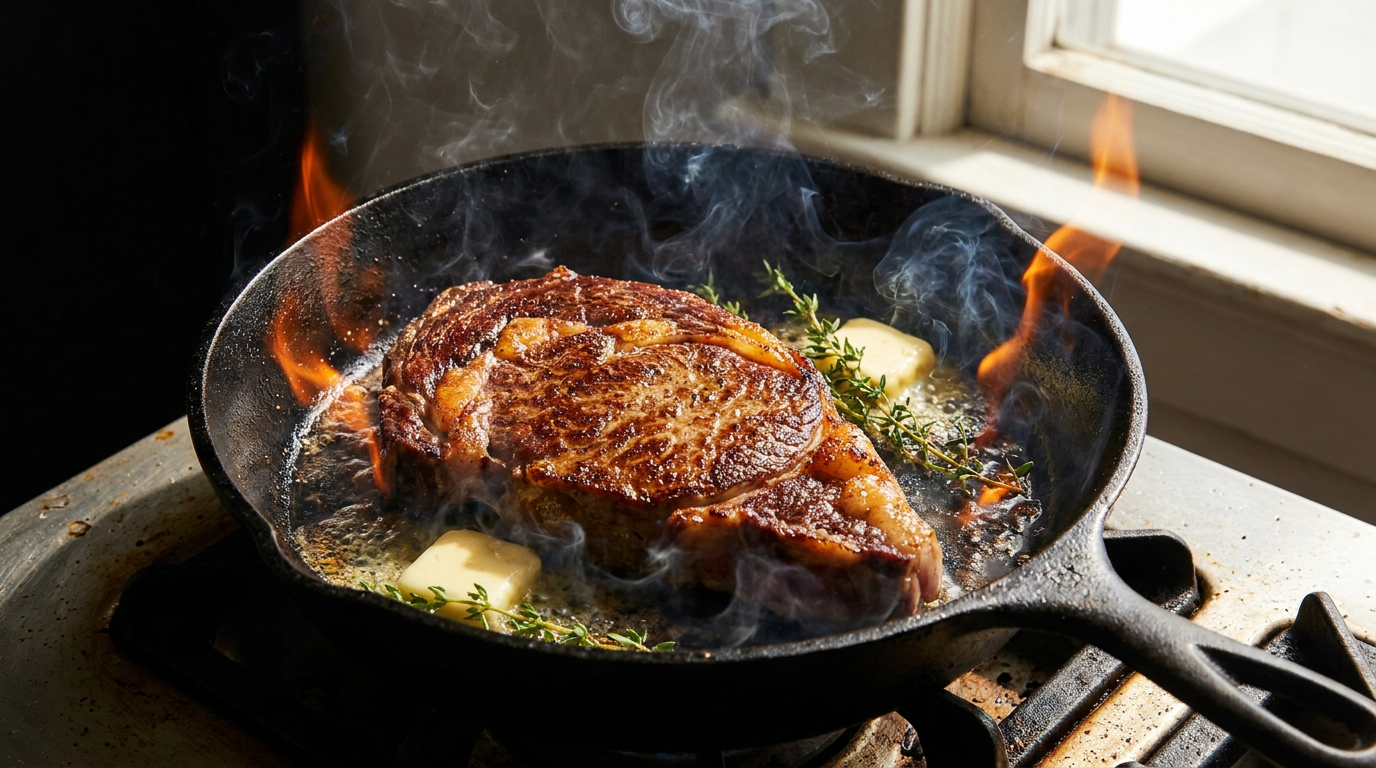
The aroma of a perfectly seared steak, the golden crust of a fresh loaf of sourdough, and the deep, roasted scent of morning coffee all share a common origin. They are not merely the result of food getting hot; they are the products of one of the most complex and delicious chemical cascades in nature.[6]
For decades, home cooks have relied on intuition to achieve these flavors, often attributing the savory depth of browned food to "sealing in the juices" or simple burning. However, the true engine behind these culinary transformations is non-enzymatic browning, a category of chemical reactions that fundamentally alters the molecular structure of ingredients.[3]
The most prominent of these is the Maillard reaction. First described in 1912 by French chemist Louis-Camille Maillard, who was originally attempting to reproduce biological protein synthesis, the reaction has since become the foundational pillar of culinary science.[1]
At its core, the Maillard reaction is a condensation reaction between the free amino group of an amino acid (the building blocks of proteins) and the carbonyl group of a reducing sugar, such as glucose or fructose.[5]

When exposed to heat, these two components merge to form an unstable intermediate called an Amadori product. This molecule rapidly breaks down and rearranges itself into a dizzying array of secondary reactions, creating hundreds of new volatile flavor compounds.[1][5]
These newly minted molecules are responsible for the specific aromas we associate with cooked food. Pyrazines deliver nutty and roasted notes, furans provide sweet and caramel-like scents, and Strecker aldehydes contribute malty, green aromas.[5]
Simultaneously, the reaction produces large, complex polymers known as melanoidins. These non-volatile compounds do not contribute to aroma, but they are responsible for the rich, mahogany-brown pigments that make a seared scallop or a toasted marshmallow look so appetizing.[1][4]
While the chemistry of the Maillard reaction can technically occur at room temperature—as seen in the slow, years-long darkening of balsamic vinegar—it requires significant heat to happen on a practical cooking timescale. The reaction rate roughly doubles for every 10 degrees Celsius increase, becoming practically rapid only when surface temperatures cross 140 degrees Celsius (285 degrees Fahrenheit).[1][5]

This temperature threshold reveals the greatest enemy of the Maillard reaction: water. Because water boils and evaporates at 100 degrees Celsius (212 degrees Fahrenheit), any moisture on the surface of food acts as a thermal ceiling. As long as liquid water is present, the surface temperature cannot rise high enough to trigger rapid browning.[4][6]
This temperature threshold reveals the greatest enemy of the Maillard reaction: water.
This is why culinary scientists and professional chefs universally recommend patting meat completely dry with a paper towel before it hits the pan. It also explains why overcrowding a skillet leads to disappointing results; the trapped steam lowers the pan's temperature, causing the food to boil in its own juices rather than sear.[4]
Often used interchangeably with the Maillard reaction, caramelization is an entirely distinct chemical process. While both are forms of non-enzymatic browning driven by heat, caramelization is the thermal decomposition—or pyrolysis—of sugars in the complete absence of amino acids.[1][5]
Because it does not rely on proteins, caramelization requires significantly higher temperatures to initiate. Fructose begins to caramelize at roughly 110 degrees Celsius, but standard table sugar (sucrose) requires temperatures upwards of 160 degrees Celsius (320 degrees Fahrenheit) before it breaks down into the sweet, buttery compounds known as furanones and caramelans.[5]

In many baked goods and roasted vegetables, both reactions occur simultaneously. A chocolate chip cookie, for instance, relies on the Maillard reaction between the flour's proteins and the sugars for its savory depth, while the edges undergo pure caramelization for a crisp, toffee-like bite.[6]
Understanding these mechanics allows cooks to manipulate the reactions to their advantage. One of the most effective techniques involves altering the pH of the food. The Maillard reaction accelerates dramatically in mildly alkaline environments, which is why traditional German pretzels are dipped in a lye solution before baking to achieve their iconic dark, glossy crust.[1][4]
Home cooks can replicate this trick by adding a small pinch of baking soda to onions as they cook. The raised pH speeds up the breakdown of the onions' cellular walls and supercharges the browning process, cutting the time required for deeply caramelized onions in half.[2]
Modernist cooking techniques have even found ways to bypass the moisture barrier entirely. By using a pressure cooker, chefs can raise the boiling point of water well above 100 degrees Celsius. This allows the Maillard reaction to occur in wet environments, creating deeply complex, roasted flavors in soups and purees in a fraction of the traditional time.[2]

However, researchers note that pushing these reactions too far can have drawbacks. At excessively high temperatures, the Maillard reaction can produce acrylamide, a compound that forms when the amino acid asparagine reacts with sugars, particularly in potatoes and grains. While the health impacts in human diets are still studied, avoiding heavy charring mitigates this formation.[1]
Ultimately, mastering the kitchen requires recognizing that cooking is applied chemistry. By controlling moisture, managing heat, and understanding the distinct roles of proteins and sugars, anyone can transform raw ingredients into a symphony of complex, roasted flavors.[6]
How we got here
1912
French chemist Louis-Camille Maillard first describes the reaction between amino acids and sugars while studying protein synthesis.
1953
Chemist John E. Hodge publishes a definitive paper mapping the complex chemical pathways of the Maillard reaction.
Early 2000s
The Modernist cuisine movement begins applying laboratory chemistry to restaurant kitchens, manipulating pH and pressure to control browning.
2002
Researchers first discover that acrylamide can form as a byproduct of the Maillard reaction in certain high-heat cooking applications.
Viewpoints in depth
Culinary Scientists
Focuses on the exact molecular pathways and how to manipulate variables like pH, pressure, and temperature to engineer specific flavor profiles.
For food scientists and modernist chefs, cooking is an applied laboratory science. They view the Maillard reaction not as a single event, but as a cascade of hundreds of micro-reactions that can be isolated and controlled. By utilizing tools like pressure cookers to raise the boiling point of water, or applying alkaline solutions to lower the activation energy required for browning, this camp seeks to bypass traditional culinary limits and extract maximum flavor efficiency from raw ingredients.
Traditional Chefs
Focuses on sensory cues and practical kitchen techniques to achieve optimal browning without relying on scientific instruments.
In professional kitchens, the Maillard reaction is managed through intuition and sensory feedback rather than exact temperature readings. Traditional chefs rely on the sound of a sizzle versus a steam to gauge pan heat, and the visual cue of a mahogany crust to know when the reaction has peaked. Their primary focus is on practical moisture management—religiously patting proteins dry and cooking in batches to prevent pan temperatures from crashing—ensuring the chemical reaction happens naturally.
Food Chemists & Health Researchers
Focuses on the nutritional impact of non-enzymatic browning, balancing flavor creation with the formation of potentially harmful byproducts.
While acknowledging the culinary importance of browning, health researchers study the secondary consequences of high-heat cooking. They focus on the formation of acrylamide, a probable carcinogen created when the amino acid asparagine reacts with sugars at high temperatures. This perspective advocates for moderation, suggesting techniques like lowering cooking temperatures, avoiding heavy charring, and balancing deeply browned foods with gentler cooking methods like steaming or poaching.
What we don't know
- Scientists have identified hundreds of volatile flavor compounds produced by the Maillard reaction, but the exact composition of the dark melanoidin pigments remains poorly understood.
- The precise health implications of consuming long-term dietary acrylamide, a high-heat byproduct, are still actively debated among nutrition researchers.
Key terms
- Amino Acids
- The organic molecules that serve as the fundamental building blocks of proteins, essential for triggering the Maillard reaction.
- Reducing Sugar
- A specific type of sugar, such as glucose or fructose, that can act as a chemical reducing agent and bond with amino acids.
- Pyrolysis
- The chemical decomposition of organic materials through the application of high heat in the absence of oxygen, as seen in caramelization.
- Melanoidins
- Large, complex polymer molecules formed during browning that give cooked foods their distinct brown pigments.
- Amadori Product
- An unstable intermediate molecule formed in the early stages of the Maillard reaction before it breaks down into flavor compounds.
- Acrylamide
- A chemical compound that can form in some starchy foods during high-temperature cooking processes like frying or baking.
Frequently asked
Why doesn't boiled meat turn brown?
Water boils at 100°C (212°F), which acts as a thermal ceiling. The Maillard reaction requires temperatures around 140°C (285°F) to occur rapidly, meaning submerged food cannot get hot enough to brown.
Is the Maillard reaction the same as caramelization?
No. The Maillard reaction requires both amino acids (proteins) and sugars, creating savory flavors. Caramelization is the breakdown of sugars alone, creating sweet, toffee-like flavors.
Why do recipes say to pat meat dry before cooking?
Surface moisture turns to steam in the pan, keeping the meat's temperature too low for browning. Removing water allows the surface to immediately reach the high heat needed for the Maillard reaction.
Can the Maillard reaction happen at room temperature?
Yes, but it occurs incredibly slowly. The darkening of balsamic vinegar or black garlic over months or years is driven by the same chemical process, just without rapid heat.
Sources
Source coverage
6 outlets
3 viewpoints surfaced






[1]WikipediaFood Chemists & Health Researchers
Maillard reaction
Read on Wikipedia →[2]Modernist CuisineCulinary Scientists
Unlocking the Maillard Reaction in Pressure-Cooked Soups
Read on Modernist Cuisine →[3]Science of CookingCulinary Scientists
Browning, or the Maillard reaction
Read on Science of Cooking →[4]WebstaurantStoreTraditional Chefs
Maillard Reaction vs Caramelization
Read on WebstaurantStore →[5]Formul.ioCulinary Scientists
Maillard reaction vs caramelization explainer
Read on Formul.io →[6]Factlen Editorial TeamTraditional Chefs
Synthesis by Factlen editorial team
Read on Factlen Editorial Team →

Every angle. Every day.
Get lifestyle stories with full source coverage and perspective breakdowns delivered to your inbox.