
US Community Solar Surpasses 10-Gigawatt Milestone as Neighborhood Microgrids Boom
A surge in local solar projects is allowing renters and low-income households to access clean energy without installing rooftop panels, pushing national capacity past a historic 10-gigawatt threshold.
By Factlen Editorial Team
- Clean Energy Advocates
- Focus on energy democracy and equitable access to renewable power.
- State Policymakers
- Focus on grid resilience, repurposing brownfields, and meeting climate targets.
- Industry Analysts
- Focus on the massive capital influx and the challenges of interconnection delays.
What's not represented
- · Traditional utility companies managing grid integration
- · Local residents living immediately adjacent to new solar farm sites
Why this matters
For decades, solar power was restricted to homeowners who could afford expensive rooftop installations. The rise of community solar democratizes clean energy, allowing apartment dwellers and low-income families to subscribe to local grids and immediately lower their utility bills while repurposing abandoned industrial land.
Key points
- US community solar capacity has officially surpassed 10 gigawatts.
- The model allows renters and low-income families to access solar energy without rooftop panels.
- Developers are increasingly building arrays on reclaimed coal mines and brownfields.
- An 8-gigawatt pipeline of new projects is currently in development.
- State grants are guaranteeing utility bill discounts of 12% to 20% for vulnerable households.
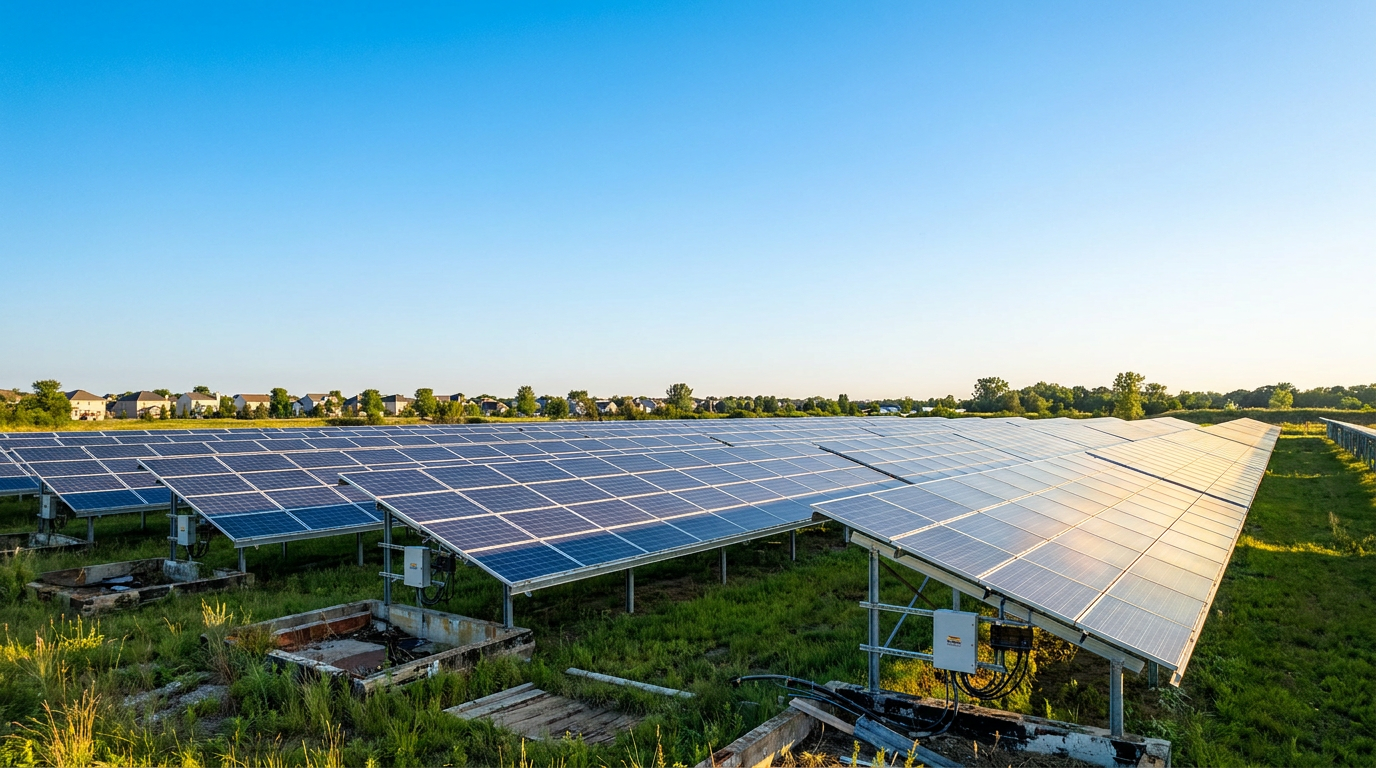
The traditional image of solar power—gleaming panels bolted to the roof of a suburban home—is rapidly expanding to include apartment renters, small businesses, and low-income families. Driven by a wave of state-level incentives and neighborhood demand, community solar has officially surpassed 10 gigawatts of installed capacity in the United States.[1][2]
Unlike traditional residential solar, community solar operates through off-site shared arrays. Local residents and businesses subscribe to a portion of a nearby solar farm and receive direct credits on their utility bills for the energy produced. The model entirely removes the need for property ownership, suitable roofs, or steep upfront installation costs.[2][4]
The 10-gigawatt milestone, detailed in a joint report by Wood Mackenzie and the Coalition for Community Solar Access, marks a historic maturation for the sector. While mature markets like New York and Maine saw a slight contraction last year, the industry still installed 1.4 gigawatts in 2025 and is projected to rebound with 12% national growth in 2026.[1][2]
This near-term growth is anchored by a massive 8-gigawatt project development pipeline. According to industry analysts, nearly 30% of that pipeline is already under construction, signaling a sustained boom in local energy generation over the next several years.[1][2]

Institutional capital is flowing heavily into the space to fund this expansion. In June 2026, Nautilus Solar Energy secured a $600 million debt facility to build out approximately 200 megawatts of community solar projects across its national portfolio.[6]
A major trend driving this physical expansion is the repurposing of "brownfields"—previously disturbed, contaminated, or abandoned industrial land that is otherwise unusable for residential or commercial development.[3][5]
In Woodford County, Illinois, developers Nexamp and TurningPoint Energy recently completed a 9.8-megawatt solar farm on a 150-year-old reclaimed coal mine. The site, which produced coal from the Colchester Seam between the 1870s and 1940s, has been transformed into a clean energy asset for the local grid.[3]
In Woodford County, Illinois, developers Nexamp and TurningPoint Energy recently completed a 9.8-megawatt solar farm on a 150-year-old reclaimed coal mine.
The Illinois project utilizes nearly 17,000 US-manufactured solar panels spread across 40 acres. By pairing the installation with advanced grid management software, the developers are turning a former environmental liability into a smart, resilient power source for hundreds of nearby households.[3]

State governments are aggressively incentivizing these neighborhood microgrids to meet climate targets while lowering utility costs for vulnerable populations. In Maryland, Governor Wes Moore recently announced $43 million in grants to fund 69 new community solar projects.[5]
Maryland's program mandates that developers deliver at least 15% of the site's electricity to low-income households, guaranteeing a minimum utility bill discount of 12%. For many participating families, the actual monthly savings exceed 20%.[5]
California is experiencing a similar wave of localized success. The California Public Utilities Commission reported this spring that 1,200 community solar projects are now operational across the state, generating 560 megawatts of power.[4]
These California projects currently serve approximately 125,000 residential and 60,000 commercial customers. In East Oakland, a new 1-megawatt array built on an industrial warehouse roof just came online specifically to serve historically marginalized neighborhoods with discounted renewable power.[4][7]

Despite the overwhelming momentum, the sector still faces structural headwinds. The Solar Energy Industries Association notes that severe interconnection queue backlogs—delays in getting approval to plug new projects into the broader grid—continue to complicate development timelines.[8]
Developers are also racing to navigate a shifting federal policy landscape. Companies must meet strict "placed-in-service" deadlines to secure the federal Investment Tax Credit before it begins to phase out in 2030, forcing a sprint to get steel in the ground.[2][8]
To adapt, energy companies are broadening their business models to include "community-scale" resources—projects up to 20 megawatts that connect directly to the distribution grid, bypassing some of the legislative hurdles required for traditional community solar. Ultimately, the 10-gigawatt milestone proves the shared model works, reshaping the grid from the bottom up by turning empty lots and old coal mines into engines of local resilience.[2][8]
How we got here
1870s–1940s
The Colchester Coal Seam in Illinois operates as an active mine, later becoming a brownfield site.
2025
The US community solar sector officially surpasses 10 gigawatts of cumulative installed capacity.
April 2026
California reports 1,200 operational community solar projects serving 185,000 customers.
June 2026
Maryland announces $43 million in grants for 69 new low-income community solar projects.
June 2026
Nexamp completes a 9.8-megawatt community solar farm on the reclaimed Illinois coal mine.
Viewpoints in depth
Clean Energy Advocates
Focus on energy democracy and equitable access to renewable power.
Advocates emphasize that community solar fundamentally democratizes the energy transition. For decades, the financial benefits of solar were locked behind homeownership and high credit scores. By allowing renters and low-income families to subscribe to local arrays, this model ensures that the economic relief of cheap, renewable power reaches the communities that need it most.
State Policymakers
Focus on grid resilience, repurposing brownfields, and meeting climate targets.
For state officials, community solar solves multiple policy goals simultaneously. It accelerates the transition to clean energy, reduces strain on centralized power plants by generating electricity close to where it is consumed, and provides a productive use for abandoned industrial sites and brownfields that would otherwise remain liabilities.
Industry Analysts
Focus on the massive capital influx and the challenges of interconnection delays.
Market analysts view the 10-gigawatt milestone as proof of commercial viability, evidenced by massive debt facilities and institutional investment. However, they warn that future growth is threatened by severe interconnection backlogs and the looming phase-out of federal tax credits, which force developers into tight construction timelines.
What we don't know
- How quickly utilities will resolve the interconnection queue backlogs delaying new projects.
- Whether the phase-out of the federal Investment Tax Credit in 2030 will significantly stall future development.
Key terms
- Community Solar
- A local solar facility shared by multiple subscribers who receive utility bill credits for their portion of the energy produced.
- Gigawatt (GW)
- A unit of power equal to one billion watts, typically enough to power roughly 750,000 homes.
- Brownfield
- A property whose redevelopment or reuse may be complicated by the presence of a hazardous substance, pollutant, or contaminant.
- Interconnection Queue
- The waiting list and approval process required for new energy projects to physically connect to the broader electrical grid.
- Investment Tax Credit (ITC)
- A federal tax incentive that allows individuals and businesses to deduct a percentage of the cost of installing a solar energy system from their federal taxes.
Frequently asked
What is community solar?
Community solar allows individuals and businesses to subscribe to a shared, off-site solar array. Subscribers receive credits on their utility bills for the energy produced, eliminating the need for rooftop panels.
Who can participate in community solar?
Anyone with an electricity bill can typically participate, including renters, apartment dwellers, and low-income households who cannot install their own solar panels.
How much money does community solar save?
Savings vary by state and program, but many low-income initiatives, such as Maryland's recent grant program, guarantee a minimum utility bill discount of 12%, with actual savings often exceeding 20%.
What is a brownfield solar project?
A brownfield project is a solar array built on previously disturbed or contaminated land, such as an old coal mine or abandoned industrial site, putting unusable land back into productive service.
Sources
Source coverage
8 outlets
3 viewpoints surfaced








[1]PV MagazineIndustry Analysts
U.S. community solar passes 10 GW milestone despite market contraction
Read on PV Magazine →[2]Wood MackenzieIndustry Analysts
US community solar surpasses 10 GW milestone in 2025 despite tightening market conditions
Read on Wood Mackenzie →[3]ElectrekClean Energy Advocates
Illinois put community solar on a 150-year-old coal mine
Read on Electrek →[4]California Public Utilities CommissionState Policymakers
CPUC Community Solar Programs Prove Success Across California
Read on California Public Utilities Commission →[5]Maryland Office of the GovernorState Policymakers
Governor Moore Announces $43 Million for New Community Solar Projects
Read on Maryland Office of the Governor →[6]Renewable WatchIndustry Analysts
Nautilus secures financing for 200 MW US community solar projects
Read on Renewable Watch →[7]Local News MattersClean Energy Advocates
A 1-megawatt community solar project 'flips the switch' in East Oakland
Read on Local News Matters →[8]Solar Energy Industries AssociationIndustry Analysts
Solar Market Insight Report Q2 2026
Read on Solar Energy Industries Association →
Every angle. Every day.
Get community stories with full source coverage and perspective breakdowns delivered to your inbox.