
The Solid-State Leap: How the 'Holy Grail' of Batteries is Finally Moving from Lab to Road
After decades of research, solid-state batteries are entering early production, promising to double EV range, eliminate fire risks, and cut charging times to under 10 minutes.
By Factlen Editorial Team
- Legacy Automakers
- View solid-state technology as the ultimate differentiator to reclaim EV market dominance, investing billions to hit 2027 commercialization targets.
- Chinese Manufacturers
- Pushing aggressive timelines to maintain their global battery supremacy, aiming to bring solid-state to mass production as early as 2026.
- Battery Startups
- Focus on proprietary material breakthroughs, such as specialized ceramic separators, to solve the physics challenges of dendrites and cell degradation.
- Materials Scientists
- Emphasize caution regarding the immense mechanical challenges of scaling solid cells that must 'breathe' over thousands of charge cycles without cracking.
What's not represented
- · Raw Material Suppliers
- · Independent Auto Mechanics
Why this matters
Solid-state batteries solve the three biggest anxieties holding back electric vehicle adoption: range, charging time, and fire safety. By fundamentally changing the chemistry of energy storage, this technology paves the way for a fully electrified transportation grid.
Key points
- Solid-state batteries replace flammable liquid electrolytes with solid ceramics or polymers.
- The technology allows for pure lithium-metal anodes, doubling energy density to 400-500 Wh/kg.
- Automakers project ranges exceeding 600 miles and charging times under 10 minutes.
- The primary engineering challenge is preventing microscopic cracks as the battery 'breathes' during use.
- Major automakers and Chinese battery giants are targeting 2026-2028 for early commercial production.
The electric vehicle revolution is currently bound by the limits of a thirty-year-old recipe. Today's lithium-ion batteries have steadily improved through thousands of incremental upgrades, but they still dictate how far a car can drive, how long a driver must wait at a charging station, and how heavily the vehicle must be armored against the risk of fire.[3][5]
In 2026, the automotive industry is crossing a critical threshold. The long-promised "solid-state" battery—often described by engineers as the holy grail of energy storage—is finally moving from isolated laboratory experiments to early production lines. Major automakers and battery startups are locking in commercialization targets, signaling the biggest leap in battery technology since the commercialization of lithium-ion in the 1990s.[2][7]
To understand the breakthrough, one must look inside a conventional battery. In standard lithium-ion cells, ions travel back and forth between the anode and cathode through a liquid organic solvent. While highly effective at conducting ions, this liquid electrolyte is inherently flammable and degrades rapidly at high temperatures.[4][5]
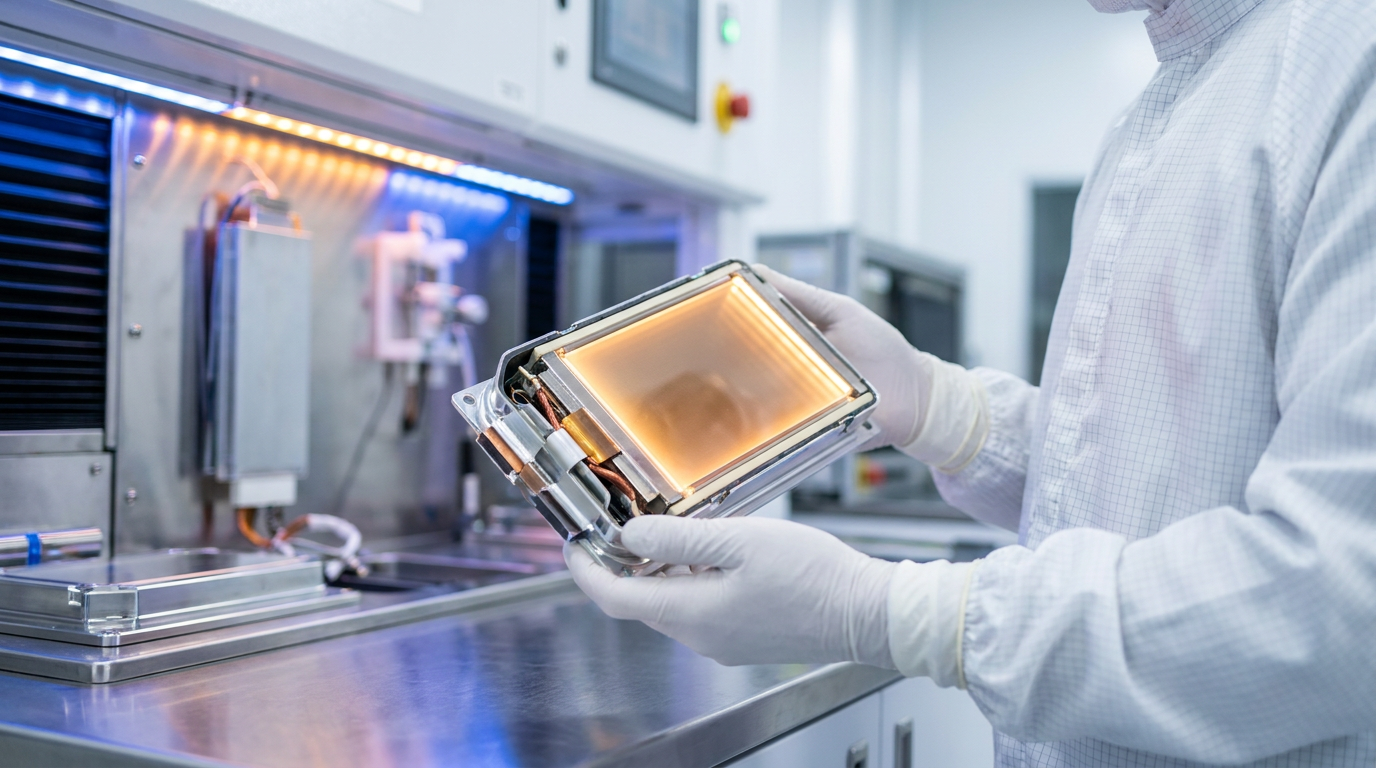
Solid-state technology replaces that volatile liquid solvent with a solid material—typically a specialized ceramic, polymer, or sulfide-based glass. By removing the liquid, engineers eliminate the primary catalyst for thermal runaway, the dangerous chain-reaction fires that make conventional EV battery blazes notoriously difficult to extinguish.[4][6]

The safety margins are drastically different. Conventional cells begin to struggle and degrade when internal temperatures exceed 50 degrees Celsius, and thermal events can trigger at 90 degrees. In contrast, solid-state systems remain stable well past 240 degrees. In recent tests by Chinese manufacturer Greater Bay Technology (GBT), solid-state "A-sample" cells successfully passed brutal needle penetration and extreme thermal shock tests without igniting or exploding.[1][3][7]
But safety is merely a byproduct of the real prize: energy density. Because the solid electrolyte acts as a rigid, stable barrier, battery designers can completely rethink the rest of the cell's architecture. Specifically, they can remove the bulky, heavy graphite anode used in almost all of today's electric cars.[4][7]
Instead of graphite, solid-state cells can utilize a pure lithium-metal anode. This single material swap allows the battery to store significantly more energy in the exact same physical footprint, creating what researchers call the "golden combination" for next-generation energy storage.[5][7]
Instead of graphite, solid-state cells can utilize a pure lithium-metal anode.
Current top-tier lithium-ion batteries max out around 250 to 300 watt-hours per kilogram (Wh/kg). Solid-state cells entering pilot production today are already targeting 400 to 500 Wh/kg. For a consumer, this translates directly to driving range. Automakers project that solid-state EVs will routinely exceed 600 miles on a single charge, effectively rendering range anxiety obsolete.[1][6][7]

The solid architecture also fundamentally alters charging physics. Because the solid electrolyte can tolerate higher voltages and temperatures without degrading, the cells can absorb power at astonishing rates. Toyota and Samsung SDI are both targeting 10-to-80 percent charge times of under 10 minutes—approaching the convenience of filling a traditional gas tank.[2][6]
Yet, the transition from liquid to solid introduces a punishing new set of mechanical challenges. As battery researchers note, replacing a liquid with a solid doesn't remove complexity; it simply trades chemistry problems for physics problems.[5]
When a battery charges and discharges, the movement of ions causes the internal materials to expand and contract. In a conventional cell, the liquid electrolyte simply flows around these dimensional changes. In a solid-state cell, this "breathing" creates immense mechanical stress.[5]
Over hundreds of cycles, this expansion and contraction can cause microscopic cracks to form at the interface between the solid electrolyte and the electrodes. If the materials lose intimate contact, electrical resistance spikes, and the battery's performance plummets prematurely.[5]

Furthermore, solid electrolytes must resist dendrites—microscopic, needle-like structures of lithium metal that can grow through the cell during rapid charging. If a dendrite pierces the separator, it causes a short circuit. Companies like QuantumScape have spent years engineering proprietary ceramic separators specifically designed to block dendrite penetration while remaining flexible enough to handle the cell's breathing.[6]
Despite these hurdles, the industry is aggressively transitioning from prototyping to manufacturing. Toyota, which has committed over $13 billion to next-generation battery development, recently announced a technical breakthrough addressing those exact durability concerns, targeting a commercial rollout between 2027 and 2028.[2]
The race is fiercely global. Volkswagen-backed QuantumScape is scaling up its pilot lines, while Chinese giants like BYD and CATL are aggressively pursuing 2027 mass-production targets. GBT, backed by China's GAC Group, is pushing even faster, aiming for gigawatt-hour-level mass production of its all-solid-state cells by late 2026.[1][7]

The final hurdle is economics. Manufacturing solid-state cells requires entirely new, highly controlled production environments, moving away from the established roll-to-roll processes of the last three decades. Early estimates suggest solid-state packs will initially carry a significant price premium, meaning they will likely debut in luxury vehicles and commercial fleets before trickling down to mass-market cars.[2][4]
If manufacturers can successfully scale these pilot lines without sacrificing the staggering performance metrics seen in the lab, the automotive landscape will be permanently altered. The solid-state era promises vehicles that are lighter, vastly safer, and capable of outlasting the chassis they power.[3][6]
How we got here
1990s
Commercialization of the liquid-electrolyte lithium-ion battery revolutionizes portable electronics.
2020
Solid-state startup QuantumScape goes public, raising significant capital to scale its ceramic separator technology.
2023
Toyota announces a technical breakthrough addressing solid-state durability, committing to a 2027 commercial rollout.
2024
Chinese manufacturer GBT sets extreme fast-charging records, proving the viability of high-speed charging architectures.
2026
First A-sample solid-state cells pass extreme safety tests and move toward gigawatt-hour mass production.
Viewpoints in depth
Legacy Automakers
View solid-state technology as the ultimate differentiator to reclaim EV market dominance.
For legacy giants like Toyota and Volkswagen, solid-state batteries represent a reset button for the EV industry. Having lost early market share to pure-play EV manufacturers, these companies are leveraging their massive R&D budgets to leapfrog current lithium-ion technology entirely. By targeting 2027 and 2028 for commercialization, they aim to introduce vehicles with fundamentally superior range and safety profiles, betting that consumers will wait for a 'no-compromise' electric vehicle rather than settling for today's liquid-electrolyte limitations.
Battery Startups
Focus on proprietary material breakthroughs to solve the physics challenges of dendrites and cell degradation.
Companies like QuantumScape and Solid Power argue that the secret to solid-state success lies in highly specialized materials science. Their approach centers on engineering proprietary components—such as flexible ceramic separators—that can physically block lithium dendrites while surviving the mechanical stress of the battery expanding and contracting. These startups operate on the premise that whoever patents the most durable, scalable solid electrolyte will effectively control the foundational technology of the next century of transportation.
Materials Scientists
Emphasize caution regarding the immense mechanical challenges of scaling solid cells.
Academic researchers and independent battery scientists frequently temper the industry's aggressive timelines. They point out that while solid-state cells perform miraculously in controlled laboratory environments, scaling them to mass production introduces severe physics problems. Maintaining intimate contact between solid layers as the battery 'breathes' over thousands of charge cycles without micro-cracking is an incredibly difficult contact-mechanics problem. Furthermore, transitioning from traditional roll-to-roll liquid battery manufacturing to the precision required for solid-state cells will require entirely new, multi-billion-dollar supply chains.
What we don't know
- Exactly how much of a price premium the first commercial solid-state EVs will carry over traditional models.
- Whether the solid electrolytes can reliably maintain physical contact over the 10,000+ charge cycles required for commercial fleet use.
- How quickly the global supply chain can pivot to provide the specific raw materials required for sulfide or ceramic electrolytes at scale.
Key terms
- Electrolyte
- The medium inside a battery that allows ions to flow back and forth between the cathode and anode during charging and discharging.
- Lithium-Metal Anode
- A highly energy-dense negative electrode made of pure lithium, which can only be safely used if paired with a solid electrolyte.
- Thermal Runaway
- A dangerous, self-sustaining chain reaction where a battery cell overheats, catches fire, and ignites adjacent cells.
- Dendrites
- Microscopic, needle-like metal structures that can grow inside a battery during charging, potentially piercing the separator and causing a short circuit.
- Energy Density
- The amount of energy a battery can store relative to its weight, typically measured in Watt-hours per kilogram (Wh/kg).
Frequently asked
What makes a battery 'solid-state'?
It replaces the flammable liquid electrolyte found in standard lithium-ion batteries with a solid material, such as a ceramic, polymer, or sulfide glass, to conduct ions.
Why do solid-state batteries hold more energy?
The solid structure is stable enough to allow the use of a pure lithium-metal anode instead of a bulky graphite anode, effectively doubling the battery's energy density in the same physical space.
Will solid-state batteries catch fire?
They are vastly safer than current batteries. Because they lack a flammable liquid solvent, they are highly resistant to thermal runaway and can withstand temperatures exceeding 240°C without igniting.
When will solid-state EVs be available to buy?
Early pilot production is beginning in 2026, with major automakers like Toyota and Volkswagen targeting 2027 to 2028 for their first commercial vehicle rollouts.
Sources
Source coverage
7 outlets
4 viewpoints surfaced







[1]ElectrekChinese Manufacturers
China ramps up solid-state EV battery production
Read on Electrek →[2]WardsAutoLegacy Automakers
Toyota announces solid-state battery breakthrough
Read on WardsAuto →[3]EV Infrastructure NewsMaterials Scientists
Solid-state batteries: Technology fundamentals explained
Read on EV Infrastructure News →[4]Flash BatteryMaterials Scientists
What are solid-state batteries and how do they work
Read on Flash Battery →[5]MediumMaterials Scientists
The hard part isn't just chemistry — it's also physics
Read on Medium →[6]Future Green TechBattery Startups
Why Solid-State Batteries Matter: The Promise and the Challenge
Read on Future Green Tech →[7]To7MotorChinese Manufacturers
Solid-state battery technology is entering real-world production in 2026
Read on To7Motor →
Every angle. Every day.
Get transportation stories with full source coverage and perspective breakdowns delivered to your inbox.