
The End of Fast Furniture: How Modular, Circular Design is Changing What We Buy
Driven by environmental concerns and nomadic lifestyles, the furniture industry is shifting toward modular, repairable designs that snap together without tools and last a lifetime.
By Factlen Editorial Team
- Circular Design Advocates
- Focus on the environmental imperative of eliminating waste and extending product lifecycles.
- Direct-to-Consumer Brands
- Focus on user experience, tool-free convenience, and lifestyle flexibility.
- Traditional Manufacturers
- Focus on the economic and logistical hurdles of scaling sustainable practices.
What's not represented
- · Budget-conscious consumers who are currently priced out of premium sustainable options.
- · Municipal waste management facilities dealing with the ongoing influx of legacy fast furniture.
Why this matters
The shift away from disposable 'fast furniture' means consumers can now invest in adaptable pieces that grow with their living spaces, saving money over a lifetime while drastically reducing landfill waste.
Key points
- The furniture industry is transitioning from disposable products to a 'circular economy' model.
- Design for Disassembly (DfD) allows furniture to be easily taken apart for repair or recycling.
- Direct-to-consumer brands have popularized tool-free, modular sofas that expand with the user's needs.
- IKEA has committed to becoming a 100% circular business by 2030 through standardized parts and buy-back programs.
- The use of recycled plastics and bio-based materials like hemp and mycelium is rapidly increasing.
- The circular office furniture market is projected to reach $6.7 billion by 2033.
For decades, the global furniture industry relied heavily on a linear 'take-make-dispose' model. Millions of tons of cheap particleboard, toxic glues, and synthetic fabrics ended up in landfills every year as consumers cycled through inexpensive, fragile pieces that rarely survived a single move.[1]
But a quiet revolution is reshaping how we furnish our homes and offices. The era of disposable decor is giving way to the 'circular economy'—a framework where furniture is explicitly designed to be repaired, reconfigured, and eventually recycled, rather than thrown away at the first sign of wear.[1][5]
At the heart of this shift is an engineering concept known as Design for Disassembly (DfD). Industrial designers are rethinking the very anatomy of a sofa, a desk, or a shelving unit, ensuring that every individual component can be easily separated at the end of its lifecycle.[6]
This represents a stark departure from traditional manufacturing, which often relies on permanent staples and chemical adhesives that make recycling nearly impossible. By utilizing advanced CAD tools optimized for modularity, designers are creating pieces that snap together and pull apart with intuitive ease.[6]

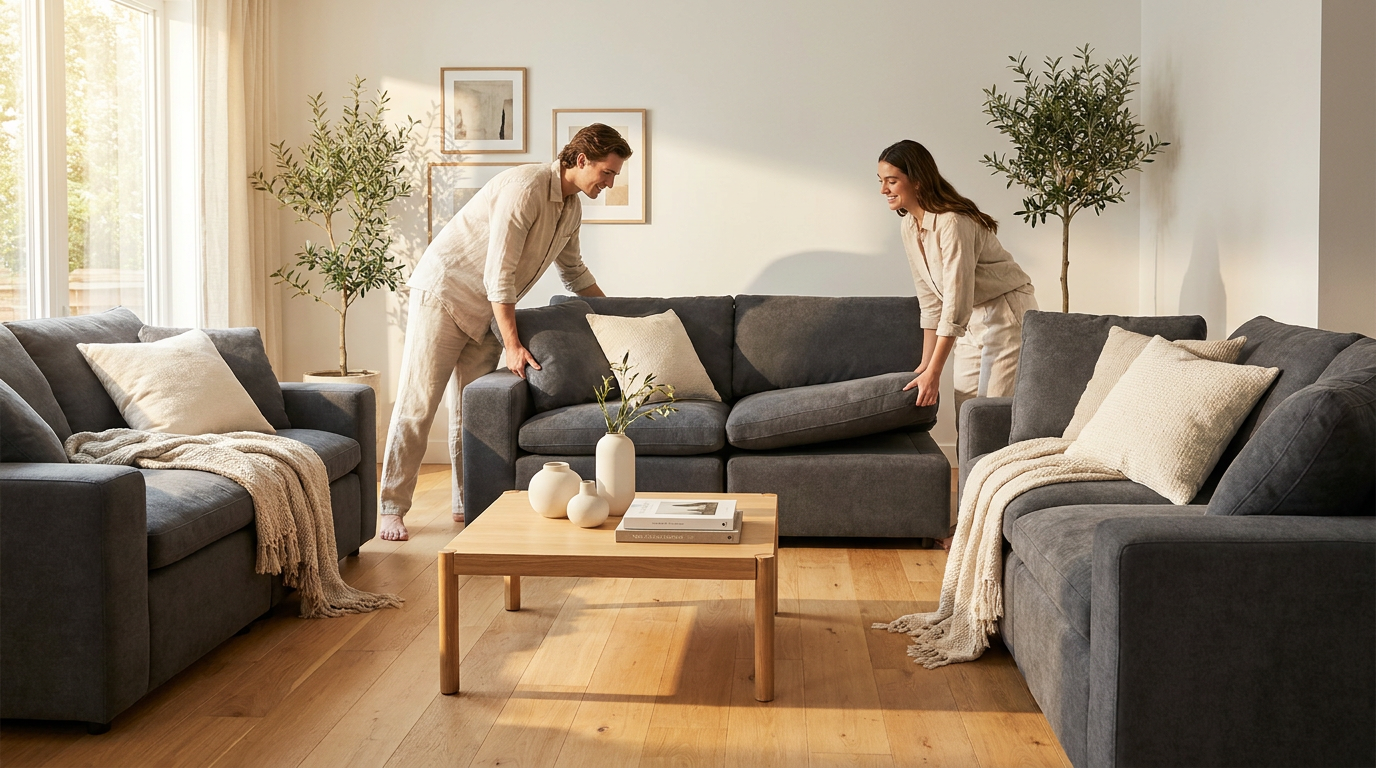
The direct-to-consumer market has been a major catalyst for this change, proving that sustainability can align perfectly with convenience. Brands like Lovesac and Burrow have built massive followings around modularity, demonstrating that modern consumers actively want furniture that adapts to their changing lives.[4]
Lovesac’s flagship 'Sactionals,' for example, feature standardized bases and sides that can be configured into hundreds of different shapes. If a user moves from a cramped apartment to a larger house, they simply purchase additional modules rather than discarding their old couch to buy a new one.[4]
Burrow takes a similar approach, utilizing tool-free connectors like heavy-duty metal clips and alignment pins. This eliminates the dreaded 'Allen wrench fatigue' associated with legacy flat-pack furniture and makes disassembling a heavy piece for moving a one-person job.[4]
Beyond sheer convenience, modularity drastically extends the functional lifespan of the product. If a pet ruins a cushion cover or an armrest snaps during a move, the user can order a single replacement part, while the core frame—often constructed from durable hardwood—remains in continuous use.[4]

The world's largest furniture retailer is also pivoting aggressively toward this model. IKEA has publicly committed to becoming a fully circular business by 2030, a monumental logistical challenge for a company that produces thousands of different items at a massive global scale.[2]
The world's largest furniture retailer is also pivoting aggressively toward this model.
To achieve this ambitious goal, IKEA developed eight core principles for circular design, focusing heavily on standardization, care, repair, and adaptability. By standardizing screws, fittings, and fabric dimensions across entirely different product lines, the company makes it vastly easier for consumers to find spare parts years after their initial purchase.[2]
IKEA has also introduced 'Buy Back & Resell' programs in numerous markets, allowing customers to return gently used furniture in exchange for store credit. This initiative keeps viable products out of the waste stream while providing affordable, high-quality options for budget-conscious shoppers.[2]
The physical materials used in modern furniture are undergoing a radical transformation alongside the structural designs. Manufacturers are steadily moving away from virgin fossil-based plastics and embracing recycled, upcycled, and bio-based alternatives.[5]
Post-consumer recycled plastics, reclaimed industrial wood, and recycled textile fibers are rapidly becoming industry standards. In the commercial office sector, upcycled materials—such as acoustic privacy panels manufactured from recycled PET water bottles—are highly sought after by corporate buyers.[5]
Bio-based materials are pushing the envelope even further. Natural fibers like hemp, linen, and even mycelium (the root structure of mushrooms) are being integrated into upholstery and acoustic paneling, offering high mechanical performance with a fraction of the carbon footprint of traditional synthetics.[5]
The financial trajectory of this industry-wide shift is undeniable. The global circular office furniture market, valued at $2.1 billion in 2024, is projected to reach $6.7 billion by 2033, growing at a robust compound annual growth rate of 13.2 percent.[3]

However, the transition to a fully circular economy is not without its hurdles. Sustainable materials and ethical manufacturing processes inherently carry higher upfront costs, which can be a tough sell for consumers who have been conditioned to expect rock-bottom prices.[7]
Supply chain consistency remains another major challenge for manufacturers. Sourcing reliable streams of high-quality recycled wood or biodegradable composites at an industrial scale is difficult, forcing brands to navigate unpredictable logistics and fluctuating material costs.[7]
There is also a significant 'awareness gap' in the broader market. While eco-conscious early adopters actively seek out circular products, the average consumer may not fully understand the long-term economic value of repairable, modular furniture over cheaper, disposable alternatives.[7]
Despite these obstacles, the momentum behind the movement is clearly building. Advances in manufacturing technology, coupled with a growing cultural rejection of disposable consumerism, are cementing circular design as the new baseline standard rather than a niche luxury.[1][7]

Ultimately, the rise of modular, forever furniture represents a profound shift in our relationship with the objects we own. We are no longer just buying a static sofa or desk; we are investing in a flexible, enduring system designed to evolve alongside us.[1]
How we got here
2015
Direct-to-consumer brands pioneer the 'sofa in a box' concept, introducing modular, tool-free assembly to the mass market.
2021
IKEA officially publishes its eight principles for circular design, committing to sweeping changes across its product lines.
2024
The global circular office furniture market surpasses $2.1 billion, driven by corporate sustainability mandates.
2030
The target year for IKEA to transition entirely to a circular business model, eliminating reliance on virgin fossil materials.
Viewpoints in depth
Circular Design Advocates
Focus on the environmental imperative of eliminating waste.
This camp argues that the furniture industry must completely abandon the linear 'take-make-dispose' model to combat the mounting crisis of landfill waste. They champion Design for Disassembly (DfD) and the integration of bio-based materials, emphasizing that the long-term ecological savings and reduction in carbon emissions far outweigh the initial research and development costs required to overhaul traditional manufacturing lines.
Direct-to-Consumer Brands
Focus on user experience, convenience, and lifestyle flexibility.
For these disruptors, modularity is primarily a solution to modern, nomadic lifestyles. Their evidence centers on intense consumer demand for tool-free assembly, stress-free moving, and the ability to expand a piece of furniture as a family or living space grows. They view sustainability as a natural byproduct of creating high-quality, adaptable products that consumers simply refuse to throw away.
Traditional Manufacturers
Focus on the economic and logistical hurdles of scaling sustainable practices.
While acknowledging the undeniable trend toward circularity, legacy manufacturers point out that sourcing consistent, high-quality recycled materials at an industrial scale is incredibly difficult. They argue that the higher upfront costs of modular, sustainable furniture still alienate a large segment of budget-conscious shoppers, making a complete industry pivot financially risky without stronger government incentives or subsidies.
What we don't know
- Whether the supply chain for high-quality recycled and bio-based materials can scale fast enough to meet global demand.
- If budget-conscious consumers will accept the higher upfront costs of modular furniture in exchange for long-term savings.
Key terms
- Design for Disassembly (DfD)
- An engineering approach that ensures a product can be easily taken apart at the end of its life, allowing individual components to be repaired, replaced, or recycled.
- Circular Economy
- An economic system aimed at eliminating waste by keeping resources, materials, and products in continuous use for as long as possible.
- Bio-based Materials
- Materials derived from renewable biological resources, such as hemp, linen, or mycelium, used as sustainable alternatives to synthetic plastics.
- Modular Furniture
- Furniture made from independent, standardized units that can be combined, reconfigured, or expanded in various ways to suit different spaces.
Frequently asked
Is modular furniture more expensive?
Upfront costs can be higher than traditional fast furniture. However, the ability to replace individual parts—like a single stained cushion—makes it significantly cheaper over a lifetime.
Can I really assemble it without tools?
Yes. Modern modular systems use alignment pins, heavy-duty latches, and metal clips that snap together by hand, eliminating the need for Allen wrenches or drills.
What happens if a piece breaks?
Circular furniture is designed with standardized, replaceable components. You can order a single replacement armrest or frame section directly from the manufacturer instead of discarding the entire piece.
Sources
Source coverage
7 outlets
3 viewpoints surfaced







[1]Factlen Editorial TeamDirect-to-Consumer Brands
Synthesis by Factlen editorial team
Read on Factlen Editorial Team →[2]Fast CompanyCircular Design Advocates
Ikea's 8 principles for circular design show how to build a business based on reuse
Read on Fast Company →[3]MarketInteloTraditional Manufacturers
Global Circular Office Furniture Market Size, Share & Trends Analysis
Read on MarketIntelo →[4]SofaticaDirect-to-Consumer Brands
Lovesac Sactionals vs Burrow Sectionals: The Modular Sofa Showdown
Read on Sofatica →[5]CirculabCircular Design Advocates
Modular furniture: agility in service of sustainability
Read on Circulab →[6]ResearchGateCircular Design Advocates
IKEA circular design strategy: A case study in sustainable furniture
Read on ResearchGate →[7]Nusantara LifestyleTraditional Manufacturers
The Challenges of Building a Circular Economy for Furniture
Read on Nusantara Lifestyle →
Every angle. Every day.
Get shopping stories with full source coverage and perspective breakdowns delivered to your inbox.