
How Intergenerational Cohousing is Solving Two Demographic Crises at Once
Intentional communities that mix university students and foster families with older adults are proving that the housing crisis and the loneliness epidemic can solve each other.
By Factlen Editorial Team
- Public Health Advocates
- View loneliness as a severe medical crisis and advocate for social connection as a preventative health intervention.
- Urban Planners & Housing Experts
- Focus on redesigning zoning laws and housing infrastructure to support affordable, multi-generational living.
- Community Care Pioneers
- Argue that traditional, age-segregated care models strip people of purpose, advocating instead for mutual, relationship-based support.
What's not represented
- · Traditional nursing home administrators
- · Real estate developers focused on single-family zoning
Why this matters
As housing costs lock young adults out of the market and an aging population faces an epidemic of isolation, intentional multi-generational communities offer a structural blueprint that solves two severe societal crises simultaneously.
Key points
- Intergenerational living models are emerging to solve both youth housing shortages and senior loneliness.
- The Humanitas model in the Netherlands exchanges free student rent for 30 hours of monthly companionship.
- US models like Generations of Hope integrate foster families with older adults who act as surrogate grandparents.
- Research shows these communities can reduce loneliness by up to 45 percent.
- Reducing isolation yields massive healthcare savings by preventing cognitive decline and hospital admissions.
Modern society is currently wrestling with two seemingly disconnected crises: a severe shortage of affordable housing for young people, and an epidemic of chronic loneliness among older adults. The World Health Organization now recognizes social disconnection as a global public health emergency, ranking its physical toll alongside poor nutrition and physical inactivity.[6]
For decades, the standard policy response has been to treat these issues in isolation—building subsidized student dormitories on one side of town, and clinical, age-segregated nursing facilities on the other. But a growing movement of urban planners, public health officials, and community organizers is proving that these two demographic challenges can actually solve each other.[2]
The solution lies in intentional intergenerational living. Broadly defined, this encompasses housing models designed specifically to bring multiple generations under one roof or within a shared, contiguous neighborhood. It is a deliberate departure from the mid-20th-century trend of age-segregation, aiming to engineer daily, organic interactions between the young and the old.[4][7]
The most famous proof-of-concept operates in the Dutch city of Deventer. In 2012, the Humanitas Retirement Village pioneered a radical "rent-for-time" model. Facing a desire to improve the quality of life for its senior residents, the facility opened its doors to local university students, creating a living arrangement that has since inspired global imitation.[1]

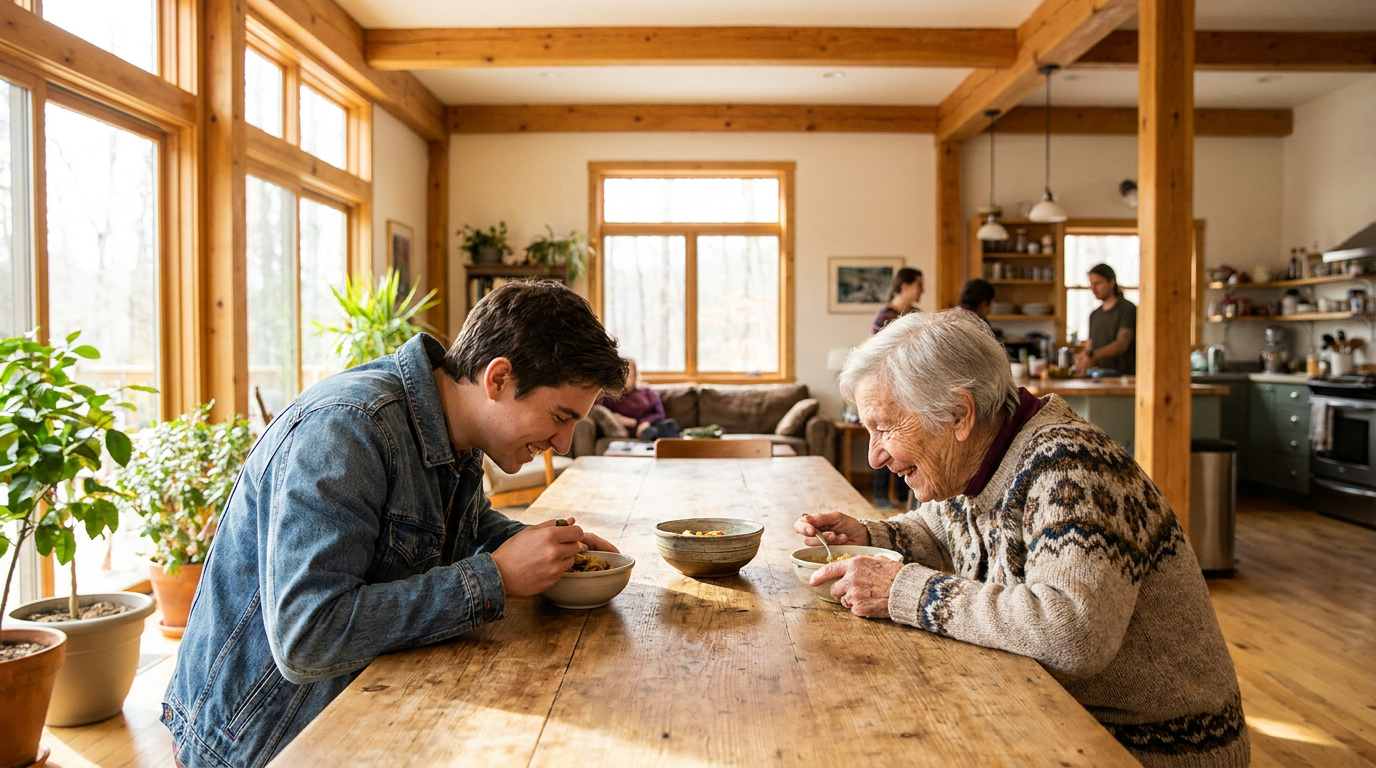
Under the Humanitas model, students receive rent-free accommodation within the nursing home. In exchange, they commit to spending 30 hours per month interacting with their older neighbors. This time isn't spent providing medical care; rather, students teach technology skills, share meals, watch sports, or simply provide companionship.[1]
The results have fundamentally challenged traditional eldercare. By prioritizing joy and connection over strictly clinical management, Humanitas created an environment where the elderly are insulated from isolation. The presence of young people normalizes the space, bringing the noise, energy, and spontaneity of everyday life back into a facility that might otherwise feel institutional.[1]
While the Dutch model focuses on students and seniors, American initiatives have adapted the concept to support vulnerable families. The "Generations of Hope" model, first established at Hope Meadows in Illinois, organizes an entire neighborhood around a specific social challenge—most notably, the foster care system.[5]
While the Dutch model focuses on students and seniors, American initiatives have adapted the concept to support vulnerable families.
In these geographically contiguous neighborhoods, families agree to adopt children from the foster system. They live alongside older adults who receive reduced rent in exchange for volunteering as surrogate grandparents, mentors, and tutors. The architecture of the neighborhood itself becomes the primary social service, a strategy researchers call "Intergenerational Community as Intervention."[5]

Similar models are expanding rapidly. The Treehouse Foundation in Massachusetts is currently developing a new community in Mattapan, slated for completion in 2028, which will integrate foster families, young adults aging out of the welfare system, and older adults into a single supportive ecosystem.[2]
The health benefits of these arrangements are profound and measurable. Savannah Fishel, a researcher who studied 54 communal housing models, coined the term "neighbourisms" to describe the informal, everyday acts of mutual support that occur in these environments.[3]
Fishel's research indicates that these casual check-ins and shared meals act as a powerful preventative health measure. By reducing chronic loneliness, intergenerational living directly mitigates associated physical health risks, including cognitive decline, malnutrition, and heart disease.[3]
The economic implications are equally striking. In the United Kingdom, research suggests that effectively reducing loneliness could save the health and social care system an estimated £1.8 billion annually by lowering hospital admissions, reducing GP visits, and delaying the need for intensive residential care.[6]

Data from the Netherlands and Denmark further supports this, showing that intergenerational housing can reduce loneliness by up to 45 percent while significantly boosting informal care networks that keep communities resilient.[6]
Beyond purpose-built neighborhoods, the concept is scaling through home-sharing platforms. Programs like Canada HomeShare match older adults who have spare bedrooms with university students. Recent data shows that 88 percent of senior participants experienced improved financial security, and 72 percent credited the program with helping them avoid institutional care and age in place.[4]
Despite the clear benefits, scaling these models remains challenging. Zoning laws in many Western countries heavily favor single-family homes, making it difficult to build cohousing developments or multi-unit shared spaces. Furthermore, advocates caution that intergenerational living should not be used by governments as an excuse to underfund professional social care or affordable housing initiatives.[2][7]

Yet, the cultural shift is already underway. From Singapore's "Kampung Admiralty"—a vertical village integrating senior apartments with childcare centers and medical facilities—to student-senior home-shares in Spain, urban design is evolving. By treating social connection as essential infrastructure, these communities are proving that the best way to care for vulnerable populations is to ensure they never live in isolation.[3][6]
How we got here
1994
Hope Meadows is established in Illinois, pioneering the 'Generations of Hope' model for foster families and seniors.
2012
Humanitas Deventer in the Netherlands launches its rent-for-time model, inviting university students to live in a nursing home.
2018
Canada HomeShare launches as a pilot in Toronto, matching students with older adults to facilitate aging in place.
2023
The World Health Organization officially declares social disconnection and loneliness a global public health crisis.
Viewpoints in depth
Public Health & Aging Advocates
Viewing loneliness as a severe medical crisis that requires preventative social infrastructure.
Public health experts argue that the medicalization of old age has stripped seniors of purpose and community. By treating loneliness as a clinical risk factor—on par with smoking or obesity—they advocate for housing models that engineer daily social interaction. They point to data showing that informal 'neighbourisms' delay cognitive decline, reduce malnutrition, and save billions in acute healthcare costs.
Urban Planners & Housing Experts
Focusing on zoning reform and the financial viability of building 'lifelong neighborhoods.'
Housing advocates emphasize the structural barriers to connection. They argue that mid-20th-century zoning laws, which heavily favor single-family homes and age-segregated developments, actively manufacture isolation. This camp pushes for municipal reforms that allow for accessory dwelling units (ADUs), cohousing developments, and vertical villages, ensuring that affordable housing solutions serve multiple demographics simultaneously.
Community Care Pioneers
Advocating for a philosophy of mutual support that rejects the institutional model of eldercare.
Pioneers of models like Humanitas Deventer and Generations of Hope argue that traditional care facilities focus too heavily on risk management and clinical outcomes at the expense of joy. They believe that bringing the noise, spontaneity, and messiness of youth into eldercare environments normalizes the space, giving older adults a renewed sense of purpose by allowing them to contribute to the lives of younger generations.
What we don't know
- Whether these models can scale effectively in highly individualistic cultures without significant government subsidies.
- How intergenerational cohousing models will adapt to the increasing medical complexities of an aging population over the long term.
Key terms
- Intergenerational Cohousing
- An intentional community of private homes clustered around shared spaces, designed to foster daily interaction between people of vastly different ages.
- Neighbourisms
- Informal, everyday acts of mutual support—such as shared meals or casual check-ins—that build social resilience within a community.
- Aging in Place
- The ability of older adults to live safely and independently in their own homes or communities for as long as possible, rather than moving to institutional care.
- Intergenerational Community as Intervention (ICI)
- A social work strategy where the architecture and social fabric of a neighborhood itself serves as the primary support system for vulnerable residents.
Frequently asked
Do young people actually want to live in nursing homes?
Yes. Programs like Humanitas Deventer have waiting lists. Students benefit from free or heavily reduced rent, while also reporting high satisfaction from the meaningful relationships they build with older residents.
How does intergenerational living save healthcare systems money?
By reducing chronic loneliness, these communities lower the incidence of depression, malnutrition, and cognitive decline, which in turn reduces hospital admissions and delays the need for expensive, full-time institutional care.
Is this model just for students and seniors?
No. Models like the Generations of Hope community in the US integrate foster families, young adults aging out of the welfare system, and older adults into a single, mutually supportive neighborhood.
What is the biggest barrier to building more of these communities?
Strict zoning laws in many countries often prohibit multi-family dwellings or cohousing structures in residential neighborhoods, making it difficult for developers to build shared-living infrastructure.
Sources
Source coverage
7 outlets
3 viewpoints surfaced







[1]AARP InternationalCommunity Care Pioneers
The Humanitas Deventer Model: Reconnecting Generations
Read on AARP International →[2]Harvard Joint Center for Housing StudiesUrban Planners & Housing Experts
Living Together by Design: Housing to Connect Generations
Read on Harvard Joint Center for Housing Studies →[3]Housing LINPublic Health Advocates
Loneliness is a public health crisis and neighbourisms should be part of the cure
Read on Housing LIN →[4]National Institutes of HealthUrban Planners & Housing Experts
Intergenerational cohousing and social connectedness
Read on National Institutes of Health →[5]Children and Youth Services ReviewCommunity Care Pioneers
Generations of Hope Communities: An intergenerational neighborhood model of support and service
Read on Children and Youth Services Review →[6]Intergenerational EnglandPublic Health Advocates
The Economic and Social Impact of Intergenerational Housing
Read on Intergenerational England →[7]Factlen Editorial TeamCommunity Care Pioneers
Synthesis by Factlen editorial team
Read on Factlen Editorial Team →


Every angle. Every day.
Get culture stories with full source coverage and perspective breakdowns delivered to your inbox.