
The Science of Blood Flow Restriction Training: How Lifting Lighter Builds Muscle Faster
Once an obscure technique used by elite bodybuilders, blood flow restriction (BFR) training has emerged as a scientifically validated method for building muscle and accelerating rehab using remarkably light weights.
By Factlen Editorial Team
- Clinical Rehabilitation Specialists
- Focus on BFR as a joint-sparing tool to prevent muscle atrophy during injury recovery.
- Sports Performance Analysts
- View BFR as a supplementary technique to maximize training volume without central nervous system burnout.
- Evidence Reviewers
- Emphasize the critical safety distinction between calibrated medical devices and unregulated elastic bands.
What's not represented
- · Recreational gym-goers attempting BFR without clinical supervision
- · Manufacturers of pneumatic BFR medical devices
Why this matters
For aging populations, injured athletes, or anyone whose joints cannot tolerate heavy weightlifting, BFR offers a proven, science-backed pathway to maintain and build muscle mass without the mechanical strain that typically accompanies strength training.
Key points
- Blood flow restriction (BFR) training uses pneumatic cuffs to partially block venous blood flow, triggering muscle growth at very low weights.
- Athletes can achieve hypertrophy using just 20% to 40% of their maximum lifting capacity, sparing joints and tendons from heavy mechanical loads.
- A 2026 orthopedic review found BFR highly effective for preventing muscle atrophy following major joint surgeries like ACL reconstructions.
- Experts warn against using uncalibrated elastic bands for BFR, as complete arterial occlusion can cause severe nerve damage or blood clots.
For decades, the foundational rule of exercise physiology has been straightforward: to build significant muscle size and strength, you must lift heavy weights. The traditional consensus dictated that mechanical tension—achieved by lifting loads exceeding 70 percent of a person's one-repetition maximum—was the non-negotiable prerequisite for muscular hypertrophy. However, a rapidly maturing technique known as blood flow restriction training is upending that consensus, offering a scientifically validated method to achieve the same physiological adaptations using remarkably light weights. By manipulating the vascular environment of the muscle rather than the mechanical load placed upon it, this approach is transforming both elite athletic performance and clinical rehabilitation.[6]
The core claim of blood flow restriction training, often abbreviated as BFR, is that it allows individuals to achieve profound muscle-building benefits using just 20 to 40 percent of their one-repetition maximum. To put that into perspective, an athlete who normally squats 200 pounds to build leg strength can theoretically trigger the same hypertrophic response using just 40 to 80 pounds. This dramatic reduction in required load shifts the primary driver of muscle growth from mechanical tension to metabolic stress, opening the door for populations who physically cannot tolerate heavy lifting to still build and maintain vital muscle mass.[5]
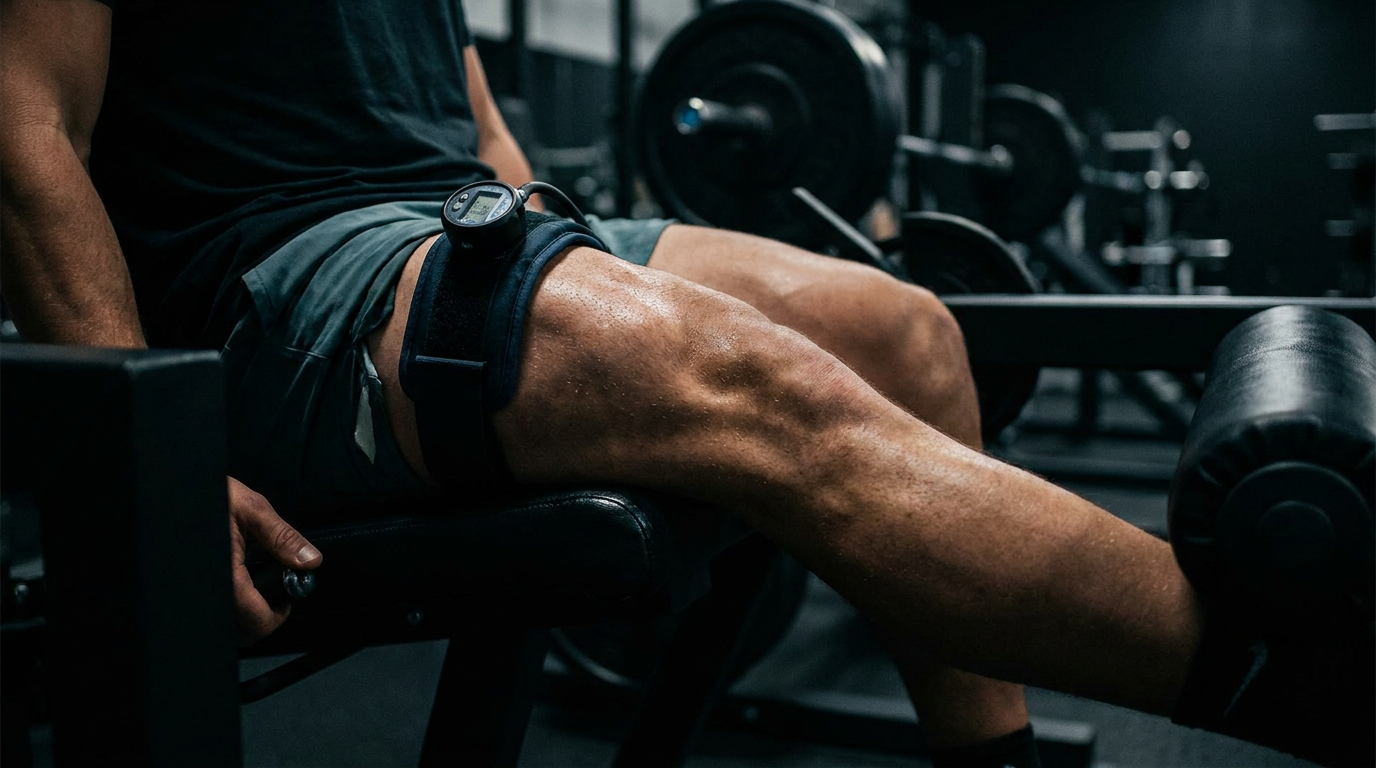
The mechanism behind BFR relies on precise vascular manipulation. The technique involves wrapping a specialized pneumatic cuff around the proximal portion of a limb—typically the upper arm near the shoulder or the upper thigh near the groin. The cuff is then inflated to a highly specific pressure. The goal is not to stop blood flow entirely, but to create a differential: the pressure must be low enough to allow oxygenated arterial blood to flow into the working muscle, but high enough to restrict deoxygenated venous blood from escaping back toward the heart.[5]

This partial occlusion creates a unique physiological cascade within the muscle tissue. Because blood is flowing in but struggling to flow out, it pools within the limb, creating a hypoxic, or low-oxygen, environment. This localized hypoxia, combined with the cellular swelling from the pooled blood, generates immense metabolic stress. The body interprets this severe metabolic disturbance as a signal of extreme exertion, triggering the release of growth factors, systemic hormones, and the recruitment of fast-twitch muscle fibers—perfectly simulating the physiological environment of high-intensity, heavy-load exercise without the actual mechanical strain.[4][5]
Professional sports franchises and elite athletes have been among the fastest adopters of this technology. According to recent industry analysis, elite competitors are increasingly utilizing sensor-controlled pressure cuffs to optimize muscle recovery and simulate physical stress during periods of heavy travel or mid-season fatigue. By integrating BFR into their routines, athletes can maintain muscle mass and stimulate the microvasculature without subjecting their joints, tendons, and central nervous systems to the punishing wear-and-tear of traditional heavy weightlifting.[1]
While the athletic applications are compelling, the clinical and rehabilitative implications of BFR are arguably much more significant. A comprehensive 2026 scoping review published in the journal JOSPT Open analyzed 30 distinct studies involving over 800 patients recovering from severe orthopedic procedures, including anterior cruciate ligament reconstructions and total knee arthroplasties. The review sought to quantify how effectively BFR could mitigate the rapid muscle loss that typically follows major joint surgery.[3]
The findings of the orthopedic review were highly encouraging. The data demonstrated that incorporating low-load BFR training into postoperative rehabilitation successfully prevented muscle atrophy while minimizing the excessive mechanical pressure that could compromise tissue healing or implant stability. Because patients could use incredibly light resistance—often just the weight of their own limb—physical therapists were able to initiate hypertrophy-stimulating protocols weeks earlier in the recovery timeline than traditional rehabilitation models would safely allow.[3]

The findings of the orthopedic review were highly encouraging.
Beyond post-surgical recovery, sports scientists are increasingly focusing on BFR's potential to combat sarcopenia—the age-related loss of muscle mass and function. For older adults, maintaining muscle is critical for metabolic health and fall prevention, but heavy resistance training is frequently contraindicated due to osteoarthritis, frailty, or cardiovascular limitations. BFR offers a physiological workaround, creating the necessary stimulus for muscle protein synthesis without requiring aging joints to bear heavy loads.[4]
A recent 2026 study conducted by researchers at Concordia University provided concrete evidence for this geriatric application. The research team guided a cohort of older adults, with an average age of 70, through a five-week program of low-intensity BFR resistance training performed at home. Despite the remarkably short duration of the intervention and the low intensity of the exercises, the participants demonstrated significant improvements in functional fitness markers, including enhanced oxygen consumption during standard sit-to-stand mobility tests.[4]
The broader efficacy of BFR has been further cemented by rigorous statistical reviews. A 2026 meta-analysis published in Frontiers in Physiology systematically evaluated the technique's impact on lower limb performance across multiple randomized controlled trials. The researchers specifically looked at post-activation potentiation—the phenomenon where a muscle's force output is temporarily enhanced following a conditioning stimulus—to determine if BFR could reliably induce this state of heightened neuromuscular readiness.[2]
The meta-analysis confirmed that lower limb BFR training significantly induces post-activation potentiation. Furthermore, the researchers were able to isolate the optimal parameters for success: the greatest potentiation effects were achieved using squat exercises at an intensity of 40 to 70 percent of a one-repetition maximum, combined with a compressive cuff strength set to 40 to 60 percent of the individual's absolute occlusion pressure, and utilizing rest intervals of two to four minutes between sets.[2]

Despite the overwhelming consensus regarding its efficacy, the evidence pack surrounding BFR does contain areas of uncertainty, primarily regarding standardization and safety protocols. The most critical variable in BFR training is determining the correct Limb Occlusion Pressure (LOP)—the exact amount of pressure required to safely restrict venous return without cutting off arterial supply. Because LOP varies wildly between individuals based on limb circumference, tissue density, and resting blood pressure, applying a universal pressure setting is physiologically impossible and potentially dangerous.[5]
This requirement for individualized pressure highlights a growing concern among sports scientists regarding the commercialization of the technique. While clinical settings utilize specialized pneumatic devices equipped with Doppler ultrasound to precisely measure and maintain a safe percentage of LOP, the fitness market has been flooded with cheap, unregulated elastic bands. Experts warn that using these uncalibrated tourniquets relies entirely on guesswork, carrying a severe risk of complete arterial occlusion, which can result in nerve damage, tissue necrosis, or deep vein thrombosis.[5][6]

Looking ahead, the future of blood flow restriction training lies in the integration of continuous biometric data. As the technology evolves from elite sports laboratories into broader clinical and commercial spaces, the next generation of BFR devices is focusing on real-time vascular monitoring. By utilizing near-infrared spectroscopy and continuous pressure sensors, these advanced cuffs will be able to dynamically adjust their compression second-by-second, responding to the dynamic fluctuations of the vascular system as the muscle fatigues.[1]
Ultimately, blood flow restriction training is not a complete replacement for traditional heavy lifting, particularly for healthy athletes whose primary goal is maximizing absolute mechanical strength. However, as an evidence-backed tool for inducing hypertrophy, accelerating orthopedic rehabilitation, and providing joint-sparing exercise for aging populations, BFR represents one of the most significant and validated shifts in sports science consensus in the last decade. By decoupling muscle growth from heavy mechanical loads, it has fundamentally expanded the boundaries of who can safely build strength.[6]
How we got here
1966
Yoshiaki Sato invents the early concept of KAATSU (added pressure) training in Japan.
2010s
BFR begins transitioning from niche bodybuilding circles to elite professional sports recovery protocols.
2021
Major physical therapy associations begin formally integrating BFR into post-operative rehabilitation guidelines.
2026
Comprehensive meta-analyses confirm BFR's efficacy for both post-surgical orthopedic recovery and geriatric functional fitness.
Viewpoints in depth
Clinical Rehabilitation Specialists
Focus on BFR as a joint-sparing tool to prevent muscle atrophy during injury recovery.
For physical therapists and orthopedic surgeons, BFR solves a fundamental biomechanical paradox: how to load a muscle enough to prevent it from wasting away without applying mechanical stress that would destroy a healing joint or ligament. By relying on metabolic stress rather than mechanical tension, clinicians can initiate hypertrophy protocols weeks earlier in the post-operative timeline than traditional protocols allow.
Sports Performance Analysts
View BFR as a supplementary technique to maximize training volume without central nervous system burnout.
Strength and conditioning coaches for elite athletes utilize BFR not to replace heavy lifting, but to supplement it. They deploy the technique for 'junk volume'—accessory exercises designed to build muscle size—allowing athletes to accumulate massive metabolic stress without incurring the central nervous system fatigue or joint wear-and-tear that accompanies heavy barbell training.
Evidence Reviewers
Emphasize the critical safety distinction between calibrated medical devices and unregulated elastic bands.
While the physiological evidence supporting BFR is robust, safety experts and physiologists warn of a growing gap between clinical application and commercial practice. The clinical efficacy of BFR relies on precise, individualized percentages of Limb Occlusion Pressure (LOP). The democratization of the technique via cheap, uncalibrated elastic tourniquets sold on social media risks complete arterial occlusion, which can lead to severe nerve damage or deep vein thrombosis.
What we don't know
- The long-term cardiovascular adaptations of decades-long BFR use compared to traditional heavy lifting.
- The precise optimal occlusion pressure for upper-body versus lower-body applications across different age demographics.
- Whether BFR induces the same degree of bone density improvement (Wolff's Law) as heavy mechanical loading.
Key terms
- Blood Flow Restriction (BFR)
- A training method using specialized cuffs to partially restrict venous blood return from a muscle while maintaining arterial inflow.
- Hypertrophy
- The enlargement of an organ or tissue from the increase in size of its cells; in fitness, the growth of muscle mass.
- Limb Occlusion Pressure (LOP)
- The minimum amount of pressure required to completely occlude arterial blood flow to a limb. Safe BFR uses a specific percentage of this pressure.
- Hypoxia
- A physiological state in which oxygen is not available in sufficient amounts at the tissue level, triggering metabolic stress.
- 1-Repetition Maximum (1RM)
- The maximum amount of weight a person can lift for one complete repetition of a given exercise.
Frequently asked
Is blood flow restriction training safe?
Yes, when performed with specialized equipment that measures and applies a specific percentage of your limb occlusion pressure. Using uncalibrated elastic bands carries significant risks of nerve damage or blood clots.
Does BFR build as much muscle as heavy lifting?
Research indicates BFR can produce similar muscle hypertrophy (size) to heavy lifting, though traditional heavy lifting remains superior for maximizing absolute maximal strength.
How long should the cuffs be left on?
Clinical guidelines generally recommend limiting BFR to 5-minute intervals per exercise, with periods of deflation and rest between sets to ensure tissue safety.
Can I use regular elastic bands for BFR?
Sports scientists strongly advise against using elastic bands or tourniquets, as they cannot measure pressure and can easily cause complete arterial occlusion.
Sources
Source coverage
6 outlets
3 viewpoints surfaced






[1]ForbesSports Performance Analysts
The evolution of blood flow monitoring from elite sports to the clinical space
Read on Forbes →[2]Frontiers in PhysiologySports Performance Analysts
The effect of blood flow restriction training on post-activation potentiation: a meta-analysis
Read on Frontiers in Physiology →[3]JOSPT OpenClinical Rehabilitation Specialists
Blood Flow Restriction Training After Orthopedic Procedures: A Scoping Review
Read on JOSPT Open →[4]EurekAlertClinical Rehabilitation Specialists
Concordia researchers explore how blood flow restriction training enhances low-intensity exercise benefits
Read on EurekAlert →[5]Science for SportSports Performance Analysts
What is Blood Flow Restriction training?
Read on Science for Sport →[6]Factlen Editorial TeamEvidence Reviewers
Synthesis by Factlen editorial team
Read on Factlen Editorial Team →

More in sports
See all 6 stories →ACL Epidemic
How Breakthrough Boot Designs and Global Research Are Finally Tackling Women's Football's ACL Epidemic
8 sources
Rule Changes
How FIFA's New 5-Second Rules Are Speeding Up the 2026 World Cup
8 sources

Women's Sports Business
NWSL Valuations Skyrocket as League Expands and Smashes Attendance Records in 2026
7 sources

WNBA Tactics
How the Indiana Fever Dialed In Their Defense to Save Their 2026 Season
6 sources
Every angle. Every day.
Get sports stories with full source coverage and perspective breakdowns delivered to your inbox.