
How the Indiana Fever Dialed In Their Defense to Save Their 2026 Season
After a rocky start and a tense team meeting, the Indiana Fever have transformed their defensive schemes, sparking a 5-1 June run.
By Factlen Editorial Team
- Fever Coaching Staff
- Emphasizes that defensive success requires collective discipline, pace, and strict adherence to scouting reports.
- Analytics Community
- Argues that individual defensive narratives are often overblown when a team's structural help defense is failing.
- WNBA Opponents
- Focuses on hunting mismatches and testing the Fever's perimeter containment through isolation plays.
What's not represented
- · Fever Front Office
- · WNBA Referees
Why this matters
Championships in professional basketball are rarely won on offense alone. The Fever's mid-season defensive adjustment proves they are evolving from a high-scoring spectacle into a structurally sound title contender.
Key points
- The Indiana Fever allowed 89.0 points per game in May, prompting a team meeting after a 100-84 loss to Portland.
- Following a five-day break, the Fever went on a 5-1 run, dropping their points allowed to 83.7 per game.
- Head coach Stephanie White implemented a stricter 'Know Your Personnel' system to fix perimeter over-rotations.
- Advanced metrics show individual defensive criticisms of the Fever's backcourt were largely overstated.
- Rookie Raven Johnson has provided crucial perimeter containment to support interior anchor Aliyah Boston.
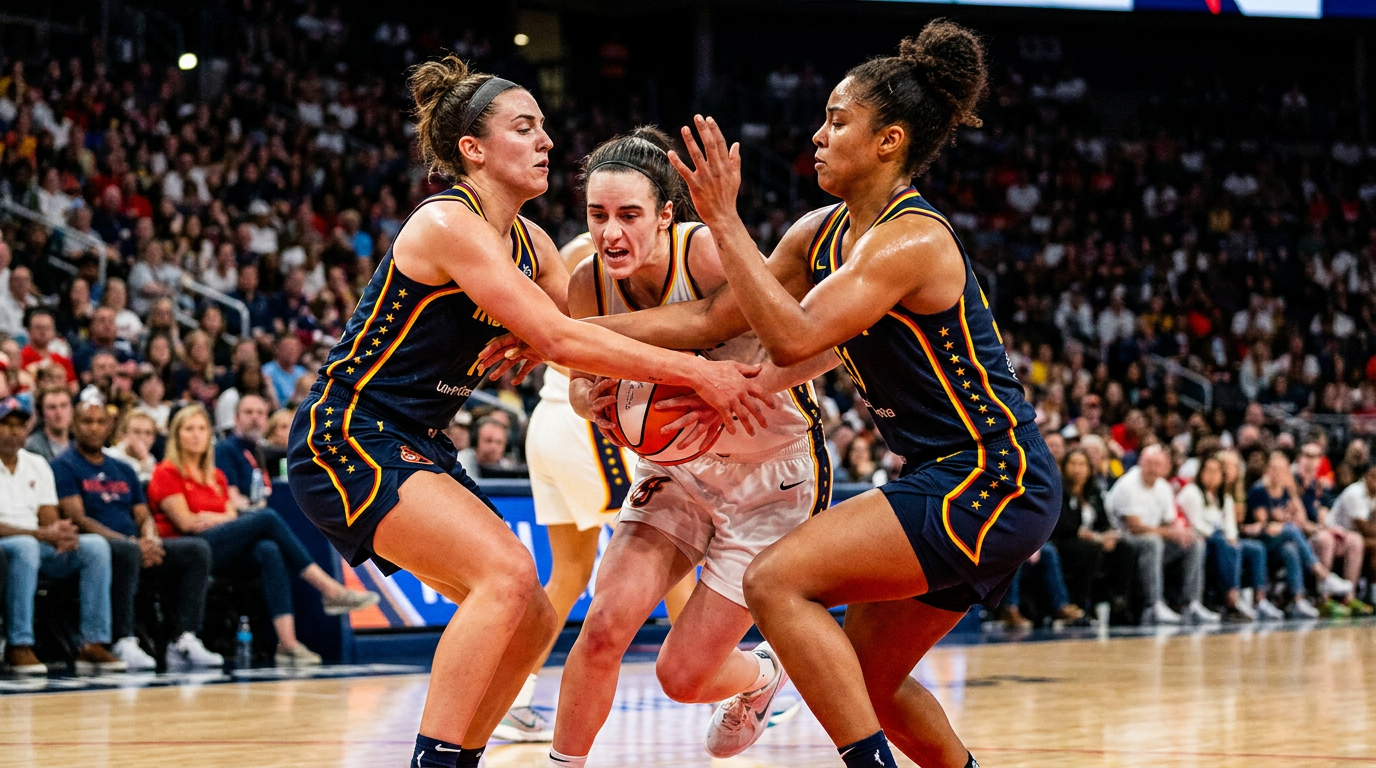
The Indiana Fever's 2026 campaign began with a glaring contradiction: a dazzling, high-octane offense undermined by a porous, generous defense. Through the opening month of the season, the Fever allowed 89.0 points per game, the second-worst mark in the WNBA. Fans leaving Gainbridge Fieldhouse were often left scratching their heads, wondering how a team with such elite scoring talent could consistently find themselves playing from behind in the fourth quarter. The metrics confirmed what the eye test already showed—Indiana's defensive structure was hemorrhaging points and putting unsustainable pressure on their shooters.[1][4]
The struggles were visible on a nightly basis, as opponents routinely eclipsed the 100-point mark against Indiana. Film from the first handful of games showed constant over-rotations and missed assignments on the perimeter, exposing structural flaws that veteran teams eagerly exploited. The breaking point arrived in late May during a historic 100-84 blowout loss to the expansion Portland Fire. Portland's guards easily bypassed Indiana's initial point of attack, forcing the Fever into scrambled, desperate closeouts that rarely succeeded. It was a wake-up call that the team's current trajectory was fundamentally broken.[1][4]
That game in Portland featured a highly visible, animated sideline exchange between star guard Caitlin Clark and head coach Stephanie White, capturing the mounting frustrations of a roster built for championship contention. The tension was palpable, prompting a lengthy, closed-door team meeting upon the squad's return to Indianapolis. Players and coaches spent the ensuing days discussing their early-season defensive woes, airing grievances, and demanding a higher standard of accountability from one another. The air needed to be cleared before the tactical adjustments could take root.[1][2]

"We put a lot of pressure on our offense to be perfect when we don't consistently defend," White noted during the team's early-season struggles, demanding that her players stop resting on the defensive end of the floor. White emphasized that building an elite defense is rarely about having five lockdown one-on-one defenders; rather, it is about collective discipline and executing assignments flawlessly on every single possession. The message delivered in that pivotal team meeting appears to have resonated deeply with a roster that knew its title window was actively opening.[4][5]
Following a rare five-day break in the schedule, the Fever emerged from their practice facility as a transformed unit. The time away from live game action allowed the coaching staff to drill down on the mechanics of their scheme, rather than just surviving from one tip-off to the next. Since that pivotal meeting, Indiana has ripped off a 5-1 stretch in June, dropping their points allowed to a much more respectable 83.7 per game. That defensive improvement ranks as the sixth-best mark in the league over that specific span, proving the turnaround is mathematically real.[1][2]
The turnaround is rooted in a renewed commitment to White's "Know Your Personnel" (KYP) philosophy. The KYP system requires players to rigorously follow scouting reports, understanding the specific tendencies and "bags of tricks" of the opponents they are guarding. Instead of relying on generic help defense that leaves shooters open, the Fever are now making calculated decisions about when to switch, when to fight through screens, and when to send double-teams. Knowing the opponent's preferred angles is literally half the battle in White's demanding half-court system.[4]

The turnaround is rooted in a renewed commitment to White's "Know Your Personnel" (KYP) philosophy.
Much of the external scrutiny during the early slump fell on Clark, whose defense has been under a microscope since she entered the professional ranks. Opposing teams, including Portland, actively hunted Clark in isolation matchups, attempting to exploit her on the perimeter and force her into foul trouble. The strategy was designed to tire her out defensively, thereby blunting her historic impact on the offensive end. For a brief period, the tactic seemed to be working, as Clark openly admitted she needed to do a better job of keeping defenders in front of her.[1][3]
However, advanced metrics suggest the narrative surrounding Clark's defensive liabilities is largely overblown by observers looking for a flaw in her game. ESPN's analytics track her Net Points defense rating at just -2, placing her only slightly below the league average. Given her massive +20 offensive output, the Fever can easily absorb average defensive metrics from their primary playmaker. The data indicates that Indiana's early problems were systemic rather than individual, and that blaming a single guard for a team-wide failure to rotate was a misdiagnosis of the actual tactical breakdown.[3]
Clark herself has acknowledged the learning curve, noting that White's system demands more "denial defense and pressure defense" than she played in previous seasons under different coaching regimes. "You have to be able to guard your yard to do well in this system," Clark explained to reporters, highlighting her growing understanding of where her built-in help is located. By trusting that her teammates will be in the right spots, Clark can apply heavier ball pressure without the constant fear of giving up an uncontested layup if she gets beat off the dribble.[1]

That built-in help relies heavily on the interior presence of center Aliyah Boston. Boston operates as the sole anchor of the Fever defense, tasked with cleaning up perimeter mistakes and protecting the rim against slashing guards and opposing bigs. The sheer volume of traffic funneling into the paint took a physical toll on Boston early in the year, making perimeter containment a top priority for the coaching staff. When the guards do their job at the point of attack, Boston is free to play true help defense rather than constantly playing emergency catch-up.[4]
To bolster that perimeter containment, the Fever have leaned heavily on rookie Raven Johnson, selected 10th overall in the 2026 WNBA Draft. A former SEC Defensive Player of the Year under Dawn Staley at South Carolina, Johnson was drafted specifically for her elite defensive IQ and her ability to set a physical tone from the moment she checks into the game. Her willingness to get after loose balls and disrupt passing lanes has provided Indiana with a reliable defensive specialist who can take the toughest backcourt assignments off Clark's plate.[6]
The results of these roster and schematic adjustments were on full display during an 83-71 victory over the Atlanta Dream to open the Commissioner's Cup. Indiana swarmed Atlanta's shooters from the opening tip, holding the Dream to just 34 percent from the field and a dismal 29 percent from beyond the arc. The Fever recorded key blocks, won the rebounding battle, and forced double-digit turnovers. It was a comprehensive defensive performance that showcased exactly what the team looks like when all five players are connected on a single string.[2]

The Fever's ability to win games with defense rather than just outscoring opponents in track meets is a critical step in their evolution. Historically, franchises that secure back-to-back No. 1 overall draft picks—as the Fever did with Boston and Clark—see their championship window open almost immediately. The Seattle Storm and Las Vegas Aces both turned consecutive top picks into multi-year dynasties by ensuring their generational offensive talents were backed by top-tier defensive structures. Indiana's front office knows that above-average defense is the baseline requirement for hanging a banner.[5]
With a healthy roster and a defense that is finally catching up to its generational offense, Indiana is proving they can navigate the inevitable adversity of a long professional season. The team's ability to look in the mirror, hold a difficult meeting, and emerge as a cohesive unit speaks volumes about their internal culture. As the season progresses into its grueling summer months, the Fever's newfound defensive identity will serve as the ultimate barometer of their title aspirations, proving they are far more than just a highlight reel.[1][2][5]
How we got here
May 2026
The Fever struggle defensively, allowing 89.0 points per game and starting the season 4-4.
May 30, 2026
A 100-84 loss to the expansion Portland Fire sparks a heated sideline exchange and a subsequent team meeting.
Early June 2026
Following a five-day break, the Fever implement stricter defensive accountability under coach Stephanie White.
June 4, 2026
Indiana holds the Atlanta Dream to 34% shooting in an 83-71 victory, signaling a defensive turnaround.
Mid-June 2026
The Fever improve to a 5-1 stretch, dropping their points allowed to 83.7 per game.
Viewpoints in depth
Fever Coaching Staff
Emphasizes accountability, pace, and strict adherence to scouting reports.
Head coach Stephanie White and her staff believe that elite defense is built on collective discipline rather than individual lockdown ability. By enforcing the 'Know Your Personnel' (KYP) philosophy, the coaching staff demands that players understand the specific offensive tendencies of their matchups. This approach aims to eliminate the over-rotations and scrambled closeouts that plagued the team in May, ensuring that players only offer help defense when it is tactically advantageous.
Analytics Community
Focuses on the math behind the narrative, showing that individual defensive struggles are often overstated.
Data analysts point to metrics like Net Points to argue that the intense scrutiny on individual players—such as Caitlin Clark—was a misdiagnosis of a team-wide structural issue. When a team fails to rotate properly, the primary defender often looks worse on film than they actually are. The numbers suggest that Indiana's backcourt defenders are performing near the league average, and that the team's early defensive woes were a result of systemic breakdowns rather than a lack of individual effort.
WNBA Opponents
The strategy of hunting matchups to test the Fever's perimeter containment.
Opposing coaches and players actively look to exploit perceived weaknesses in the Fever's defense by forcing switches and running isolation plays. Teams like the Portland Fire and Atlanta Dream have attempted to tire out Indiana's primary scorers by making them work relentlessly on the defensive end. This strategy tests the Fever's communication and forces their interior anchor, Aliyah Boston, to step out of the paint, creating rebounding advantages and open driving lanes for the offense.
What we don't know
- Whether the Fever's perimeter defenders can consistently contain elite, quick guards in a seven-game playoff series.
- How the physical toll of anchoring the paint will affect Aliyah Boston's health late in the season.
- If the team's improved defensive metrics will hold steady during their upcoming grueling road trips against top-tier opponents.
Key terms
- Know Your Personnel (KYP)
- A defensive philosophy emphasizing strict adherence to scouting reports and understanding the specific tendencies of the player being guarded.
- Denial Defense
- A defensive technique where a player actively prevents their assigned opponent from receiving a pass.
- Isolation (Iso)
- An offensive strategy that clears out space for one player to attack their defender one-on-one, often used to exploit a perceived mismatch.
- Net Points Defense Rating
- An analytics metric estimating how many points a player costs their team on the defensive end compared to a league-average player.
- Over-rotation
- A defensive mistake where a player moves too far or too early to help a teammate, leaving their own assigned offensive player wide open.
Frequently asked
Why did the Indiana Fever struggle on defense early in 2026?
The team suffered from constant over-rotations and missed assignments on the perimeter, allowing opponents to score 89.0 points per game in May.
How has Caitlin Clark's defense improved?
Clark has focused on denial defense and guarding her specific area, learning to rely on the team's built-in help rather than getting beaten in isolation.
What is the 'KYP' defensive philosophy?
'Know Your Personnel' is coach Stephanie White's mandate that players rigorously follow scouting reports and understand the specific offensive tendencies of the player they are guarding.
Who anchors the Indiana Fever defense?
Center Aliyah Boston serves as the primary interior anchor, tasked with protecting the rim and cleaning up perimeter mistakes.
Sources
Source coverage
6 outlets
3 viewpoints surfaced






[1]TSNWNBA Opponents
How Clark and Fever have dialed in on defence
Read on TSN →[2]Associated PressWNBA Opponents
Caitlin Clark and the Fever take advantage of a 5-day break to overcome drama and the Dream
Read on Associated Press →[3]Sports IllustratedAnalytics Community
WNBA Net Defense Stat Suggests Caitlin Clark Isn't Such a Bad Defender
Read on Sports Illustrated →[4]Indianapolis RecorderFever Coaching Staff
Indiana Fever’s defense is hemorrhaging points early in the 2026 campaign
Read on Indianapolis Recorder →[5]CBS SportsWNBA Opponents
What's in store for Caitlin Clark in Year 3? Fever superstar is healthy, and their title window is wide open
Read on CBS Sports →[6]BolavipFever Coaching Staff
Stephanie White, Fever get the key to help Caitlin Clark in 2026 WNBA season
Read on Bolavip →
More in sports
See all 5 stories →ACL Epidemic
How Breakthrough Boot Designs and Global Research Are Finally Tackling Women's Football's ACL Epidemic
8 sources
Rule Changes
How FIFA's New 5-Second Rules Are Speeding Up the 2026 World Cup
8 sources

Women's Sports Business
NWSL Valuations Skyrocket as League Expands and Smashes Attendance Records in 2026
7 sources

Every angle. Every day.
Get sports stories with full source coverage and perspective breakdowns delivered to your inbox.