
UK Voters Head to Polls in Makerfield By-Election That Could Topple Prime Minister Keir Starmer
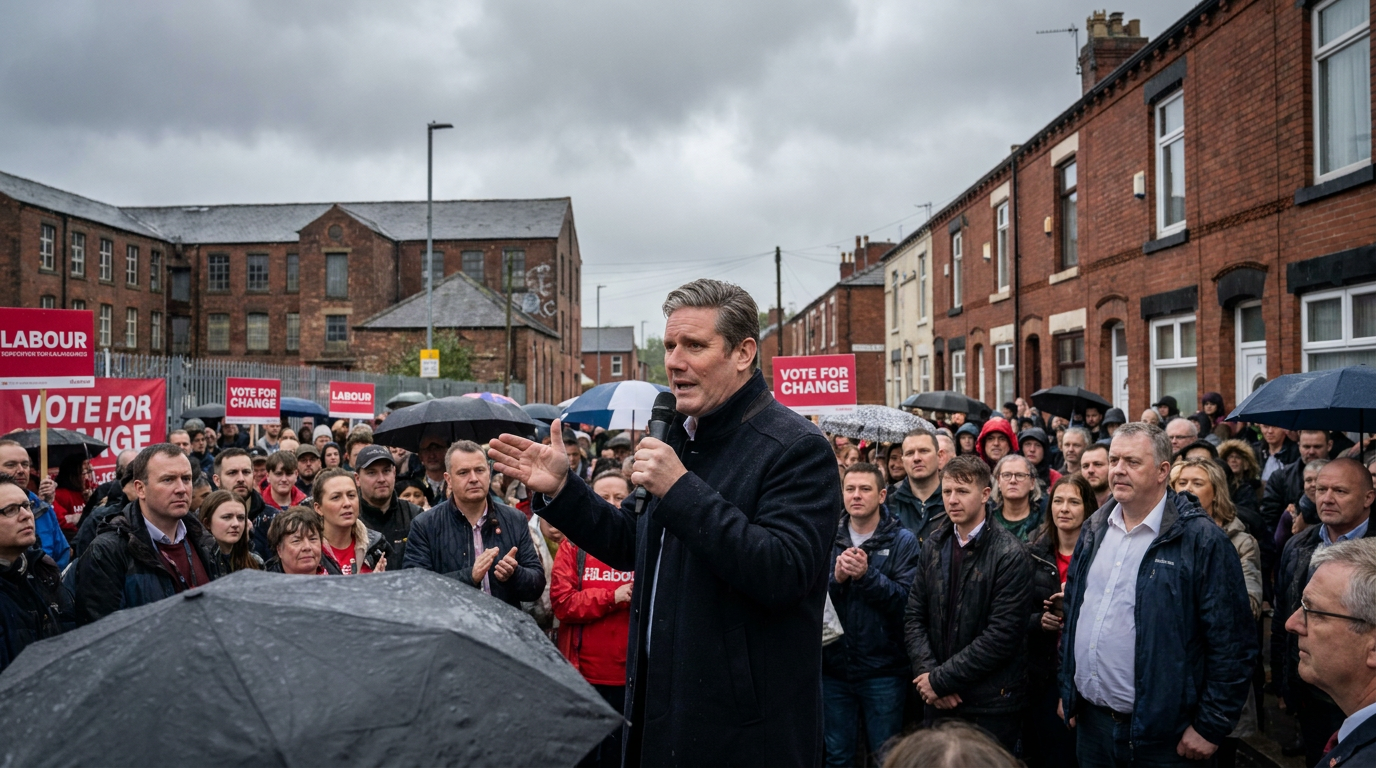
Voters in the Makerfield constituency are casting ballots in a highly consequential by-election that could pave the way for Greater Manchester Mayor Andy Burnham to challenge Keir Starmer for the UK premiership.
By Factlen Editorial Team
- Andy Burnham Supporters
- Argues that Labour needs a fresh, popular leader untainted by the current government's struggles.
- Keir Starmer Loyalists
- Maintains that the Prime Minister has a national mandate and that an internal leadership challenge is self-indulgent.
- Reform UK Voters
- Views the Labour infighting as proof that the political establishment is failing working-class voters.
- Neutral Observers
- Focuses on the constitutional and procedural mechanics of the unprecedented by-election maneuver.
What's not represented
- · Conservative Party strategists observing the Labour infighting
- · Greater Manchester residents facing a sudden mayoral vacancy
Why this matters
If Andy Burnham wins the Makerfield seat, he will be eligible to launch a formal leadership challenge against Keir Starmer. Because the Labour Party holds a parliamentary majority, the winner of that internal contest would automatically become the next Prime Minister of the United Kingdom.
Key points
- Voters in Makerfield are casting ballots to replace Labour MP Josh Simons, who resigned to open the seat for Andy Burnham.
- Burnham, the Mayor of Greater Manchester, needs a parliamentary seat to legally challenge Keir Starmer for the Labour leadership.
- Starmer has faced mounting pressure to resign following massive Labour losses in the May 2026 local elections.
- The Prime Minister has offered Burnham a cabinet position, which Burnham's allies have swiftly rejected.
- Burnham faces a right-wing challenge from Reform UK candidate Rob Kenyon, who is polling in second place.
- If Burnham wins, he must immediately resign as mayor, triggering a separate mayoral by-election in Greater Manchester.
Voters in Makerfield, a working-class constituency in northwest England, are heading to the polls today for a by-election that could fundamentally alter the trajectory of the United Kingdom's government. The Labour Party candidate, Greater Manchester Mayor Andy Burnham, is seeking to return to Parliament in a highly unusual political maneuver widely viewed as the first step in a bid to oust Prime Minister Keir Starmer. The stakes are extraordinarily high: because the Labour Party holds a commanding majority in the House of Commons, whoever leads the party automatically serves as Prime Minister. If Burnham secures the seat, he will be eligible to launch a formal leadership challenge, potentially installing the UK's seventh Prime Minister since 2017 in a matter of weeks.[1][2]
The vacancy in Makerfield was engineered specifically to facilitate this power struggle. In mid-May, incumbent Labour MP Josh Simons abruptly resigned his seat to provide Burnham with a clear, safe path back to the House of Commons. Under Labour Party rules, any candidate for the leadership must be a sitting Member of Parliament. Simons's resignation—formalized by his appointment as Crown Steward and Bailiff of the Chiltern Hundreds, an ancient procedural device used to allow MPs to quit—marked the first time since 1965 that a by-election was triggered explicitly to parachute an outside figure into Parliament for a leadership bid.[5][6]
Starmer's premiership has been severely weakened over the past month following massive Labour losses in the May 2026 local elections, where the party surrendered over 1,500 council seats. The electoral drubbing sparked widespread panic within the governing party, prompting nearly 100 Labour lawmakers to publicly call for Starmer to announce a timetable for his resignation. The internal revolt escalated further when several high-profile cabinet members, including Health Secretary Wes Streeting and Defense Secretary John Healey, resigned from the government, citing a lack of confidence in Starmer's political direction and policy execution.[1][6]

Into this leadership void steps Burnham, a 56-year-old career politician who previously served as a Labour MP and cabinet minister before leaving Westminster in 2017 to become the first elected mayor of Greater Manchester. Burnham has capitalized on his physical and political distance from the central government's recent struggles. On the campaign trail, he has pitched his collaborative, long-term approach to governance—which he dubs "Manchesterism"—as a necessary corrective to restore public trust in national politics. By running as an outsider to the current Westminster turmoil, Burnham has positioned himself as the only figure capable of uniting the fractured party.[5]
Starmer, however, has made it abundantly clear that he will not step down quietly to facilitate a Burnham coronation. Speaking to reporters from the fringes of the G7 summit in Switzerland, the Prime Minister insisted he retains a mandate from the party's historic 2024 general election victory and is fully prepared to fight any leadership challenge. In a strategic maneuver designed to neutralize the threat, Starmer publicly offered Burnham a "big role in government" if he wins the Makerfield seat, attempting to co-opt his chief rival into the cabinet and bind him to collective responsibility.[3][4]
Starmer, however, has made it abundantly clear that he will not step down quietly to facilitate a Burnham coronation.
Burnham's allies swiftly rejected the Prime Minister's overture, emphasizing that his entire campaign is built on representing a clean break from the current administration's failings. If Burnham secures the Makerfield seat, he would need the formal backing of 20 percent of Labour MPs—currently 81 lawmakers—to trigger a leadership contest. Given the sheer volume of MPs who have already demanded Starmer's resignation, political analysts and Westminster insiders believe Burnham would easily clear that threshold, forcing a vote among the broader Labour Party membership where Burnham is highly popular.[2][4][5]

Despite his national profile, the by-election is not a guaranteed victory for Burnham. He faces a spirited and aggressive challenge from Reform UK candidate Rob Kenyon, a local self-employed plumber who is tapping into deep-seated working-class frustrations over immigration, public services, and economic stagnation. Reform UK has been surging across post-industrial northern England, and Kenyon's campaign has framed Burnham as an opportunistic career politician using Makerfield merely as a stepping stone for his own prime ministerial ambitions. A strong showing by Kenyon could severely complicate Burnham's narrative as Labour's electoral savior.[1][3][5]
Recent polling data suggests Burnham remains the heavy favorite, though the margins reflect a divided electorate. A Survation poll conducted ahead of the vote gave Burnham a comfortable 10-point lead over Kenyon, projecting the Greater Manchester Mayor to capture roughly 49 percent of the vote compared to Reform UK's 39 percent. However, the presence of Restore Britain—a hardline, ethnonationalist offshoot of Reform UK—threatens to splinter the right-wing vote. Restore candidate Rebecca Shepherd is polling at around 8 percent, effectively siphoning critical support away from Kenyon and padding Burnham's path to victory.[5]

If Burnham is victorious, his ascension to Parliament will trigger a cascade of secondary electoral consequences. Because the Greater Manchester Mayoralty encompasses Police and Crime Commissioner powers, UK law dictates that Burnham must immediately vacate his mayoral office the moment he is elected to the House of Commons. This would force a separate mayoral by-election in Greater Manchester within 35 days. Starmer has seized on this logistical hurdle, urging the party infrastructure to focus its resources on retaining the crucial Manchester mayoralty rather than engaging in a divisive and self-indulgent leadership battle in London.[4][7]
As polling stations across Makerfield prepare to close at 10:00 p.m. local time, the implications of the vote extend far beyond the borders of the constituency. A Burnham victory would immediately set the stage for a bruising internal Labour conflict, paralyzing the government's legislative agenda while the party decides its future. For Keir Starmer, the results will dictate whether he can somehow stabilize his fractured administration, or if his tenure at 10 Downing Street is rapidly approaching an unceremonious end.[1][2]
How we got here
July 2024
Keir Starmer leads the Labour Party to a landslide victory in the UK general election.
May 2026
Labour suffers massive losses in local council elections, prompting nearly 100 MPs to call for Starmer's resignation.
May 14, 2026
Makerfield MP Josh Simons resigns his seat specifically to allow Andy Burnham to run for Parliament.
June 18, 2026
Polls open for the Makerfield by-election.
Viewpoints in depth
Andy Burnham's Camp
Argues that Labour needs a fresh, popular leader untainted by the current government's struggles.
Supporters of the Greater Manchester Mayor believe his track record of regional governance and collaborative "Manchesterism" offers a blueprint for national renewal. They argue that Keir Starmer's administration has lost the public's trust following heavy local election defeats, and that Burnham is uniquely positioned to neutralize the electoral threat posed by right-wing populist parties like Reform UK in Labour's traditional heartlands.
Keir Starmer's Loyalists
Maintains that the Prime Minister has a national mandate and that an internal leadership challenge is self-indulgent.
Allies of the Prime Minister emphasize that Starmer led the Labour Party to a historic landslide victory just two years ago in 2024. They view the Makerfield maneuver as an act of political self-harm that distracts from governing and hands ammunition to the Conservative opposition. Starmer's camp argues that the party should focus on delivering its legislative agenda rather than plunging the country into another cycle of leadership instability.
Reform UK & Populist Challengers
Views the Labour infighting as proof that the political establishment is failing working-class voters.
Candidates like Rob Kenyon of Reform UK argue that both Starmer and Burnham represent an out-of-touch political elite that takes post-industrial northern towns for granted. They are capitalizing on local frustrations regarding immigration, public services, and economic decline, framing the by-election not as a Labour leadership primary, but as a referendum on the establishment's neglect of communities like Makerfield.
What we don't know
- Whether Keir Starmer would immediately resign if Burnham wins convincingly, or force a protracted leadership contest.
- How the right-wing vote will split between Reform UK and the hardline Restore Britain party.
- Who Labour would field to replace Burnham as Greater Manchester Mayor if he transitions to Westminster.
Key terms
- By-election
- A special election held to fill a political office that has become vacant between general elections.
- Member of Parliament (MP)
- An elected representative in the UK House of Commons. Under Labour rules, only sitting MPs can run for party leader.
- Reform UK
- A right-wing populist political party in the UK that campaigns heavily on reducing immigration and reforming national institutions.
- Chiltern Hundreds
- An ancient procedural device used in the UK Parliament to allow an MP to resign, as members are technically forbidden from quitting directly.
Frequently asked
Why did the previous Makerfield MP resign?
Labour MP Josh Simons resigned intentionally to create a vacancy for Andy Burnham. This maneuver was designed to give Burnham a path back into Parliament so he could challenge Keir Starmer for the party leadership.
Can Andy Burnham be both Mayor and an MP?
No. Because the Greater Manchester Mayor also holds Police and Crime Commissioner powers, UK law requires Burnham to immediately vacate the mayoralty if he is elected to the House of Commons.
How does a Labour leadership challenge work?
A challenger must secure the backing of 20 percent of Labour MPs, which currently equates to 81 lawmakers. If that threshold is met, the contest goes to a vote among the broader Labour Party membership.
Why would the Labour leader automatically become Prime Minister?
Because the Labour Party currently holds a majority of seats in the House of Commons, whoever leads the party commands the confidence of the House and serves as Prime Minister without needing a national general election.
Sources
Source coverage
7 outlets
4 viewpoints surfaced







[1]The Washington PostReform UK Voters
The local election that could topple Britain's prime minister
Read on The Washington Post →[2]The GuardianNeutral Observers
Makerfield byelection: polls open in vote that could decide Keir Starmer's fate
Read on The Guardian →[3]Associated PressNeutral Observers
Keir Starmer's future as Britain's prime minister is on the line in a special election
Read on Associated Press →[4]Financial TimesKeir Starmer Loyalists
Keir Starmer offers Andy Burnham cabinet role ahead of Makerfield vote
Read on Financial Times →[5]The NationAndy Burnham Supporters
In Britain, an Election That Could Mark the Beginning of Prime Minister Keir Starmer's End
Read on The Nation →[6]WikipediaNeutral Observers
2026 Makerfield by-election
Read on Wikipedia →[7]House of Commons LibraryNeutral Observers
Can the mayor of Greater Manchester also be an MP?
Read on House of Commons Library →
More in news politics
See all 7 stories →NATO Posture
Defense Secretary Hegseth Announces Review of U.S. Forces in Europe, Cuts Crisis Commitments
7 sources
Nuclear Diplomacy
Full Text of U.S.-Iran Memorandum of Understanding Released, Outlining Ceasefire and Nuclear Framework
7 sources

Iran Peace Deal
U.S. and Iran Sign 14-Point Memorandum to Halt War and Reopen Strait of Hormuz
8 sources
Ranked-Choice Voting
Evidence Pack: Does Ranked-Choice Voting Actually Reduce Political Polarization?
7 sources
Every angle. Every day.
Get news politics stories with full source coverage and perspective breakdowns delivered to your inbox.