
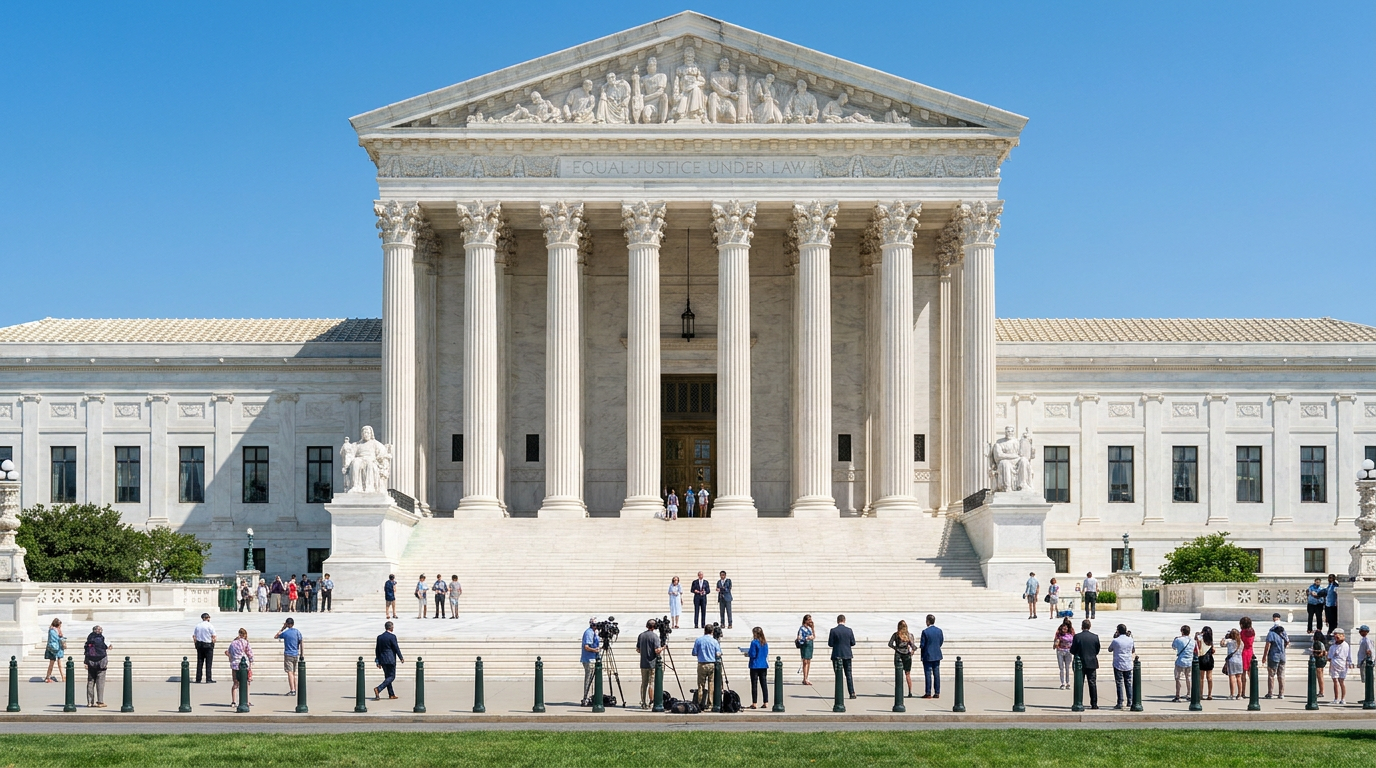
Supreme Court Rules Last-Mile Delivery Drivers Cannot Be Forced Into Arbitration
In a unanimous decision, the Supreme Court ruled that local delivery drivers who transport goods as part of an interstate journey are exempt from mandatory arbitration, opening the door for widespread class-action labor lawsuits.
By Factlen Editorial Team
- Labor Advocates
- Argue the ruling restores workers' constitutional right to a jury trial and provides a crucial tool against wage theft.
- Corporate Employers
- Warn that the decision will trigger a flood of costly class-action lawsuits and disrupt established franchise distribution models.
- Legal Analysts
- Focus on the Court's textualist approach and the ongoing expansion of the FAA's transportation worker exemption.
What's not represented
- · Consumers who may face higher delivery fees if logistics companies pass on the costs of class-action litigation.
- · Independent arbitrators whose caseloads may decrease as disputes move back to federal courts.
Why this matters
By stripping companies of the ability to force last-mile delivery drivers into private arbitration, this unanimous ruling opens the door for millions of gig workers and distributors to file class-action lawsuits for wage theft and labor violations.
Key points
- The Supreme Court ruled unanimously that last-mile delivery drivers cannot be forced into mandatory arbitration.
- The decision allows workers who transport goods on the final, intrastate leg of an interstate journey to sue in federal court.
- The ruling stems from a wage-and-hour lawsuit filed by a delivery driver against Flowers Foods.
- Labor advocates view the decision as a major victory against wage theft and misclassification.
- Corporate defense firms warn the ruling will lead to a surge in costly class-action litigation.
The Supreme Court has unanimously ruled that last-mile delivery drivers cannot be forced into private arbitration, delivering a massive blow to logistics companies and gig-economy platforms that rely heavily on independent contractors.[1][2]
The decision in Flowers Foods, Inc. v. Brock centers on Section 1 of the Federal Arbitration Act (FAA) of 1925, which explicitly exempts "seamen, railroad employees, or any other class of workers engaged in foreign or interstate commerce" from mandatory arbitration clauses.[6][9]
Justice Neil Gorsuch, writing for the 9-0 court, affirmed that workers who transport goods on an intrastate segment of an interstate route fall squarely under this exemption, even if the drivers themselves never personally cross state lines.[2][8]
The case originated with Angelo Brock, a delivery driver for Flowers Foods—the national baking conglomerate behind Wonder Bread, which operates commercial bakeries across 19 states and distributes products through a vast network of local franchisees.[7][8]

Brock sued the company in a Colorado federal court, alleging widespread wage-and-hour violations under the Fair Labor Standards Act. In response, Flowers Foods attempted to force the dispute out of the public court system and into private arbitration.[5][7]
Brock sued the company in a Colorado federal court, alleging widespread wage-and-hour violations under the Fair Labor Standards Act.
The company argued that because Brock only drove his delivery routes within the borders of Colorado and never interacted with the long-haul vehicles crossing state lines, he failed to qualify as a worker engaged in interstate commerce.[8]
However, the Supreme Court firmly rejected this bright-line "cross-or-tag" rule. Gorsuch noted that because the baked goods originated out-of-state, Brock played a "direct, active, and necessary part" in moving the goods to their final contractual destination, making him an interstate commerce worker under the 1925 definition.[6][8]
The ruling has immediate and sweeping implications for the modern supply chain, particularly the rapidly expanding last-mile delivery sector that serves as the backbone for e-commerce giants and local distribution networks.[4][7]

For years, corporations have relied on mandatory arbitration clauses to prevent workers from banding together in class-action lawsuits. Arbitration typically favors employers, severely limits the discovery of internal documents, and keeps labor disputes entirely out of the public record.[3][5]
Labor advocates celebrated the decision as a restoration of fundamental legal rights, arguing it will finally allow misclassified independent contractors to hold massive logistics networks accountable for systemic wage theft in open court.[3][5]

Conversely, industry groups and corporate defense firms warn the ruling will unleash a torrent of costly class-action litigation. Legal advisors are already urging clients to brace for increased legal exposure and to consider restructuring their franchise and independent contractor models.[4][7][8]
As lower courts begin applying the Flowers Foods precedent, legal analysts expect the battleground to shift toward determining exactly which local delivery routes are sufficiently connected to an interstate journey to qualify for the exemption, setting the stage for years of high-stakes labor litigation.[1][6]
How we got here
1925
Congress passes the Federal Arbitration Act to encourage out-of-court dispute resolution.
2001
The Supreme Court rules the FAA applies to most employment contracts, leading to a surge in mandatory arbitration clauses.
2022
The Supreme Court rules airline cargo loaders are exempt from the FAA, expanding the transportation worker definition.
May 2026
The Supreme Court unanimously rules in Flowers Foods v. Brock that last-mile delivery drivers are also exempt.
Viewpoints in depth
Labor Advocates
View the end of forced arbitration as a crucial step in fighting systemic wage theft.
Labor unions and worker advocacy groups argue that mandatory arbitration is a secretive system inherently stacked against employees. Because arbitration prevents workers from pooling their resources in class-action lawsuits, individual claims for wage theft or misclassification are often too small to pursue financially. Advocates celebrate the Supreme Court's ruling as a restoration of the constitutional right to a jury trial, arguing it is the only viable way to hold massive logistics networks accountable for labor violations.
Corporate Employers
Argue that arbitration is more efficient and warn of rising costs from class-action litigation.
Logistics companies, gig-economy platforms, and corporate defense firms maintain that arbitration provides a faster, less adversarial, and more cost-effective way to resolve disputes than the federal court system. They warn that stripping employers of this tool will unleash a wave of opportunistic class-action lawsuits driven by plaintiffs' attorneys. Industry groups caution that the resulting surge in legal costs will inevitably force companies to restructure their distribution models and pass the financial burden down to consumers via higher delivery fees.
Legal Analysts
Focus on the jurisprudential trend of the Roberts Court adhering strictly to the 1925 statutory text.
Legal scholars note that this unanimous decision continues a clear trend: the current Supreme Court, driven by textualism, has consistently read the FAA's transportation worker exemption broadly. Rather than deferring to modern corporate preferences for arbitration, the justices focused entirely on the original public meaning of "interstate commerce" at the time the law was drafted in 1925. Analysts expect future legal battles to focus heavily on the factual nuances of specific delivery routes to determine if they meet this historical standard.
What we don't know
- How lower courts will draw the line between goods that are still on an 'interstate journey' versus those that have permanently come to rest at a local warehouse.
- Whether major logistics companies will restructure their franchise and contractor models to avoid the new litigation risks.
- If gig-economy platforms like Uber Eats or Instacart will face successful class-action challenges under this precedent.
Key terms
- Federal Arbitration Act (FAA)
- A 1925 federal law that generally requires courts to enforce private arbitration agreements, with specific exemptions for transportation workers.
- Last-mile delivery
- The final step of the shipping process where goods are transported from a local distribution hub to the final customer.
- Class-action lawsuit
- A legal proceeding where one or more plaintiffs sue on behalf of a larger group of people who have suffered similar harm.
- Fair Labor Standards Act (FLSA)
- A federal law that establishes minimum wage, overtime pay, and recordkeeping standards for workers in the private sector.
Frequently asked
What is mandatory arbitration?
A clause in employment contracts that requires workers to resolve disputes privately with an arbitrator chosen by the company, rather than suing in a public court.
Does this ruling apply to Uber and DoorDash drivers?
It depends on the cargo. Drivers transporting goods that originated out-of-state (like Amazon packages) likely qualify, but those delivering locally made restaurant food may not.
Why did the Supreme Court rule this way?
The Court applied a textualist reading of the 1925 Federal Arbitration Act, determining that local drivers play a necessary role in the continuous interstate journey of goods.
Sources
Source coverage
9 outlets
3 viewpoints surfaced









[1]ReutersLegal Analysts
Supreme Court exempts local delivery drivers from arbitration in Flowers Foods case
Read on Reuters →[2]Bloomberg LawLegal Analysts
SCOTUS Unanimously Backs Delivery Drivers in Arbitration Fight
Read on Bloomberg Law →[3]Associated PressLabor Advocates
Supreme Court rules for delivery drivers in wage dispute, dealing blow to forced arbitration
Read on Associated Press →[4]The Wall Street JournalCorporate Employers
Supreme Court Ruling Opens Door to Costly Delivery Driver Lawsuits
Read on The Wall Street Journal →[5]OnLaborLabor Advocates
Supreme Court Clarifies Which Workers Can Avoid Arbitration
Read on OnLabor →[6]SCOTUSblogLegal Analysts
Unanimous court rules for delivery driver in arbitration dispute
Read on SCOTUSblog →[7]Sullivan & Cromwell LLPCorporate Employers
Supreme Court Rules Employers Cannot Compel Arbitration for Last-Mile Drivers
Read on Sullivan & Cromwell LLP →[8]Reed Smith LLPCorporate Employers
Flowers Foods, Inc. v. Brock: SCOTUS narrows FAA arbitration
Read on Reed Smith LLP →[9]Thomson ReutersLegal Analysts
Legal Update: Flowers Foods v. Brock
Read on Thomson Reuters →
More in news politics
See all 7 stories →NATO Posture
Defense Secretary Hegseth Announces Review of U.S. Forces in Europe, Cuts Crisis Commitments
7 sources
Nuclear Diplomacy
Full Text of U.S.-Iran Memorandum of Understanding Released, Outlining Ceasefire and Nuclear Framework
7 sources

Iran Peace Deal
U.S. and Iran Sign 14-Point Memorandum to Halt War and Reopen Strait of Hormuz
8 sources
Ranked-Choice Voting
Evidence Pack: Does Ranked-Choice Voting Actually Reduce Political Polarization?
7 sources
Every angle. Every day.
Get news politics stories with full source coverage and perspective breakdowns delivered to your inbox.