
Controlled Forest Fires Drastically Reduce Long-Term Smoke Pollution, Study Finds
A landmark analysis of two decades of California satellite data reveals that the long-term air quality benefits of prescribed burns outweigh their initial smoke output by a ratio of six to one.
By Factlen Editorial Team
- Public Health & Climate Scientists
- Prioritize the net long-term reduction of toxic PM2.5 exposure and the prevention of mega-fires.
- Forest Management Agencies
- Focus on the operational validation of prescribed burns and the logistical hurdles of scaling them.
- Clean Air Regulators
- Tasked with balancing long-term climate strategies against immediate, localized air quality standards.
What's not represented
- · Indigenous fire practitioners
- · Insurance industry risk assessors
Why this matters
Wildfire smoke is erasing decades of air quality improvements and causing severe respiratory illness across North America. This evidence proves that intentionally burning forests—despite the short-term smoke—is the most mathematically effective way to protect public health.
Key points
- Low-severity fires reduce the probability of very-high-severity wildfires by 92 percent.
- The protective effect of a controlled burn lasts up to a decade and extends 5 kilometers.
- The long-term reduction in toxic smoke outweighs the initial pollution of a prescribed burn by 6-to-1.
- Treating 500,000 acres annually in California could cut cumulative PM2.5 smoke pollution by up to 23 percent.
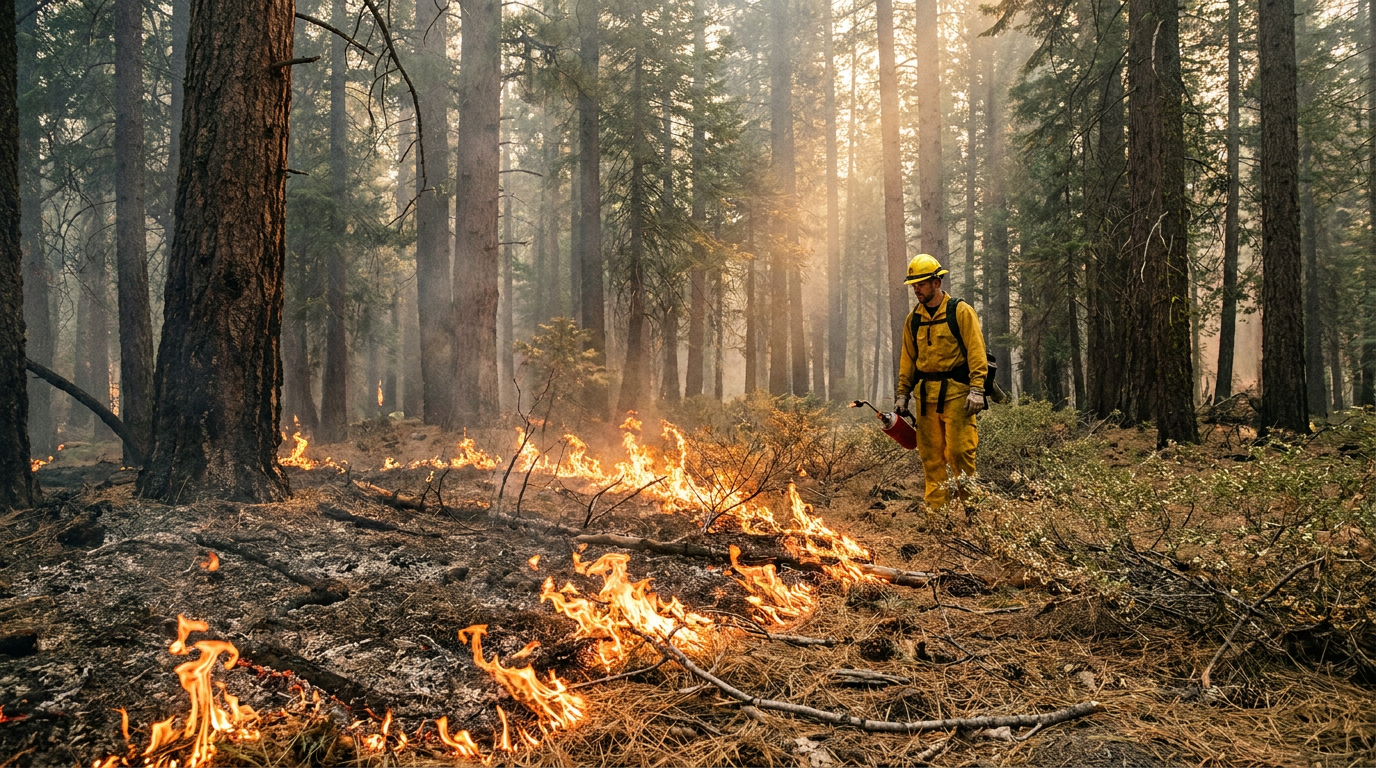
To breathe cleaner air in the future, communities must first be willing to light their surrounding forests on fire. For decades, the public health consensus has been to avoid smoke inhalation at all costs, leading residents and local regulators to fiercely oppose the use of prescribed burns near populated areas.
But a century of aggressive fire suppression has turned the American West into a tinderbox. The resulting mega-fires are now generating massive plumes of fine particulate matter, known as PM2.5, which are actively reversing decades of air quality improvements achieved under the Clean Air Act.[5]
The debate over forest management has always hinged on a high-stakes mathematical question: does the intentional smoke from a controlled burn actually prevent a greater volume of toxic smoke later? A landmark study published this week in the journal Science, and highlighted by Nature, provides the first causal quantification of this trade-off.[1][2]

The verdict is definitive: the long-term air quality benefits of low-severity fires overwhelmingly outweigh their immediate pollution costs. Researchers from Stanford University utilized two decades of high-resolution, satellite-derived measurements across California to track both fire severity and the resulting smoke plumes, creating a massive dataset of how particulate matter travels and lingers.[1][4]
By employing a statistical technique known as a synthetic control method, the team compared areas that experienced low-severity fires—serving as a real-world proxy for prescribed burns—against mathematically identical landscapes that remained completely unburned.[1]
The primary finding is stark. A location treated with low-severity fire sees an immediate 92 percent reduction in the probability of a very-high-severity wildfire occurring in that exact spot.[1][3]
This protective shield is not a fleeting phenomenon. The data reveals that the reduced risk of catastrophic fire persists for up to a decade. Furthermore, the benefit radiates outward, measurably lowering severe fire risk for up to five kilometers from the treated boundary.[1]

The data reveals that the reduced risk of catastrophic fire persists for up to a decade.
But the core of the analysis addresses the "smoke trade-off." When land managers conduct a prescribed burn, they intentionally release PM2.5 into the atmosphere. These microscopic particles can penetrate deep into the lungs and enter the bloodstream, triggering asthma, heart attacks, and long-term cognitive decline.[5]
Despite this initial pollution, the researchers calculated that the smoke avoided by preventing future mega-fires far exceeds the smoke generated during the controlled treatment. After a decade, the benefit-to-cost ratio of smoke reduction exceeds six-to-one.[1]
The American Association for the Advancement of Science summarized the findings bluntly, noting that the smoke particulate pollution produced by these less severe fires is entirely eclipsed by the massive reductions in future smoke from catastrophic wildfires.[3]
To understand the broader policy implications, the researchers modeled a massive scaling of prescribed fire. If California were to sustain a treatment rate of 500,000 acres annually for ten years, the state would see cumulative PM2.5 smoke concentrations drop by roughly 10 to 23 percent by the end of the period.[1]
Achieving this scale, however, presents monumental logistical and social challenges. State environmental agencies tightly regulate when burns can occur to protect vulnerable populations from immediate smoke exposure, requiring extensive permitting and community coordination.[6][7]

Finding the necessary "burn windows"—days with the precise humidity, wind speed, and atmospheric mixing required to safely carry smoke away from population centers—is becoming increasingly difficult as climate change narrows the safe seasons for controlled fire.[7]
Furthermore, the study notes a crucial ecological caveat: the profound protective benefits measured are most impactful in conifer forests. The evidence for similar protective effects in other dominant California landscapes, such as highly flammable chaparral or grasslands, remains mixed.[1]
Ultimately, the data forces a difficult public health reckoning. Regulators and residents can no longer choose between a future with smoke or without it. The mathematical reality dictates a choice between the mild, predictable smoke of a winter prescribed burn, or the toxic, uncontrolled plumes of a summer mega-fire.[7]
How we got here
1970s - 1990s
Federal and state agencies enforce strict fire suppression policies, leading to a massive buildup of hazardous fuels in Western forests.
2020
California experiences its worst wildfire season on record, with mega-fires erasing decades of air quality gains.
2022
The U.S. Forest Service launches a 10-year strategy to dramatically increase fuels and forest health treatments, including prescribed burns.
June 2026
Researchers publish a landmark study in Science causally proving that the long-term smoke reductions of prescribed burns outweigh the initial pollution costs 6-to-1.
Viewpoints in depth
Public Health & Climate Scientists
Focus on the net reduction of PM2.5 exposure over decades.
For epidemiologists and atmospheric scientists, the math is now undeniable. Wildfire smoke is uniquely toxic, often containing higher concentrations of oxidized organic compounds than urban smog. By intentionally introducing small amounts of smoke during favorable weather conditions—when atmospheric mixing pushes the plume away from vulnerable populations—scientists argue we can prevent the massive, uncontrolled smoke waves that blanket entire continents during the summer.
Forest Management Agencies
Focus on the operational feasibility and funding required to scale treatments.
Agencies like Cal Fire and the U.S. Forest Service view these findings as vital validation for their shifting strategies. However, they emphasize the immense logistical hurdles of scaling up. Treating 500,000 to 1 million acres annually requires not just funding, but a massive expansion of the wildland firefighting workforce. Furthermore, managers are constrained by narrow 'burn windows'—days where wind, humidity, and temperature align to make a controlled burn safe.
Local Communities & Clean Air Advocates
Concerned about the immediate, localized health impacts of prescribed burn smoke.
While the long-term math favors prescribed burns, local residents and some clean air advocates point out that the 'initial cost' is borne by specific communities. A prescribed burn still introduces PM2.5 into local valleys, affecting asthmatics, children, and the elderly in the immediate vicinity. These groups argue that if agencies are going to increase prescribed burning, they must simultaneously provide robust support—such as subsidized HEPA filters and clean-air shelters—for the communities forced to breathe the preventative smoke.
What we don't know
- Whether the 6-to-1 benefit-cost ratio holds true in non-conifer ecosystems, such as the highly flammable chaparral shrublands of Southern California.
- How climate change and increasingly extreme summer heatwaves might shorten the 10-year protective window provided by a prescribed burn.
- Whether state and federal agencies can secure the sustained funding and workforce required to hit the 500,000-acre annual treatment target.
Key terms
- Prescribed Burn
- A planned, controlled fire intentionally set by land managers to reduce hazardous fuel loads and restore ecosystem health.
- PM2.5
- Fine inhalable particles, with diameters that are generally 2.5 micrometers and smaller, heavily present in wildfire smoke.
- Low-Severity Fire
- A fire that burns close to the ground, consuming surface fuels like dead leaves and small branches without killing mature trees.
- Synthetic Control Method
- A statistical technique used to evaluate the effect of an intervention by comparing the treated area to a mathematically weighted combination of untreated areas.
Frequently asked
Doesn't a prescribed burn just create more smoke for local residents?
It does create immediate, localized smoke. However, the study proves this initial pollution is far less severe than the massive, toxic smoke plumes generated when untreated forests catch fire during peak summer heat.
How long does a forest stay protected after a controlled burn?
The data shows a 92 percent drop in severe wildfire risk immediately following a low-severity fire, with protective benefits lasting up to a decade.
Does this strategy work in all types of environments?
The strongest benefits were measured in conifer forests. Evidence for protective effects in other landscapes, such as grasslands or chaparral, remains mixed and requires further study.
What is PM2.5 and why is it dangerous?
PM2.5 refers to fine particulate matter 2.5 micrometers or smaller. These microscopic particles can penetrate deep into the lungs and enter the bloodstream, triggering asthma, heart attacks, and other severe health issues.
Sources
Source coverage
7 outlets
3 viewpoints surfaced







[1]SciencePublic Health & Climate Scientists
The air pollution benefits of low-severity fire
Read on Science →[2]NaturePublic Health & Climate Scientists
Fiery data hint that controlled forest fires benefit human health
Read on Nature →[3]AAASPublic Health & Climate Scientists
Low-severity fires can save on smoke pollution over decades
Read on AAAS →[4]Stanford UniversityPublic Health & Climate Scientists
Research: The air pollution benefits of low severity fire
Read on Stanford University →[5]U.S. Environmental Protection AgencyClean Air Regulators
Particulate Matter (PM) Pollution
Read on U.S. Environmental Protection Agency →[6]California Air Resources BoardClean Air Regulators
Prescribed Burning and Smoke Management
Read on California Air Resources Board →[7]Factlen Editorial TeamForest Management Agencies
Synthesis by Factlen editorial team
Read on Factlen Editorial Team →
Every angle. Every day.
Get science stories with full source coverage and perspective breakdowns delivered to your inbox.