
The Universe is Humming: How Dead Stars Revealed the Gravitational Wave Background
By turning the Milky Way into a galaxy-sized detector, astronomers have discovered a constant, low-frequency hum of gravitational waves rippling through spacetime.
By Mateo Ramos

In short
- Astronomers have found evidence of a 'gravitational wave background'—a constant hum of low-frequency spacetime ripples.
- The discovery was made using a Pulsar Timing Array, which monitors the highly precise radio flashes of dead stars.
- The waves stretch and squeeze the space between Earth and the pulsars, altering the arrival times of their pulses by billionths of a second.
The universe is not silent. It hums with a low-frequency vibration that continuously stretches and squeezes the very fabric of spacetime. For decades, scientists suspected that this ambient cosmic noise existed, but proving it required an instrument far larger than anything humanity could ever build on Earth.[1]
This phenomenon is known as the gravitational wave background. It is a cosmic symphony played at a pitch so low that a single wave takes years, or even decades, to pass completely through our solar system. Detecting it meant finding a way to measure the microscopic flexing of space over distances spanning thousands of light-years.[2]
Albert Einstein first predicted gravitational waves in 1916 as a natural consequence of his general theory of relativity, though he believed they would be too faint to ever detect. A century later, the Laser Interferometer Gravitational-Wave Observatory (LIGO) proved him wrong by catching the fleeting, high-frequency chirp of two stellar-mass black holes colliding in a fraction of a second.[5]
But LIGO's laser arms, stretching just four kilometers across the Earth's surface, are far too small to catch the deepest bass notes of the cosmos. To detect nanohertz-frequency waves—where the crests are separated by two to ten light-years—astronomers realized they needed a detector the size of a galaxy.[3]
Enter the Pulsar Timing Array. Instead of building physical mirrors and lasers, scientists turned to the dead, spinning cores of massive stars known as millisecond pulsars. These ultra-dense remnants act as the universe's most precise natural metronomes.[5]
Pulsars are cosmic lighthouses. As they spin hundreds of times per second, they sweep intense beams of radio waves across the cosmos. When these beams wash over Earth, radio telescopes record them as a series of highly regular "ticks" that rival the stability of the best atomic clocks.[3]
By monitoring a vast network of these dead stars—including 68 specific pulsars tracked by the North American Nanohertz Observatory for Gravitational Waves (NANOGrav)—astronomers effectively transformed our region of the Milky Way into a colossal, multi-armed sensor.
The premise is elegantly simple but painstakingly difficult to execute. If a massive gravitational wave rolls through the galaxy, it physically warps the space between Earth and the pulsars. This spatial distortion forces the radio pulses to travel slightly different distances.[2][5]
As spacetime stretches, the pulsar's rhythmic flashes arrive a few hundred billionths of a second late. As spacetime squeezes, the pulses arrive a fraction of a second early. By tracking these minuscule deviations over years, astronomers can map the invisible waves passing through our neighborhood.[3]
However, a single pulsar's timing deviation isn't enough to prove a gravitational wave passed by. The interstellar medium, solar wind, or intrinsic "glitches" within the star itself can cause similar delays. The definitive proof requires finding a specific spatial correlation across the entire sky.[2][4]
This smoking gun is known as the Hellings-Downs curve. It dictates exactly how the timing delays between any two pulsars should relate based solely on their angular separation in the sky. No known source of local noise can mimic this precise geometric pattern.[2]
After 15 years of meticulously collecting data using some of the world's largest radio telescopes—including the Green Bank Telescope and the Very Large Array—the NANOGrav collaboration, alongside international partners in Europe, India, China, and Australia, finally found this exact pattern hidden in the noise.
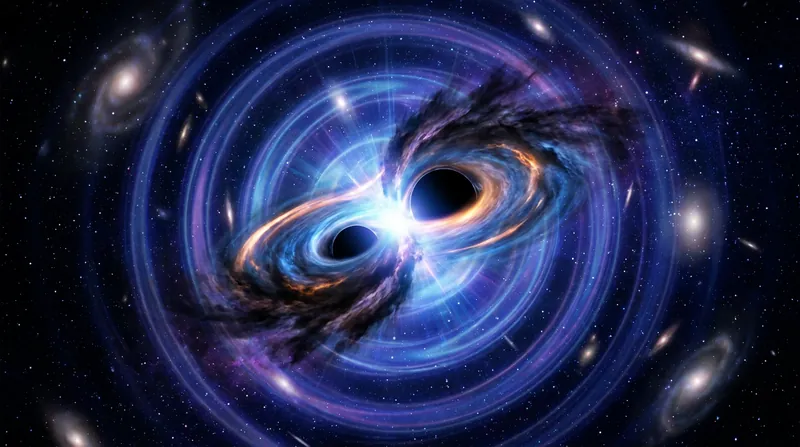
What is generating this gargantuan cosmic hum? The primary suspects are the most terrifying and massive objects in the universe: supermassive black hole binaries. These are pairs of black holes that weigh millions or even billions of times more than our Sun.[4]
At the heart of nearly every large galaxy lies a supermassive black hole. When two galaxies collide and merge—a common occurrence in the cosmic web—their central black holes eventually sink to the center of the newly formed galaxy.[2][3]
There, they enter a deadly orbital dance. As they spiral inward over millions of years, they churn the spacetime around them, radiating immense gravitational waves outward into the void long before they actually collide.[3][5]
Because there are hundreds of thousands of these colossal binaries slowly merging throughout the cosmos at any given moment, their individual waves overlap and combine, washing over the Earth from all directions simultaneously.[2][4]
The result is a stochastic background—a chaotic, overlapping sea of spacetime ripples. It is much like the ambient roar of a crowded room where many conversations are happening at once, making it impossible to distinguish a single voice.[1][3]
Yet, while supermassive black holes are the most likely source, the signal could also contain whispers of even more exotic physics that cosmologists have theorized about for decades.[2][4]
Theorists suggest the hum might include primordial gravitational waves left over from the rapid expansion of the universe fractions of a second after the Big Bang, or the snapping of hypothetical "cosmic strings"—defects in the fabric of the universe itself.[2][4]
Opening this nanohertz window into the gravitational universe marks a historic milestone in astronomy. We are no longer just looking at the cosmos through the electromagnetic spectrum; we are finally equipped to listen to its deepest, most ancient rhythms.[1]
Terms to know
- Gravitational waves
- Ripples in the fabric of spacetime caused by the acceleration of massive objects, traveling at the speed of light.
- Pulsar
- A highly magnetized, rapidly rotating neutron star that emits beams of electromagnetic radiation, appearing to pulse as it spins.
- Pulsar Timing Array
- A network of monitored pulsars across the galaxy used collectively as a giant gravitational wave detector.
- Hellings-Downs correlation
- The specific mathematical pattern of timing delays across the sky that proves the presence of a gravitational wave background.
- Supermassive black hole
- A black hole containing millions to billions of solar masses, typically found at the center of a galaxy.
Questions readers ask
Can we feel these gravitational waves on Earth?
No. The stretching and squeezing of spacetime is incredibly minuscule—altering the distance between Earth and a pulsar by only a few meters over thousands of light-years.
How is this different from what LIGO detected?
LIGO detects high-frequency waves from small black holes merging over a fraction of a second. Pulsar timing arrays detect ultra-low-frequency waves from supermassive black holes that take years to complete a single cycle.
Will this help us find specific black holes?
Currently, the signal is a blended 'background hum' of many sources. As the arrays gather more data, astronomers hope to eventually isolate the signal of individual supermassive black hole pairs.
Different angles
Pulsar Astronomers
Focus on the extreme precision of millisecond pulsars as instruments and the decades-long challenge of isolating the signal.
For the astronomers operating the radio telescopes, the triumph lies in the sheer precision of the measurement. Millisecond pulsars are incredibly stable, but the signals they emit must travel through thousands of light-years of interstellar plasma, which can delay the radio waves. Furthermore, the Earth itself is moving, and the solar wind fluctuates. Stripping away all of these local noise sources to find a timing deviation of a few hundred billionths of a second required 15 years of relentless observation and the development of entirely new statistical models to prove the Hellings-Downs correlation was real.
Cosmologists
View the discovery as a tool to understand galaxy evolution and the behavior of supermassive black holes.
Cosmologists see the gravitational wave background as a fossil record of galactic evolution. The amplitude and shape of the hum tell them how often galaxies merge and how efficiently their central supermassive black holes find each other. Before this discovery, there was a theoretical concern known as the 'final parsec problem'—a hypothesis that supermassive black holes might stall and never actually merge. The strength of the detected background suggests that nature easily overcomes this hurdle, meaning black hole mergers are a robust and frequent feature of the universe.
Alternative Physics Theorists
Investigate whether the background hum contains signatures of exotic physics, such as cosmic strings.
While supermassive black holes are the most conventional explanation, theoretical physicists are eager to see if the signal hides more exotic phenomena. The gravitational wave background could contain primordial waves generated by the exponential expansion of the universe just fractions of a second after the Big Bang. Alternatively, it might feature the signature of 'cosmic strings'—hypothetical one-dimensional defects in the fabric of spacetime that vibrate and snap, releasing massive amounts of gravitational energy. As the arrays collect more data, theorists hope to tease apart these different frequencies.
- Pulsar Astronomers
- Focus on the extreme precision of millisecond pulsars as instruments and the decades-long challenge of filtering out interstellar noise to isolate the signal.
- Cosmologists
- View the discovery as a tool to understand galaxy evolution, the frequency of galactic mergers, and the behavior of supermassive black holes.
- Alternative Physics Theorists
- Investigate whether the background hum contains signatures of exotic physics, such as cosmic strings or primordial waves from the Big Bang.
Perspectives this story doesn't cover
- Radio telescope engineers
- Optical astronomers studying galaxy mergers
Sources
Source coverage
5 outlets
3 viewpoints surfaced





- [1]Factlen Editorial TeamCosmologists
Synthesis by Factlen editorial team
Read on Factlen Editorial Team → - [2]arXivAlternative Physics Theorists
The NanoHertz Gravitational Wave Landscape
Read on arXiv → - [3]AstrobitesPulsar Astronomers
The NANOGrav 15-year Data Set: Evidence for a Gravitational-Wave Background
Read on Astrobites → - [4]MDPIAlternative Physics Theorists
Pulsar Timing Arrays and the Gravitational-Wave Background
Read on MDPI → - [5]WikipediaCosmologists
Pulsar timing array
Read on Wikipedia →
More in Science
See all →Exoplanet Habitability
First-Ever Detection of Magnetic Field on Exoplanet Opens New Window to Habitability
8 sources
Time-Domain Astronomy
World's Largest Digital Camera Begins 10-Year Survey to Map the Dynamic Universe
5 sources
Dark Matter
Gravitational Wave Signal May Hold First Imprint of Dark Matter's Halo Around Black Holes
2 sources
Black Hole Physics
Gravitational Waves Reveal First 'Fingerprints' of a Black Hole's Event Horizon, Probing the 'Point of No Return'
5 sources
Comments
Every angle. Every day.
Get Science stories with full source coverage and perspective breakdowns, free every day.