
full timeline
China–Pakistan space cooperation
China has named the three-person crew for its upcoming Shenzhou 24 mission, including Pakistan's Muhammad Zeeshan Ali.
Follow China–Pakistan space cooperation in the Factlen app and get an alert when there is news. Get the app
Share this story
Latest report
China Unveils Shenzhou 24 Crew Featuring First Pakistani Astronaut to Visit Tiangong Station
China has named the three-person crew for its upcoming Shenzhou 24 mission, including Pakistan's Muhammad Zeeshan Ali. The launch marks the first time a foreign astronaut will board the Tiangong space station.
- The Shenzhou 24 mission will launch on November 25, carrying two Chinese astronauts and one Pakistani payload specialist.
- Muhammad Zeeshan Ali will become the first foreign astronaut to visit China's Tiangong space station during his one-week stay.
- Mission commander Tang Hongbo will become the first Chinese astronaut to visit the orbital outpost three times.
- Zhu Yangzhu from the Shenzhou 23 crew will remain aboard the station to complete China's first year-long orbital mission.
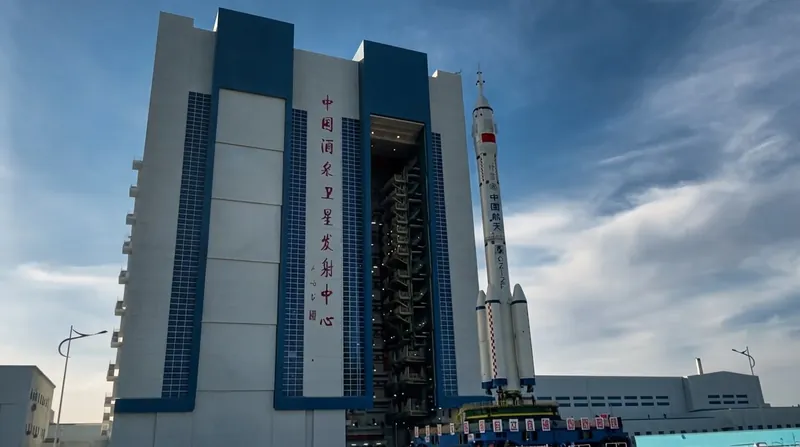
China's space agency has officially named the crew for the Shenzhou 24 mission, marking a historic milestone for its orbital program and its international partnerships. When the Long March 2F rocket lifts off from the Jiuquan Satellite Launch Center on November 25, 2026, it will carry the first foreign astronaut to the Tiangong space station, inaugurating a new era of multinational cooperation in low Earth orbit.[1][2]
The three-person team includes mission commander Tang Hongbo, flight engineer Wu Yi, and payload specialist Muhammad Zeeshan Ali of Pakistan. The announcement, made one day before the scheduled 8:18 a.m. Beijing Time launch, fulfills a bilateral space cooperation agreement signed between the two nations in February 2025, which aimed to integrate international researchers into China's operational space infrastructure.[1][5]
For commander Tang Hongbo, 51, the flight represents a personal milestone in China's rapidly advancing space program. Having previously flown on the Shenzhou 12 mission in 2021 and the Shenzhou 17 mission in 2023, Tang will become the first Chinese astronaut to visit the Tiangong outpost three times, bringing unparalleled operational experience to the multinational crew.[2][5]
Joining Tang is 39-year-old flight engineer Wu Yi, a member of China's third cohort of astronauts selected specifically for the station's operational phase. Wu will be making his maiden voyage to space, tasked with monitoring the spacecraft's vital systems and maintaining the station's core modules during the planned 180-day orbital rotation.[2][5]
Muhammad Zeeshan Ali, a 40-year-old former pilot in the Pakistan Air Force, serves as the mission's payload specialist. His inclusion makes him the first Pakistani citizen to reach space and the first international partner to participate in a Chinese crewed spaceflight, a role that required passing rigorous physical and psychological evaluations over the past two years.[2][3]
"I want to assure you that I am not flying for myself," Ali told reporters during a press conference at the launch center, speaking fluidly in a mix of Urdu, Mandarin, and English. "I carry the name of Pakistan on my shoulders, the hopes of 250 million Pakistanis who have dreamed of seeing our flag in orbit."[2][3]
Scientific Objectives in Orbit
Unlike his Chinese crewmates who will remain aboard Tiangong for six months, Ali is scheduled for a highly focused short-term visit. He will spend approximately one week on the station conducting his research before returning to Earth aboard the docked Shenzhou 23 spacecraft alongside two returning astronauts.[3][5]
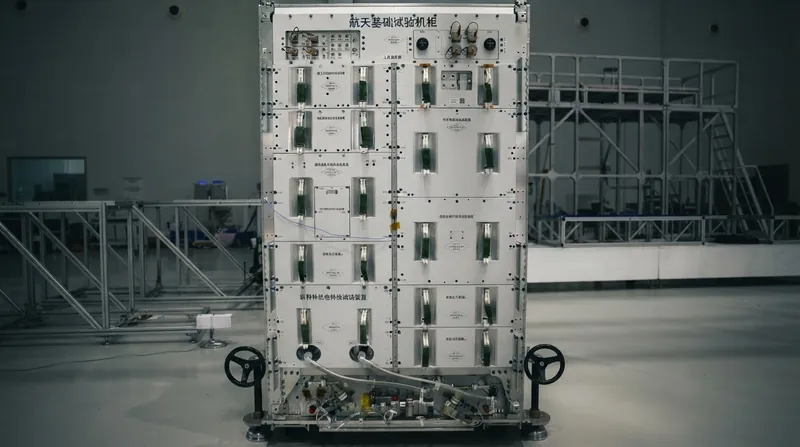
During his orbital stay, Ali will focus on four specific scientific projects designed to leverage the unique microgravity environment of the Tiangong station. State media reports indicate his primary responsibilities involve advanced biotechnology research and a specialized in-orbit experiment studying the behavior of photosynthetic microorganisms.[1][2]
The photosynthetic experiments aim to understand how specific microorganisms convert light into energy outside Earth's protective atmosphere. These findings could prove crucial for developing sustainable, closed-loop life-support systems that rely on biological processes to generate oxygen and food for long-duration space travel.[1][4]
Integrating a foreign astronaut into the Chinese space program required significant adjustments to standard operational procedures. Because the Tiangong station's labels, software interfaces, and operating instructions are entirely in Chinese, Ali underwent intensive language immersion and technical training alongside his crewmates over the past year.[2][3]
Commander Tang acknowledged the unique hurdles of preparing for the joint mission, pointing to differences in language, cultural background, and psychological approaches to problem-solving. "The Pakistani astronaut began training with virtually no foundation of the language," Tang said, noting that he and Wu also increased their English proficiency to ensure seamless communication during critical maneuvers.[2]
Expanding Tiangong's Reach
The arrival of Shenzhou 24 will initiate a complex crew handover with the current occupants of the Tiangong station. Two members of the Shenzhou 23 crew, including Hong Kong astronaut Lai Ka-ying, will conclude their six-month rotation and return to Earth with Ali, demonstrating the station's capacity to manage overlapping crew schedules.[3][5]
The handover also sets the stage for a new endurance record within the Chinese space program. Zhu Yangzhu, the third member of the Shenzhou 23 crew, will remain aboard the station alongside Tang and Wu to complete China's first year-long stay in orbit, effectively doubling the standard mission duration.[3][5]
Zhu's extended mission is designed to gather critical medical data on how the human cardiovascular and musculoskeletal systems adapt to prolonged exposure to microgravity. Researchers will use this physiological information to prepare for future deep-space endeavors, including China's planned crewed lunar landings targeted for 2030.[3][5]
Ali's flight represents a strategic shift in how China utilizes its completed orbital outpost. By opening Tiangong to foreign researchers and payload specialists, Beijing is actively positioning its station as a viable alternative to the International Space Station, which is slated for retirement and deorbiting around 2030.[2][4]
The China Manned Space Agency has repeatedly stated its intention to host astronauts from other nations, particularly those from developing countries without independent launch capabilities. The successful execution of Ali's mission serves as a vital proof of concept for international training protocols, hardware compatibility, and orbital integration.[1][4]
A Broader Space Partnership
Pakistani officials celebrated the crew announcement as a major diplomatic and scientific achievement, coinciding with the 75th anniversary of bilateral cooperation between Islamabad and Beijing. The joint flight underscores the deepening technological ties between the two nations, expanding their partnership under the Belt and Road Initiative into the aerospace sector.[2][4]
Pakistan's national space agency, SUPARCO, collaborated closely with Chinese counterparts to select, evaluate, and prepare Ali for the historic mission. The partnership provides Pakistan with direct access to crewed spaceflight capabilities and orbital laboratories without the prohibitive financial costs of developing an independent rocket and capsule infrastructure.[3][5]
The Shenzhou 24 mission is widely viewed as a foundational step for broader collaborative projects between the two space agencies. Both nations have expressed strong interest in expanding their partnership beyond low Earth orbit, potentially including joint lunar exploration initiatives and deep-space scientific missions in the coming decades.[2][4]
Ali emphasized that his week-long stay on Tiangong is just the beginning of a larger trajectory for his country's space ambitions. "This mission is not a finish line," he told the press, expressing hope that future cooperation would evolve from single-astronaut flights to multiple joint missions to the Moon, Mars, and beyond.[2]
Addressing the younger generation in his home country, the payload specialist offered a poignant message of encouragement before his departure. "To every child who is watching while I'm in orbit, just look up at the sky and remember that I am up there with your dreams," Ali said.[2][3]
At the Jiuquan Satellite Launch Center, engineers have completed final system checks on the Long March 2F rocket and the Shenzhou capsule. Propellant loading is scheduled to begin shortly before the Wednesday morning liftoff, marking the 41st flight of China's crewed space program and a new chapter in its operational history.[1][4]
As the Shenzhou 24 crew prepares for launch, the mission establishes a clear precedent for international access to the Tiangong station. The successful integration of a foreign payload specialist demonstrates the facility's operational maturity as it fully enters its application and development phase, ready to host a diverse global scientific community.[1][4]
Sources
- [1]Xinhua — China unveils Shenzhou-24 crew for space station mission, including first foreign astronaut Read on Xinhua →
- [2]Associated Press — China unveils new space mission crew, with a Pakistani astronaut set to board its space station Read on Associated Press →
- [3]South China Morning Post — 'The hope of 250 million': China's space station to welcome Pakistani astronaut Read on South China Morning Post →
- [4]Phys.org — China unveils new space mission crew, with a Pakistani astronaut set to board its space station Read on Phys.org →
- [5]Wikipedia — Shenzhou 24 Read on Wikipedia →
What to watch
- The flight is scheduled to launch on November 25.
- Zhu Yangzhu is set to complete China's first year-long orbital mission.
- A planned Pakistani lunar rover is scheduled for 2028.
Charts, maps and images
Timeline
November 2026
China Unveils Shenzhou 24 Crew Featuring First Pakistani Astronaut to Visit Tiangong Station
Pakistani Astronaut Selected for China's Shenzhou 24 Space Station Mission
How the story developed
The space partnership between Islamabad and Beijing expanded to include crewed spaceflight cooperation. To prepare for the joint endeavor, two Pakistani pilots traveled to China.
In Beijing, the pilots completed intensive centrifuge and language training. This preparation was required to qualify a candidate for the Tiangong space station.
On November 7, it was established that a Pakistani astronaut would join the Shenzhou 24 mission. This marked a major milestone, representing the first time a foreign national would visit the Chinese station.
The crewed flight represents one facet of a broader bilateral space partnership between the two nations.