
Physicists Successfully Recreate Black Hole Energy Extraction in a Laboratory
More than 50 years after Roger Penrose theorized that energy could be harvested from a rotating black hole, scientists have successfully demonstrated the mechanism using a laboratory analogue.
By Logan Price

Share this story
In short
- Physicists have successfully demonstrated the Penrose process, a method for extracting energy from a black hole, in a laboratory.
- The experiment used twisted laser light and nonlinear optical crystals to create a synthetic analogue of a black hole's rotating ergosphere.
- Light waves fired into the synthetic vortex emerged with 20% more energy, proving the 1969 theory correct.
For decades, black holes have been viewed as the universe's ultimate one-way streets—cosmic trapdoors from which nothing, not even light, can escape. But in 1969, British mathematical physicist Roger Penrose proposed a radical loophole. He theorized that if a black hole is rotating, it might be possible to steal some of its rotational energy.
This concept, known as the Penrose process, suggested that an advanced civilization could theoretically drop an object into the black hole's outer halo, split it in two, and retrieve one half with more energy than the original object possessed. The extra energy would be siphoned directly from the black hole's spin.[1][4]
The mathematics behind Penrose's theory were sound, eventually contributing to his 2020 Nobel Prize in Physics. However, testing the theory seemed impossible. The nearest rotating black hole is thousands of light-years away, and the engineering required to build a megastructure around one belongs firmly to the realm of science fiction. For a long time, the Penrose process remained a brilliant but untestable mathematical curiosity, confined to chalkboards and theoretical astrophysics papers.[4]
That paradigm has now shifted. A team of physicists has successfully demonstrated the exact mechanics of the Penrose process in a laboratory setting, using a highly advanced optical analogue. By creating a synthetic "ergosphere"—the region of twisted spacetime surrounding a rotating black hole—using nonlinear optical crystals and twisted laser light, researchers were able to observe the precise energy amplification Penrose predicted 57 years ago.[2]
To understand how this works, one must look at the anatomy of a rotating black hole. Unlike a stationary black hole, a spinning one drags the very fabric of spacetime along with it, creating a swirling vortex known as the ergosphere. Inside this region, space is moving faster than the speed of light. An object entering the ergosphere is forced to rotate with the black hole, regardless of how much energy it expends trying to stay still.[1][4]
Penrose realized that if a particle enters this chaotic region and splits into two, the laws of physics allow for a bizarre accounting trick. One piece can be forced into a trajectory that gives it "negative energy" relative to the outside universe.
When this negative-energy piece falls past the event horizon and is consumed, the black hole effectively swallows a deficit. To balance the cosmic ledger, the surviving half of the particle is violently ejected outward, carrying away the original energy plus a stolen portion of the black hole's rotational mass.[4]
Translating this astrophysical violence into a tabletop experiment required a conceptual leap first proposed in 1971 by Soviet physicist Yakov Zel'dovich. He suggested that the Penrose process wasn't exclusively about gravity. Instead, it was a fundamental property of waves interacting with rotating bodies. Zel'dovich theorized that if twisted light or sound waves were fired at a rapidly spinning cylinder, they would bounce off with more energy than they arrived with, provided the cylinder was spinning fast enough to trigger a specific rotational Doppler shift.[1]
Zel'dovich's idea, known as rotational superradiance, was brilliant but technologically out of reach in the 1970s. The cylinder would need to rotate billions of times per second to amplify light waves, a speed that would instantly tear any known material apart. As a result, the theory languished for decades, waiting for technology to catch up with the mathematics.
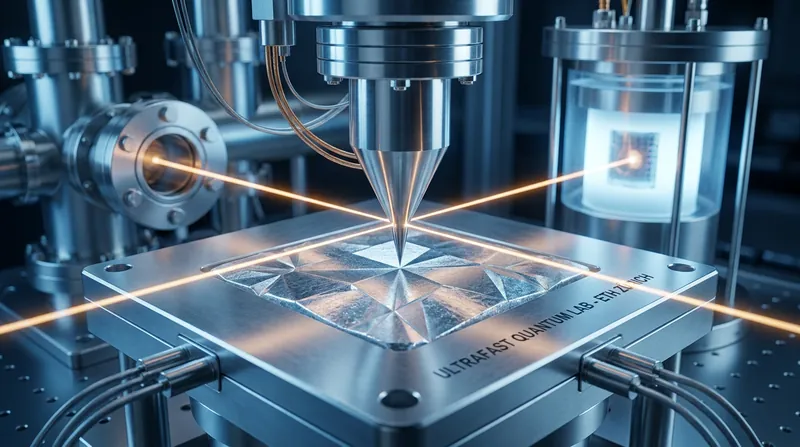
The breakthrough arrived when researchers stopped trying to spin a physical object and instead spun the optical properties of a material. In the new experiment, physicists utilized a nonlinear optical medium—a specialized crystal whose refractive index can be rapidly altered by intense laser pulses. By firing a sequence of precisely timed, circular laser pulses into the crystal, they created a rotating "effective spacetime" that mimicked the dragging effect of a black hole's ergosphere.[2]
Into this synthetic vortex, the team fired a probe beam of twisted light—photons carrying orbital angular momentum. As the probe beam entered the rotating optical field, it interacted with the synthetic spacetime. A portion of the wave's energy was absorbed into the "negative energy" state of the rotating medium, while the rest was reflected back toward the detectors.[2][3]
The results were unmistakable. The reflected light waves emerged with approximately 20 percent more energy than they had when they entered the crystal. The synthetic black hole had been forced to give up a portion of its rotational energy to the escaping light, perfectly mirroring the mathematics of the Penrose process. The researchers had successfully harvested energy from a laboratory analogue of curved spacetime.[2]
This optical demonstration builds upon earlier, slower-moving analogues. In 2020, a different team successfully demonstrated Zel'dovich's theory using sound waves and a rotating ring of sound absorbers. Because sound travels much slower than light, the physical rotation speeds required were achievable. However, moving from acoustic waves to optical quantum fields marks a massive leap in precision and applicability, bringing the experiment much closer to the quantum mechanics that govern actual black holes.[1]
The implications of this experiment extend far beyond astrophysical vindication. The ability to amplify light waves by bouncing them off rotating synthetic fields opens a new frontier in metamaterials. Engineers are already theorizing how this mechanism could be used to build entirely new classes of optical amplifiers, which are crucial components in fiber-optic communications and quantum computing networks.[1][3]
Furthermore, analogue gravity experiments like this one are providing physicists with a unique sandbox to test the boundaries between general relativity and quantum mechanics. The holy grail of modern physics is a unified theory of quantum gravity, and black holes are the ultimate testing ground. By creating synthetic black holes in the lab, researchers can observe how quantum fields behave in curved spacetime without needing a telescope.
There are, of course, limitations to the analogue approach. A nonlinear crystal is not a true singularity, and it does not possess the crushing gravitational mass of a collapsed star. Theoretical astrophysicists caution that while the wave mechanics of the Penrose process have been proven, the extreme quantum gravity effects that might occur near a real event horizon remain shrouded in mystery.
Nevertheless, the successful extraction of energy from a synthetic black hole stands as a monumental achievement in experimental physics. It bridges a half-century gap between theoretical mathematics and physical reality. Roger Penrose's vision of a universe where black holes are not just cosmic destroyers, but potential engines of immense power, has finally been realized—not in the distant reaches of space, but on a laboratory table.[1][4]
Key terms
- Penrose Process
- A theoretical mechanism proposed by Roger Penrose to extract energy from the rotational momentum of a spinning black hole.
- Ergosphere
- The chaotic region of spacetime just outside a rotating black hole's event horizon, where space itself is dragged along faster than the speed of light.
- Analogue Gravity
- A branch of physics that uses laboratory systems, like fluids or optical crystals, to mimic the mathematical behavior of curved spacetime and black holes.
- Rotational Superradiance
- The phenomenon where a wave bounces off a rapidly rotating object and emerges with more energy than it started with, stealing momentum from the rotation.
Frequently asked
Could we actually power Earth with a real black hole?
No. The nearest known black hole is thousands of light-years away, making it impossible to reach, let alone build an energy-harvesting megastructure around it.
Did the scientists create a real black hole in the lab?
No. They created an 'analogue'—a system using light and crystals that perfectly mimics the mathematics of a black hole's rotation, but without the crushing gravity.
Why is this discovery useful if we can't use real black holes?
The mechanism used to amplify the waves in the lab could be adapted to build highly efficient optical amplifiers for fiber-optic internet and quantum computers.
Viewpoints in depth
Analogue Gravity Researchers
Argue that fluid and optical analogues are mathematically identical to curved spacetime for specific wave equations, making these lab tests definitive proof of the underlying physics.
For physicists working in analogue gravity, the distinction between a 'real' black hole and a laboratory optical vortex is mathematically irrelevant when it comes to wave kinematics. Because the equations governing the propagation of light in the nonlinear crystal are identical to the equations governing scalar fields in a Kerr (rotating) spacetime, the researchers argue that the lab experiment is a true physical realization of the Penrose process. They view these tabletop experiments not as mere simulations, but as genuine physical proofs of theories that would otherwise remain forever untestable.
Theoretical Astrophysicists
Emphasize that while the lab tests prove the wave mechanics, true gravitational black holes involve extreme spacetime curvature that cannot be fully captured in a crystal.
Astrophysicists celebrate the laboratory breakthrough but maintain a strict boundary between analogue systems and actual cosmology. They point out that a nonlinear crystal does not possess a true gravitational singularity, nor does it feature the extreme back-reaction of spacetime that occurs when massive objects interact with a real black hole. While the experiment perfectly validates the wave mechanics of rotational superradiance, theoretical purists argue that the ultimate mysteries of the Penrose process—particularly how it interacts with Hawking radiation and quantum gravity at the event horizon—can only be solved by observing the cosmos itself.
Metamaterial Engineers
View the Penrose process not as an astrophysical curiosity, but as a blueprint for next-generation optical amplifiers and acoustic devices.
To engineers and applied physicists, the origin of the Penrose process in black hole thermodynamics is just an interesting backstory. Their focus is entirely on the practical application of rotational superradiance. By proving that energy can be reliably extracted from a rotating synthetic field, this research provides a new mechanism for amplifying signals without traditional chemical or electrical gain mediums. Metamaterial engineers are already drafting designs for 'Penrose amplifiers' that could boost the strength of fragile quantum signals in next-generation optical computers, turning a cosmic phenomenon into a commercial technology.
- Analogue Gravity Researchers
- Argue that fluid and optical analogues are mathematically identical to curved spacetime for specific wave equations, making these lab tests definitive proof of the underlying physics.
- Theoretical Astrophysicists
- Emphasize that while the lab tests prove the wave mechanics, true gravitational black holes involve extreme spacetime curvature that cannot be fully captured in a crystal.
- Metamaterial Engineers
- View the Penrose process not as an astrophysical curiosity, but as a blueprint for next-generation optical amplifiers and acoustic devices.
Perspectives this story doesn't cover
- Science Fiction Authors
- Quantum Computing Hardware Developers
Sources
Source coverage
4 outlets
3 viewpoints surfaced




- [1]Factlen Editorial TeamMetamaterial Engineers
Synthesis by Factlen editorial team
Read on Factlen Editorial Team → - [2]Physical Review LettersAnalogue Gravity Researchers
Observation of the Optical Penrose Process in a Nonlinear Medium
Read on Physical Review Letters → - [3]arXivAnalogue Gravity Researchers
Superradiant amplification of twisted light in analogue spacetime
Read on arXiv → - [4]NobelPrize.orgTheoretical Astrophysicists
Roger Penrose - Facts and Biographical Information
Read on NobelPrize.org →
More in Science
See all →Quantum Physics
Scientists Have Connected a 'Time Crystal' to a Real Device, Unlocking a New Phase of Matter
4 sources
Stellar Physics
Einstein Probe Captures Supernova 'Shock Breakout' in Real-Time, Revealing New Stellar Death Pathway
6 sources
Quantum Materials
Quantum Entanglement Observed in Centimeter-Scale Crystal, Challenging Classical-Quantum Boundary
6 sources
Quantum Mechanics
Physicists Discover New Fundamental 'Space-Time Limit' Governing Electron Motion
8 sources
Comments
Every angle. Every day.
Get Science stories with full source coverage and perspective breakdowns, free every day.