
The Mechanics of the 2026 Esports World Cup Relocation: The Riyadh Mega-Venue vs. the Paris Olympic Model
The $75 million Esports World Cup has successfully opened in Paris after an unprecedented eight-week relocation from Riyadh, setting up a real-time test of centralized mega-campuses versus decentralized legacy infrastructure.
By Omar Haddad

- Decentralized Legacy Proponents
- Believe that utilizing existing Olympic-grade infrastructure and tapping into organic local fanbases creates a superior tournament atmosphere.
- Centralized Mega-Event Advocates
- Argue that purpose-built, unified campuses offer superior logistical control and frictionless player experiences.
- Esports Ecosystem Analysts
- Focus on the financial resilience of the event, noting that the $75 million prize pool survived the geographical pivot.
Perspectives this story doesn't cover
- Local Parisian Residents
- Visa Processing Authorities
Key points
- The 2026 Esports World Cup successfully relocated from Riyadh to Paris in just eight weeks.
- The move was prompted by regional security concerns related to the Iran War.
- The event maintained its record-breaking $75 million prize pool despite the geographical pivot.
- The relocation provides a real-time comparison between centralized mega-campuses and decentralized legacy infrastructure.
- Paris offers an organic, deeply entrenched esports fanbase but introduces complex urban logistics.
- The successful pivot proves the global esports ecosystem is highly resilient to geopolitical disruption.
The 2026 Esports World Cup opened its doors on July 6 in a city its organizers never originally planned to use. For its first two years, the massive tournament was synonymous with Riyadh, the Saudi capital that built it into the richest prize pool in competitive gaming history. This year, however, the event is unfolding across Paris, following a security-driven relocation announced just eight weeks before the opening ceremony due to regional instability stemming from the Iran War. The successful launch of the event in France marks one of the most complex logistical pivots in modern sports entertainment.[1][2][4]
The sheer scale of the relocation is staggering. Within a two-month window, organizers had to reroute flights, secure visas, and arrange accommodations for more than 2,000 players and team personnel representing 200 clubs from 100 different countries. They also had to transport the broadcast infrastructure required to run 25 distinct tournaments across 24 video game titles simultaneously. Despite the geopolitical friction, the Esports World Cup Foundation maintained its record-breaking $75 million prize pool, signaling to the industry that the financial backing of the Saudi Public Investment Fund is decoupled from the geographical requirement of hosting the event in Riyadh.[2][5]
This forced pivot sets up a real-time comparative analysis between two fundamentally different approaches to hosting a global mega-event: the centralized, purpose-built model versus the decentralized, legacy-infrastructure model. The esports industry is watching closely to see which logistical framework yields a better experience for players, broadcasters, and fans.[1][4]
The comparative analysis begins with the case for the Riyadh model, which rests on absolute centralization and frictionless logistics. Evidence for this approach is found in the 2024 and 2025 editions of the tournament, where the Saudi Esports Federation utilized a 59,900-square-meter campus at Boulevard City. This massive footprint featured four distinct, purpose-built arenas—the SEF Arena, the 5V5 Arena, the BR Arena, and the Riyadh Festival—all contained within a single, highly controlled perimeter.[4][5]
Further evidence supporting this centralized approach highlights the ease of broadcasting and player welfare. Because competitors lived, practiced, and competed within a single secure bubble, organizers eliminated transit fatigue and standardized the technical environment. Network latency, hardware specifications, and security protocols were uniform across all 25 titles, creating a frictionless pipeline for tournament administrators.[1][5]
Conversely, the argument against the centralized mega-campus points to its rigidity and immense capital requirements. The evidence here lies in the unrecoverable state capital required to build and maintain temporary mega-structures in the desert. Furthermore, while the Riyadh events drew impressive viewership, critics noted that the in-person crowds lacked the organic, decades-deep legacy of traditional Western or Asian esports hubs, giving the centralized model a slightly artificial atmosphere.[1]
Conversely, the argument against the centralized mega-campus points to its rigidity and immense capital requirements.
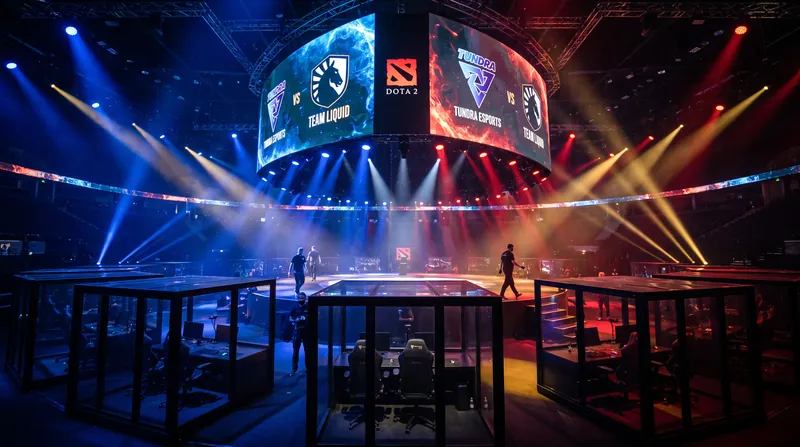
On the other side of the ledger, the case for the Paris model relies on the integration of existing, world-class legacy infrastructure. Evidence supporting this decentralized approach is visible in the 2026 tournament's utilization of the Paris Expo Porte de Versailles and the Accor Arena. By tapping into venues that were battle-tested during the 2024 Summer Olympics, the Esports World Cup bypassed the need for ground-up construction, plugging directly into a city already wired for global broadcast events.[3]
Additional evidence for the decentralized approach is found in the crowd dynamics and cultural integration. Paris offers a deeply entrenched esports fanbase. The Accor Arena, for instance, has a storied history of hosting legendary League of Legends and Valorant finals. This legacy provides an electric, organic atmosphere that cannot be manufactured, elevating the stakes of the matches through sheer crowd volume and historical resonance.[3]
However, the argument against the Paris model centers on logistical friction and fragmented operations. The evidence is seen in the complexities of navigating a sprawling European metropolis. Players, broadcast teams, and fans are dispersed across multiple hotels and transit lines, introducing variables like Parisian traffic, decentralized security protocols, and varying network infrastructures across different venues. The frictionless bubble of Riyadh has been replaced by the chaotic energy of a living city.[1]
Despite these logistical hurdles, the financial architecture of the tournament remains remarkably stable. The $75 million purse breaks down into a $30 million Club Championship pool, roughly $39 million spread across the individual game championships, and the remainder allocated to qualifiers and MVP awards. The preservation of this structure proves that the multi-game "Club" format—designed to incentivize organizations to field rosters across multiple titles—can survive outside its incubator.[5]
In synthesizing these trade-offs, the centralized, purpose-built model fits well when a host entity possesses the capital to underwrite a unified campus, prioritizing broadcast standardization and player convenience above all else. It is the ideal framework for building an industry footprint from scratch, provided the geopolitical environment remains stable.[1][4]
By contrast, the decentralized legacy model fits well when an event must pivot rapidly or seeks to tap into a deeply entrenched, organic fanbase. It leverages existing civic investments and delivers a superior in-arena atmosphere. However, it does not fit when organizers require absolute control over the transit and security environment, or when dealing with titles that demand hyper-specific, non-standard stage builds.[1][3]
Ultimately, the 2026 Esports World Cup will serve as the definitive case study for the industry. By successfully executing an eight-week pivot to Paris, the organizers have proven that competitive gaming's largest spectacle is no longer tethered to a single city, but rather to the resilience and adaptability of its underlying global infrastructure.[1][2]
Why this matters
The successful eight-week pivot of a $75 million global tournament proves the esports ecosystem is no longer fragile. It demonstrates that competitive gaming's largest spectacle can survive severe geopolitical disruption by plugging into existing Olympic-grade infrastructure.
Viewpoints in depth
Centralized Mega-Event Advocates
Argue that purpose-built, unified campuses offer superior logistical control and frictionless player experiences.
Proponents of the Riyadh model argue that modern esports requires absolute technical standardization. When 2,000 players are housed within a single 59,000-square-meter campus like Boulevard City, organizers can guarantee identical network latency, hardware specifications, and security protocols across all 25 titles. This frictionless bubble eliminates the variables of urban transit and fragmented hotel accommodations, allowing competitors to focus entirely on performance while streamlining the global broadcast pipeline.
Decentralized Legacy Proponents
Believe that utilizing existing Olympic-grade infrastructure and tapping into organic local fanbases creates a superior tournament atmosphere.
Advocates for the Paris model emphasize the intangible value of legacy and culture. By utilizing venues like the Accor Arena—which has a storied history of hosting legendary esports finals—the tournament plugs into a deeply entrenched, passionate local fanbase. This approach avoids the unrecoverable capital costs of building temporary mega-structures in the desert, proving that esports can seamlessly integrate into the existing civic infrastructure of major global metropolises, much like traditional sports.
Esports Ecosystem Analysts
Focus on the financial resilience of the event, noting that the $75 million prize pool survived the geographical pivot.
Financial analysts view the 2026 relocation as a massive stress test that the esports industry successfully passed. The fact that the Saudi Public Investment Fund maintained the record $75 million prize pool despite losing the domestic tourism benefits of hosting the event in Riyadh signals a long-term commitment to the ecosystem. This decoupling of funding from geography provides immense stability to the 200 participating clubs, proving the financial architecture of the EWC is robust enough to withstand severe geopolitical shocks.
Sources
Source coverage
5 outlets
3 viewpoints surfaced





- [1]Factlen Editorial TeamEsports Ecosystem Analysts
Synthesis by Factlen editorial team
Read on Factlen Editorial Team → - [2]Esports World Cup FoundationCentralized Mega-Event Advocates
EWC 2026: Paris Hosts the World's Largest Esports Tournament
Read on Esports World Cup Foundation → - [3]Paris Convention BureauDecentralized Legacy Proponents
Iconic venues for your sports or esports event in Paris
Read on Paris Convention Bureau → - [4]Red Bull EsportsEsports Ecosystem Analysts
From Gamers8 to Paris: The Evolution of the Esports World Cup
Read on Red Bull Esports → - [5]LiquipediaCentralized Mega-Event Advocates
Esports World Cup 2026: Format, Teams, and Prize Pool
Read on Liquipedia →
Comments

More in Gaming & Esports
See all →Esports Economics
Team Falcons Exits Dota 2, Citing Lack of Operational Sustainability
6 sources
Network Architecture
Authoritative Server vs. Peer-to-Peer: Quantifying the Trade-Off in Security, Latency, and Scalability
7 sources

Integrity Enforcement
Inside the ESIC Sanctioning Ladder: How Esports Punishes Betting Fraud
8 sources
Display Tech
QD-OLED vs. Tandem WOLED: Quantifying the 2026 Dual-Mode Monitor Trade-Off
4 sources

Every angle. Every day.
Get Gaming & Esports stories with full source coverage and perspective breakdowns delivered to your inbox.