
The Shein-Everlane Paradox: How the Ultra-Fast Fashion Giant Acquired the Face of 'Radical Transparency'
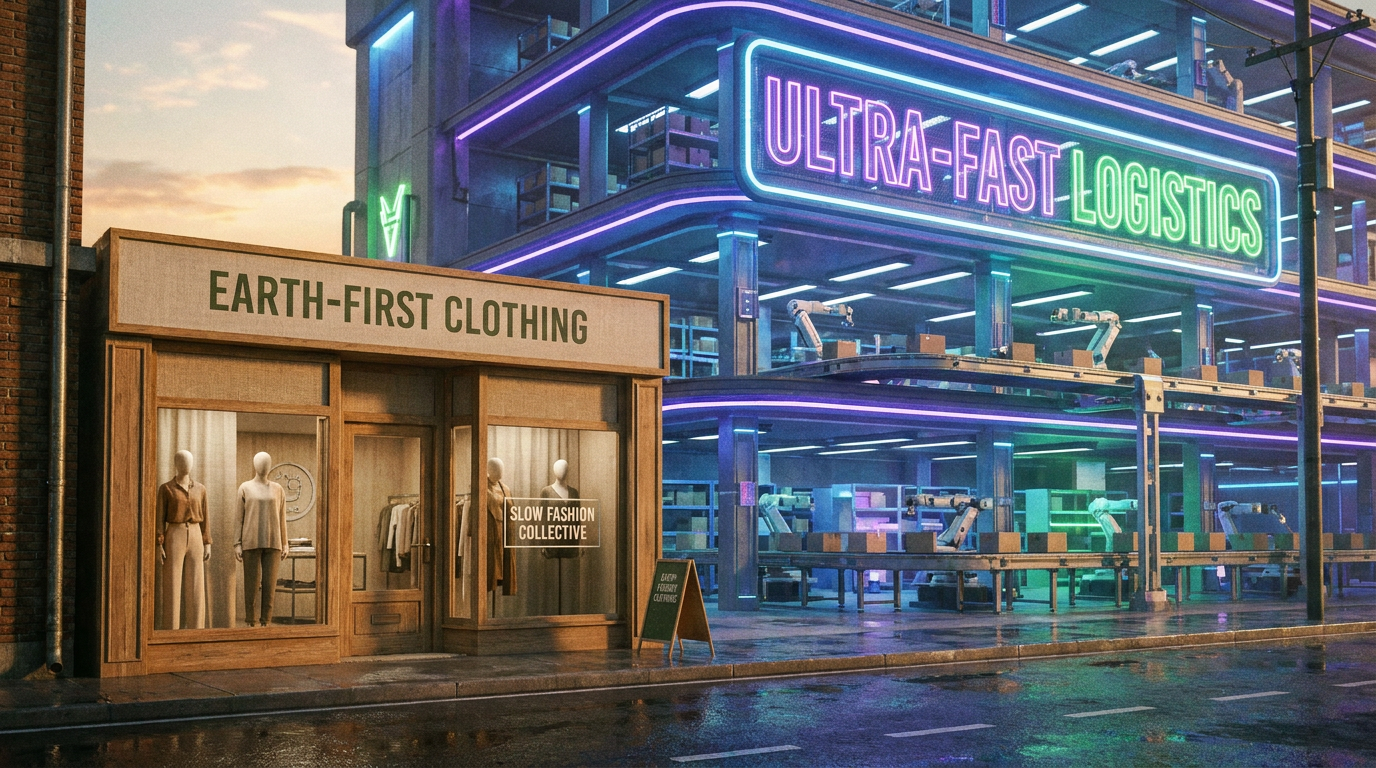
Shein's $100 million acquisition of Everlane forces eco-conscious shoppers to weigh the benefits of scaled sustainable materials against the ethics of fast-fashion conglomerates.
By Factlen Editorial Team
- Pragmatic Retail Analysts
- Industry experts who view the deal as a necessary financial rescue and a strategic win for Shein.
- Sustainable Fashion Purists
- Critics who believe the acquisition fundamentally destroys Everlane's ethical credibility.
- Brand Loyalists
- Shoppers hopeful that Everlane can maintain its quality while benefiting from Shein's efficiency.
What's not represented
- · Garment workers in Everlane's currently audited factories
- · Independent sustainable fashion founders competing with Shein
Why this matters
The acquisition of a sustainable fashion pioneer by an ultra-fast fashion giant fundamentally changes the ethical calculus of buying basics. Shoppers must now decide whether affordable eco-friendly materials are worth supporting a conglomerate heavily criticized for its labor and environmental practices.
Key points
- Shein has acquired sustainable apparel brand Everlane for approximately $100 million.
- The sale is a debt-driven exit by private equity firm L Catterton to clear Everlane's $90 million in liabilities.
- Everlane's CEO claims the brand will operate independently and maintain its 'radical transparency' standards.
- Shoppers face a trade-off between Everlane's new massive supply chain scale and the uncompromised ethics of independent labels.
- The deal highlights the financial vulnerability of mid-tier sustainable fashion brands in a tightening economy.
In a transaction that merges two diametrically opposed retail philosophies, the Chinese ultra-fast fashion giant Shein has acquired the San Francisco-based apparel brand Everlane. The deal, valued at approximately $100 million, sees Shein purchasing the majority stake from private equity firm L Catterton. For Everlane, a company that reached a peak valuation of roughly $600 million during the direct-to-consumer boom of the 2010s, the sale represents a steep financial comedown. The brand had recently struggled under the weight of $90 million in debt and a rapidly shifting retail landscape that made its independent operations unsustainable. In a message to employees, Everlane CEO Alfred Chang confirmed the acquisition, framing it as a necessary partnership that provides the stability and resources needed to maintain the brand's core operations without compromising its foundational standards.[1][2][3]
To understand the magnitude of this retail shift, one must look at the foundational ethos of Everlane. Founded in 2010 by Michael Preysman, the brand built its entire identity around the concept of "radical transparency." Everlane stood apart in a crowded apparel market by offering consumers a behind-the-scenes look at its factories, detailing the true cost of production for each garment, and championing ethically sourced materials. The company publicized regular audits of its pay and working conditions, as well as the brand's environmental impact. For years, Everlane was the darling of the sustainable fashion movement, proving that a direct-to-consumer label could offer minimalist basics to eco-minded shoppers while maintaining a highly profitable, venture-backed growth trajectory.[1][2][5]
The acquisition creates an immediate paradox by uniting this pioneer of transparency with a conglomerate frequently criticized for its opaque, high-volume manufacturing model. Shein has dominated the global apparel market through an ultra-cheap, rapid-turnaround system that environmental and labor groups have heavily scrutinized. The fast-fashion e-commerce company has faced a barrage of controversies, including allegations of unethical labor practices, hazardous chemicals in its clothing, and widespread copyright infringement. Industry analysts suggest that for Shein, absorbing Everlane offers a crucial reputational facelift and a strategic entry into the premium, eco-conscious market. It also aligns with Shein's broader strategy of acquiring distressed Western intellectual property to diversify its portfolio ahead of a potential initial public offering.[1][4][5]

The financial realities that forced Everlane into Shein's portfolio reflect a broader collapse of the direct-to-consumer fashion premium. Sales for Everlane slumped during the work-from-home pandemic era, and the company faced internal turmoil, including the layoff of hundreds of retail and customer support employees in 2020 after they attempted to unionize. As interest rates ticked up and venture-capital funds ran dry, Everlane found itself saddled with untenable liabilities. Shein's acquisition is ultimately a debt-driven exit by L Catterton, whose majority stake in Everlane came with approximately $90 million in debt. Common stockholders will reportedly not receive a payout from the sale, underscoring the severe financial distress that pushed the sustainability icon into the arms of its ideological opposite.[3][5][6]
For consumers who built their wardrobes around Everlane's ethical promises, the buyout forces a complex shopping trade-off. Shoppers must now compare the reality of purchasing from an acquired eco-brand backed by a fast-fashion giant against the alternative of seeking out remaining independent sustainable labels. Evaluating the "for" argument of sticking with Everlane under Shein's umbrella reveals distinct advantages in scale and accessibility. Shein's massive, highly efficient supply chain could theoretically lower Everlane's production costs, making sustainable materials like organic cotton and recycled polyester more affordable for the average consumer. If Shein applies its logistical prowess to Everlane's existing ethical framework, it could democratize access to higher-quality basics that were previously priced out of reach for budget-conscious shoppers.[4][5]
For consumers who built their wardrobes around Everlane's ethical promises, the buyout forces a complex shopping trade-off.
However, the "against" argument for continuing to shop at the newly acquired Everlane centers on the fundamental compromise of corporate profits. Any purchase made at Everlane now ultimately funnels revenue to Shein, enriching a parent company whose core business model relies on hyper-consumption and disposable fashion. For purists, the original concept of radical transparency is inherently diluted when the parent organization operates in the shadows of global supply chains. The evidence from Shein's previous acquisitions, including its stakes in Forever 21 and Missguided, suggests that while the front-facing brand identity may remain intact, the backend operations are inevitably integrated into Shein's broader ecosystem to maximize efficiency. This integration raises serious questions about whether Everlane can truly maintain its rigorous factory audits when its financial lifeline is tied to the king of fast fashion.[1][2][4]

On the other side of the trade-off, the "for" argument for shifting to independent sustainable labels offers uncompromised ethical alignment. Brands that remain privately held and dedicated to slow fashion can guarantee that their supply chains are free from the pressures of ultra-fast volume demands. Shoppers who choose this route are directly supporting smaller manufacturing ecosystems, ensuring that their dollars vote for fair wages and lower carbon footprints without the caveat of a conglomerate parent. The evidence supporting this choice is rooted in the original success of Everlane itself; before the pressures of venture capital and private equity debt took hold, the independent model successfully proved that consumers were hungry for honest pricing and ethical production.[3][6]
Yet, the "against" argument for relying solely on independent sustainable brands is starkly financial. As Everlane's $90 million debt and subsequent fire sale demonstrate, operating a truly transparent, eco-friendly apparel company is incredibly expensive. Independent brands must pass these high operational costs onto the consumer, resulting in premium price points that exclude a vast portion of the market. Furthermore, these smaller labels often struggle with limited sizing, slower shipping times, and lower inventory levels. The collapse of Everlane's independence serves as hard evidence that the mid-tier sustainable fashion model is highly vulnerable to economic downturns, rising interest rates, and consumers' growing preference for low prices over eco-conscious fashion in a tightening economy.[3][5][6]

When navigating this new retail landscape, the acquired eco-brand route fits well when shoppers prioritize access to sustainable materials but are strictly constrained by their budgets. If a consumer wants a recycled cashmere sweater or an organic cotton t-shirt but cannot afford the $150 premium demanded by independent labels, purchasing from a scaled-up, Shein-backed Everlane provides a pragmatic middle ground. It also fits well for shoppers who believe that injecting sustainable practices into massive conglomerates is the only realistic way to achieve industry-wide environmental impact. For these consumers, the acquisition is viewed as an opportunity for Everlane's ethos to gradually influence Shein's broader operations, rather than a total defeat of sustainable ideals.[4][5]
Conversely, the acquired eco-brand route does not fit when a shopper's primary goal is ensuring their money does not support the ultra-fast fashion ecosystem. If a consumer's definition of sustainability includes corporate accountability and a strict rejection of hyper-consumption, the Shein-Everlane partnership represents an unacceptable compromise. In these cases, the independent label route fits perfectly, serving consumers who demand end-to-end supply chain purity and are willing to pay a premium for guaranteed labor standards. It does not fit, however, when shoppers need immediate, affordable wardrobe replacements. Ultimately, the acquisition of the face of radical transparency marks a sobering reality for the fashion industry, forcing shoppers to continually weigh their ethical aspirations against their economic realities.[1][3][6]
How we got here
2010
Everlane is founded by Michael Preysman, pioneering the 'radical transparency' model.
2020
L Catterton acquires a minority stake in Everlane; the company faces internal turmoil and layoffs.
2024
L Catterton becomes the majority owner of Everlane as the brand struggles with debt.
May 2026
Shein officially acquires Everlane for approximately $100 million in a debt-driven exit.
Viewpoints in depth
Sustainable Fashion Purists
Critics who believe the acquisition fundamentally destroys Everlane's ethical credibility.
For sustainable fashion advocates, the Shein-Everlane deal is viewed as a worst-case scenario for the direct-to-consumer movement. This camp argues that 'radical transparency' cannot coexist with a parent company that produces thousands of new styles daily and has faced intense scrutiny over its labor and environmental records. They point to the fact that any profits generated by Everlane will now enrich a conglomerate whose core business model relies on hyper-consumption. From this perspective, the acquisition is a cautionary tale about the dangers of venture capital in the ethical fashion space, proving that independent brands often cannot survive the financial pressures of scaling without compromising their foundational values.
Pragmatic Retail Analysts
Industry experts who view the deal as a necessary financial rescue and a strategic win for Shein.
Retail analysts take a more detached, financial view of the acquisition, noting that Everlane was drowning in $90 million of debt and desperately needed a lifeline. This camp sees the deal as a brilliant strategic move for Shein, which acquires valuable Western intellectual property and a reputational boost for a fraction of Everlane's peak $600 million valuation. Analysts argue that Shein's massive supply chain could actually help Everlane lower its production costs, making sustainable materials more accessible to the mass market. Furthermore, they suggest that as Shein prepares for a potential IPO, diversifying its portfolio with a respected eco-brand is a necessary step to appease skeptical investors.
What we don't know
- Whether Shein will eventually replace Everlane's audited factories with its own ultra-fast manufacturing network.
- How Everlane's core customer base will react to the acquisition in upcoming sales quarters.
- Whether preferred shareholders of Everlane will receive cash or Shein stock from the transaction.
Key terms
- Radical Transparency
- A business model where a company openly shares the true costs of production, factory conditions, and markups with consumers.
- Ultra-Fast Fashion
- A highly accelerated retail model that produces massive volumes of inexpensive clothing based on real-time trend data.
- Direct-to-Consumer (DTC)
- A retail strategy where brands sell products directly to customers, bypassing third-party retailers and wholesalers.
- Intellectual Property (IP)
- In fashion, this refers to a brand's name, trademark, design aesthetics, and established consumer goodwill.
Frequently asked
Why did Everlane sell to Shein?
Everlane was burdened with approximately $90 million in debt and faced declining sales. The sale was a debt-driven exit orchestrated by its majority owner, L Catterton, to salvage the company's finances.
Will Everlane's clothing quality change?
Everlane's CEO stated the brand will continue to run independently and maintain its quality standards, though analysts note that backend supply chains are often integrated after such acquisitions.
How much did Shein pay for Everlane?
Shein acquired Everlane for approximately $100 million, a significant drop from the brand's peak valuation of $600 million in the 2010s.
Sources
Source coverage
6 outlets
3 viewpoints surfaced






[1]FashionistaBrand Loyalists
Shein acquires Everlane
Read on Fashionista →[2]The GuardianSustainable Fashion Purists
Chinese fast-fashion company Shein to buy eco-friendly retailer Everlane
Read on The Guardian →[3]Los Angeles TimesPragmatic Retail Analysts
Fast-fashion giant Shein quietly agrees to buy Everlane
Read on Los Angeles Times →[4]ESG DiveSustainable Fashion Purists
Shein agrees to acquire Everlane
Read on ESG Dive →[5]ForbesPragmatic Retail Analysts
Shein To Reportedly Acquire Everlane For $100 Million
Read on Forbes →[6]The San Francisco StandardPragmatic Retail Analysts
Shein acquires Everlane in debt-driven exit
Read on The San Francisco Standard →


Every angle. Every day.
Get shopping stories with full source coverage and perspective breakdowns delivered to your inbox.