
Xi Jinping to Deliver First-Ever Keynote at World AI Conference, Signaling Major Push for Global Governance
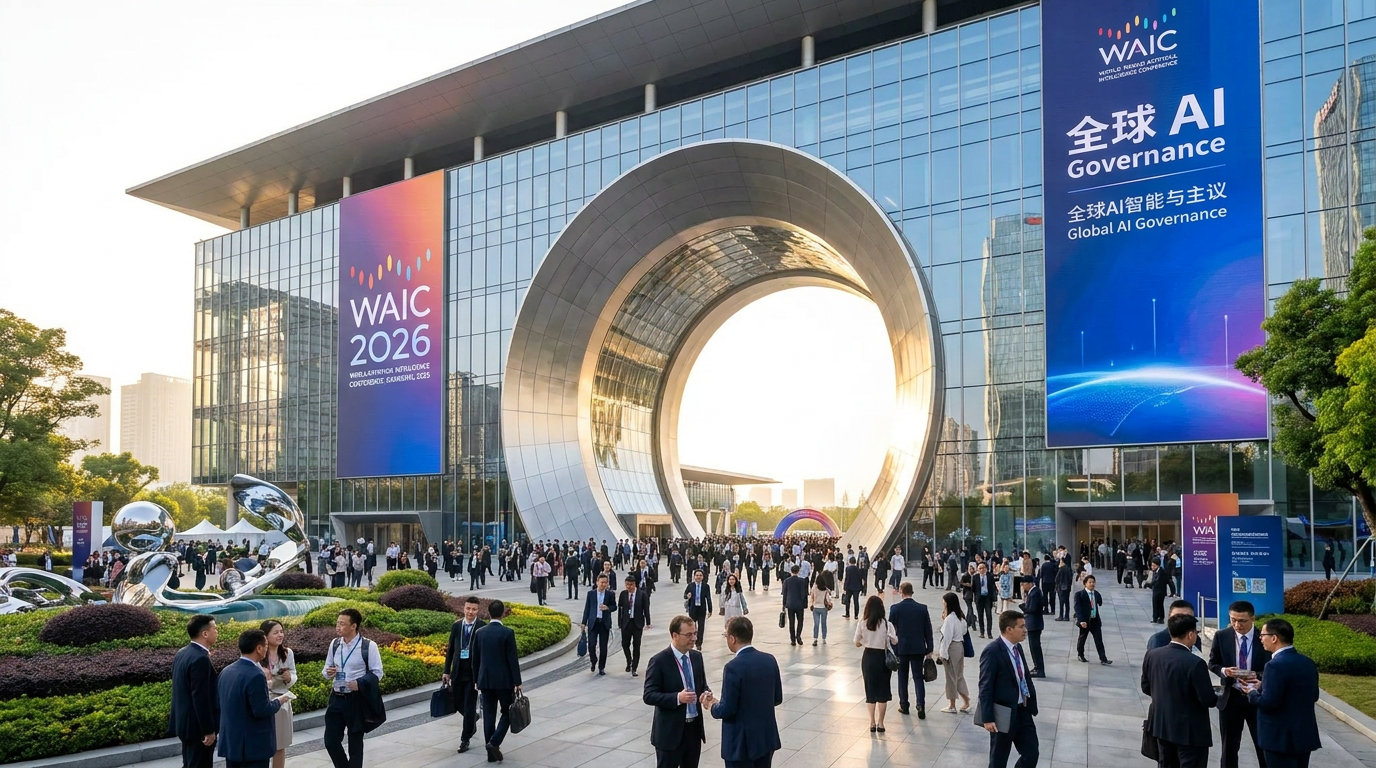
Chinese President Xi Jinping will make his first in-person appearance at the World Artificial Intelligence Conference in Shanghai, elevating AI safety and international regulation to a top diplomatic priority. The summit highlights a growing global consensus that advanced AI requires coordinated multilateral guardrails.
By Factlen Editorial Team
- Multilateral Governance Advocates
- Argue for inclusive, UN-centric AI regulations that prioritize capacity-building in developing nations.
- Strategic Competitors
- Warn that competing governance frameworks are being used to export geopolitical influence and challenge market dominance.
- Global AI Industry
- Advocate for unified, interoperable technical standards to prevent a fractured global regulatory landscape.
What's not represented
- · Civil liberties organizations concerned about surveillance
- · Independent open-source developers
Why this matters
As artificial intelligence becomes deeply integrated into the global economy, the rules governing its safety and deployment will shape the next century. Establishing international consensus now is critical to preventing a fragmented, unregulated AI arms race that could pose systemic risks to humanity.
Key points
- Chinese President Xi Jinping will deliver his first in-person keynote at the 2026 World AI Conference.
- The Shanghai summit expects over 1,400 international guests and 300 global product debuts.
- Discussions will center on the Global AI Governance Initiative and establishing multilateral safety standards.
- A major focus is providing AI capacity-building infrastructure to developing nations in the Global South.
- The event highlights a growing international consensus that advanced AI requires coordinated, cross-border oversight.
The era of unregulated artificial intelligence development is rapidly closing. As frontier models achieve unprecedented capabilities, the focus of the global tech community is shifting from raw compute power to the establishment of international guardrails. This week, that regulatory pivot takes center stage in Shanghai.
Chinese President Xi Jinping will make his first in-person appearance at the 2026 World Artificial Intelligence Conference (WAIC), delivering the keynote address at the opening ceremony on July 17. The four-day event, held alongside the High-Level Meeting on Global AI Governance, represents a major escalation in the diplomatic priority assigned to AI safety.[1][7]
Historically, the Chinese leader has sent congratulatory letters to the summit or delegated attendance to the Premier. His physical presence this year signals to domestic ministries, provincial governments, and the international community that AI governance is now a foundational pillar of state policy.[3][5]
The scale of the 2026 conference reflects this elevated status. Organizers expect more than 1,400 international guests, including government officials, academics, and executives from top multinational corporations. The exhibition space has expanded to over 100,000 square meters, hosting 1,100 companies and featuring more than 300 global product debuts.[3][7]

Crucially, the event is not merely a trade show for software and robotics; it is a diplomatic forum designed to build consensus on how humanity manages its most powerful new technology. The theme, "AI Partnership for a Brighter Future," underscores a push for multilateral cooperation at a time when the risk of a fragmented, polarized AI ecosystem is high.[1]
At the core of the summit is the Global AI Governance Initiative (GAIGI), a framework proposed by Beijing to establish international norms for AI development. The initiative advocates for a "people-centered" approach, emphasizing that the benefits of AI—from medical breakthroughs to automated logistics—must be accessible to all nations, not just a handful of tech superpowers.[1][4]
At the core of the summit is the Global AI Governance Initiative (GAIGI), a framework proposed by Beijing to establish international norms for AI development.
A major focus of this framework is capacity-building in the Global South. Developing nations often lack the massive data centers and specialized silicon required to train frontier models, leaving them vulnerable to technological exclusion. By offering "international public goods" and assisting emerging economies in building their own AI infrastructure, the initiative aims to democratize access to the technology.[6][7]
This approach involves bundling AI governance frameworks with physical infrastructure investments. Recent agreements, such as the planned AI safety network with the Association of Southeast Asian Nations (ASEAN) and the launch of the China-BRICS AI Development and Cooperation Center, demonstrate how these policies are moving from theory to practice.[4]

Western analysts view this diplomatic push through the lens of strategic competition. Observers note that as Chinese open-weight models—which have rapidly closed the performance gap with their American counterparts—gain global market share, the regulatory standards governing them become increasingly influential.[2][3]
Some policy experts caution that the proliferation of these frameworks could challenge Western market dominance and embed different normative values into the digital infrastructure of developing nations. The concern is that competing regulatory spheres could increase friction for multinational AI firms attempting to navigate a patchwork of international laws.[4][6]
Despite these geopolitical tensions, there is a profound silver lining: the world's largest technological powers are in broad agreement that advanced AI requires strict, institutionalized oversight. Both Washington and Beijing have actively supported United Nations resolutions promoting safe AI development, recognizing that the risks of unaligned superintelligence respect no borders.[4]

The Shanghai conference will feature dedicated sections on embodied AI and intelligent robotics, highlighting the urgent need for safety standards as AI systems transition from digital chatbots to physical machines operating in human environments. Ensuring these systems behave predictably and safely is a universal imperative.[7]
Ultimately, the 2026 WAIC represents a critical maturation point for the global tech industry. The conversation has decisively moved beyond whether AI should be regulated, focusing instead on the practical mechanics of international cooperation, data sovereignty, and equitable access.[5]
As delegates convene in Shanghai, the overarching narrative is one of necessary dialogue. Establishing a unified global safety network remains a monumental challenge, but high-level diplomatic engagement is the essential first step toward ensuring that the AI revolution benefits humanity as a whole.[1]
How we got here
2018
The inaugural World Artificial Intelligence Conference (WAIC) is launched in Shanghai to foster international tech cooperation.
October 2023
China officially proposes the Global AI Governance Initiative, outlining its vision for multilateral AI regulation.
July 2025
The China-BRICS AI Development and Cooperation Center is launched at the 2025 WAIC to assist emerging economies.
July 2026
President Xi Jinping delivers his first in-person keynote at WAIC, signaling a major escalation in AI diplomacy.
Viewpoints in depth
Multilateral Governance Advocates
Emphasize the need for inclusive AI development that prevents a technological divide between the Global North and South.
This perspective, heavily championed by Beijing and various developing nations, argues that AI governance cannot be dictated solely by a handful of Western tech hubs. They advocate for a United Nations-centric approach where 'international public goods'—such as open-source models and compute infrastructure—are shared equitably. By bundling AI capacity-building with broader economic partnerships, they aim to ensure that emerging economies can harness AI for healthcare, agriculture, and education without being entirely dependent on foreign corporate monopolies.
Strategic Competitors
View the push for global governance frameworks as a geopolitical maneuver to export specific normative values.
Western policy analysts and national security experts often interpret these multilateral initiatives through the lens of great power competition. They express concern that exporting AI infrastructure to the Global South also exports techno-authoritarian standards, prioritizing state control and data sovereignty over individual privacy. From this viewpoint, the race to establish global AI rules is a zero-sum contest to define the digital architecture of the 21st century, potentially increasing compliance costs and friction for multinational tech firms.
Global AI Industry
Focus on the practical challenges of navigating a fragmented, multi-polar regulatory landscape.
For the researchers and executives actually building frontier models, the primary concern is regulatory fragmentation. The tech industry broadly supports the establishment of unified safety guardrails to prevent catastrophic risks, but fears a scenario where the US, EU, and China enforce incompatible compliance regimes. Industry leaders emphasize that because open-weight models and algorithmic breakthroughs cross borders instantly, effective AI safety requires a baseline of interoperable, globally accepted technical standards rather than competing geopolitical blocs.
What we don't know
- Whether the United States and China can successfully harmonize their competing AI safety frameworks into a single global standard.
- If the conference will result in the announcement of a new, formalized international AI regulatory institution.
- How multinational tech companies will navigate compliance if the world fractures into distinct regulatory blocs.
Key terms
- Global AI Governance Initiative (GAIGI)
- A diplomatic framework proposed by China to establish international norms, safety standards, and equitable access for artificial intelligence development.
- Open-Weight Models
- AI systems where the core mathematical parameters are made publicly available, allowing developers worldwide to download, modify, and build upon the technology.
- Capacity-Building
- The process of developing and strengthening the skills, infrastructure, and resources that communities need to survive and adapt in a fast-changing technological landscape.
- Embodied AI
- Artificial intelligence integrated into physical systems, such as advanced robotics, allowing the AI to interact directly with the real-world environment.
Frequently asked
What is the World AI Conference?
The World Artificial Intelligence Conference (WAIC) is an annual global summit held in Shanghai since 2018. It gathers international government officials, tech executives, and researchers to discuss AI development, showcase new products, and establish governance frameworks.
Why is Xi Jinping's attendance significant?
It marks his first in-person appearance at the event, elevating AI governance to a top-tier diplomatic priority. Historically, he has sent congratulatory letters or delegated attendance to the Premier.
What is the Global AI Governance Initiative?
It is a framework proposed by China aimed at establishing international norms for AI. It emphasizes a 'people-centered' approach, data sovereignty, and providing AI capacity-building assistance to developing nations in the Global South.
How does this affect Western tech companies?
The proliferation of competing international AI regulations could create a fragmented landscape, increasing compliance costs and friction for multinational firms operating across different regulatory blocs.
Sources
Source coverage
7 outlets
3 viewpoints surfaced







[1]XinhuaMultilateral Governance Advocates
Xi to attend opening ceremony of 2026 World AI Conference, deliver keynote speech
Read on Xinhua →[2]BloombergStrategic Competitors
Xi to Debut at China's Flagship AI Summit as US Rivalry Heats Up
Read on Bloomberg →[3]South China Morning PostGlobal AI Industry
Xi Jinping to attend World AI Conference for first time as China elevates tech push
Read on South China Morning Post →[4]War on the RocksStrategic Competitors
China's Global AI Governance Initiative and the Export of Norms
Read on War on the Rocks →[5]The Next WebGlobal AI Industry
Xi Jinping will give the keynote at China's flagship AI summit for the first time
Read on The Next Web →[6]Observer Research FoundationStrategic Competitors
China's Global Governance Initiatives: Diplomacy-Intelligence Convergence
Read on Observer Research Foundation →[7]China DailyMultilateral Governance Advocates
President to attend world AI conference in Shanghai, deliver keynote speech
Read on China Daily →

Every angle. Every day.
Get ai stories with full source coverage and perspective breakdowns delivered to your inbox.