
Gravitational Wave Signal May Hold First Imprint of Dark Matter's Halo Around Black Holes
Physicists have developed a new model suggesting that a previously recorded gravitational wave carries the signature of a dense dark matter cloud surrounding a merging black hole. The breakthrough offers a novel way to detect the invisible substance that makes up most of the universe's mass.

Share this story
In short
- Physicists have developed a fully relativistic model to detect dark matter using gravitational waves.
- Out of 28 clear signals analyzed, one event (GW190728) showed a distinct anomaly.
- The anomaly suggests the merging black holes spiraled through a dense cloud of dark matter.
For nearly a century, astronomers have been haunted by a ghost. Observations of spinning galaxies and the large-scale structure of the cosmos dictate that roughly 85 percent of the matter in the universe is completely invisible. This elusive substance, known as dark matter, refuses to interact with light or electromagnetic forces, making it impossible to see through any traditional telescope.
It only reveals itself through the gentle, macroscopic tug of gravity on stars and galaxies. But the exact nature of the particles that make up this invisible scaffolding has remained one of the most profound mysteries in modern physics.[2]
Decades of multi-billion-dollar experiments have attempted to catch a dark matter particle interacting with ordinary matter in deep underground detectors, largely to no avail. This persistent silence has forced theoretical physicists to look beyond traditional particle colliders and optical observatories. If dark matter only speaks the language of gravity, the reasoning goes, then scientists must learn to listen to the universe's most extreme gravitational events.[2]
Now, a breakthrough model developed by an international coalition of physicists, including researchers at the Massachusetts Institute of Technology and the University of Amsterdam, suggests we may have finally heard dark matter's whisper. By analyzing the ripples in spacetime generated by colliding black holes, the team has identified a potential method to detect the direct imprint of dark matter. Their framework provides a new mathematical lens through which to view existing astronomical data, turning gravitational wave observatories into dark matter microscopes.
The tantalizing evidence centers on a specific gravitational wave signal designated GW190728. Detected on July 28, 2019, by the global LIGO-Virgo-KAGRA (LVK) network, the signal originated from a binary black hole system with a total mass roughly twenty times that of our sun. While the event was cataloged years ago, the new analytical model allowed researchers to screen the archival data for subtle anomalies that standard models would miss.
To test their hypothesis, the researchers applied their technique to the 28 clearest gravitational wave signals recorded during the LVK network's first three observing runs. The results were stark. For 27 of those events, the waveforms perfectly matched the predictions of two black holes merging in a pure, empty vacuum. This aligned with the standard astrophysical assumption that the immediate vicinity of a black hole merger is swept clear of significant matter.
However, the 28th signal, GW190728, refused to conform to the vacuum model. Instead, the pattern of the spacetime ripples showed a distinct "preference" for the team's newly developed dark matter framework. The subtle distortions in the wave's frequency and amplitude strongly suggest that these two black holes did not merge in empty space, but rather spiraled through a dense, invisible cloud of dark matter.
To understand how such a cloud forms, physicists point to a phenomenon known as a "dark dress" or a dark matter halo. While dark matter is generally diffuse across a galaxy, the extreme gravitational well of a supermassive or stellar-mass black hole can act as an anchor. As the black hole forms and grows, it can drag dark matter into a steep, dense spike surrounding its event horizon, creating a localized environment where the invisible substance is packed tightly together.[1]
This concentration is dramatically amplified if the black hole is spinning rapidly. Through a process called superradiance, the black hole's rotational energy can actually be transferred to the surrounding vacuum. If dark matter consists of certain theoretical particles, this energy transfer whips the particles into a frenzy, amplifying the dark matter waves to extraordinarily high densities. Researchers often compare the process to churning liquid cream until it suddenly thickens into dense butter.
The superradiance model specifically points toward a leading dark matter candidate known as the light scalar boson, or axion. Unlike the heavy, sluggish particles previously favored by physicists, these ultralight bosons are orders of magnitude lighter than an electron and can exhibit coherent, wave-like behavior. When trapped in the ergosphere of a spinning black hole, these wave-like particles synchronize and multiply, forming an immense, dragging halo.
The true test of this halo's existence occurs when a second, smaller black hole enters the system. As the companion object begins its fatal inward spiral, it does not travel through empty space. Instead, it must wade through the thick, churning cloud of ultralight dark matter. This interaction fundamentally alters the orbital dynamics of the cosmic dance, bleeding energy from the system in ways that a vacuum merger would not.[1]
The primary mechanism at play is dynamical friction. Just as water slows down a wading swimmer, the dense dark matter halo exerts a gravitational drag on the incoming black hole. As the smaller black hole plows through the scalar field, it leaves a wake of disturbed dark matter behind it. The gravitational pull of this wake acts as a persistent brake, causing the black hole to lose orbital energy and spiral inward faster than Einstein's equations would predict for a vacuum.[1]
This accelerated orbital decay leaves a permanent, measurable fingerprint on the resulting gravitational waves—a phenomenon physicists call "dephasing." Because the black holes are merging faster, the frequency and timing of the emitted spacetime ripples shift out of phase with the standard vacuum template. By meticulously measuring this dephasing, scientists can essentially reverse-engineer the density and profile of the dark matter cloud that caused it.[1]
Building the mathematical tools to detect this dephasing was a monumental task. Until recently, most studies relied on simplified, Newtonian approximations of how a surrounding environment might affect a black hole merger. The new research closes this gap by providing a fully relativistic framework. The team utilized Einstein's theory of general relativity in its entirety to track exactly how the extreme gravity of the black holes interacts with the surrounding scalar field.
Executing these meticulous numerical relativity simulations required immense computational power and rigorous skepticism. The primary danger in such complex modeling is the risk of numerical artifacts—where a quirk in the code masquerades as a physical discovery. The researchers spent months ensuring that the dephasing effect they were seeing was a genuine consequence of dark matter drag, rather than a hallucination produced by the simulation's mathematical boundaries.
The successful isolation of this dark matter signature in GW190728 represents a watershed moment for particle physics. If the superradiance model holds true across future detections, it would provide some of the strongest indirect evidence to date that dark matter is composed of ultralight scalar bosons rather than heavy, weakly interacting massive particles (WIMPs). It effectively shifts the hunt for dark matter from deep-earth mineshafts to the cosmic horizon.[2]
Looking ahead, the scientific community is preparing to scale up this analytical technique. The most promising targets are Extreme Mass Ratio Inspirals (EMRIs), systems where a stellar-mass black hole slowly spirals into a supermassive black hole at the center of a galaxy. Because these inspirals take vastly longer to complete, the smaller black hole spends much more time wading through the dark matter halo, accumulating a massive, unmistakable dephasing signature.[1]
The ultimate test will come with the deployment of next-generation space-based observatories. The European Space Agency's Laser Interferometer Space Antenna (LISA), slated for launch in 2035, is specifically designed to detect the low-frequency gravitational waves emitted by EMRIs. LISA will be able to track these cosmic dances for months or even years, capturing millions of orbital cycles and providing a high-definition map of the dark matter spikes surrounding galactic cores.
For now, GW190728 stands as a tantalizing preview of a new era in astronomy. Researchers emphasize that a single anomalous signal does not constitute definitive proof of dark matter's composition. However, it proves that the methodology works. Humanity is no longer restricted to looking for the light in the universe; we have finally learned how to listen to the shadows, and the shadows are beginning to speak back.[2]
Terms to know
- Dark Matter
- An invisible substance that makes up most of the universe's mass, detectable only through its gravitational effects on galaxies.
- Gravitational Waves
- Ripples in the fabric of spacetime caused by the acceleration of massive objects, such as merging black holes.
- Superradiance
- A process where a rapidly spinning black hole transfers its rotational energy to surrounding particles, whipping them into a dense cloud.
- Axion
- A theoretical, ultralight subatomic particle that is currently a leading candidate for what dark matter might be made of.
- Dephasing
- A measurable shift in the timing and frequency of a gravitational wave, caused in this case by the drag of a dark matter halo.
Questions readers ask
Does this prove that dark matter exists?
While it provides compelling indirect evidence, it is not definitive proof. The signal GW190728 strongly matches the new dark matter model, but researchers need more detections to rule out other astrophysical anomalies.
Why can't we just look at dark matter through a telescope?
Dark matter does not interact with light or electromagnetic forces, making it completely invisible to traditional optical, radio, or X-ray telescopes.
What is the LISA mission?
The Laser Interferometer Space Antenna (LISA) is a planned space-based observatory launching in 2035. It will be sensitive to lower-frequency gravitational waves, making it ideal for studying dark matter halos.
Different angles
Cosmology Researchers
Focused on the potential to finally map the distribution of dark matter in the universe.
For cosmologists, the ability to detect dark matter halos via gravitational waves is a paradigm-shifting tool. For decades, the field has relied on observing the gravitational lensing of light or the rotation curves of galaxies to infer where dark matter resides on a macro scale. This new technique acts as a micro-probe, allowing researchers to measure the exact density and distribution of dark matter in the immediate vicinity of black holes. It opens the door to mapping the invisible universe with unprecedented precision, potentially confirming theories about how dark matter seeds the formation of galaxies.
Particle Physics Community
Excited by the evidence pointing toward ultralight scalar bosons over traditional heavy particles.
Particle physicists view the GW190728 anomaly as a crucial clue in the hunt for the dark matter particle. For years, the community heavily favored Weakly Interacting Massive Particles (WIMPs), but exhaustive underground experiments have failed to find them. The superradiance model heavily relies on the existence of ultralight scalar bosons, such as axions. If gravitational wave dephasing becomes a consistently observed phenomenon, it would provide massive indirect support for the axion theory, fundamentally redirecting billions of dollars in future particle physics research toward detecting these wave-like particles.
Observational Skeptics
Cautioning that the anomaly could be a data artifact or a different astrophysical phenomenon.
While acknowledging the elegance of the mathematical model, observational skeptics urge caution before declaring the dark matter mystery solved. They point out that GW190728 is a single event out of dozens, and the 'dephasing' signature could potentially be explained by other complex astrophysical factors, such as the presence of a third, distant black hole in the system, or subtle calibration errors in the LVK detectors. This camp argues that until the LISA mission or next-generation terrestrial detectors capture a definitive, high-signal-to-noise Extreme Mass Ratio Inspiral, the dark matter imprint remains a compelling hypothesis rather than an established fact.
- Cosmology Researchers
- View the breakthrough as a revolutionary tool to map the invisible structure of the universe.
- Particle Physics Community
- Argue the findings strongly support the existence of ultralight axions over traditional heavy particles.
- Observational Skeptics
- Caution that the single anomaly requires more data to rule out alternative astrophysical explanations.
Perspectives this story doesn't cover
- Alternative gravity theorists who argue dark matter does not exist at all.
Sources
Source coverage
2 outlets
3 viewpoints surfaced


- [1]arXivObservational Skeptics
Gravitational waves of extreme-mass-ratio inspirals in a rotating black hole with Dehnen dark matter halo
Read on arXiv → - [2]Factlen Editorial TeamCosmology Researchers
Synthesis by Factlen editorial team
Read on Factlen Editorial Team →

More in Science
See all →Quantum Physics
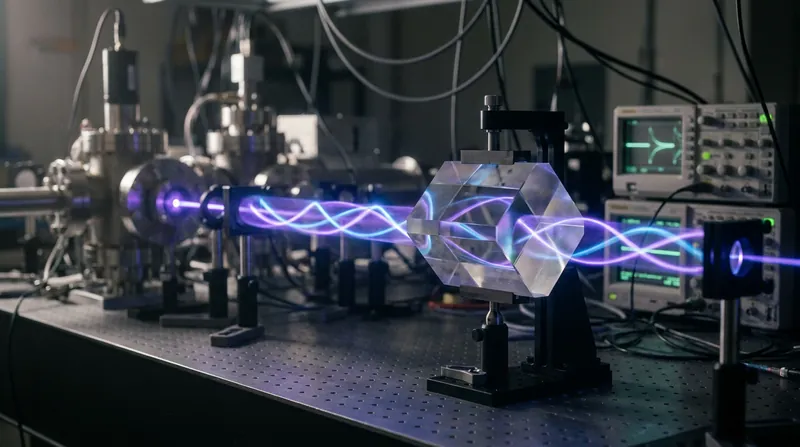
Physicists Successfully Recreate Black Hole Energy Extraction in a Laboratory
4 sources
Exoplanet Habitability
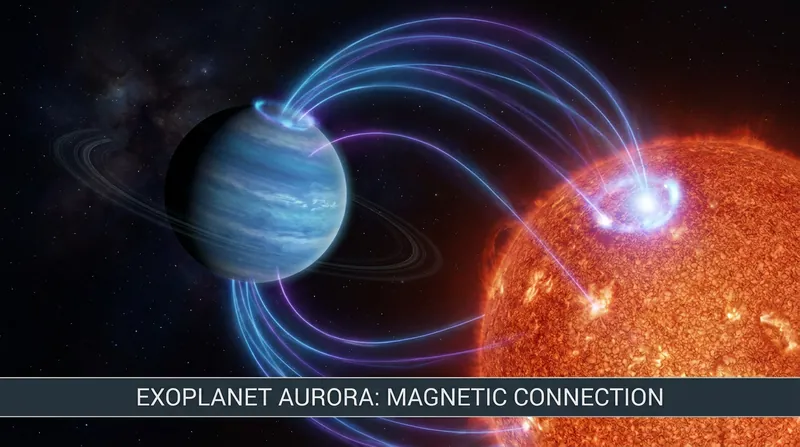
First-Ever Detection of Magnetic Field on Exoplanet Opens New Window to Habitability
8 sources
Time-Domain Astronomy
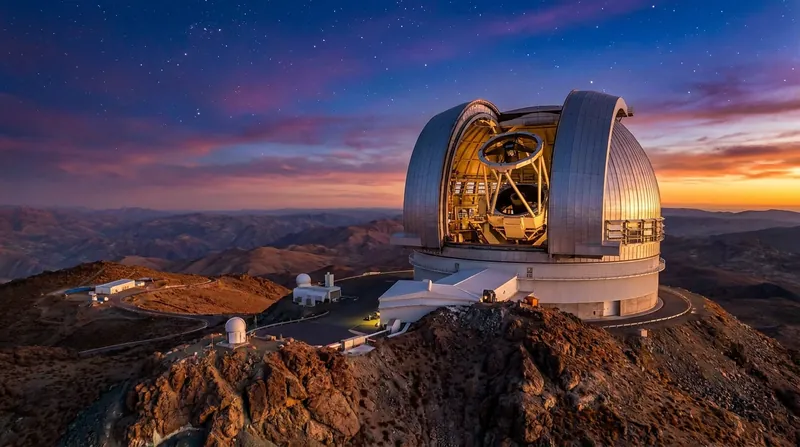
World's Largest Digital Camera Begins 10-Year Survey to Map the Dynamic Universe
5 sources
Black Hole Physics
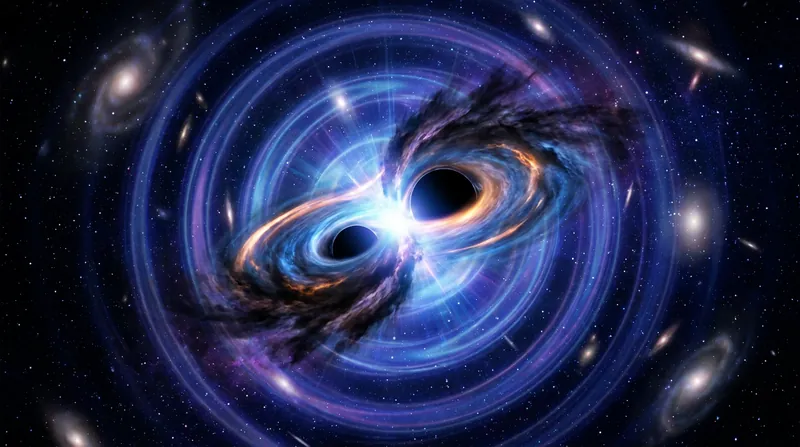
Gravitational Waves Reveal First 'Fingerprints' of a Black Hole's Event Horizon, Probing the 'Point of No Return'
4 sources
Comments
Every angle. Every day.
Get Science stories with full source coverage and perspective breakdowns, free every day.