
New Maps from Webb and Euclid Telescopes Reveal the Universe's Invisible Dark Matter Scaffolding
Astronomers have released the highest-resolution maps of dark matter to date, using gravitational lensing to trace the invisible mass that holds galaxies together. The combined data from the James Webb and Euclid space telescopes provides unprecedented evidence of how dark matter shaped the early universe.
By Factlen Editorial Team
- Observational Cosmologists
- Focus on mapping the distribution of mass using precise gravitational lensing measurements.
- Theoretical Physicists
- Seek to determine the fundamental particle nature of dark matter based on its structural behavior.
- Space Agency Planners
- Focus on deploying next-generation wide-field survey missions to scale these pilot maps across the entire sky.
What's not represented
- · Alternative gravity theorists (MOND advocates) who argue the lensing effects could be explained by modifying the laws of gravity rather than invisible mass.
- · Particle experimentalists attempting to detect dark matter directly in underground laboratories.
Why this matters
Dark matter makes up roughly 85% of the mass in the universe, yet its exact nature remains one of science's greatest mysteries. By finally mapping this invisible framework in high resolution, researchers are moving closer to understanding the fundamental physics that allowed galaxies, stars, and ultimately life to form.
Key points
- The James Webb and Euclid space telescopes have released the highest-resolution maps of dark matter ever produced.
- Astronomers mapped the invisible mass using gravitational lensing, which measures how massive objects bend the light of background galaxies.
- Euclid's June 2026 pilot study mapped the Abell 2390 galaxy cluster, revealing it is 1.5 quadrillion times more massive than our Sun.
- Webb's early 2026 observations of the Sextans constellation identified 800,000 galaxies, providing a map twice as sharp as previous efforts.
- The high-resolution maps confirm that dark matter and normal matter are perfectly aligned, proving dark matter acted as the universe's architectural framework.
For decades, astronomers have known that the visible universe—every star, planet, and glowing cloud of gas—represents only a tiny fraction of the cosmos. The rest is dominated by dark matter, an invisible substance that exerts a powerful gravitational pull but emits no light. Now, the invisible scaffolding of the universe is finally coming into sharp focus.
In the first half of 2026, two major space observatories released the highest-resolution maps of dark matter ever created. The James Webb Space Telescope (JWST) and the European Space Agency's Euclid telescope have both successfully utilized a phenomenon known as gravitational lensing to trace this elusive mass, providing unprecedented evidence of how dark matter shaped the early universe.[2][4]
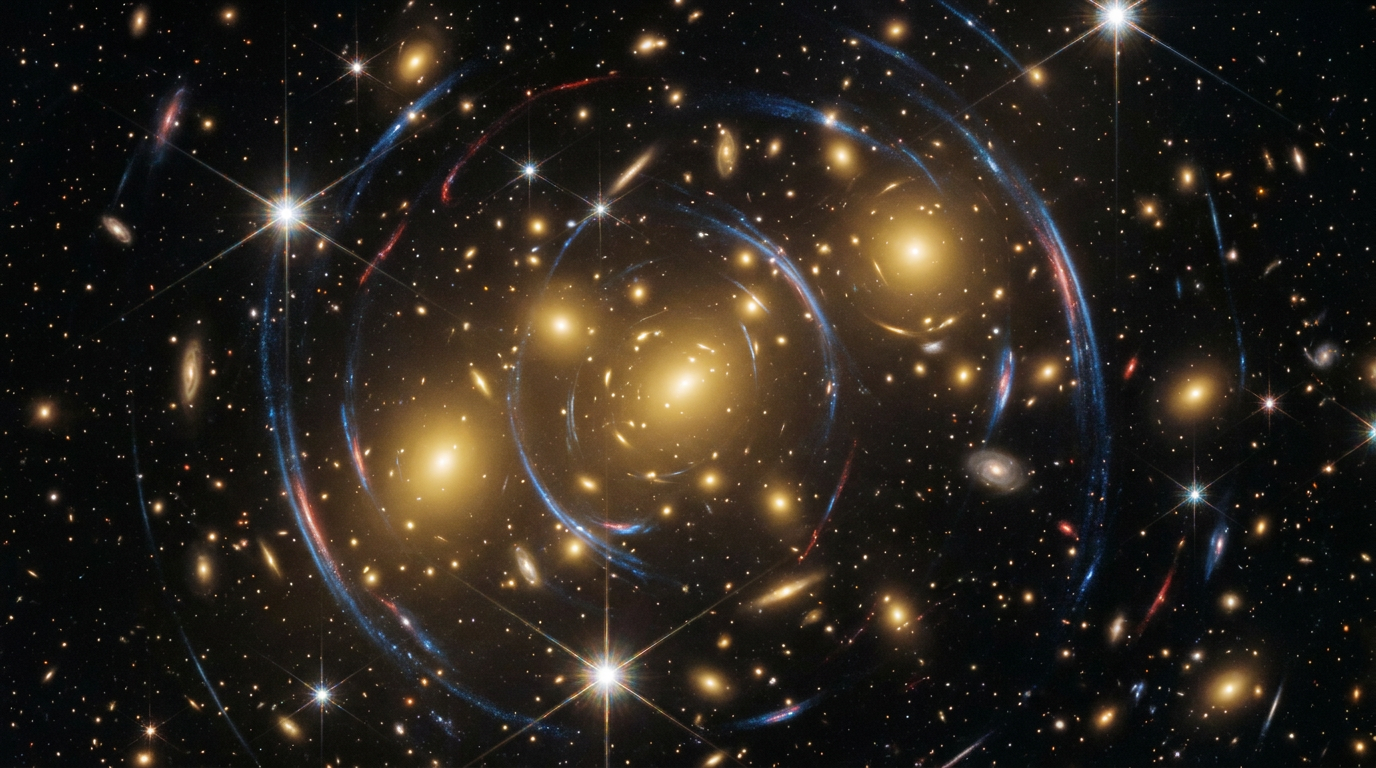
The core mechanism behind these maps relies on Albert Einstein's theory of general relativity. When light from a distant background galaxy travels toward Earth, it must pass through the gravitational fields of massive objects along the way. If a massive cluster of dark matter sits in the foreground, its gravity warps the fabric of spacetime, bending the light rays like a giant magnifying glass.[1][5]
This effect, known as weak gravitational lensing, causes the background galaxies to appear slightly stretched and distorted from our perspective. Because the undistorted shapes of these distant galaxies are unknown, astronomers cannot rely on a single object. Instead, they must statistically analyze the subtle deformations of thousands, or even hundreds of thousands, of galaxies simultaneously to reconstruct the mass of the invisible object bending their light.[1]

The most recent breakthrough arrived in June 2026, when an international team led by astrophysicist Tim Schrabback at the University of Innsbruck published the first major dark matter mapping from the Euclid space telescope. The pilot study targeted Abell 2390, a massive galaxy cluster located approximately 2.4 billion light-years from Earth.[1]
By analyzing the shapes of thousands of background galaxies, the Euclid team reconstructed the mass distribution within Abell 2390. They determined that the cluster is roughly 1.5 quadrillion times more massive than our Sun. The vast majority of this immense gravitational force comes not from the glowing galaxies themselves, but from the invisible dark matter binding them together.[1]
To ensure the accuracy of their map, the researchers employed three independent shape-measuring algorithms. They also combined Euclid's pristine space-based imagery with complementary observations from the ground-based Subaru Telescope in Hawaii, using photometric redshifts to confirm that the distorted galaxies were indeed positioned behind the massive cluster.[1]
To ensure the accuracy of their map, the researchers employed three independent shape-measuring algorithms.
Euclid's pilot study follows an even deeper, highly targeted observation released earlier in 2026 by the JWST. While Euclid is designed to survey vast swaths of the sky, Webb excels at peering deeply into narrow patches. A team led by researchers at NASA's Jet Propulsion Laboratory and Durham University used Webb to map a region in the constellation Sextans, known as the COSMOS-Webb field, detailing their findings in Nature Astronomy.[2][5][6]
Over the course of 255 hours of observation, Webb identified nearly 800,000 galaxies in a patch of sky about 2.5 times the size of the full Moon. The resulting map is twice as sharp as any dark matter map produced by previous observatories, capturing roughly ten times more galaxies than earlier ground-based efforts and twice as many as the Hubble Space Telescope.[2][3]
"Previously, we were looking at a blurry picture of dark matter," noted Dr. Diana Scognamiglio of NASA's Jet Propulsion Laboratory. "Now we're seeing the invisible scaffolding of the Universe in stunning detail, thanks to Webb's incredible resolution."[2]

A crucial finding from the JWST map is the near-perfect alignment between dark matter and normal matter. The high-resolution contours of the dark matter map perfectly overlap with the locations of visible galaxies. According to the research team, this confirms the long-held theory that dark matter acted as the architectural framework of the cosmos.[3][5]
In the early universe, clumps of dark matter exerted a gravitational pull that drew in normal, visible matter. This accumulation of hydrogen and helium gas eventually became dense enough to ignite the first stars and form the first galaxies. "Wherever you find normal matter in the universe today, you also find dark matter," explained Professor Richard Massey of Durham University.[5]
Without this invisible scaffolding, the universe as we know it could not exist. The swirling cloud of dark matter surrounding the Milky Way provides the necessary gravity to hold our galaxy together; without it, the Milky Way would spin itself apart, and the elements required for life would never have coalesced.[2][5]
Despite these mapping breakthroughs, the fundamental nature of dark matter remains a profound mystery. The maps show where it is and how it behaves gravitationally, but they do not reveal what it is. Physicists are still debating whether dark matter consists of massive, slow-moving "cold" particles or lighter, faster-moving "warm" particles.[4]

The resolution of these new maps provides critical data for theorists attempting to answer that question. If future, even more detailed maps reveal that dark matter clumps tightly on very small scales, it would strongly support the cold dark matter model. Conversely, if the distribution is smoother, it could point toward warm dark matter or other exotic physics.[4]
The astronomical community is now preparing to scale these pilot maps across the entire sky. While the Abell 2390 observation covered less than 0.004 percent of Euclid's intended survey area, the telescope will begin its full large-scale cosmological analysis in 2027. Its field of view is 180 times larger than that of the Hubble Space Telescope, allowing it to track the growth of cosmic structures throughout the universe's history.[1]
These efforts will soon be joined by NASA's Nancy Grace Roman Space Telescope and the ground-based Vera C. Rubin Observatory in Chile. Together, this next generation of observatories will transition dark matter research from isolated, targeted maps to a comprehensive, three-dimensional atlas of the invisible universe.[4][5]
How we got here
2021
James Webb Space Telescope launches, equipped with the high-resolution Mid-Infrared Instrument (MIRI).
2023
The European Space Agency launches the Euclid space telescope, designed specifically to map the dark universe.
January 2026
Astronomers release the ultra-high-resolution COSMOS-Webb dark matter map, identifying 800,000 galaxies in the Sextans constellation.
June 2026
The Euclid mission publishes its first major pilot study, mapping the massive dark matter distribution in the Abell 2390 galaxy cluster.
2027
Euclid is scheduled to begin its full large-scale cosmological analysis, tracking the growth of cosmic structures across the sky.
Viewpoints in depth
Observational Cosmologists
Focus on mapping the distribution of mass using precise gravitational lensing measurements.
For observational astronomers, the primary goal is precision. By utilizing multiple independent shape-measuring algorithms and cross-referencing space-based images with ground-based photometric redshifts, this camp aims to eliminate optical distortions and instrumental noise. Their focus is on proving where dark matter is, relying on the statistical deformation of millions of background galaxies to build an undeniable topographical map of the invisible universe.
Theoretical Physicists
Seek to determine the fundamental particle nature of dark matter based on its structural behavior.
Theorists look at these high-resolution maps to constrain the physical properties of dark matter itself. If the maps show dark matter clumping tightly on small scales, it supports the 'cold' dark matter model, which posits massive, slow-moving particles. If the structures are smoother and more diffuse, it might suggest 'warm' dark matter composed of lighter, faster particles. For this camp, the maps are a stepping stone to rewriting the Standard Model of particle physics.
Space Agency Planners
Focus on deploying next-generation wide-field survey missions to scale these pilot maps across the entire sky.
For the architects of multi-billion-dollar space missions, these pilot studies are crucial proofs of concept. Space agency planners view the JWST and Euclid maps as validation that their instruments can successfully measure weak gravitational lensing from orbit. Their long-term objective is to combine data from Euclid, the upcoming Nancy Grace Roman Space Telescope, and ground-based observatories to create a comprehensive, three-dimensional atlas of the cosmos.
What we don't know
- The fundamental particle nature of dark matter—whether it consists of massive, slow-moving 'cold' particles or lighter, fast-moving 'warm' particles.
- Whether dark matter interacts with itself or with normal matter through any force other than gravity.
- If alternative theories of gravity might eventually explain these lensing effects without requiring an invisible particle.
Key terms
- Dark Matter
- An invisible form of matter that makes up most of the mass in the universe, detectable only through its gravitational effects on visible objects.
- Gravitational Lensing
- The bending and distortion of light from distant galaxies as it passes through the gravitational field of a massive foreground object.
- Photometric Redshift
- A technique used to estimate the distance to a galaxy by measuring how much its light has been stretched into redder wavelengths by the expansion of the universe.
- Cold Dark Matter
- A theoretical model suggesting dark matter is made of massive, slow-moving particles that easily clump together to form structures.
Frequently asked
Can telescopes actually see dark matter?
No. Dark matter does not emit, absorb, or reflect light. Telescopes map it indirectly by observing how its gravity bends the light of galaxies located behind it.
Why is dark matter important?
Dark matter provides the gravitational 'scaffolding' that pulled normal matter together in the early universe, allowing galaxies, stars, and planets to form.
What is the difference between the Webb and Euclid telescopes?
Webb is designed to peer incredibly deeply into narrow, targeted patches of the sky with extreme resolution. Euclid is designed to survey vast, wide swaths of the sky to create a large-scale map of the cosmos.
Sources
Source coverage
6 outlets
3 viewpoints surfaced






[1]University of InnsbruckObservational Cosmologists
Euclid makes dark matter visible
Read on University of Innsbruck →[2]ScienceDailyObservational Cosmologists
Astronomers have produced the most detailed map yet of dark matter
Read on ScienceDaily →[3]Discover MagazineObservational Cosmologists
Highest-Resolution Map of Dark Matter Unveiled
Read on Discover Magazine →[4]National GeographicSpace Agency Planners
A new map of dark matter reveals the hidden framework of the universe
Read on National Geographic →[5]Mapping IgnoranceTheoretical Physicists
An ultra-high-resolution map of (dark) matter
Read on Mapping Ignorance →[6]Nature AstronomyTheoretical Physicists
An ultra-high-resolution map of (dark) matter
Read on Nature Astronomy →

Every angle. Every day.
Get science stories with full source coverage and perspective breakdowns delivered to your inbox.