
The 2026 US AI Regulatory Showdown: Federal Preemption Collides With State Laws
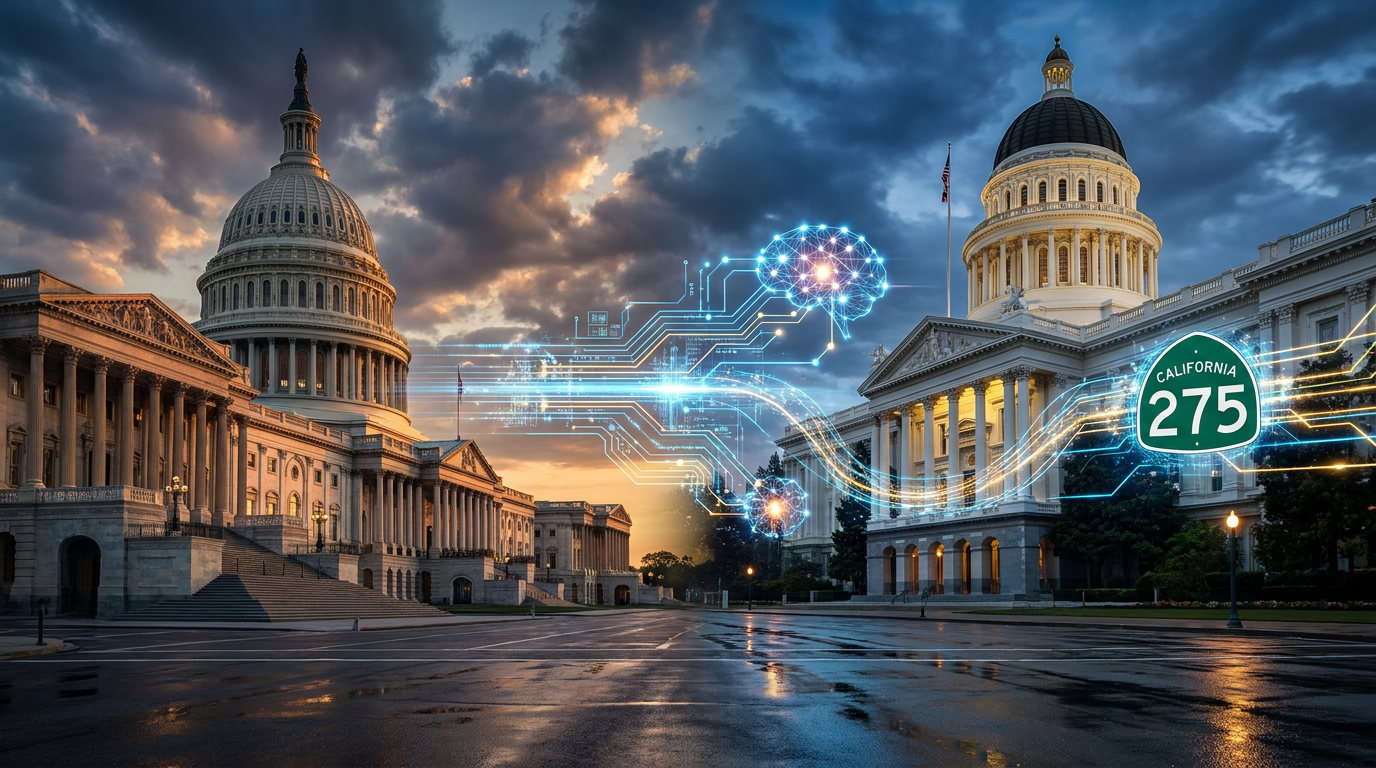
As the US operates without a comprehensive federal AI law, a fierce legal battle has erupted between state legislatures enforcing new transparency mandates and a federal executive branch pushing for nationwide deregulation.
By Factlen Editorial Team
- Federal Administration
- Argues that a patchwork of state laws stifles innovation and that a unified, light-touch federal framework is necessary for global competitiveness.
- State Regulators
- Maintain that in the absence of federal congressional action, states have a duty to protect consumers from algorithmic bias and opaque training data.
- AI Industry Developers
- Caught in the middle, advocating for a single national standard to avoid the immense compliance costs of navigating 50 different state frameworks.
- Compliance & Oversight
- Focus on the operational reality of meeting conflicting legal mandates and the role of existing agencies like the FTC.
What's not represented
- · Open-source AI developers
- · International regulatory bodies
Why this matters
The clash between federal deregulation and state-level AI laws dictates how artificial intelligence is built, what data it consumes, and whether developers face legal consequences for algorithmic harm. For businesses and consumers, this legal fragmentation determines the safety and transparency of the AI tools they use daily.
Key points
- The US lacks a comprehensive federal AI law, leading to a fragmented regulatory landscape.
- California enacted strict transparency and risk framework laws for frontier models in early 2026.
- Colorado repealed its original AI Act, replacing it with a narrower automated decision-making law.
- Federal Executive Order 14365 attempts to preempt state AI laws via an AI Litigation Task Force.
- A June 2026 federal order mandates classified benchmarking for the cyber capabilities of frontier models.
- AI developers face immense compliance costs navigating conflicting state and federal mandates.
The United States artificial intelligence sector has entered a period of unprecedented legal fragmentation. As of mid-2026, the country lacks a comprehensive federal AI law, leaving a vacuum that state legislatures and the executive branch are fighting to control. We have synthesized the current regulatory landscape, mapping the collision course between state-level consumer protections and a federal mandate for deregulation. The evidence points to a looming constitutional showdown over preemption, with AI developers caught in the crossfire.[1][5]
The core claim driving this conflict is that a patchwork of state laws threatens American technological supremacy. In response, the federal government has aggressively pivoted toward deregulation. In January 2025, President Trump issued Executive Order 14179, which revoked the Biden administration’s previous AI safety mandates. This order dismantled federal requirements for safety testing and reporting, signaling a clear preference for unencumbered innovation over preemptive risk management.[2][3]
However, the absence of federal congressional action has catalyzed state legislatures. The evidence shows states are rapidly filling the regulatory void with binding legislation. California has enacted the most aggressive framework, with several major laws taking effect on January 1, 2026. The state’s Transparency in Frontier Artificial Intelligence Act (SB 53) specifically targets the largest AI developers, imposing strict risk framework requirements on models trained using massive computational power.[1][4]
California’s approach extends deeply into the mechanics of AI development. The state's AI Training Data Transparency Act (AB 2013), which also became enforceable in early 2026, mandates that developers publish comprehensive summaries of their training datasets. This includes disclosing data sources, intellectual property information, and the presence of personal information. For an industry built on scraping the open web, this represents a profound shift in operational transparency.[1][5]

Colorado has experienced an even more volatile regulatory trajectory. The state initially passed the Colorado AI Act, heralded as the first comprehensive state-level AI law in the nation, which was slated to take effect in early 2026. However, following intense pushback from pro-business advocates, Governor Jared Polis signed SB 26-189 in May 2026, effectively repealing the original act before it could be enforced.[1][4]
The replacement Colorado legislation, which takes effect in January 2027, strips away mandatory impact assessments and the affirmative defense tied to the NIST AI Risk Management Framework. Instead, it pivots to consumer-facing requirements, mandating pre-use notices for automated decision-making technologies and requiring developers to provide explanations for adverse outcomes within 30 days. This legislative whiplash highlights the instability of state-level AI governance.[1][5]
The federal executive branch has not passively accepted this state-level activity. The most significant evidence of federal pushback is Executive Order 14365, titled "Ensuring a National Policy Framework for Artificial Intelligence," signed in December 2025. This order explicitly seeks to preempt state AI regulations, arguing that a unified national approach is essential for economic and national security.[3][4]
EO 14365 establishes an AI Litigation Task Force directed to evaluate state AI laws for potential conflicts with federal priorities and challenge them through legal action. Furthermore, the order attempts to use the power of the purse, conditioning certain federal funding on a state’s compliance with the federal framework and the absence of what the administration deems onerous local AI laws.[3][4]
The legal uncertainty surrounding EO 14365 is substantial. Constitutional scholars and legal analysts note that while executive orders can direct federal agencies, they generally cannot preempt state laws without an underlying act of Congress. The administration has already issued warning letters to state lawmakers, but the ultimate test will come when the AI Litigation Task Force files its first major injunction against a state like California.[2][4]

While pushing back against state consumer regulations, the federal government has simultaneously carved out a strict mandate for national security. On June 2, 2026, a new Executive Order titled "Promoting Advanced Artificial Intelligence Innovation and Security" was issued. This directive shifts the federal focus entirely toward the intersection of frontier models and cyber warfare.[3]
While pushing back against state consumer regulations, the federal government has simultaneously carved out a strict mandate for national security.
The June 2026 order requires the Department of the Treasury, the National Security Agency, and the Cybersecurity and Infrastructure Security Agency (CISA) to develop a classified benchmarking process within 60 days. This process is designed to assess the advanced cyber capabilities of frontier AI models and establish the exact threshold at which a model becomes a national security concern.[3]
Additionally, the order mandates the creation of a vulnerability clearinghouse within 30 days. This initiative, led by the Treasury in voluntary collaboration with the AI industry, aims to coordinate the scanning, discovery, and remediation of software vulnerabilities in critical infrastructure. It represents a rare instance of the federal government actively building operational infrastructure for AI risk, albeit strictly confined to cybersecurity.[3][5]
For the AI industry, this dual reality—federal deregulation coupled with aggressive state mandates—creates a severe compliance burden. Companies must now navigate California’s stringent transparency rules, Colorado’s automated decision-making requirements, and emerging laws in Texas and Illinois, all while the federal government threatens to invalidate those very frameworks.[1][2]
The financial stakes of non-compliance are severe. Under California’s SB 53, companies with annual revenues exceeding $500 million can face penalties of up to $1 million per violation. This has forced major AI labs to build localized compliance architectures, effectively treating California as a distinct regulatory jurisdiction akin to the European Union.[1][5]

The political economy of AI regulation is also shifting rapidly. In February 2026, the nonprofit Public First Action announced a massive campaign to support political candidates who favor unified AI regulation. Backed by a $20 million donation from AI developer Anthropic, the initiative underscores how desperately the industry wants a single, predictable federal standard, even if it means accepting tighter baseline rules.[4]
Despite the lack of an omnibus AI law, federal agencies are not entirely sidelined. The Federal Trade Commission (FTC) continues to police the AI sector using its existing authority over unfair and deceptive practices. The agency has aggressively pursued companies that make false claims about their AI capabilities or use automated systems to obscure discriminatory practices, proving that the absence of new laws does not mean an absence of enforcement.[1][2]
The evidence suggests that the United States is heading toward a critical legal bottleneck. The administration's push for unified national legislation, as outlined in its March 2026 "National Legislative Policy Framework," has stalled in a divided Congress. Until federal lawmakers pass a binding statute, the tension between state-level consumer protection and federal executive preemption will only escalate.[4][5]
Ultimately, the resolution of this conflict will likely fall to the federal courts. As the AI Litigation Task Force prepares its dockets and states begin enforcing their 2026 mandates, the judicial system will be forced to determine the boundaries of state authority over frontier technologies. Until then, the US AI sector operates in a state of profound legal ambiguity, where the rules of deployment depend entirely on state lines.[4][5]
How we got here
January 2025
President Trump issues EO 14179, revoking previous AI safety mandates to promote deregulation.
December 2025
EO 14365 is signed, establishing a federal task force to challenge state-level AI regulations.
January 2026
Major California AI laws, including AB 2013 on training data transparency, officially take effect.
May 2026
Colorado repeals its original AI Act, replacing it with SB 26-189 to ease business compliance burdens.
June 2026
A new federal EO mandates classified benchmarking for the cyber capabilities of frontier AI models.
Viewpoints in depth
The Federal Preemption Argument
The assertion that national security and economic dominance require a unified, deregulated AI framework.
Proponents of the federal approach argue that AI is inherently borderless, making state-by-state regulation structurally unworkable. By establishing the AI Litigation Task Force, the administration aims to dismantle what it views as onerous local laws that slow down frontier model development. This camp relies on the premise that global technological supremacy, particularly against international rivals, supersedes local consumer protection concerns.
The State Sovereignty Stance
The belief that states must act to protect citizens from AI risks when Congress fails to pass legislation.
State lawmakers and consumer advocates point to the tangible risks of unregulated AI, from algorithmic discrimination in hiring to the opaque use of copyrighted training data. Because Congress has not passed a comprehensive AI bill, states like California and Colorado argue they are constitutionally permitted—and morally obligated—to fill the void. They view federal executive orders attempting to preempt their laws as executive overreach that will likely fail in court.
The Industry Compliance Dilemma
The operational reality of AI developers caught between conflicting legal mandates.
For AI developers, the current landscape is a worst-case scenario. Companies are forced to spend millions building localized compliance architectures to satisfy California's transparency rules, while simultaneously lobbying for a unified federal standard. Initiatives like Anthropic's $20 million backing of Public First Action highlight the industry's willingness to accept federal regulation if it means eliminating the chaotic, fragmented patchwork of state laws.
What we don't know
- Whether the federal AI Litigation Task Force will successfully secure injunctions against state laws like California's SB 53.
- How the Supreme Court will ultimately rule on the constitutionality of executive preemption in the absence of an omnibus AI law.
- If Congress will manage to pass a unified national AI framework before the 2026 midterm elections.
Key terms
- Frontier Model
- Highly advanced, large-scale AI models that exceed specific computational thresholds, such as 10^26 FLOPS, and possess broad capabilities.
- Preemption
- A legal doctrine where higher-level laws (like federal regulations) override or invalidate lower-level laws (like state statutes).
- FLOPS
- Floating-point operations per second; a measure of computer performance and the sheer amount of computational power used to train an AI model.
- Automated Decision-Making Technology (ADMT)
- Systems that use algorithms to make or assist in making decisions that significantly impact consumers, such as in hiring, lending, or housing.
Frequently asked
Is there a federal AI law in the United States?
As of mid-2026, there is no comprehensive federal AI law. Congress has debated various bills, but governance currently relies on executive orders and state-level legislation.
What does California's SB 53 require?
California's SB 53 requires developers of frontier AI models (trained on more than 10^26 FLOPS) to publish risk frameworks and report safety incidents, with penalties up to $1 million per violation.
How is the federal government responding to state AI laws?
The federal executive branch issued EO 14365, establishing an AI Litigation Task Force to challenge state laws and threatening to withhold federal funding from states with onerous AI regulations.
What happened to the Colorado AI Act?
The original Colorado AI Act was repealed before it took effect and replaced by SB 26-189 in May 2026, which focuses on consumer notices and explanations for automated decisions starting in 2027.
Sources
Source coverage
5 outlets
4 viewpoints surfaced





[1]VerifyWiseState Regulators
State of AI governance regulations in the United States: June 2026 Update
Read on VerifyWise →[2]DrataCompliance & Oversight
Federal and State AI Regulations in the United States
Read on Drata →[3]McDermott Will & EmeryFederal Administration
How the Trump administration's AI stance has evolved
Read on McDermott Will & Emery →[4]WikipediaAI Industry Developers
Artificial intelligence law in the United States
Read on Wikipedia →[5]Factlen Editorial TeamCompliance & Oversight
Synthesis by Factlen editorial team
Read on Factlen Editorial Team →


Every angle. Every day.
Get ai stories with full source coverage and perspective breakdowns delivered to your inbox.