
SpaceX's Historic $2 Trillion IPO Sparks Unprecedented Retail Investor Frenzy
SpaceX has completed the largest stock market debut in history, allocating a record portion of its shares to everyday retail investors and pushing its valuation past $2 trillion.
By Factlen Editorial Team
- Retail Investors & Advocates
- View the IPO as a historic democratization of wealth creation.
- Institutional Analysts
- Focused on the company's massive valuation relative to its current unprofitability.
- Space Industry Enthusiasts
- See the successful listing as the ultimate validation of the commercial space sector.
What's not represented
- · Competitors in the aerospace and defense sectors who now face a publicly funded, $2 trillion rival.
- · Regulators concerned about the market concentration of a single company controlling both global satellite internet and primary launch capabilities.
Why this matters
For decades, the most lucrative tech IPOs were walled off for institutional elites, leaving everyday investors to buy in only after the price had surged. SpaceX's decision to allocate up to 30% of its historic offering to retail brokerages marks a massive shift in how everyday people can access and build wealth alongside generational companies.
Key points
- SpaceX completed the largest IPO in history, raising $75 billion at a fixed price of $135 per share.
- The stock surged on its first day of trading, pushing the company's valuation past $2.1 trillion.
- In a rare move, SpaceX allocated 20% to 30% of its shares directly to retail investors.
- Retail buyers purchased $369.8 million in SpaceX stock in the first three days, outpacing the 'Magnificent Seven'.
- Major brokerages like Robinhood and Fidelity filled hundreds of thousands of retail orders at the IPO price.
- The debut officially made CEO Elon Musk the world's first trillionaire.
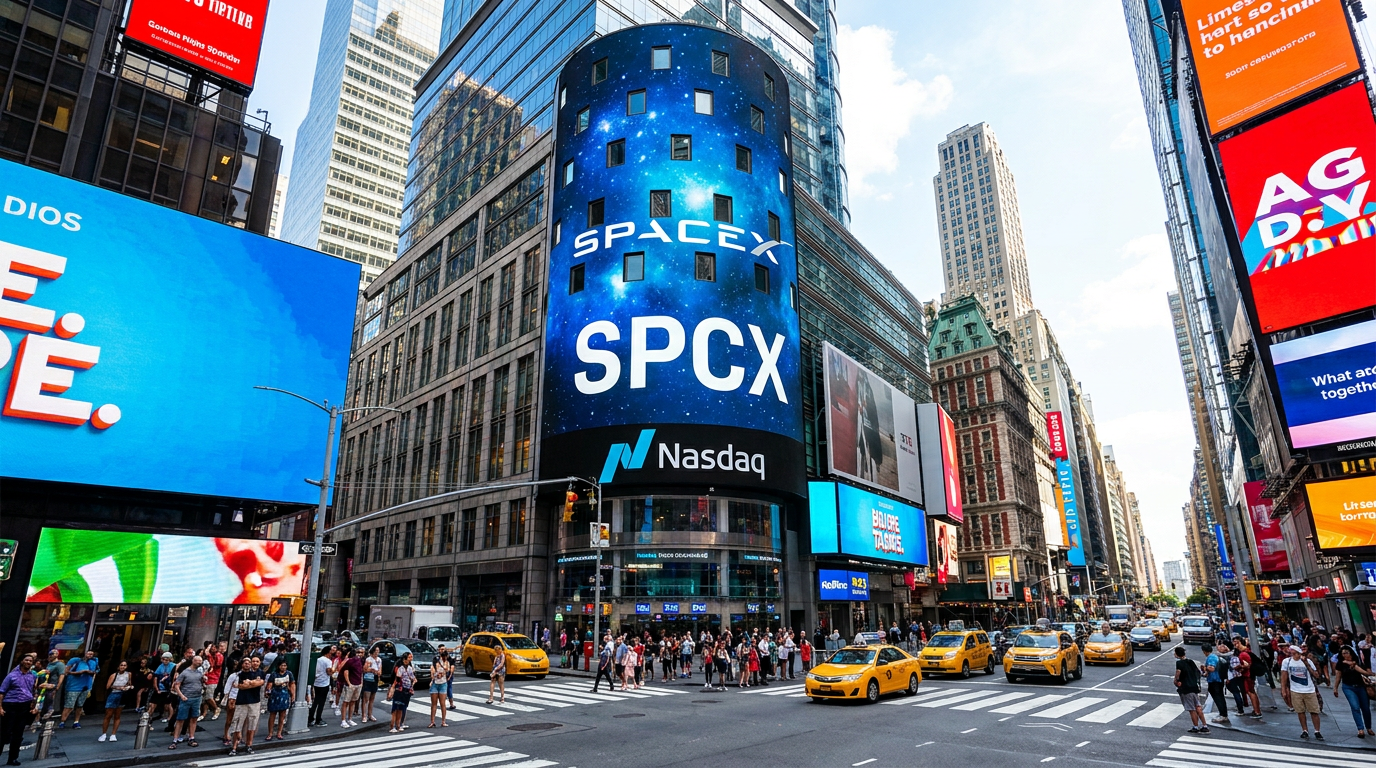
SpaceX has officially completed the largest stock market debut in history, ending its nearly two-and-a-half-decade run as a private company and instantly reshaping the landscape of global equities. Trading under the ticker SPCX on the Nasdaq, the aerospace and satellite giant bypassed traditional Wall Street roadshows, offering a fixed accept-it-or-leave-it price of $135 per share.[2][3]
When the opening bell rang to the tune of Elton John's "Rocket Man," the stock immediately popped. Shares opened at $150 and surged as high as $176 before settling around $160 by the end of its first day. The jump pushed SpaceX's valuation past a staggering $2.1 trillion, instantly making it one of the most valuable companies on Earth and crowning CEO Elon Musk as the world's first trillionaire.[2][3]
But the most revolutionary aspect of the SpaceX IPO wasn't its size—it was who got to participate. Historically, mega-cap tech IPOs are heavily gated, with investment banks reserving the lion's share of the float for institutional clients and hedge funds. Everyday investors are typically left to buy shares on the open market after the price has already skyrocketed.[4][6]
SpaceX flipped that script. The company deliberately allocated an estimated 20% to 30% of its offering directly to retail investors globally. Major brokerage platforms, including Robinhood, Charles Schwab, Fidelity, and SoFi, reported that all eligible customers who requested shares received at least some allocation at the $135 IPO price.[5][6]

The retail response has been nothing short of historic. In the first three days of trading alone, everyday investors net-bought $369.8 million worth of SpaceX stock. To put that enthusiasm into perspective, retail buyers poured more money into SpaceX during that 72-hour window than they did into all of the "Magnificent Seven" tech stocks combined.[1]
In the first three days of trading alone, everyday investors net-bought $369.8 million worth of SpaceX stock.
Robinhood disclosed that over 855,000 of its customers requested shares through its IPO Access platform, and the brokerage managed to fill every single request with at least one share. In the UK, retail buyers submitted nearly $1 billion in orders, receiving roughly $364 million worth of shares through platforms like Hargreaves Lansdown. Across Europe and Asia, similar retail frenzies played out, though some international brokerages struggled to secure enough supply to meet the crushing demand.[5][6]
The overall demand for the offering was staggering. SpaceX sought to raise $75 billion, but investor orders eclipsed $250 billion, oversubscribing the offering by nearly four times. Institutional giants like BlackRock alone placed orders for at least $5 billion, underscoring Wall Street's desperation to gain exposure to the company's Starlink satellite internet monopoly and its reusable rocket dominance.[4]

The enthusiasm comes despite significant near-term financial hurdles. SpaceX's IPO prospectus revealed a net loss of $4.28 billion in the first quarter of 2026, driven heavily by massive capital expenditures for its Starlink constellation and new artificial intelligence infrastructure. Yet, investors appear entirely willing to look past current unprofitability, treating the company's deep technological moat and $18.7 billion in 2025 revenue as proof of long-term viability.[4]
The cultural footprint of the debut has matched its financial weight. SpaceX released a line of IPO-themed merchandise, including mission patches and a $125 model of its Raptor V3 rocket engine, which quickly sold out. Meanwhile, celebrities and influencers publicly flaunted their allocations, further fueling the retail hype cycle.[3]

For the broader market, the successful listing provides a massive injection of optimism. It proves that public markets can still absorb unprecedented capital raises, and more importantly, it sets a new precedent for retail inclusion. By opening the doors to everyday investors on day one, SpaceX has demonstrated that the public can be trusted to participate in the wealth-creation events of generational tech monopolies.[1][5]
How we got here
May 20, 2026
The SEC publicly discloses SpaceX's S-1 filing, detailing plans for the historic IPO.
June 3, 2026
SpaceX bypasses the traditional price-range bookbuilding process, setting a fixed price of $135 per share.
June 9, 2026
Reports emerge that the IPO is massively oversubscribed, drawing $250 billion in investor demand.
June 12, 2026
SpaceX begins trading on the Nasdaq under the ticker SPCX, opening at $150 and closing near $160.
June 15, 2026
Data reveals retail investors bought more SpaceX stock in three days than all 'Magnificent Seven' stocks combined.
Viewpoints in depth
Retail Investors & Advocates
View the IPO as a historic democratization of wealth creation.
For years, retail advocates have criticized the traditional IPO process, arguing that investment banks intentionally underprice shares to guarantee a first-day 'pop' for their wealthy institutional clients, leaving everyday investors to buy in at inflated open-market prices. SpaceX's decision to allocate up to 30% of its float to retail brokerages is being hailed as a structural breakthrough. By allowing hundreds of thousands of individuals to buy in at the $135 ground floor, advocates believe SpaceX has set a new standard for how generational tech companies should transition to the public markets.
Institutional Analysts
Focused on the company's massive valuation relative to its current unprofitability.
While Wall Street institutions clamored for shares—driving $250 billion in total demand—many analysts remain cautious about the math underpinning the $2.1 trillion valuation. SpaceX reported a net loss of over $4 billion in the first quarter of 2026 alone, driven by the staggering capital expenditures required to maintain the Starlink satellite network and build out new AI infrastructure. Institutional skeptics warn that the current share price assumes flawless execution for the next decade, leaving little room for error if launch cadences slow or satellite internet adoption plateaus.
Space Industry Enthusiasts
See the successful listing as the ultimate validation of the commercial space sector.
For the aerospace community, the IPO is less about stock charts and more about securing the capital required for humanity's expansion into space. Enthusiasts and industry insiders view the $75 billion raised as the ultimate war chest for the Starship program and the mission to colonize Mars. The fact that public markets are willing to assign a $2 trillion valuation to a company whose stated goal is making humanity multiplanetary is seen as a profound shift in how society values long-term, science-fiction-scale ambitions.
What we don't know
- How the stock will perform once the initial retail hype subsides and institutional lock-up periods expire.
- Whether SpaceX can quickly pivot to profitability given its massive ongoing capital expenditures for Starlink and AI.
- If other major private tech companies will adopt SpaceX's model of heavy retail allocation for their own future IPOs.
Key terms
- Initial Public Offering (IPO)
- The process by which a private company offers shares of its stock to the public for the first time, allowing it to raise capital from public investors.
- Float
- The total number of shares of a corporation that are available for trading by the public.
- Market Capitalization
- The total value of a publicly traded company's outstanding shares, calculated by multiplying the current share price by the total number of shares.
- Oversubscribed
- A situation in an IPO where investor demand for shares exceeds the total number of shares the company is offering.
- Magnificent Seven
- A popular financial term referring to a group of high-performing, mega-cap US technology stocks.
Frequently asked
Can I still buy SpaceX stock?
Yes. Now that the IPO is complete, SpaceX trades publicly on the Nasdaq exchange under the ticker symbol SPCX, and shares can be purchased through any standard brokerage account.
How much did SpaceX raise in the IPO?
SpaceX raised $75 billion by selling 555.6 million shares at a fixed price of $135 each.
Did retail investors get a fair chance to buy in?
Unusually, yes. SpaceX allocated an estimated 20% to 30% of its offering to retail brokerages like Robinhood and Fidelity, allowing hundreds of thousands of everyday investors to buy shares at the $135 IPO price.
Is SpaceX profitable right now?
No. Despite generating $18.7 billion in revenue in 2025, the company reported a net loss of over $4 billion in the first quarter of 2026 due to massive investments in its Starlink network and AI infrastructure.
Sources
Source coverage
6 outlets
3 viewpoints surfaced






[1]MarketWatchRetail Investors & Advocates
Retail investors have been buying more SpaceX shares than all of the 'Magnificent Seven' combined
Read on MarketWatch →[2]The GuardianSpace Industry Enthusiasts
SpaceX makes biggest stock market debut in history, making Musk a trillionaire
Read on The Guardian →[3]Business InsiderSpace Industry Enthusiasts
SpaceX's record-breaking market debut made history as the largest public offering ever
Read on Business Insider →[4]ForbesInstitutional Analysts
SpaceX's IPO Has Drawn $250 Billion In Demand From Investors
Read on Forbes →[5]The Straits TimesRetail Investors & Advocates
SpaceX investors at US retail brokers got at least one IPO share
Read on The Straits Times →[6]Hargreaves LansdownRetail Investors & Advocates
SpaceX IPO: Retail investors given chance to own shares
Read on Hargreaves Lansdown →
Every angle. Every day.
Get finance stories with full source coverage and perspective breakdowns delivered to your inbox.